

High-Functioning ADHD in Adults: Why Success Doesn't Rule Out ADHD
High-achieving but constantly overwhelmed? Recent ADHD research may explain why successful adults often struggle in ways that other people don't see.
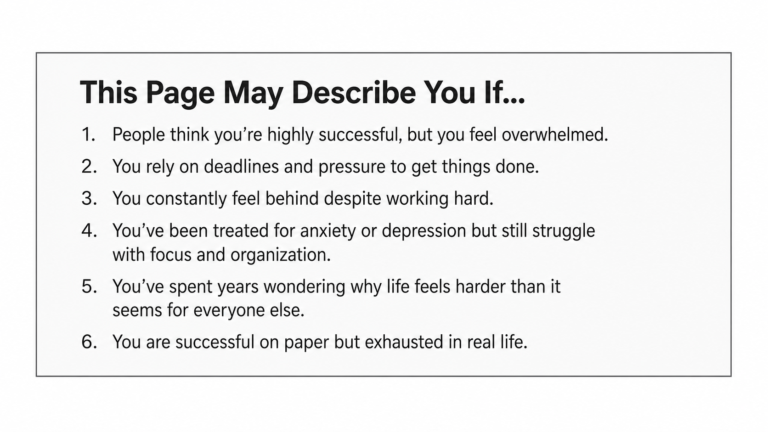
Editor’s Note: Admittedly, this is a long article. But spending 10 minutes reading it could be one of the best investments you make all year.
Bookmark it. Email it to yourself. Save it for later. Do whatever you need to do to come back and read it when you can give it your full attention—the same laser-focused concentration you bring to topics that genuinely capture your interest.
At the end of the article, you’ll find a downloadable Executive Summary that you can keep for future reference.
You Have a Successful Life… Why Does It Still Feel So Hard?
You have a career.
People depend on you.
You’ve achieved goals that many people never will.
You solve complex problems. You meet deadlines. You manage responsibilities. Others often describe you as capable, intelligent, and driven.
From the outside, your life may look successful.
Yet behind the scenes, things often feel much harder than they should.
You forget things that matter.
You miss emails.
You procrastinate on important tasks despite genuinely wanting to complete them.
You feel perpetually behind, even though you’re working harder than most people around you.
You tell yourself that once things calm down, you’ll finally get organized.
But somehow they never do.
Many high-achieving adults spend years assuming these struggles are personal failures.
They conclude they must be:
- Lazy
- Disorganized
- Undisciplined
- Bad at managing time
Recent ADHD research suggests another possibility.
And it may explain why so many successful adults go undiagnosed for years.
A New Idea in ADHD Research: High Functioning, Yet High Suffering
In 2026, psychiatrists de Melo and França proposed that current ADHD diagnostic frameworks may overlook a group of adults who appear successful while privately struggling.
They described these individuals as:
“High functioning, yet high suffering.”
Their concern was not that these adults fail to meet responsibilities.
Many of them are exceptionally responsible.
The concern was that traditional ADHD diagnostic systems focus heavily on observable impairment while paying less attention to the effort required to maintain performance.
In other words:
Success may be visible.
The suffering often is not.
This observation helps explain an experience many adults know well.
From the outside, life appears organized and successful.
Inside, it feels unsustainably difficult.
You remember everything by writing it down.
You create increasingly elaborate systems to stay on track.
You spend hours thinking about tasks you cannot seem to start.
You rely on pressure and deadlines to create motivation.
You worry constantly about what you’ve forgotten.
Others see competence.
You experience compensation.
The challenge is not necessarily failure.
The challenge is how much effort success requires.
This distinction matters.
Because when suffering is hidden beneath achievement, ADHD can remain invisible for years.
Success Doesn't Rule Out ADHD
One reason ADHD is frequently overlooked in successful adults is the belief that intelligence protects against it.
Research suggests otherwise.
In a landmark study, Antshel and colleagues (2009) found that ADHD remained a valid diagnosis even among adults with high IQ.
More recently, Rommelse and colleagues (2016) reviewed the available evidence and concluded that ADHD in highly intelligent individuals demonstrates the same core clinical features, developmental course, and treatment response seen in the broader ADHD population.
Intelligence does not eliminate ADHD.
It changes how ADHD looks.
Higher intelligence can help people compensate.
It can help them perform well academically.
It can help them solve problems creatively.
It can help them achieve professional success.
What it does not do is eliminate the underlying executive functioning challenges associated with ADHD.
This helps explain a paradox many adults experience.
Their accomplishments seem to contradict their daily reality.
They think:
“If I really had ADHD, I wouldn’t have gotten this far.”
The research suggests otherwise.
Success may be evidence of compensation.
It is not evidence that ADHD is absent.
In fact, Antshel and colleagues found that adults with both high IQ and ADHD still experienced lower quality of life, poorer occupational and family functioning, and higher rates of anxiety and depression compared to similarly intelligent adults without ADHD.
The suffering remained.
The intelligence simply made it easier to hide.
The Hidden Cost of Looking Fine
The findings from Antshel and Rommelse raise an important question:
If intelligence does not eliminate ADHD, how do so many adults succeed for years before receiving a diagnosis?
Part of the answer may lie in compensation.
Many successful adults become extraordinarily skilled at creating systems that help them function despite persistent executive functioning challenges.
From the outside, these systems often look like organization.
From the inside, they can feel like survival.
You become the person who writes everything down.
The person with multiple calendars.
The person with reminders for reminders.
The person who arrives early because being late feels catastrophic.
The person who double-checks everything because you’re afraid of forgetting something important.
Over time, these systems become normal.
The effort becomes invisible.
Even to you.
This is one reason many successful adults never consider ADHD.
They are functioning.
The question is how much energy it takes to keep functioning.
The Invisible Work Researchers Discovered
In a qualitative study of adults with ADHD, Canela and colleagues (2017) identified five broad categories of compensatory strategies people developed before receiving a diagnosis:
- Organizational strategies
- Motoric strategies
- Attentional strategies
- Social strategies
- Psychopharmacological strategies such as caffeine use
At first glance, these findings may not seem particularly surprising.
Until you consider what they actually represent.
Every compensatory strategy exists because something else is difficult.
The color-coded calendar.
The extensive task list.
The notebook that never leaves your side.
The reminder app.
The habit of checking everything twice.
The caffeine.
The tendency to overprepare.
The tendency to start earlier than necessary because you’re afraid of forgetting.
The tendency to work later than everyone else because tasks seem to require more effort than they should.
For many adults, these systems become so integrated into daily life that they stop recognizing them as compensation.
The compensation becomes invisible.
The exhaustion becomes invisible.
Eventually, it simply feels like adulthood.
Yet Canela’s findings suggest something important.
What looks like organization may actually be adaptation.
What looks like discipline may actually be compensation.
And what looks like success may be sustained by an extraordinary amount of hidden effort.
When Success Starts to Feel Unsustainable
Compensation can be remarkably effective.
For years.
Sometimes decades.
Which raises another question:
If these systems work so well, why do many adults seek ADHD evaluation later in life?
The answer may lie in another important concept from ADHD research.
Not intelligence.
Not motivation.
Not discipline.
But support.
Researchers call it external scaffolding.
And it may help explain why life suddenly feels harder for many successful adults even though nothing seems to have changed.
Why ADHD Often Doesn't Become Obvious Until Later in Life
The idea of compensation helps explain how many adults manage ADHD symptoms for years.
But it does not fully explain why those symptoms often become more noticeable later in life.
For that, we need another important concept from the ADHD literature.
In 2016, Asherson and colleagues described the role of external scaffolding—structures in the environment that help compensate for executive functioning challenges.
These supports often exist long before a person realizes they need them.
During childhood and adolescence, scaffolding may come from:
- Parents
- Teachers
- School schedules
- Academic structure
- Clear expectations
- Frequent feedback
These supports help create organization, deadlines, accountability, and routine.
In effect, they perform some of the executive functioning tasks that ADHD makes more difficult.
This is one reason some highly intelligent children with ADHD perform reasonably well in school despite underlying symptoms.
The supports are doing part of the work.
The problem is that adulthood gradually removes many of those supports.
Then life becomes more complicated.
A promotion.
Leadership responsibilities.
Marriage.
Children.
Running a business.
Managing employees.
Caring for aging parents.
The scaffolding slowly disappears.
At the same time, the demands increase.
The ADHD did not suddenly appear.
The environment changed.
And eventually the amount of compensation required may exceed the amount of energy available.
For many adults, this is the moment life begins to feel harder than it should.
It is also the moment many begin searching for answers.
When Demands Exceed Compensation
The concept of external scaffolding helps explain another fascinating finding in ADHD research.
In the E-Risk Longitudinal Twin Study, Agnew-Blais and colleagues (2016) found that many young adults who met criteria for ADHD at age 18 had not met criteria during childhood.
Interestingly, this “late-onset” group tended to have higher childhood IQs than those with persistent ADHD.
Yet by adulthood, they experienced similar levels of impairment.
At first glance, this finding seems surprising.
How can ADHD appear later in life?
The answer may not be that ADHD suddenly develops.
The answer may be that life eventually becomes more demanding than the compensatory systems that once worked.
Many adults describe this experience in remarkably similar ways.
They were managing.
Until they weren’t.
They were keeping up.
Until the responsibilities multiplied.
They were functioning.
Until every day began feeling like a race they could barely finish.
The promotion that once felt exciting suddenly felt overwhelming.
The business that once energized them became difficult to manage.
Parenthood stretched every organizational system to its limit.
What changed was not their character.
What changed was the balance between compensation and demand.
For years, effort was enough.
Then life required more than effort alone could provide.
Why Anxiety Often Gets Diagnosed First
Another important insight from the ADHD literature is that many successful adults are diagnosed with anxiety long before ADHD is considered.
At first glance, this makes sense.
Many adults with ADHD appear anxious.
They worry about deadlines.
They worry about forgetting things.
They worry about making mistakes.
They worry about letting people down.
The question is why.
Asherson and colleagues (2016) noted that executive functioning difficulties can create chronic stress long before ADHD is recognized.
Similarly, Olagunju and Ghoddusi (2024) observed that anxiety and ADHD frequently overlap in adulthood, making diagnosis more complicated.
This distinction is important.
People with primary anxiety often struggle because they anticipate negative outcomes.
People with ADHD may struggle because ordinary tasks require far more effort than others realize.
The resulting stress can look remarkably similar.
Consider what happens when a task feels difficult to initiate.
You postpone it.
The deadline gets closer.
The anxiety increases.
The urgency finally creates enough stimulation to begin.
The task gets completed.
Relief follows.
Then the cycle starts again.
Over time, anxiety becomes a productivity system.
Not because it is healthy.
Because it works.
For many successful adults, anxiety becomes the fuel that powers performance.
The problem is that living this way is exhausting.
Many people spend years treating the smoke while never discovering the fire underneath.
Why Women Are Often Diagnosed Later
The phenomenon of delayed recognition may be especially common among women.
In their review of ADHD in women and girls, Quinn and Madhoo (2014) noted that ADHD often presents differently than the stereotypical image many people associate with the condition.
Rather than obvious hyperactivity, many women experience:
- Internal restlessness
- Chronic overwhelm
- Difficulties with organization
- Emotional distress
- Perfectionistic coping strategies
Because these symptoms are less visible, they are often attributed to:
- Anxiety
- Depression
- Stress
- Burnout
- Personality traits
Many women become exceptionally skilled at masking difficulties.
They become high achievers.
Perfectionists.
Caregivers.
People who appear to have everything under control.
Yet the effort required to maintain that appearance can be immense.
This is one reason many women are not diagnosed until adulthood.
The symptoms were always there.
The coping strategies were simply effective enough to keep them hidden.
Until they weren’t.
Success and Struggle Can Coexist
One of the themes that emerges repeatedly throughout the ADHD literature is that success and impairment are not mutually exclusive.
This may be the most important idea in the entire article.
Many adults believe that because they have achieved meaningful things, their struggles must not be legitimate.
The research suggests otherwise.
Antshel’s work demonstrated that high intelligence does not eliminate impairment.
Canela’s work showed how compensation can hide symptoms.
Asherson’s work explained how environmental supports can delay recognition.
Agnew-Blais demonstrated that impairment may become apparent only when demands increase.
Taken together, these findings suggest something profound:
Success does not rule out ADHD.
In many cases, it helps conceal it.
And when the struggles remain hidden, people often blame themselves instead.
They assume they need more discipline.
Better habits.
More motivation.
More effort.
What they may actually need is a different explanation.
Fortunately, recent ADHD research provides one.
ADHD-Related Strengths Are Real
After reading about compensation, anxiety, hidden suffering, and delayed diagnosis, some readers may begin to wonder:
“So are you saying everything about me is a problem?”
Recent research suggests otherwise.
In 2026, Rafael and colleagues published a scoping review examining 125 studies on ADHD-related strengths in adults.
Their findings challenged the common assumption that ADHD should be viewed only through the lens of deficits and impairment.
Across the literature, several strengths appeared consistently.
The most commonly reported was creativity, appearing in approximately two-thirds of the studies reviewed.
Other frequently identified strengths included:
- Interest-based attention
- Empathy and interpersonal warmth
- High energy
- Adaptability
- Resilience
- Entrepreneurship
- Flexibility
- Positive forms of risk-taking
One of the most interesting conclusions from the review was that many ADHD traits appeared highly dependent on context.
A characteristic that creates difficulty in one environment may become an advantage in another.
Restlessness may be problematic in a rigid workplace.
The same energy may become an asset in entrepreneurship.
Curiosity may create distraction in one setting.
It may fuel innovation in another.
This idea is supported by research from Verheul and colleagues (2016), who found a positive association between hyperactivity traits and self-employment.
Their findings suggest that certain ADHD characteristics may confer advantages in entrepreneurial environments.
None of this minimizes the very real challenges ADHD can create.
But it does offer a more complete picture.
ADHD is not simply a collection of deficits.
It is a different way of processing information, attention, motivation, and novelty.
The goal of treatment is not to eliminate who you are.
The goal is to reduce unnecessary friction while helping you use your strengths more intentionally.
What Happens When Adults Finally Have an Explanation
Many adults seek ADHD evaluation because they want to become more productive.
What they often experience first is something much more important.
Relief.
For years, they have been trying to solve the wrong problem.
They believed they were:
- Lazy
- Undisciplined
- Inconsistent
- Disorganized
- Failing to live up to their potential
Every missed deadline became evidence.
Every forgotten task became proof.
Every unfinished project reinforced the same story.
“I should be able to do this.”
Then something changes.
They begin understanding that many of the struggles they have spent years criticizing themselves for may actually have a name.
There is often a moment when the pieces begin fitting together.
The procrastination.
The overwhelm.
The chronic feeling of falling behind.
The anxiety.
The exhaustion.
The endless effort required to do things that seem easier for everyone else.
For the first time, those experiences begin to make sense.
Many patients describe the realization in remarkably similar ways:
“It’s like the blinders have been lifted.”
Not because every challenge disappears.
But because the struggle finally has an explanation.
And understanding often creates something that years of self-criticism never could.
Self-compassion.
What an Adult ADHD Evaluation Looks Like
One reason many successful adults delay seeking evaluation is uncertainty about what the process involves.
They worry that assessment will be based on a simplistic checklist.
Or that their success will automatically disqualify them.
A comprehensive adult ADHD evaluation should be far more nuanced than that.
Particularly when working with high-achieving adults whose symptoms may have been masked for years.
A thorough evaluation typically includes:
- A detailed clinical interview
- Review of childhood history
- ADHD rating scales
- Screening for anxiety and depression
- Assessment of executive functioning challenges
- Review of academic, occupational, and relationship history
The goal is not simply to identify symptoms.
The goal is to understand patterns.
How have attention, organization, motivation, and executive functioning affected your life over time?
What role have compensation strategies played?
What strengths have helped you succeed?
And could ADHD help explain struggles that never fully made sense?
The objective is understanding.
Not labeling.
Understanding.
Click To Learn More: Adult ADHD Diagnosis in California: What to Expect
Evidence-Based Treatment and What Can Change
The purpose of treatment is not to transform someone into a different person.
The purpose is to reduce the amount of effort required to function effectively.
Volkow and Swanson (2013) described ADHD as a disorder involving differences in attention, motivation, and executive functioning systems.
Treatment helps address those underlying processes.
For many adults, treatment includes a combination of:
- Medication
- Psychoeducation
- Cognitive Behavioral Therapy (CBT)
- Executive functioning skills
- Lifestyle interventions
Medication:
Studies consistently show that approximately 7 out of 10 adults with ADHD experience significant improvement when treated with appropriate medication.
Researchers use two ways to measure effectiveness:
- Response Rate: How many people improve.
- Effect Size: How much they improve.
ADHD medications not only help a large percentage of people—they often produce improvements that are substantial enough to be noticed at work, at home, and in daily life.
CBT:
A Cochrane review by Lopez and colleagues (2018) found that CBT-based interventions can help improve organization, time management, problem solving, and emotional regulation in adults with ADHD.
Importantly, these approaches often build upon compensatory strategies that people already use.
The goal is not to start from scratch.
It is to refine what works and replace what doesn’t.
Many adults come into treatment believing they need more discipline.
What they often discover is that they no longer need to compensate so aggressively.
With treatment, patients commonly describe:
- Less mental clutter
- Easier task initiation
- Better follow-through
- Reduced overwhelm
- Greater consistency
- More confidence
- Less self-criticism
One of the most meaningful changes is often psychological rather than practical.
People stop viewing themselves as broken.
They stop assuming every struggle is a character flaw.
They begin recognizing that they have been navigating an untreated neurodevelopmental condition.
For many, that realization is profoundly liberating.
The Question Isn't Whether You've Been Successful
Throughout this article, we’ve explored several important discoveries from modern ADHD research.
de Melo and França described adults who are high functioning, yet high suffering.
Antshel and Rommelse demonstrated that high intelligence does not eliminate ADHD.
Canela showed how compensation can conceal symptoms for years.
Asherson explained how external scaffolding can delay recognition.
Agnew-Blais illustrated how difficulties may become more apparent when demands exceed compensatory capacity.
Rafael highlighted strengths that often accompany ADHD.
Taken together, these findings point toward a common conclusion.
The question is not whether you’ve been successful.
The question is how much effort success has required.
If life has always felt harder than it seems for other people…
If you’ve spent years relying on pressure, perfectionism, and overwork to stay on track…
If you’ve built a successful life while privately feeling overwhelmed…
There may be an explanation.
And understanding that explanation can be the beginning of meaningful change.
Schedule an Adult ADHD Evaluation in California
At Peace & Prosperity Psychiatry, I work with adults throughout California who are seeking answers to challenges that have often been misunderstood for years.
Many of my patients are successful professionals, parents, business owners, healthcare providers, and high-achieving adults who have spent much of their lives wondering why things seem harder than they should.
An evaluation cannot answer every question.
But it can help determine whether ADHD may be part of the picture.
And for many adults, finally understanding the picture changes everything.
Click To Learn More: Complimentary Consultation
Frequently Asked Questions About High-Functioning ADHD
1. Can you have ADHD and still be successful?
Yes. ADHD occurs across the IQ spectrum and among people with a wide range of educational and professional achievements. Many successful adults with ADHD develop compensatory strategies that help them perform well despite ongoing struggles with organization, time management, procrastination, and overwhelm.
2. What is high-functioning ADHD?
High-functioning ADHD is not an official medical diagnosis. It is a term commonly used to describe adults who meet criteria for ADHD but maintain successful careers, relationships, and responsibilities while continuing to experience significant challenges with executive functioning.
3. Why is ADHD often missed in successful adults?
Many successful adults compensate through intelligence, perfectionism, anxiety, long work hours, and sophisticated organizational systems. These strategies can mask symptoms for years, making ADHD harder to recognize.
4. What are common signs of high-functioning ADHD in adults?
Common signs include chronic overwhelm, procrastination, difficulty starting tasks, time blindness, forgetfulness, disorganization, relying on deadlines to get motivated, and feeling exhausted from constantly trying to stay on top of responsibilities.
5. Can ADHD look like anxiety?
Yes. Many adults with ADHD experience anxiety related to missed deadlines, executive functioning challenges, and chronic overwhelm. Because anxiety and ADHD frequently occur together, ADHD is often overlooked or misdiagnosed as anxiety alone.
6. Why do many adults discover ADHD later in life?
ADHD symptoms often become more noticeable when life demands increase. Career advancement, parenting, leadership responsibilities, marriage, or running a business can overwhelm compensatory strategies that worked earlier in life.
7. Can you have ADHD if you did well in school?
Yes. Strong intelligence, supportive environments, and structured academic settings can help some individuals compensate for ADHD symptoms during childhood and adolescence. Many successful students are not diagnosed until adulthood.
8. What does an adult ADHD evaluation involve?
A comprehensive ADHD evaluation typically includes a detailed clinical interview, review of childhood history, validated ADHD rating scales, screening for anxiety and depression, and assessment of executive functioning challenges across multiple areas of life.
9. What are the strengths associated with ADHD?
Research suggests that many adults with ADHD report strengths such as creativity, adaptability, resilience, curiosity, entrepreneurial thinking, empathy, and the ability to hyperfocus on tasks that are personally meaningful or engaging.
10. Does ADHD treatment help high-achieving adults?
Yes. Effective treatment can reduce the amount of effort required to manage daily responsibilities. Many adults report improved focus, easier task initiation, reduced overwhelm, better follow-through, greater consistency, and less self-criticism.
11. Why does everything feel harder for me than it seems for other people?
Many adults with ADHD describe feeling as though ordinary responsibilities require extraordinary effort. This often reflects executive functioning challenges rather than a lack of intelligence, motivation, or discipline. Understanding the underlying cause can be the first step toward meaningful change.
References
Agnew-Blais, J. C., Polanczyk, G. V., Danese, A., Wertz, J., Moffitt, T. E., & Arseneault, L. (2016). Evaluation of the persistence, remission, and emergence of attention-deficit/hyperactivity disorder in young adulthood. JAMA Psychiatry, 73(7), 713–720. https://doi.org/10.1001/jamapsychiatry.2016.0465
Antshel, K. M., Faraone, S. V., Maglione, K., Doyle, A., Fried, R., Seidman, L., Biederman, J. (2009). Is adult attention deficit hyperactivity disorder a valid diagnosis in the presence of high IQ? Psychological Medicine, 39(8), 1325–1335. https://doi.org/10.1017/S0033291708004959
Asherson, P., Buitelaar, J., Faraone, S. V., & Rohde, L. A. (2016). Adult attention-deficit hyperactivity disorder: Key conceptual issues. The Lancet Psychiatry, 3(6), 568–578. https://doi.org/10.1016/S2215-0366(16)30032-3
Canela, C., Buadze, A., Dube, A., Eich, D., & Liebrenz, M. (2017). Skills and compensation strategies in adult ADHD – A qualitative study. PLOS ONE, 12(9), e0184964. https://doi.org/10.1371/journal.pone.0184964
Despature, I., & Galiana, A. (2023). Clinical and cognitive features of attention deficit hyperactivity disorder with intellectual giftedness: A systematic review. Developmental Neuropsychology, 48(7), 347–360. https://doi.org/10.1080/87565641.2023.2279117
de Melo, I. H., & Franca, G. (2026). High functioning, yet high suffering – The need to incorporate invisible struggles in adult ADHD diagnostic assessment/criteria. Frontiers in Psychiatry, 17, 1813029. https://pubmed.ncbi.nlm.nih.gov/42232996
Lopez, P. L., Torrente, F. M., Ciapponi, A., Lischinsky, A. G., Cetkovich-Bakmas, M., Díaz, S. S., Martino, D. J. (2018). Cognitive-behavioural interventions for attention deficit hyperactivity disorder (ADHD) in adults. Cochrane Database of Systematic Reviews, 3, CD010840. https://doi.org/10.1002/14651858.CD010840.pub2
Olagunju, A. E., & Ghoddusi, F. (2024). Attention-deficit/hyperactivity disorder in adults. American Family Physician, 110(2), 157–166.
Quinn, P. O., & Madhoo, M. (2014). A review of attention-deficit/hyperactivity disorder in women and girls: Uncovering this hidden diagnosis. Primary Care Companion for CNS Disorders, 16(3), PCC.13r01596. https://doi.org/10.4088/PCC.13r01596
Rafael, R. B., Jia, H., Rouel, M., Wootton, B. M., & Mitchison, D. (2026). Attention-deficit/hyperactivity disorder (ADHD)-related strengths in adults: A scoping review. Journal of Attention Disorders. Advance online publication. https://pubmed.ncbi.nlm.nih.gov/41889015
Rommelse, N., van der Kruijs, M., Damhuis, J., Hoek, I., Slaats-Willemse, D., Oosterlaan, J., Buitelaar, J. (2016). An evidenced-based perspective on the validity of attention-deficit/hyperactivity disorder in the context of high intelligence. Neuroscience & Biobehavioral Reviews, 71, 21–47. https://doi.org/10.1016/j.neubiorev.2016.08.032
Takagi, S., Masuda, R., Tamura, T., et al. (2026). Grit mediates social success across attention deficit/hyperactivity disorder tendencies. Acta Psychologica, 265, 106743. https://doi.org/10.1016/j.actpsy.2026.106743
Verheul, I., Rietdijk, W., Block, J., Buunk, A., Tims, M., Stolk, R., Zijlstra, F. (2016). The association between attention-deficit/hyperactivity (ADHD) symptoms and self-employment. European Journal of Epidemiology, 31(8), 793–801. https://doi.org/10.1007/s10654-016-0159-1
Volkow, N. D., & Swanson, J. M. (2013). Adult attention deficit–hyperactivity disorder. The New England Journal of Medicine, 369(20), 1935–1944. https://doi.org/10.1056/NEJMcp1212625
Free Download:
White Paper: High-Functioning, Yet High-Suffering ADHD Patient
Click Here to Download: WP ADHD high_functioning_yet_high_suffering_patient_pdf