
Trouble concentrating, procrastinating, or feeling mentally restless can happen with both conditions. Understanding what drives those symptoms can help clarify whether ADHD, anxiety, or both may be playing a role.
If you are constantly distracted, overwhelmed, forgetful, restless, or unable to finish what you start, you may find yourself wondering:
Is this ADHD or anxiety?
It is an understandable question.
Adult ADHD and anxiety can look surprisingly similar from the outside. Both can interfere with concentration. Both can make it difficult to complete tasks. Both can contribute to restlessness, irritability, procrastination, sleep problems, and feeling mentally overwhelmed.
But ADHD and anxiety are not the same condition.
And sometimes the answer isn’t ADHD or anxiety.
It can be both.
Research consistently shows substantial overlap between ADHD and anxiety disorders, which is one reason distinguishing them based on symptoms alone can be difficult (Grogan et al., 2018; Fu et al., 2025). (PubMed)
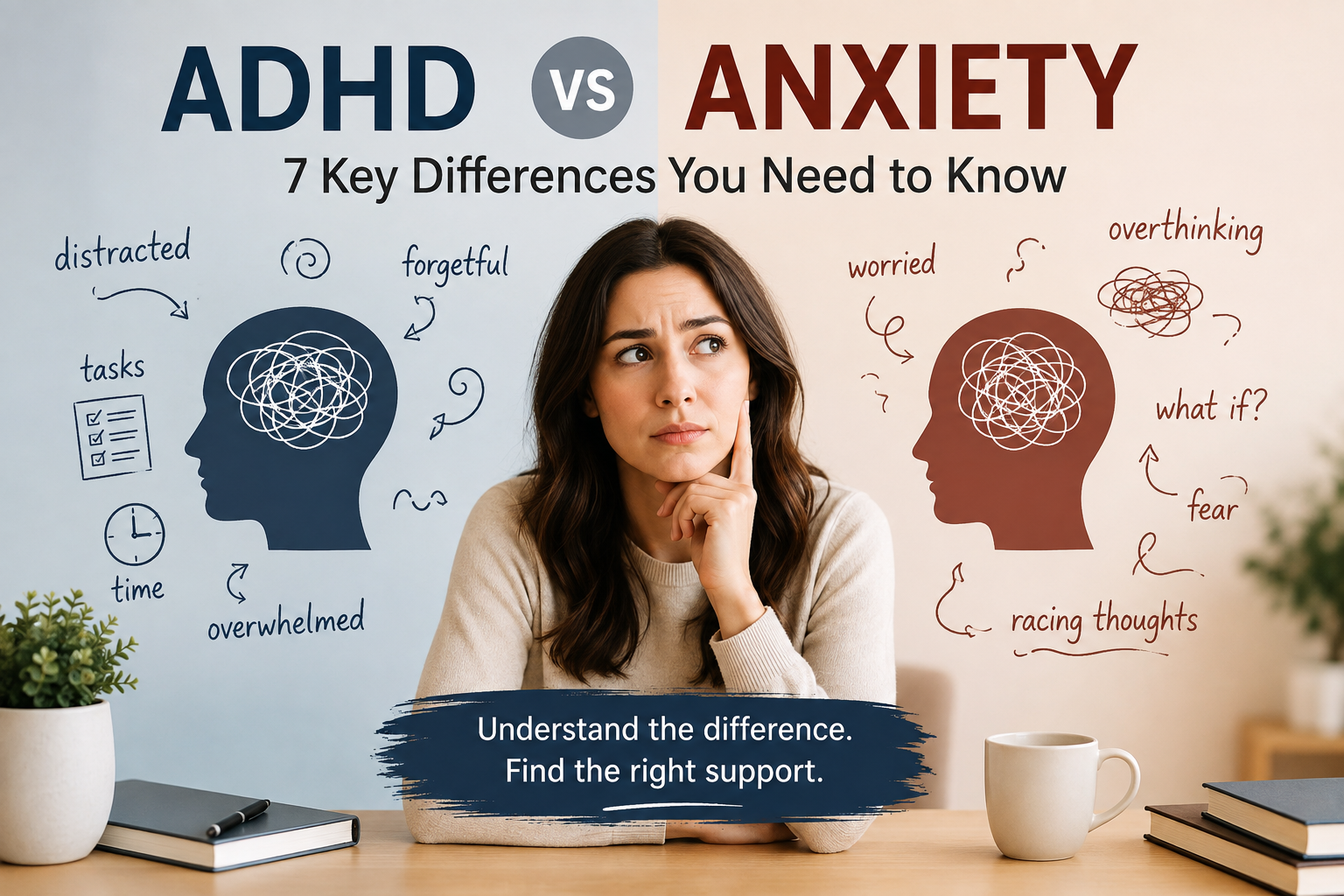
In this guide, we’ll look at ADHD vs Anxiety through seven practical differences that may help you better understand what could be driving your symptoms.
This isn’t meant to diagnose either condition. Instead, think of it as a framework for understanding what clinicians look for when symptoms of ADHD and anxiety overlap.
Table of Contents
ToggleWhy ADHD vs Anxiety Can Be Difficult to Tell Apart
Imagine two people sitting at their desks staring at unfinished work.
Both are having trouble concentrating.
The first person’s mind keeps jumping from one thought to another. An email notification appears, another task comes to mind, and suddenly they’re doing something completely unrelated to what they intended to finish.
The second person is also unable to concentrate—but for a different reason.
They’re thinking:
What if I make a mistake?
What if my boss doesn’t like this?
What happens if I miss the deadline?
The outward symptom is the same:
Difficulty concentrating.
But what is happening underneath may be very different.
That distinction is important because ADHD and anxiety can share symptoms such as restlessness, irritability, emotional reactivity, and difficulty concentrating. Clinical guidance therefore emphasizes evaluating other psychiatric and medical explanations when assessing adults for ADHD rather than diagnosing ADHD from a checklist alone (Olagunju & Ghoddusi, 2024).
The key question is often not simply what symptom you have.
It is:
Why is that symptom happening?
Let’s look more closely.
ADHD vs Anxiety: 7 Important Differences
1. ADHD vs Anxiety: Why Is It Hard to Concentrate?
Difficulty concentrating is one of the biggest areas of overlap between ADHD and anxiety.
But the reason concentration breaks down may provide an important clue.
With ADHD
Attention may be inconsistent because regulating attention itself is difficult.
You may:
- Become distracted by noises, conversations, notifications, or your own thoughts
- Start one task and unintentionally move to another
- Lose track of what you were doing
- Struggle to sustain attention on repetitive or uninteresting work
- Become intensely absorbed in something interesting while neglecting other responsibilities
You may even notice something frustrating:
You can concentrate extremely well sometimes—but seemingly not when you need to.
With anxiety
Concentration problems are often connected to worry or threat.
Your attention may be consumed by thoughts such as:
What if something goes wrong?
Did I make a mistake?
What are they going to think of me?
What if I can’t handle this?
In other words, your brain may be capable of focusing, but worry keeps occupying the mental bandwidth you need to concentrate.
Clinical descriptions of the differential diagnosis similarly note that anxiety-related concentration problems may improve when the person is relaxed, whereas ADHD involves more persistent difficulties regulating attention and behavior (Olagunju & Ghoddusi, 2024).
A useful question to ask yourself:
When I cannot concentrate, is my attention wandering—or is worry taking over my attention?
That question doesn’t diagnose either condition, but it can reveal an important pattern.
2. ADHD vs Anxiety: What Causes the Procrastination?
Both ADHD and anxiety can produce serious procrastination.
But again, the mechanism may differ.
ADHD-related procrastination
With ADHD, you may know exactly what needs to be done and genuinely intend to do it.
Yet starting feels strangely difficult.
A task may feel too boring, too complicated, too distant, or insufficiently urgent to activate your attention.
So you wait.
And wait.
Then the deadline gets close.
Suddenly the urgency creates enough stimulation to get moving.
This can produce the familiar cycle:
Avoid → delay → panic → sprint → finish → promise yourself you’ll start earlier next time → repeat.
Anxiety-related procrastination
Anxiety can also make you avoid tasks, but the avoidance may be driven more by fear.
You may worry about:
- Making the wrong decision
- Being criticized
- Failing
- Disappointing someone
- Not doing something perfectly
- Feeling overwhelmed by what could go wrong
The result may look identical from the outside.
The task still doesn’t get done.
But one person may be struggling primarily with task initiation and executive functioning, while another is avoiding the emotional discomfort associated with the task.
And some people experience both.
3. ADHD vs Anxiety: Where Does the Restlessness Come From?
Adults with ADHD do not always appear outwardly hyperactive.
Hyperactivity may become more subtle with age.
It can feel like:
- Internal restlessness
- Constant mental activity
- Difficulty relaxing
- Fidgeting
- Needing stimulation
- Frequently changing activities
- Feeling uncomfortable doing nothing
Anxiety can create restlessness too.
But anxious restlessness may feel more connected to tension, apprehension, or a sense that something is wrong—or might go wrong.
You may feel physically keyed up.
Your muscles may be tense.
Your mind may repeatedly scan for problems.
So both conditions can produce the feeling:
“My brain won’t shut off.”
But the mental activity underneath that feeling may be different.
4. ADHD vs Anxiety: What Happens When Life Becomes Calm?
This can be one of the more useful distinctions to consider.
Suppose the stressful situation disappears.
The project gets completed.
The difficult conversation is over.
You go on vacation.
There is nothing urgent to worry about.
What happens to your symptoms?
If anxiety is primarily driving your concentration problems, those difficulties may lessen when worry and stress decrease.
With ADHD, problems involving attention, organization, forgetfulness, time management, or impulse control are more likely to continue across different situations—even during relatively calm periods.
That doesn’t mean ADHD symptoms never fluctuate.
They absolutely can.
Interest, structure, novelty, sleep, stress, environment, and the demands being placed on you can all influence how noticeable ADHD symptoms become.
But ADHD is a neurodevelopmental disorder rather than a temporary response to a stressful period.
Which brings us to an especially important distinction.
5. ADHD Usually Has a Longer History
When clinicians evaluate an adult for ADHD, they don’t look only at what is happening today.
They look backward.
ADHD begins during development. Adult diagnostic assessment therefore includes investigating whether symptoms were present during childhood and whether difficulties occur across more than one setting. AAFP’s adult ADHD guidance similarly recommends corroborating current impairment, establishing childhood onset, and evaluating conditions that could mimic or coexist with ADHD.
You may not have been diagnosed as a child.
That is not unusual.
But looking backward may reveal patterns.
Perhaps teachers described you as:
- Bright but inconsistent
- Daydreamy
- Disorganized
- Forgetful
- Talkative
- Frequently late with assignments
- Capable of doing better if you “just applied yourself”
Maybe you regularly lost homework.
Maybe your backpack was chaos.
Maybe you waited until the night before to complete every major assignment.
Or perhaps you compensated extremely well because you were intelligent, highly structured, anxious about failure, or supported by parents and teachers.
The important point is that adult ADHD generally does not suddenly appear for the first time at age 35 or 45.
If concentration problems began only recently, a clinician should consider other explanations as well.
These can include anxiety, depression, inadequate sleep, chronic stress, substance use, medication effects, medical conditions, and other psychiatric disorders.
6. ADHD vs Anxiety: Is Worry the Central Problem?
Everyone worries.
Having ADHD doesn’t mean you never experience anxiety.
The more useful question is whether persistent worry and fear are central features of the problem.
Someone experiencing significant anxiety may spend substantial amounts of time anticipating negative outcomes.
The mind continually moves toward:
“What if?”
What if I lose my job?
What if something happens to my child?
What if I embarrass myself?
What if this physical sensation means something is seriously wrong?
What if I make the wrong choice?
ADHD can create worry too—but sometimes the worry develops around the consequences of living with ADHD.
For example:
“Did I forget something?”
“I’m probably going to be late again.”
“I hope I didn’t miss that deadline.”
“Where did I put my keys?”
“I know I’m forgetting something important.”
Years of missed appointments, forgotten responsibilities, late work, and last-minute crises can understandably make someone anxious.
That creates an important clinical question:
Is anxiety producing the organizational difficulties—or have years of organizational difficulties contributed to anxiety?
Sometimes the answer is one.
Sometimes it is the other.
And sometimes they reinforce each other.
7. You Can Have ADHD and Anxiety at the Same Time
This may be the most important point in the entire article.
ADHD vs Anxiety is not always an either/or question.
The conditions commonly occur together.
A large review of population-level studies found substantially greater odds of anxiety disorders among adults with ADHD compared with adults without ADHD. More recent research continues to show higher anxiety symptom levels among adults with ADHD, reinforcing the importance of assessing for both conditions rather than assuming one automatically explains the other.
And when both conditions are present, they can interact.
For example:
ADHD may contribute to missed deadlines.
Missed deadlines create anxiety.
Anxiety makes concentrating harder.
Poor concentration makes the deadline problem worse.
Now the person is caught in a loop:
ADHD difficulties → negative consequences → anxiety → greater difficulty functioning → more negative consequences.
This is one reason a careful evaluation matters.
Treating only one part of the problem may leave an important source of impairment unaddressed.
ADHD vs Anxiety at a Glance
The same difficulty can show up in both ADHD and anxiety—but for very different reasons. Here are some patterns that may help illustrate the difference.
Difficulty Concentrating
ADHD: Attention tends to wander or is easily redirected by thoughts, sounds, notifications, or something more interesting.
Anxiety: Attention may be consumed by worry, fear, or thoughts about what could go wrong.
Procrastination
ADHD: You may have difficulty getting started or sustaining effort, particularly when a task feels boring, complicated, or unrewarding.
Anxiety: You may avoid getting started because of fear, uncertainty, perfectionism, or concern about making a mistake.
Restlessness
ADHD: Restlessness may feel like a need for stimulation, movement, activity, or something new to engage your attention.
Anxiety: Restlessness may feel more like tension, nervousness, apprehension, or being physically “on edge.”
Thoughts
ADHD: Thoughts may feel rapid, shifting, and distractible—one thought quickly leading to another.
Anxiety: Thoughts may repeatedly return to worries, possible problems, or negative outcomes.
What Happens When Things Are Calm?
ADHD: Problems with attention, organization, time management, or follow-through may remain even when you aren’t particularly worried.
Anxiety: Some concentration and organizational difficulties may improve when anxiety and worry decrease.
Your History
ADHD: The underlying pattern generally traces back to childhood, even if ADHD wasn’t recognized or diagnosed at the time.
Anxiety: Anxiety can begin at different points in life and may become more prominent during particular periods or circumstances.
Organization and Follow-Through
ADHD: Problems with planning, time management, remembering responsibilities, and following through may be longstanding and occur across different areas of life.
Anxiety: Organization and follow-through may become especially difficult during periods when anxiety is consuming significant mental energy.
Keep in mind: These are general patterns, not rules. ADHD and anxiety can look different from one person to another, and they frequently occur together. This comparison should be used as a starting point for understanding your symptoms—not as a way to diagnose yourself.
Could Anxiety Actually Be Masking ADHD?
This is another possibility worth considering.
Some adults develop elaborate systems to compensate for ADHD symptoms.
Anxiety itself can become one of those systems.
You might arrive extremely early because you’re terrified of being late.
You might check your calendar repeatedly because you don’t trust yourself to remember appointments.
You might spend excessive amounts of time preparing because you’re afraid you’ll overlook something.
You might appear highly organized professionally while feeling exhausted by the amount of effort required to maintain that organization.
From the outside, you may look responsible and successful.
Internally, however, you may feel as though you’re constantly working to prevent everything from falling apart.
This doesn’t mean anxiety proves that ADHD is present.
It means clinicians sometimes need to look beyond outward performance and understand how a person is achieving that performance and how much effort it requires.
Could ADHD Be Mistaken for Anxiety?
The reverse can happen as well.
Living with unmanaged ADHD can be stressful.
Imagine repeatedly:
- Forgetting important responsibilities
- Losing things
- Running late
- Missing deadlines
- Underestimating how long tasks will take
- Feeling overwhelmed by ordinary responsibilities
- Falling behind despite working hard
Eventually, you may become anxious because experience has taught you that things really do get forgotten.
In that situation, anxiety may be very real.
But it may not tell the whole story.
This is one reason clinicians should assess for co-occurring conditions rather than assuming that all concentration problems belong to whichever diagnosis is identified first. Research on adult ADHD specifically emphasizes the diagnostic difficulty created by overlapping psychiatric symptoms and frequent comorbidity.
How Do Clinicians Tell ADHD vs Anxiety Apart?
There isn’t one laboratory test, brain scan, or questionnaire that definitively answers:
“ADHD or anxiety?”
A proper evaluation looks at the broader pattern.
That can include:
- Current symptoms
- Childhood history
- When symptoms began
- How symptoms have changed over time
- Whether symptoms occur in multiple environments
- Academic and occupational history
- Relationships and daily functioning
- Sleep
- Medical history
- Medications and substances
- Other mental health symptoms
- Family history
- Standardized rating scales when appropriate
Rating scales can be useful, but they shouldn’t be interpreted in isolation. Research has demonstrated that commonly used ADHD and anxiety scales can have difficulty distinguishing the conditions because some symptoms overlap (Grogan et al., 2018).
The goal isn’t simply to count symptoms.
It is to understand the pattern behind them.
What If I Think I Have Both ADHD and Anxiety?
If you recognize yourself in both sides of this article, that doesn’t necessarily mean you’re confused about your symptoms.
You may actually be noticing something important.
ADHD and anxiety frequently coexist.
A comprehensive evaluation can help determine whether your difficulties are better explained by:
ADHD, an anxiety disorder, both conditions, or something else entirely.
That distinction matters because treatment should address the conditions actually contributing to your difficulties.
When Should You Consider an ADHD Evaluation?
Consider speaking with a qualified mental health professional if problems with attention, organization, impulsivity, restlessness, or follow-through are consistently interfering with your life.
An ADHD evaluation may be particularly worth considering when you recognize a longstanding pattern such as:
- Chronic disorganization
- Repeated procrastination despite consequences
- Difficulty completing tasks
- Frequent forgetfulness
- Losing important items
- Poor time management
- Difficulty sustaining attention
- Impulsive decisions
- Restlessness
- Similar difficulties dating back to childhood
You don’t need to determine whether you have ADHD vs Anxiety before seeking help. Figuring that out is part of the evaluation.
If you’re wondering what the process involves, read our guide to Adult ADHD Diagnosis in California: What to Expect.
Frequently Asked Questions About ADHD vs Anxiety
Can anxiety look like ADHD in adults?
Yes. Anxiety can cause difficulty concentrating, restlessness, procrastination, forgetfulness, and feeling mentally overwhelmed—all of which can resemble ADHD. One important difference is why the symptoms are occurring. With anxiety, concentration problems may be driven by persistent worry or fear, while ADHD involves broader difficulties regulating attention and executive functioning.
Can you have ADHD and anxiety at the same time?
Yes. ADHD and anxiety frequently occur together. In some people, the difficulties associated with ADHD—such as missed deadlines, chronic disorganization, or forgetting important responsibilities—may also contribute to anxiety over time.
How do I know if I have ADHD or anxiety?
Symptoms alone may not be enough to distinguish ADHD from anxiety because the conditions can overlap. A clinician will typically consider when symptoms began, whether they occur across different situations, childhood history, the role of worry, and whether another mental health or medical condition could better explain the symptoms.
Should I get evaluated for ADHD if I already have anxiety?
It may be worth considering an ADHD evaluation if significant problems with attention, organization, time management, impulsivity, or follow-through continue even when anxiety is relatively well controlled—particularly if similar patterns can be traced back to childhood.
ADHD vs Anxiety: The Bottom Line
ADHD and anxiety can both make you distracted.
They can both make you procrastinate.
They can both make your mind feel busy.
And they can both make everyday responsibilities feel much harder than they appear to other people.
But the underlying patterns are often different.
With ADHD, difficulties more commonly involve persistent problems regulating attention, organization, impulses, activity, and executive functioning.
With anxiety, attention and behavior may be disrupted primarily by excessive worry, fear, apprehension, or avoidance.
And sometimes ADHD and anxiety occur together.
So when you’re trying to understand ADHD vs Anxiety, don’t focus on a single symptom.
Look at the pattern.
Look at what drives the difficulty.
Look at when it began.
Look at what happens when you’re relaxed.
And look at whether the same problems have followed you through different stages of your life.
Most importantly, remember that you don’t have to solve the diagnostic puzzle yourself.
A comprehensive evaluation can help determine what is actually contributing to your symptoms—and what might help you move forward.
References
Fu, X., Wu, W., Wu, Y., Liu, X., Liang, W., Wu, R., & Li, Y. (2025). Adult ADHD and comorbid anxiety and depressive disorders: A review of etiology and treatment. Frontiers in Psychiatry, 16, 1597559.
Grogan, K., Gormley, C. I., Rooney, B., Whelan, R., Kiiski, H., Naughton, M., & Bramham, J. (2018). Differential diagnosis and comorbidity of ADHD and anxiety in adults. British Journal of Clinical Psychology, 57(1), 99–115.
Hoskins, J. I., Gooch, D., & Gilligan-Lee, K. A. (2026). Symptoms of anxiety in adults with ADHD: A systematic review and meta-analysis of case-control studies. Journal of Attention Disorders. Advance online publication.
Olagunju, A. E., & Ghoddusi, F. (2024). Attention-deficit/hyperactivity disorder in adults. American Family Physician, 110(2), 157–166.
Medical Review & Author Information
Written and medically reviewed by Troy Don, DC, AGACNP-BC, PMHNP-BC
For additional information about clinical education, professional credentials, and background, see Clinical Credentials & Professional Background.
Last medically reviewed: April 2026
Evidence reviewed through: April 2026
Medical Disclaimer
This article is for educational purposes only and is not a substitute for individualized medical advice, diagnosis, or treatment. If you have questions about ADHD, mental health symptoms, medications, or treatment options, discuss them with an appropriate healthcare professional.