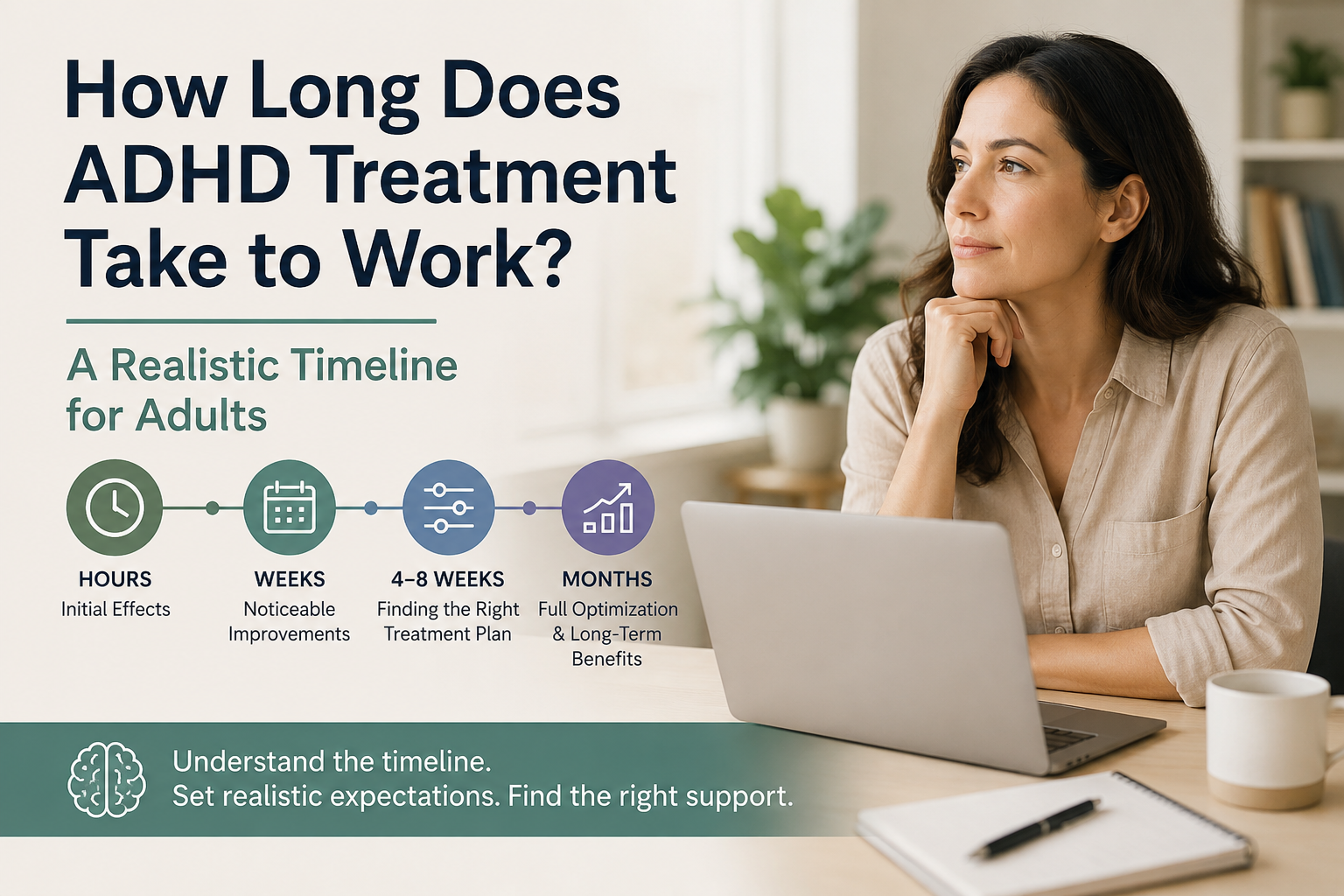

Short answer: Some adults notice improvements from ADHD treatment within hours, while others may need several weeks before benefits become noticeable. Finding the right treatment plan often takes 4 to 8 weeks, and full optimization may take several months as treatment is adjusted to fit your life, goals, and symptoms.
How long does ADHD treatment take to work? Many adults ask this question after years of struggling with focus, procrastination, organization, or feeling like success requires far more effort than it should.
While some adults notice improvements quickly, many are surprised to learn that the most meaningful benefits often develop over time. Finding the right treatment plan may require adjustments to medication, therapy, routines, and follow-up care before treatment feels fully optimized.
If you’ve recently been diagnosed with ADHD—or you’re wondering whether treatment might help—you’ve probably asked yourself:
“How long before I actually feel better?”
It’s a reasonable question. Many adults who seek treatment have spent years working harder than everyone around them just to stay organized, meet deadlines, and keep up with responsibilities. In fact, many people searching for answers are experiencing common adult ADHD symptoms without realizing ADHD may be the underlying cause.
Check out: Adult ADHD and Executive Function
The good news is that many effective ADHD treatments can begin helping relatively quickly. The reality, however, is that lasting improvement often comes from a process of refinement rather than a single prescription or appointment.
Understanding what to expect can help you avoid becoming discouraged too early and recognize the signs that treatment is moving in the right direction.
Table of Contents
ToggleWhat Does It Mean for ADHD Treatment to "Work"?
When patients ask, “How long does ADHD treatment take to work?”, they’re often asking two different questions:
- When will I notice a difference?
- When will my treatment feel optimized and stable?
These are not the same milestone.
Research suggests that symptom improvement can occur before the ideal treatment regimen has been established (Volkow & Swanson, 2013; Wolraich et al., 2019). A patient may notice better focus and concentration within days while still requiring dose adjustments, schedule modifications, or additional support strategies before treatment is fully optimized.
For most adults, successful ADHD treatment means more than simply paying attention better. It means improvements in real-world functioning, including:
- Completing tasks more consistently
- Following through on commitments
- Managing time more effectively
- Reducing procrastination
- Staying organized
- Improving work performance
- Feeling less overwhelmed by daily responsibilities
It also means finding a treatment plan that is sustainable over time and balances symptom improvement with manageable side effects (Wolraich et al., 2019).
How Quickly Can ADHD Medication Start Working?
Some first-line ADHD medications are known for their rapid onset of action.
Research has demonstrated that certain ADHD medications can begin producing noticeable effects within approximately 30 to 60 minutes after a dose (Greenhill et al., 2002; Volkow & Swanson, 2013).
Many adults report improvements such as:
- Better concentration
- Less distractibility
- Improved ability to sustain attention
- Greater mental clarity
- Increased productivity
Volkow and Swanson (2013) reported that approximately 70% of adults experience immediate improvements in attentiveness and distractibility when appropriately treated with stimulant medication.
If you’d like to understand the science behind treatment, learn more about how ADHD medication works in adults.
Check out: Stimulant vs. Non-Stimulant ADHD Medication: Which Is Right for Adults?
Check out: How Long Does ADHD Treatment Take to Work? A Realistic Timeline for Adults
However, experiencing improvement on the first day does not necessarily mean treatment is fully optimized.
Healthcare providers often need to adjust:
- Medication dosage
- Timing of administration
- Duration of symptom coverage
- Side-effect management
- Overall treatment strategy
As a result, even when medication begins helping immediately, treatment refinement often continues for several weeks (Wolraich et al., 2019).
Why Many Successful Adults Feel Better Before They Feel "Fixed"
One of the most surprising aspects of ADHD treatment is that many adults notice improvements before they feel completely transformed.
This is especially true for high-achieving professionals, executives, entrepreneurs, attorneys, healthcare providers, and parents who have spent years compensating for untreated ADHD.
Many patients tell us things like:
“I was always successful, but everything felt harder than it should have.”
Or:
“I could perform well, but I was exhausted from constantly trying to stay on top of everything.”
In the first few weeks of treatment, many adults notice:
- Less procrastination
- Easier task initiation
- Better concentration during meetings
- Reduced mental fatigue
- Improved ability to prioritize tasks
At the same time, they may still struggle with:
- Overcommitting
- Poor boundaries
- Last-minute work habits
- Chronic stress
- Organizational systems built around crisis management
This is normal.
Many adults diagnosed with ADHD have spent years developing workarounds that helped them succeed despite underlying symptoms. Treatment often reduces the effort required to perform, but it may take additional time to develop healthier systems, routines, and habits.
This pattern is especially common among women who have spent years masking symptoms and achieving at a high level before receiving a diagnosis. Learn more about ADHD in high-achieving women and why successful women are often diagnosed later in life.
Click HERE → ADHD in High-Achieving Women
For many patients, one of the earliest signs that treatment is working is not perfection—it’s that daily life starts feeling easier.
Why ADHD Treatment Often Takes Several Weeks to Optimize
A common misconception is that if medication works quickly, the treatment process is complete.
In reality, evidence-based ADHD treatment is often an ongoing process of evaluation and refinement.
Check out: The Complete Guide to Adult ADHD Treatment
Clinical guidelines recommend ongoing monitoring of:
- Symptom improvement
- Sleep quality
- Appetite
- Mood
- Blood pressure
- Heart rate
- Work performance
- Overall functioning (Wolraich et al., 2019)
For many adults, the first 4 to 8 weeks involve careful observation and adjustment.
During this period, your clinician may:
- Fine-tune medication dosage
- Adjust timing throughout the day
- Address side effects
- Evaluate real-world outcomes
- Modify the treatment plan as needed
These adjustments are often necessary to maximize benefits while minimizing unwanted effects.
Why Some ADHD Treatments Take Longer to Show Results
Not all evidence-based ADHD treatments work on the same timeline.
Some treatment approaches require 1 to 4 weeks before meaningful benefits become noticeable (Volkow & Swanson, 2013; Olagunju & Ghoddusi, 2024).
In a pooled analysis of adults with ADHD, Wietecha and colleagues (2016) found that symptom improvement became distinguishable from placebo after one week and continued to increase throughout a 26-week observation period.
This research highlights an important reality:
Meaningful improvement may continue developing over months rather than appearing all at once.
Patients sometimes assume treatment is failing because they do not experience a dramatic change immediately. In many cases, however, clinicians recommend allowing adequate time at a therapeutic dose before determining whether a treatment is effective.
How Long Does Therapy for ADHD Take to Work?
Medication is only one component of comprehensive ADHD treatment.
Behavioral interventions, executive functioning strategies, ADHD-focused therapy, and coaching often require more time to produce noticeable improvements than medication (Chang et al., 2020; Wolraich et al., 2019).
These interventions commonly focus on:
- Time management
- Organization
- Planning
- Habit formation
- Emotional regulation
- Goal completion
Unlike medication, these skills are developed through repetition and practice.
Many adults begin noticing meaningful improvements in daily functioning over several months as new habits become integrated into everyday life (Chang et al., 2020).
Research suggests that combining symptom reduction with behavioral strategies often produces the strongest long-term outcomes (Olagunju & Ghoddusi, 2024).
A Realistic ADHD Treatment Timeline
While every person is different, many adults experience a timeline similar to the following:
First Day
Some individuals notice:
- Improved focus
- Better concentration
- Reduced distractibility
- Increased mental clarity
First 1–2 Weeks
Patients and clinicians begin evaluating:
- Symptom improvement
- Side effects
- Daily functioning
- Medication tolerability
Weeks 4–8
Treatment effectiveness becomes clearer.
This period often involves:
- Dosage adjustments
- Schedule refinements
- Monitoring sleep and appetite
- Measuring real-world improvements
Several Months
Long-term benefits become more established.
Patients often report:
- Greater consistency
- Improved productivity
- Better organization
- Reduced overwhelm
- More sustainable routines
How Do You Know ADHD Treatment Is Working?
One of the best ways to evaluate treatment is to focus on real-life outcomes rather than searching for a dramatic feeling.
Signs that treatment may be working include:
- Completing tasks you previously avoided
- Following through more consistently
- Arriving on time more often
- Feeling less overwhelmed
- Managing competing priorities more effectively
- Improving work performance
- Experiencing less mental exhaustion
Many patients ask, “How long does ADHD treatment take to work?” because they want to know when they can expect meaningful improvements in focus, organization, productivity, and day-to-day functioning. While some improvements may occur within hours or days, lasting success often develops over time.
For many adults, success feels less like a sudden transformation and more like a gradual reduction in the daily friction that has made life harder than it needed to be.
Key Takeaways
ADHD treatment can begin helping surprisingly quickly for some adults, but finding the right treatment plan often takes time.
While some patients notice improvements within hours, most benefit from several weeks of treatment adjustments and follow-up care. The first 4 to 8 weeks are commonly used to refine treatment, and full optimization may take several months.
Perhaps most importantly, successful ADHD treatment is not simply about how quickly symptoms improve. It is about creating lasting improvements in focus, productivity, relationships, and overall quality of life.
For many adults, treatment does not just improve attention—it helps life feel more manageable, sustainable, and less exhausting.
Ultimately, when patients ask how long does ADHD treatment take to work, the most accurate answer is that early improvements may occur within hours or days, while long-term success often develops over weeks and months of treatment refinement.
Adult ADHD Treatment Throughout California
Many adults live for years believing they are simply disorganized, procrastinators, or “not reaching their potential,” when the underlying issue may be untreated ADHD.
If you’re considering an evaluation, learn more about what to expect during an adult ADHD diagnosis in California.
Click LINK HERE → Adult ADHD Diagnosis in California: What to Expect
At Adult ADHD California, we specialize in comprehensive ADHD evaluations and evidence-based treatment for adults throughout California via secure telehealth appointments.
Whether you’re exploring a diagnosis for the first time or looking for a treatment plan that better fits your life, professional evaluation can help clarify your options and provide a path forward.
To learn more about our approach to ADHD evaluation and treatment, visit our Services page.
Click LINK HERE → Service Page
If you’re ready to take the next step, you can schedule a consultation to discuss your symptoms, goals, and treatment options.
Click LINK HERE → Contact Page
For additional information about ADHD symptoms, diagnosis, and treatment, visit the Centers for Disease Control and Prevention (CDC) ADHD resource page.
References
Chang, Z., Ghirardi, L., Quinn, P. D., Asherson, P., D’Onofrio, B. M., & Larsson, H. (2020). Risks and benefits of attention-deficit/hyperactivity disorder medication on behavioral and neuropsychiatric outcomes.
Greenhill, L. L., Pliszka, S., Dulcan, M. K., et al. (2002). Practice parameter for the use of stimulant medications in the treatment of children, adolescents, and adults.
Olagunju, A. T., & Ghoddusi, M. (2024). Adult attention-deficit/hyperactivity disorder: diagnosis and management.
Volkow, N. D., & Swanson, J. M. (2013). Clinical practice: Adult attention deficit-hyperactivity disorder.
Wietecha, L., Williams, D., Shaywitz, S., et al. (2016). Atomoxetine improved attention-deficit/hyperactivity disorder symptoms in adults over 26 weeks.
Wolraich, M. L., Hagan, J. F., Allan, C., et al. (2019). Clinical practice guideline for the diagnosis, evaluation, and treatment of ADHD.
Medical Review & Author Information
Written and medically reviewed by Troy Don, DC, AGACNP-BC, PMHNP-BC
For additional information about clinical education, professional credentials, and background, see Clinical Credentials & Professional Background.
Last medically reviewed: June 2026
Evidence reviewed through: June 2026
Medical Disclaimer
This article is for educational purposes only and is not a substitute for individualized medical advice, diagnosis, or treatment. Do not start, stop, or change a medication based on information in this article. Medication decisions should be made with an appropriate prescribing healthcare professional.