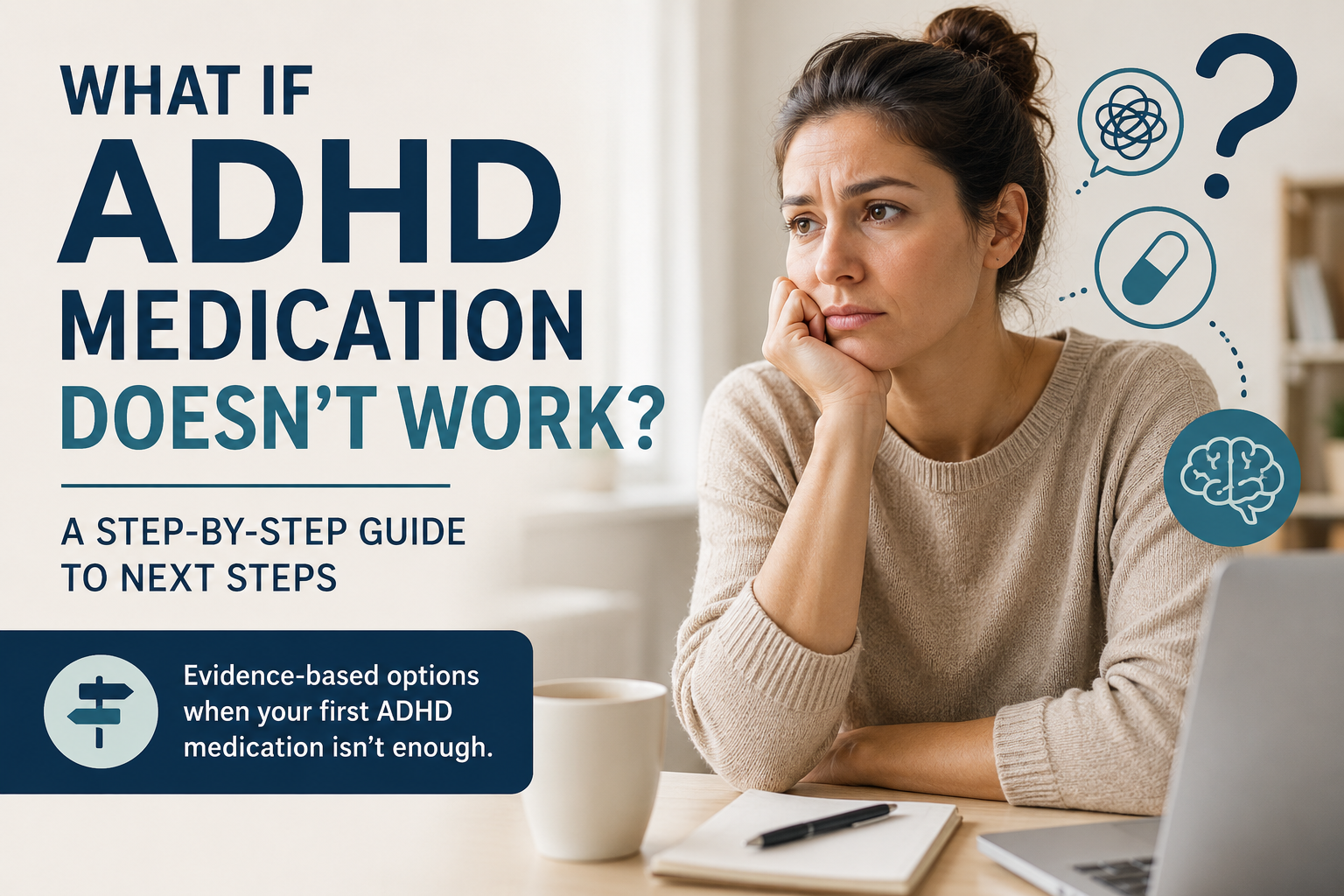

What if ADHD medication doesn’t work? Many adults ask this question after starting treatment and feeling disappointed with the results….
After years of struggling with focus, procrastination, disorganization, or feeling like you have to work twice as hard as everyone else to keep up, receiving an ADHD diagnosis can feel like a major breakthrough.
Finally, there is an explanation.
You start medication hoping things will become easier.
Maybe you’ve heard stories from friends, coworkers, or people online who describe ADHD medication as life-changing. You imagine being more productive, more organized, more focused, and less overwhelmed.
But then something unexpected happens.
Weeks later, you’re still struggling to:
- Stay focused during meetings
- Finish projects you’ve started
- Keep up with emails, paperwork, or household responsibilities
- Follow through on personal goals
- Manage the mental exhaustion that comes from constantly trying harder than everyone else
Now you’re wondering:
“What if ADHD medication doesn’t work for me?”
If this sounds familiar, you’re not alone.
Research suggests that approximately 30% of patients do not adequately respond to their first stimulant medication, yet more than 90% will respond to at least one ADHD medication when both methylphenidate and amphetamine-based stimulants are systematically trialed (Childress & Sallee, 2014; Shim et al., 2016).
In other words, a disappointing response to your first medication is much more common than most people realize.
Many adults assume they’re lazy, undisciplined, or simply not trying hard enough when ADHD treatment doesn’t work immediately. In reality, finding the right treatment often requires adjustment, refinement, and a personalized approach.
The good news is that a poor response to your first medication rarely means you’re out of treatment options.
Instead, ADHD treatment should follow a structured, evidence-based process designed to identify what is—and isn’t—working.
If you’re still early in your ADHD journey, understanding how ADHD is diagnosed can help set realistic expectations for treatment.
Click LINK: The Complete Guide to Adult ADHD Diagnosis, Treatment, and What to Expect
Adults seeking more information about ADHD can review educational resources from the National Institute of Mental Health (NIMH).
Table of Contents
ToggleWhat If ADHD Medication Doesn't Work? Understanding Your Next Steps
When ADHD medication does not produce the expected results, clinicians generally follow a stepwise approach before concluding that treatment has failed (Cortese et al., 2021).
The process typically involves:
- Optimizing the current medication
- Reassessing the diagnosis and screening for co-occurring conditions
- Considering alternative medication strategies
- Adding behavioral and psychological interventions
- Consulting an ADHD specialist when needed
Let’s look at each step.
Step 1: Optimize the Current Medication
Before changing medications, it’s important to determine whether the current treatment has been adequately optimized.
Is the Dose High Enough?
One of the most common reasons ADHD medication appears ineffective is inadequate dosing.
Stimulant medications are often started at a low dose and gradually increased to balance effectiveness with side effects. Research suggests that stimulant medications are frequently underdosed in routine clinical practice, which can lead patients to incorrectly assume the medication doesn’t work (Cortese et al., 2021; Farhat et al., 2022).
A proper titration process typically involves gradually increasing the dose until:
- Symptoms improve significantly
- Side effects become problematic
- The maximum recommended dose is reached
Are You Taking the Medication Consistently?
Poor adherence is another common but overlooked cause of apparent treatment failure (Childress & Sallee, 2014).
Common reasons include:
- Side effects
- Cost concerns
- Difficulty remembering doses
- Concerns about dependence
- Uncertainty about whether the medication is helping
If medication is not taken consistently, it becomes difficult to accurately evaluate its effectiveness.
Is the Formulation Right?
Sometimes the medication is helping, but not for long enough.
Patients may notice:
- Good focus in the morning
- Symptoms returning in the afternoon
- Difficulty concentrating during evening responsibilities
In these cases, the issue may be medication coverage rather than medication failure.
Potential solutions include:
- Adjusting the dosing schedule
- Changing the formulation
- Improving symptom coverage throughout the day
Before concluding that a medication doesn’t work, it’s important to ensure it has been given a fair trial under the right conditions.
Step 2: Reassess the Diagnosis and Screen for Co-Occurring Conditions
If medication optimization doesn’t produce adequate results, the next step is reassessing the broader clinical picture.
ADHD frequently co-occurs with other conditions that can affect concentration, motivation, and executive functioning (Barbaresi et al., 2020; Wolraich et al., 2019).
Common co-occurring conditions include:
- Anxiety disorders
- Depression
- Sleep disorders
- Learning disabilities
- Autism spectrum disorder
- Trauma-related disorders
- Substance use disorders
- Bipolar disorder
For example, chronic anxiety can create racing thoughts and distractibility that closely resemble ADHD. Depression can lead to poor concentration, low motivation, fatigue, and cognitive slowing.
Sleep disorders are particularly important because sleep deprivation can mimic nearly every core symptom of ADHD.
National clinical guidelines emphasize the importance of screening for co-occurring conditions during ADHD assessment. National Institute for Health and Care Excellence (NICE) ADHD Guidelines
It’s also important to recognize that many successful professionals spend years developing coping strategies that mask ADHD symptoms. By the time they seek treatment, multiple factors may be contributing to their difficulties.
Click LINK: ADHD in High-Achieving Women: Why Successful Women Are Often Diagnosed Later in Life
Sometimes medication isn’t failing—the diagnosis may need further clarification, or another condition may require treatment alongside ADHD.
A comprehensive evaluation helps ensure treatment is targeting the correct underlying problem.
Step 3: Consider Alternative Medication Strategies
If you’re wondering what if ADHD medication doesn’t work, remember that additional treatment options are often available..
If the current medication has been optimized and symptoms remain problematic, the next step may be adjusting the overall treatment strategy.
Many patients assume that if one ADHD medication doesn’t work, all ADHD medications will fail. Fortunately, this is rarely the case.
Research shows that while approximately 30% of patients may not respond adequately to their first stimulant medication, more than 90% ultimately respond to at least one ADHD medication when different treatment options are systematically explored (Childress & Sallee, 2014; Shim et al., 2016).
A Different Medication May Work Better
ADHD medications are not one-size-fits-all.
Individual responses vary considerably, and a medication that works extremely well for one person may provide little benefit for another. For this reason, clinicians often recommend trying a different medication approach when the first option fails to produce adequate results (Cortese et al., 2021).
Sometimes Combination Approaches Are Helpful
Some individuals experience partial improvement but continue to struggle with symptoms such as emotional dysregulation, impulsivity, sleep difficulties, or executive dysfunction.
In these situations, clinicians may consider combining treatment approaches to address a broader range of symptoms and improve overall functioning (Chan et al., 2016; Posner et al., 2020).
Medication Is Often a Process of Refinement
Finding the right ADHD treatment is often less about discovering a “perfect” medication and more about identifying the combination of strategies that works best for a particular individual.
This process may involve:
- Adjusting the medication strategy
- Addressing co-occurring conditions
- Improving symptom coverage throughout the day
- Incorporating behavioral and psychological interventions
The encouraging news is that a poor response to one medication does not predict long-term treatment failure. In most cases, additional options remain available.
Step 4: Add Behavioral and Psychological Treatment
One of the biggest misconceptions about ADHD treatment is that medication alone should solve every symptom.
Medication can improve attention and executive functioning, but it cannot automatically create habits, routines, or organizational systems.
Think of medication as improving your brain’s ability to engage. The skills themselves still need to be developed.
This is where behavioral treatment becomes important.
Cognitive Behavioral Therapy (CBT)
Among adults with ADHD, cognitive behavioral therapy has demonstrated effectiveness for:
- Executive dysfunction
- Emotional regulation
- Procrastination
- Negative thinking patterns
- Coping skills
Multiple studies have found that CBT can significantly improve outcomes, particularly among adults who continue to experience symptoms despite medication treatment (Lopez et al., 2018; Safren et al., 2010).
Additional educational resources and support are available through CHADD. Children and Adults with Attention-Deficit/Hyperactivity Disorder (CHADD)
ADHD Coaching and Skills Training
Additional interventions may include:
- Organizational skills training
- Time-management systems
- Productivity coaching
- Accountability structures
These approaches help translate symptom improvement into real-world functional gains.
For many professionals, the goal isn’t simply concentrating better—it’s improving consistency, follow-through, productivity, and reducing the mental energy required to stay on top of daily responsibilities.
Lifestyle Interventions Matter
Although lifestyle changes are rarely sufficient as standalone treatment, they can significantly influence how well ADHD treatment works.
Helpful strategies include:
- Consistent sleep schedules
- Regular exercise
- Stress management
- Structured routines
- Reduced digital distractions
Research suggests these interventions provide modest but meaningful benefits when combined with medication and therapy (Robaey et al., 2026).
Step 5: Consider Referral to an ADHD Specialist
Many adults ask, what if ADHD medication doesn’t work even after several adjustments. In most cases, a specialist can help identify additional strategies. If symptoms remain difficult to manage despite medication optimization, diagnostic reassessment, and behavioral interventions, referral to an ADHD specialist may be appropriate (Barbaresi et al., 2020).
Specialists can help evaluate:
- Complex ADHD presentations
- Treatment-resistant symptoms
- Co-occurring psychiatric conditions
- Diagnostic uncertainty
- Advanced treatment planning
Treatment-resistant ADHD does not mean treatment is hopeless. It usually means a more individualized and comprehensive approach is needed.
What Not to Do If ADHD Medication Isn't Working
If medication doesn’t seem effective, avoid:
- Increasing the dose on your own
- Taking extra doses without medical guidance
- Abruptly stopping treatment
- Assuming all ADHD medications will fail
- Ignoring sleep, anxiety, depression, or stress
A thoughtful, systematic approach is far more likely to produce meaningful results than making changes independently.
The Bottom Line
Understanding what if ADHD medication doesn’t work can help you avoid unnecessary frustration and make informed decisions about treatment. If ADHD medication doesn’t work at first, don’t assume you’ve reached the end of your treatment options.
Research consistently shows that most patients ultimately respond to treatment when medications are properly optimized, alternative strategies are explored, co-occurring conditions are addressed, and behavioral interventions are incorporated (Childress & Sallee, 2014; Cortese et al., 2021; Shim et al., 2016).
The most successful treatment plans typically include:
- Accurate diagnosis
- Medication optimization
- Screening for co-occurring conditions
- Evidence-based therapy
- Practical organizational strategies
- Ongoing monitoring and adjustment
ADHD treatment is rarely one-size-fits-all.
The goal is not perfection.
The goal is meaningful improvement in focus, productivity, emotional regulation, and quality of life.
Looking for ADHD Evaluation and Treatment in California?
If you’re struggling with ADHD symptoms or feel that your current medication isn’t providing the results you hoped for, a comprehensive evaluation can help identify the next steps.
Many adults who initially believe that medication “doesn’t work” discover that the issue is not a lack of treatment options, but rather the need for a more personalized approach.
If you’re looking for evidence-based ADHD evaluation and treatment, learning more about the assessment process is a good place to start.
Click LINK: ADHD Evaluation and Treatment in Southern California
If you are considering ADHD evaluation or treatment in California, contact Peace & Prosperity Psychiatry to ask about current availability.
References
Barbaresi, W. J., Campbell, L., Diekroger, E. A., Froehlich, T. E., Liu, Y. H., Okechukwu, K., … & Society for Developmental and Behavioral Pediatrics. (2020). Society for developmental and behavioral pediatrics clinical practice guideline for the assessment and treatment of children and adolescents with complex attention-deficit/hyperactivity disorder. Journal of Developmental & Behavioral Pediatrics, 41(Suppl. 2), S35–S57. https://doi.org/10.1097/DBP.0000000000000770
Chan, E., Fogler, J. M., & Hammerness, P. G. (2016). Treatment of attention-deficit/hyperactivity disorder in adolescents: A systematic review. JAMA, 315(18), 1997–2008. https://doi.org/10.1001/jama.2016.5453
Childress, A. C., & Sallee, F. R. (2014). Attention-deficit/hyperactivity disorder with inadequate response to stimulants: Approaches to management. CNS Drugs, 28(2), 121–129. https://doi.org/10.1007/s40263-013-0130-6
Cortese, S. (2020). Pharmacologic treatment of attention-deficit–hyperactivity disorder. The New England Journal of Medicine, 383(11), 1050–1056. https://doi.org/10.1056/NEJMra1917069
Cortese, S., Newcorn, J. H., & Coghill, D. (2021). A practical, evidence-informed approach to managing stimulant-refractory attention deficit hyperactivity disorder (ADHD). CNS Drugs, 35(10), 1035–1051. https://doi.org/10.1007/s40263-021-00848-3
Farhat, L. C., Flores, J. M., Behling, E., Irarrázaval, M., Rizzo, L. B., Bressan, R. A., Rohde, L. A., & Miguel, E. C. (2022). The effects of stimulant dose and dosing strategy on treatment outcomes in attention-deficit/hyperactivity disorder in children and adolescents: A meta-analysis. Molecular Psychiatry, 27(3), 1562–1572. https://doi.org/10.1038/s41380-021-01391-9
Lopez, P. L., Torrente, F. M., Ciapponi, A., Lischinsky, A. G., Cetkovich-Bakmas, M., Rojas, J. I., Romano, M., & Manes, F. F. (2018). Cognitive-behavioural interventions for attention deficit hyperactivity disorder (ADHD) in adults. Cochrane Database of Systematic Reviews, 2018(3), Article CD010840. https://doi.org/10.1002/14651858.CD010840.pub2
Posner, J., Polanczyk, G. V., & Sonuga-Barke, E. (2020). Attention-deficit hyperactivity disorder. The Lancet, 395(10222), 450–462. https://doi.org/10.1016/S0140-6736(19)33004-1
Robaey, P., Rogers, M. A., & Schachar, R. J. (2026). Advances in the management of ADHD in children and adolescents. BMJ, 393, e082507. https://doi.org/10.1136/bmj-2024-082507
Safren, S. A., Sprich, S., Mimiaga, M. J., Surman, C., Knouse, L., Groves, M., & Otto, M. W. (2010). Cognitive behavioral therapy versus relaxation with educational support for medication-treated adults with ADHD and persistent symptoms: A randomized controlled trial. JAMA, 304(8), 875–880. https://doi.org/10.1001/jama.2010.1192
Shim, S. H., Yoon, H. J., Bak, J., Hahn, S. W., & Kim, Y. K. (2016). Clinical and neurobiological factors in the management of treatment refractory attention-deficit hyperactivity disorder. Progress in Neuro-Psychopharmacology & Biological Psychiatry, 70, 237–244. https://doi.org/10.1016/j.pnpbp.2016.04.007
Wolraich, M. L., Hagan, J. F., Allan, C., Chan, E., Davison, D., Earls, M., Evans, S. W., Flinn, S. K., Froehlich, T., Frost, J., Holbrook, J. R., Kaplanek, B., Leslie, L. K., Loe, I. M., Perrin, J. M., Pierce, K. L., Winner, J. D., Zurhellen, W., & Subcommittee on Children and Adolescents With Attention-Deficit/Hyperactive Disorder. (2019). Clinical practice guideline for the diagnosis, evaluation, and treatment of attention-deficit/hyperactivity disorder in children and adolescents. Pediatrics, 144(4), e20192528. https://doi.org/10.1542/peds.2019-2528
For readers interested in learning more about ADHD treatment recommendations, the CDC and APSARD provide evidence-based educational materials.
Medical Review & Author Information
Written and medically reviewed by Troy Don, DC, AGACNP-BC, PMHNP-BC
For additional information about clinical education, professional credentials, and background, see Clinical Credentials & Professional Background.
Last medically reviewed: June 2026
Evidence reviewed through: June 2026
Medical Disclaimer
This article is for educational purposes only and is not a substitute for individualized medical advice, diagnosis, or treatment. Do not start, stop, or change a medication based on information in this article. Medication decisions should be made with an appropriate prescribing healthcare professional.