

What Every Adult with ADHD Should Know Before Beginning Treatment
Evidence-Based Guide • About a 20-Minute Read
Now That I Know I Have ADHD... What Happens Next?
Adult ADHD treatment raises a very different set of questions than the diagnostic process itself.
If you’ve recently been diagnosed with ADHD, you’re probably asking a very different question than you were just a few weeks ago.
Instead of wondering whether ADHD explains your struggles…
You’re wondering what to do about them.
Should I take medication?
Would therapy help?
Can exercise make a difference?
What about ADHD coaching?
Where do I even begin?
Those are exactly the questions this guide was written to answer.
The challenge isn’t finding opinions about ADHD treatment.
The challenge is knowing which treatments are supported by the best scientific evidence, why clinicians recommend certain treatments before others, and how those treatments fit together to help adults with ADHD function at their best.
That’s what you’ll learn here.
We’ll explore today’s major evidence-based treatment options, look at the research behind them, and explain how clinicians use that evidence to build individualized treatment plans.
Along the way, you’ll see Research Spotlights that summarize important studies in plain language. Rather than simply telling you what works, we’ll look at what researchers actually found, how confident we can be in those findings, and what they mean for adults living with ADHD.
One of the most important things to remember before we begin is this:
You don’t have to figure out your entire treatment plan today.
The best treatment plans usually aren’t built all at once.
They begin with one thoughtful, evidence-based decision.
From there, you and your healthcare provider can build a plan that evolves over time as you learn what works best for you.
Let’s start with the question that should come before every treatment decision.
Can ADHD treatment really make a meaningful difference?
Can ADHD Treatment Really Make a Meaningful Difference?
It’s a fair question.
Beginning treatment takes time, effort, and often a willingness to try something new.
Before investing that time and energy, most people want to know one thing.
Is it actually worth it?
For many adults, the answer is yes.
Not because treatment makes ADHD disappear.
Not because every treatment works for every person.
But because decades of research have shown that many adults with ADHD experience meaningful improvements when they receive evidence-based care.
Those improvements often extend far beyond paying attention.
Many adults describe feeling more organized, more productive, more consistent, and less overwhelmed by everyday responsibilities.
They may find it easier to complete projects, manage their time, stay engaged in conversations, regulate emotions, or follow through on important goals.
For some, those changes improve work performance.
For others, they strengthen relationships, reduce stress at home, or restore confidence that had slowly eroded over many years.
The goal of treatment isn’t perfection.
It’s progress.
It’s helping your daily life better reflect your abilities, your effort, and your potential.
That doesn’t happen overnight.
And it rarely happens because of one single intervention.
Like many chronic medical conditions, ADHD is often managed through a thoughtful combination of evidence-based treatments that work together over time.
The encouraging news is that clinicians no longer have to rely on trial and error alone.
Today, treatment recommendations are guided by decades of carefully conducted research involving thousands of adults with ADHD.
That research helps us understand not only whether treatments work, but also which treatments are most effective, who is most likely to benefit, and how different treatments can complement one another.
Before we explore the different treatment options, let’s begin by looking at what the best available scientific evidence tells us—and why some studies deserve more confidence than others.
Why Do Some Treatment Recommendations Carry More Weight Than Others?
By now, you’ve probably noticed that this guide doesn’t simply say, “Research shows…”
Instead, we’re showing you the actual research behind many of the recommendations clinicians make every day.
There’s a reason for that.
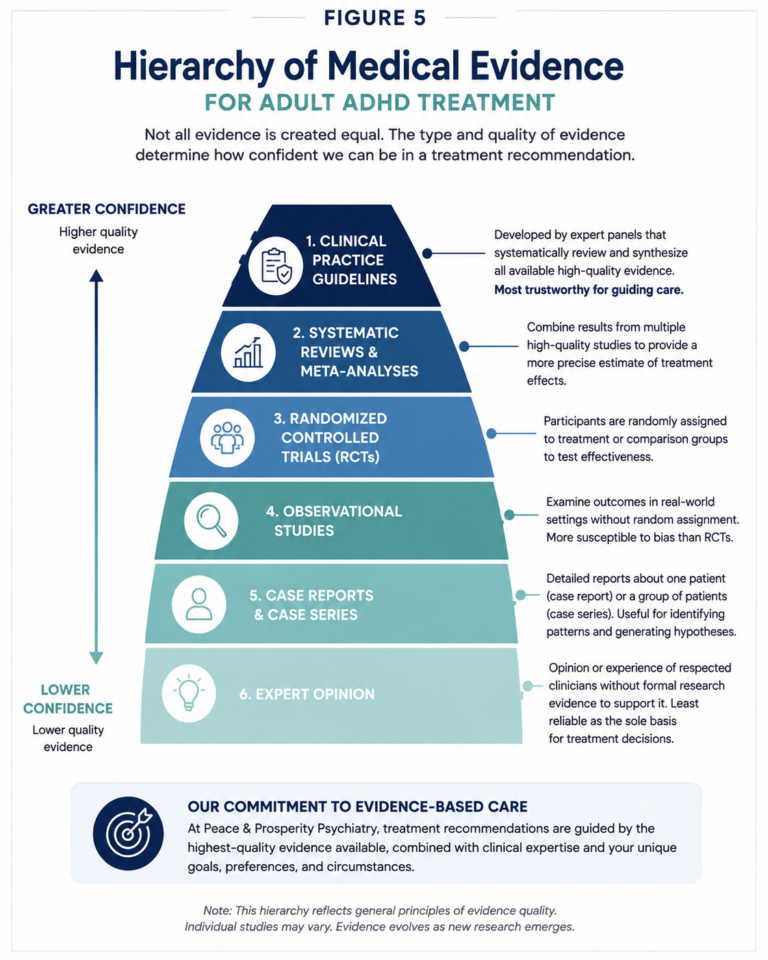
Not all research provides the same level of confidence.
Imagine you wanted to know whether a new ADHD treatment really worked.
You could ask one person about their experience.
You could read hundreds of stories online.
Or you could study thousands of people in carefully designed clinical trials and compare all of those results together.
Which answer would you trust more?
Most people would choose the third option.
That’s exactly what evidence-based medicine tries to do.
Rather than relying on opinions or isolated experiences, clinicians look for the highest-quality evidence available before making treatment recommendations.
That doesn’t mean personal experiences aren’t valuable.
They absolutely are.
But individual experiences can vary for many reasons, including placebo effects, expectations, natural improvement over time, or differences between one person and another.
High-quality research helps us look beyond individual stories to understand what is most likely to help the greatest number of people.
That’s why you’ll notice that many of our Research Spotlights feature systematic reviews, meta-analyses, and clinical practice guidelines.
These represent some of the strongest forms of evidence available because they evaluate the findings from many studies rather than relying on a single investigation.
One final point is worth remembering.
Research can answer three very different questions.
Sometimes the evidence consistently shows that a treatment works.
Sometimes the evidence consistently shows that a treatment does not provide meaningful benefit.
And sometimes the most honest answer is that we simply don’t know yet.
That last answer is often misunderstood.
A lack of strong evidence doesn’t necessarily mean a treatment is ineffective.
It may simply mean that more high-quality research is needed before we can draw confident conclusions.
You’ll see all three situations throughout this guide.
Understanding the difference is one of the most important parts of becoming an informed participant in your own care.
Now that we’ve discussed how to evaluate treatment evidence, let’s look at the different approaches clinicians use to help adults with ADHD function at their best.
🔬 Research Spotlight: Which ADHD Treatments Have the Strongest Scientific Evidence?
In 2025, Ostinelli and colleagues published one of the largest and most comprehensive evaluations of adult ADHD treatments ever conducted in The Lancet Psychiatry. Rather than relying on a single clinical trial, the researchers performed a component network meta-analysis, combining data from 113 randomized controlled trials involving 14,887 adults with ADHD. Because this type of study synthesizes results from many high-quality clinical trials, it represents one of the strongest forms of medical evidence available.
Key Findings
- Stimulant medications demonstrated the strongest evidence for improving the core symptoms of adult ADHD.
- Cognitive behavioral therapy (CBT) showed the strongest evidence among psychological treatments.
- Mindfulness, ADHD coaching, cognitive training, and neurostimulation showed encouraging but less consistent evidence.
- The authors concluded that additional high-quality research is needed before stronger recommendations can be made for many emerging treatments.
Why This Matters
One of the goals of this guide is to help you understand not only what treatments are available, but how confident we can be that they work.
Some treatments have been studied extensively and can be recommended with a high degree of confidence. Others appear promising but require additional research before equally strong recommendations can be made. Understanding that distinction allows you and your healthcare provider to make decisions based on the best available scientific evidence, not simply opinions or anecdotes.
Reference
Ostinelli, E. G., Schulze, M., Zangani, C., et al. (2025). Comparative efficacy and acceptability of pharmacological, psychological, and neurostimulatory interventions for adults with attention-deficit/hyperactivity disorder: A systematic review and component network meta-analysis. The Lancet Psychiatry, 12(1), 32–43. https://doi.org/10.1016/S2215-0366(24)00360-2
The study above also introduces an important idea.
When researchers evaluate treatments, they don’t simply ask whether something works.
They also ask how confident we should be in the answer.
Before we compare different treatment options, it’s worth spending a few minutes understanding how medical evidence is evaluated—and why some studies carry more weight than others.
What Does Successful ADHD Treatment Look Like?
If you ask ten adults with ADHD what they hope treatment will accomplish, you’ll probably hear ten different answers.
One person wants to stop missing deadlines.
Another wants to become a more patient parent.
Someone else wants to finish college, improve their relationships, feel less overwhelmed, or simply make it through the day without feeling mentally exhausted.
Those are all reasonable goals.
But they also highlight an important point.
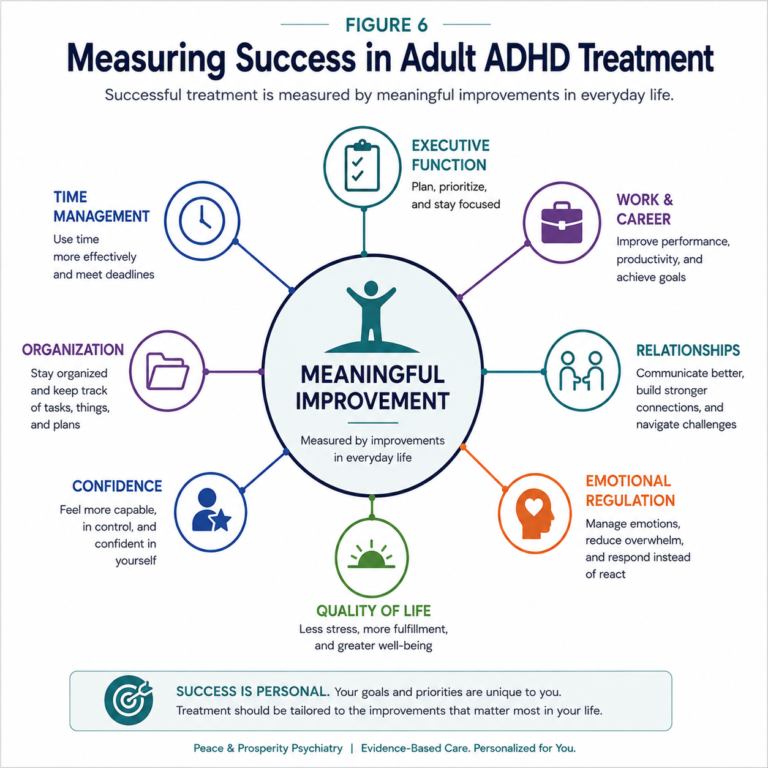
Successful ADHD treatment isn’t defined by one outcome.
It’s defined by helping you function better in the areas of life that matter most to you.
That’s an important distinction.
Many people assume the goal of treatment is simply to improve attention.
Attention is certainly part of ADHD.
But it isn’t the whole story.
Treatment may also help improve organization, time management, emotional regulation, planning, follow-through, working memory, and the ability to consistently translate intentions into actions.
For many adults, those changes have a ripple effect.
Work becomes less overwhelming.
Relationships become less strained.
Daily responsibilities become more manageable.
Confidence begins to return.
Notice something.
None of those goals require perfection.
They require progress.
One of the biggest misconceptions about ADHD treatment is that successful treatment means symptoms disappear completely.
That’s rarely how medicine works.
Think about conditions like high blood pressure, diabetes, or asthma.
The goal isn’t perfection.
The goal is better control, improved functioning, and a better quality of life.
ADHD is no different.
For many adults, treatment doesn’t eliminate every challenge.
Instead, it makes those challenges easier to manage.
Tasks that once felt impossible become manageable.
Planning becomes easier.
Following through becomes more consistent.
Life begins to require less effort just to accomplish ordinary things.
That’s why clinicians often think about treatment in terms of functional improvement, not simply symptom reduction.
Ultimately, the most successful treatment plan isn’t necessarily the one with the fewest symptoms.
It’s the one that helps your daily life better reflect your abilities, your values, and your goals.
Figure 6 illustrates some of the ways meaningful improvement may be reflected in everyday life.
🔬 Research Spotlight: How Do Researchers Measure Whether ADHD Treatment Is Successful?
Study
Researchers no longer judge ADHD treatment by attention alone. Modern clinical trials routinely evaluate whether treatment improves everyday functioning, including executive functioning, work performance, relationships, emotional well-being, and quality of life. This approach is reflected in both the World Federation of ADHD International Consensus Statement and the Australian ADHD Professionals Association Clinical Practice Guideline, two of the most influential evidence-based publications in adult ADHD care.
Key Findings
- Effective treatment improves much more than attention.
- Researchers commonly measure executive functioning, work and academic performance, emotional well-being, relationships, and overall quality of life.
- Medication and cognitive behavioral therapy have consistently demonstrated improvements in both ADHD symptoms and everyday functioning.
Why This Matters
Treatment isn’t about creating a “perfect” version of yourself.
It’s about helping your daily life become easier to manage.
Can you follow through more consistently?
Finish important tasks?
Feel less overwhelmed?
Improve your relationships?
Those are the outcomes that matter most—and they’re the same outcomes we’ll use throughout the rest of this guide as we evaluate each treatment option.
References
Australian ADHD Professionals Association. (2022). Australian evidence-based clinical practice guideline for attention deficit hyperactivity disorder (ADHD).
Faraone, S. V., et al. (2021). The World Federation of ADHD International Consensus Statement: 208 evidence-based conclusions about the disorder. Neuroscience & Biobehavioral Reviews, 128, 789–818.
That’s the standard we’ll use throughout the rest of this guide as we explore each treatment option.
Understanding Your Treatment Options
By now, you’ve seen that evidence-based treatment can make a meaningful difference for many adults living with ADHD.
You’ve also seen that not every treatment has the same level of scientific support.
That naturally leads to another important question.
Where should most adults begin?
The answer isn’t always the same for every person.
Age, medical history, other health conditions, previous treatment experiences, personal preferences, and individual goals all influence the treatment plan you and your healthcare provider decide to build together.
At the same time, that doesn’t mean every option is equally likely to help.
One of the most important principles of evidence-based medicine is that clinicians begin with the treatments supported by the strongest scientific evidence and then individualize those recommendations based on the person sitting in front of them.
In other words, treatment is personalized…
But it isn’t random.
There is a roadmap.
Decades of research, combined with clinical practice guidelines developed by experts who carefully review that research, help clinicians understand where to begin and how different treatments fit together.
For many adults, that roadmap starts with medication because it has the strongest evidence for improving the core symptoms of ADHD.
For others, therapy may play an important role early in treatment, particularly when anxiety, depression, low self-esteem, or long-standing coping patterns are making everyday life more difficult.
Lifestyle strategies—including improving sleep, regular physical activity, learning about ADHD, and developing practical organizational skills—often strengthen the overall treatment plan regardless of whether medication is used.
Rather than thinking about these treatments as competing with one another, it’s often more helpful to think of them as different tools.
Each has a purpose.
Each has strengths.
Each has limitations.
Some have stronger scientific evidence than others.
And many work best when combined thoughtfully over time.
That’s exactly what we’ll explore in the chapters ahead.
We’ll begin with medication—not because it’s the only treatment available, but because it has consistently demonstrated the strongest evidence for improving the core symptoms of adult ADHD and is recommended as a first-line treatment for many adults by major clinical guidelines.
From there, we’ll explore psychological therapies, lifestyle interventions, coaching, and other evidence-based strategies that help many adults build a comprehensive treatment plan.
As you read, remember one important idea.
The goal isn’t to find the perfect treatment.
The goal is to understand your options well enough to make informed decisions with your healthcare provider and build a treatment plan that helps your daily life better reflect your abilities, your goals, and the life you want to live.
Let’s begin with the treatment that most adults ask about first.
Medication.
How Can Medication Help Adults with ADHD?
For many adults, medication is the first treatment they think about after receiving an ADHD diagnosis.
It’s also the treatment that generates the most questions.
Will it change my personality?
Will I have to take it forever?
Is it safe?
What if I don’t want to take medication?
Those are all reasonable questions.
Before answering them, it’s helpful to start with a simpler one.
Why is medication usually discussed first?
The answer is straightforward.
Among all available ADHD treatments, medication has been studied more extensively than any other treatment and has consistently demonstrated the strongest evidence for improving the core symptoms of ADHD in adults.
That’s why major clinical practice guidelines recommend medication as a first-line treatment for many adults with ADHD.
Notice what that does not mean.
It doesn’t mean medication is the only treatment.
It doesn’t mean everyone should take medication.
And it certainly doesn’t mean medication solves every challenge associated with ADHD.
Instead, it means medication is often the best place to begin because it is the treatment we understand best and the one supported by the strongest scientific evidence.
For many adults, medication helps improve the core symptoms of ADHD, including attention, distractibility, impulsivity, and, for some people, hyperactivity.
As those symptoms improve, many people find it easier to stay focused, complete tasks, manage their time, and follow through on responsibilities.
Medication doesn’t teach organizational skills.
It doesn’t automatically improve communication in relationships.
It doesn’t replace healthy sleep, regular exercise, or practical strategies for managing everyday life.
Those areas often improve when medication is combined with other evidence-based treatments.
That’s one reason ADHD treatment is often described as comprehensive care rather than simply prescribing medication.
🔬 Research Spotlight: Why Is Medication Considered a First-Line Treatment for Adults with ADHD?
Medication is recommended as a first-line treatment for many adults because it has been studied more extensively than any other ADHD intervention. In their landmark 2025 network meta-analysis, Ostinelli and colleagues compared medications with psychological and neurostimulatory treatments across 113 randomized controlled trials involving nearly 15,000 adults.
Key Findings
- Stimulant medications consistently produced the largest improvements in the core symptoms of adult ADHD.
- Medications outperformed placebo and most non-pharmacological interventions for symptom reduction.
- CBT remained the strongest-supported psychological treatment, while several other interventions showed promising but less consistent evidence.
Why This Matters
Medication is not considered first-line because it’s the only treatment available.
It’s considered first-line because it currently has the strongest and most consistent scientific evidence for improving the core symptoms of ADHD.
That doesn’t mean medication is right for everyone.
It means it’s often the most logical place to begin when developing an evidence-based treatment plan.
Reference
Ostinelli, E. G., Schulze, M., Zangani, C., et al. (2025). Comparative efficacy and acceptability of pharmacological, psychological, and neurostimulatory interventions for adults with attention-deficit/hyperactivity disorder: A systematic review and component network meta-analysis. The Lancet Psychiatry, 12(1), 32–43.
Medication also isn’t an all-or-nothing decision.
Some adults choose to start with medication.
Others prefer to begin with therapy.
Some decide to combine treatments from the very beginning.
Others gradually add new strategies over time as their understanding of ADHD grows and their goals change.
These are conversations you and your healthcare provider will have together.
The important thing is that those conversations begin with the best available evidence and then focus on finding the approach that works best for you.
Before discussing the different types of ADHD medications, there’s another question that’s worth answering.
If medication works so well, why do many adults also benefit from therapy?
If Medication Works So Well, Why Does Therapy Matter?
It’s a question many adults ask.
If medication is considered the first-line treatment for ADHD, why would anyone need therapy?
The answer is simple.
Because medication and therapy do different jobs.
Medication helps improve the brain’s ability to regulate attention, focus, impulsivity, and other core symptoms of ADHD.
Therapy helps people learn how to work with that improved attention in everyday life.
Think of it this way.
Medication can make it easier to focus on your planner.
Therapy helps you develop a planning system you’ll actually use.
Medication may reduce distractibility.
Therapy can help you recognize the situations that consistently derail your productivity and develop practical strategies to stay on track.
Medication may make it easier to pause before reacting.
Therapy can teach skills for managing stress, improving communication, and responding more intentionally in difficult situations.
In other words…
Medication helps improve the symptoms of ADHD.
Therapy helps improve the way ADHD affects your daily life.
That’s why many clinicians recommend combining both treatments, particularly when ADHD has affected work performance, relationships, self-esteem, anxiety, or depression.
Not all forms of therapy are equally effective for ADHD, however.
While many types of psychotherapy can provide support, cognitive behavioral therapy (CBT) has the strongest scientific evidence for improving ADHD-related functioning in adults.
CBT for ADHD looks different from traditional talk therapy.
Rather than focusing primarily on the past, CBT is practical, structured, and goal-oriented.
Sessions often focus on skills such as:
- organizing tasks and managing time
- breaking overwhelming projects into manageable steps
- reducing procrastination
- improving problem-solving
- challenging unhelpful thinking patterns
- building routines that are realistic and sustainable
The goal isn’t simply to understand ADHD.
The goal is to learn strategies that make everyday life easier.
🔬 Research Spotlight: Which Psychological Therapy Has the Strongest Evidence for Adults with ADHD?
Two major meta-analyses published in 2026 evaluated the effectiveness of cognitive behavioral therapy (CBT) for adults with ADHD. Liu and colleagues reviewed 14 randomized controlled trials, while López-Pinar and colleagues analyzed 70 studies involving more than 5,100 participants, making it one of the largest evaluations of CBT for adult ADHD to date.
Key Findings
- CBT significantly improved core ADHD symptoms and executive functioning.
- Participants also experienced meaningful improvements in depression, anxiety, overall functioning, and quality of life.
- Many benefits continued after therapy ended, suggesting that patients continued applying the practical skills they had learned.
- Group-based CBT appeared particularly effective for ADHD symptoms, while individual CBT may provide greater benefit for emotional regulation and quality of life.
Why This Matters
Unlike medication, which works while you take it, CBT teaches practical skills that can continue benefiting you long after therapy ends.
For many adults, medication improves the brain’s ability to focus, while CBT teaches the strategies needed to organize, plan, prioritize, and follow through in everyday life.
Together, they address both the symptoms of ADHD and the daily challenges those symptoms create.
References
Liu, Y., Zhu, F., Yu, Y., et al. (2026). A meta-analysis of the intervention effect of cognitive behavioral therapy on adult ADHD. Journal of Affective Disorders.
López-Pinar, C., Selaskowski, B., Schulze, M., et al. (2026). Cognitive behavioral therapy effects on global functioning, domain-specific functioning, and quality of life in adult ADHD: A comprehensive meta-analysis. Behaviour Research and Therapy, 201, 105026.
It’s also important to recognize that CBT isn’t the only therapy used for adults with ADHD.
Therapies such as dialectical behavior therapy (DBT), mindfulness-based interventions (MBIs), and other skills-based approaches have shown encouraging results in certain situations, particularly for adults who struggle with emotional dysregulation, chronic stress, or co-occurring anxiety and depression.
However, the current evidence is not equally strong across all therapies.
Some approaches have been studied extensively.
Others have only a small number of clinical trials.
And for some, we simply don’t have enough high-quality evidence to draw firm conclusions yet.
That doesn’t necessarily mean those therapies don’t work.
It means we should be honest about what we know, what we don’t know, and where additional research is still needed.
For that reason, CBT remains the psychological treatment most consistently recommended by clinical guidelines for adults with ADHD.
The encouraging news is that therapy is only one part of the picture.
Many adults can also improve ADHD symptoms and everyday functioning through changes in sleep, physical activity, education, and other lifestyle strategies.
The next question is…
Can lifestyle changes really make a meaningful difference?
Can Lifestyle Changes Really Improve ADHD?
For many years, ADHD treatment conversations focused almost entirely on medication.
Today, we know that’s only part of the picture.
Medication can be highly effective for improving the core symptoms of ADHD.
Therapy can help build practical skills and healthier patterns.
But everyday habits also influence how well the ADHD brain functions.
Sleep.
Physical activity.
Stress.
Nutrition.
Daily routines.
None of these cause ADHD.
And none of them cure it.
But each can either support—or undermine—the effectiveness of your overall treatment plan.
That’s why most experienced ADHD clinicians think beyond prescriptions alone.
They think about the entire environment in which your brain functions.
Exercise
If there were a medication that improved attention, executive functioning, mood, sleep quality, cardiovascular health, and overall well-being—with very few side effects—it would likely become one of the most prescribed treatments in medicine.
Exercise isn’t that medication.
But it’s remarkably close.
Regular physical activity has repeatedly been associated with improvements in executive functioning, attention, mood, and emotional regulation.
Exercise also appears to increase brain-derived neurotrophic factor (BDNF), improve dopamine and norepinephrine signaling, reduce stress, and promote better sleep—all systems that are highly relevant to ADHD.
Does exercise replace medication?
No.
The evidence simply doesn’t support that conclusion.
Can it make an already good treatment plan even better?
For many adults, the answer appears to be yes.
🔬 Research Spotlight: Does Exercise Improve ADHD Symptoms in Adults?
A 2026 systematic review and meta-analysis by Xu and colleagues examined randomized controlled trials evaluating structured exercise programs for adults with ADHD. The researchers compared different types of exercise—including aerobic exercise, resistance training, and combined exercise programs—to determine whether regular physical activity improves ADHD symptoms and executive functioning.
Key Findings
- Regular exercise produced measurable improvements in attention, executive functioning, and emotional well-being.
- Moderate-to-vigorous aerobic exercise demonstrated the most consistent benefits.
- Exercise also improved mood and supported overall brain health.
- The greatest benefits were observed when exercise was used alongside other evidence-based treatments rather than as a replacement for them.
Why This Matters
Exercise isn’t a cure for ADHD, and the evidence doesn’t suggest it should replace medication or therapy.
However, it offers something few treatments can match—it improves both ADHD-related functioning and overall physical and mental health.
For that reason, regular physical activity is best viewed as an important part of a comprehensive treatment plan rather than an alternative to evidence-based medical care.
Reference
Xu, S., Zhao, C., & Hu, L. (2026). The effects of acute and chronic exercise on executive functions and core symptoms in adults with ADHD: A systematic review and meta-analysis. Psychology of Sport and Exercise, 84, 103088.
Sleep
Ask almost any adult with ADHD about sleep, and you’ll often hear a familiar story.
“I know I should go to bed earlier…”
“My mind won’t shut off.”
“I get a second wind at night.”
“I’ve always been a night owl.”
Sleep problems are remarkably common among adults with ADHD.
Unfortunately, poor sleep and ADHD often create a frustrating cycle.
ADHD symptoms can make it harder to maintain healthy sleep habits.
Poor sleep can then make attention, emotional regulation, memory, and executive functioning even more difficult the following day.
The result is that many adults feel as though their ADHD has become significantly worse—even when the underlying condition hasn’t changed.
Improving sleep won’t eliminate ADHD.
But better sleep often improves your ability to manage ADHD.
That’s an important distinction.
For that reason, improving sleep quality is one of the simplest and most consistently recommended lifestyle interventions in ADHD care.
Education and Self-Understanding
One of the most overlooked treatments for ADHD is also one of the most empowering.
Understanding your condition.
Learning how ADHD affects attention, motivation, executive functioning, emotional regulation, and daily routines helps transform confusing experiences into understandable patterns.
Many adults describe diagnosis itself as life-changing.
Not because it solved every problem.
But because it finally gave those problems a name.
Education builds on that foundation.
It helps replace self-criticism with understanding.
It helps explain why certain strategies work while others consistently fail.
And it allows you to become an active participant in your treatment rather than simply following instructions.
The more you understand ADHD, the better equipped you’ll be to make informed decisions alongside your healthcare provider.
Lifestyle changes rarely receive the same attention as medication.
That’s understandable.
Lifestyle changes usually produce smaller improvements than medication alone.
But they often improve overall health, strengthen other treatments, and help people function more consistently over time.
That’s why many clinicians view them not as optional extras, but as valuable components of comprehensive ADHD care.
Of course, lifestyle interventions aren’t the only non-medication treatments available.
Many adults also wonder about ADHD coaching, mindfulness, neurofeedback, dietary approaches, supplements, and other emerging interventions.
What does the evidence say about those options?
What About ADHD Coaching, Mindfulness, Neurofeedback, Supplements, and Other Emerging Treatments?
One of the most encouraging developments in ADHD research is that scientists continue to explore new ways to improve symptoms and everyday functioning.
Some of these treatments are becoming increasingly supported by research.
Others remain promising but require additional study.
Knowing the difference is one of the advantages of evidence-based care.
Rather than asking whether a treatment is simply “good” or “bad,” clinicians ask a more useful question:
How confident are we that it works?
That confidence depends on the quality and quantity of the available research.
Let’s look at several treatments that adults commonly ask about.
ADHD Coaching
ADHD coaching has become increasingly popular over the past decade. In a large 2024 survey conducted by ADDitude Magazine, approximately 17% of adults with ADHD reported having used ADHD coaching, reflecting growing interest in this approach despite the limited body of high-quality clinical research evaluating its effectiveness.
Unlike psychotherapy, coaching focuses on implementation rather than emotional processing.
A coach helps translate goals into daily action by providing accountability, improving organization, strengthening time management, and helping develop systems that make everyday responsibilities easier to manage.
Many adults find coaching practical, motivating, and encouraging.
The research is promising.
Several studies suggest that coaching can improve organization, goal attainment, executive functioning, and confidence in daily life. However, compared with medication and cognitive behavioral therapy, the research is still in its early stages.
In fact, despite coaching’s growing popularity, rigorous randomized controlled trials remain surprisingly limited, making it difficult to know exactly how much benefit coaching provides on its own (Sibley et al., 2026).
That doesn’t mean coaching isn’t helpful.
It means we need more high-quality research before making stronger recommendations.
For many adults, coaching is best viewed as a valuable addition to—not a replacement for—evidence-based medical and psychological treatment.
Mindfulness-Based Interventions
Mindfulness has received increasing attention as a possible treatment for adult ADHD.
Rather than trying to eliminate distracting thoughts, mindfulness teaches people to recognize when their attention has wandered and gently redirect it to the present moment.
Researchers have now studied mindfulness in multiple clinical trials.
A 2025 meta-analysis of 10 controlled studies found that adults who participated in mindfulness-based interventions experienced small-to-moderate improvements in ADHD symptoms, attention, and everyday functioning compared with people who did not receive mindfulness training (Kim & Jung, 2025).
One of the largest randomized clinical trials produced another encouraging finding.
After completing mindfulness-based cognitive therapy, about 1 in 4 participants experienced a clinically meaningful improvement in their ADHD symptoms, compared with only a small percentage of those who did not receive the treatment. Many of those improvements were still present six months later (Hepark et al., 2021).
At the same time, researchers also noticed something important.
When mindfulness was compared with other active treatments rather than no treatment at all, the benefits became much smaller.
That tells us two things.
Mindfulness appears to be genuinely helpful for many adults.
But based on the current evidence, it should be viewed as a complementary treatment—not a replacement for treatments such as medication or cognitive behavioral therapy that have much stronger scientific support.
Neurofeedback
Neurofeedback is one of the most frequently discussed—and often misunderstood—ADHD treatments.
The idea is certainly appealing.
By giving people real-time feedback about their brain activity, neurofeedback aims to improve attention and self-regulation through training rather than medication.
Unfortunately, the highest-quality research has been less encouraging.
A 2025 meta-analysis published in JAMA Psychiatry combined the results of 38 randomized controlled trials involving 2,472 participants. When researchers focused on the studies least likely to be influenced by bias, they found that neurofeedback did not produce a meaningful improvement in ADHD symptoms overall (Cortese et al., 2025).
Some specialized neurofeedback protocols showed modest benefits, suggesting the field continues to evolve.
However, based on the evidence available today, neurofeedback has not demonstrated the consistent effectiveness needed to recommend it as a routine treatment for adult ADHD.
Future research may change that conclusion.
For now, it’s best viewed as an emerging treatment rather than an established one.
Dietary Supplements and Nutrition
Questions about diet and nutritional supplements are incredibly common.
Can changing what I eat improve ADHD?
Do omega-3 fatty acids help?
Should I take vitamins or herbal supplements?
Researchers have spent years studying these questions.
So far, the results have been mixed.
Some supplements—particularly omega-3 fatty acids—have shown small improvements in ADHD symptoms in some studies.
However, those improvements have generally been much smaller than those seen with stimulant medication or cognitive behavioral therapy.
That doesn’t mean nutrition isn’t important.
Quite the opposite.
A healthy diet supports overall brain and physical health, and addressing nutritional deficiencies is an important part of good medical care.
But based on current evidence, dietary supplements should be viewed as supportive strategies rather than substitutes for treatments with substantially stronger scientific evidence.
What Should You Take Away from All of This?
One of the goals of this guide is not simply to tell you which treatments are recommended.
It’s to help you understand why.
Some ADHD treatments have been studied for decades in thousands of people.
Others have only been examined in a handful of small studies.
Some have consistently demonstrated meaningful benefits.
Others remain promising but require additional research.
And for some treatments, the most honest answer today is simply:
We don’t know yet.
That’s not a weakness of science.
It’s one of its greatest strengths.
Evidence-based medicine doesn’t require us to reject new ideas.
It asks us to match our confidence to the strength of the evidence.
That approach allows clinicians to remain both scientifically rigorous and open to future discoveries.
It also allows patients to make informed decisions without feeling overwhelmed by conflicting opinions or the latest trend circulating online.
Now that we’ve explored the major treatment options, one important question remains.
How do you put all of these pieces together into a treatment plan that’s right for you?
How Do You Build a Treatment Plan That Fits Your Life?
By now, you’ve seen that there isn’t just one treatment for adult ADHD.
There are several.
Medication.
Therapy.
Exercise.
Sleep optimization.
Education.
Coaching.
And, in some situations, other emerging approaches.
So how do you decide where to begin?
The answer may surprise you.
Most successful treatment plans don’t begin by trying to do everything at once.
They begin by identifying the next best step.
For many adults, that’s medication because it has the strongest evidence for improving the core symptoms of ADHD.
For others, therapy may be the first priority, particularly if anxiety, depression, or long-standing patterns of self-criticism are making daily life more difficult.
Sometimes improving sleep becomes the first goal because chronic sleep deprivation is making ADHD symptoms significantly worse.
There isn’t one path that fits everyone.
But there is a thoughtful process that guides good clinical decision-making.
Step 1: Start with the Strongest Evidence
Whenever possible, clinicians begin with treatments supported by the highest-quality research.
That doesn’t guarantee a treatment will work for every individual.
Medicine rarely offers that kind of certainty.
But it does mean you’re beginning with the option that has helped the greatest number of people in carefully conducted clinical studies.
For many adults with ADHD, that’s why medication is often discussed first.
Not because it’s the only option.
Because it’s the option supported by the strongest evidence.
Step 2: Consider the Whole Person
ADHD rarely exists in isolation.
Some adults also struggle with anxiety.
Others experience depression, chronic stress, insomnia, or substance use disorders.
Some are raising young children while working full-time.
Others are returning to school after many years.
These differences matter.
A treatment plan should fit the person—not the diagnosis alone.
That’s one reason two people with ADHD may leave the same clinic with very different treatment recommendations.
Both plans can be evidence-based.
They’re simply designed around different lives, different goals, and different challenges.
Step 3: Evaluate Progress
One of the biggest misconceptions about ADHD treatment is that success is determined after the first appointment.
In reality, treatment is a process.
After starting a new medication, learning a CBT skill, improving sleep, or beginning another intervention, the next question is always the same:
Is this helping?
Some improvements are obvious.
Others are more subtle.
You may notice that work feels less overwhelming.
You finish projects more consistently.
Arguments at home become less frequent.
You stop relying on last-minute adrenaline to meet deadlines.
Those changes matter.
They’re often signs that treatment is improving the way ADHD affects your daily life—not just your symptoms.
Step 4: Adjust the Plan
Sometimes the first treatment works remarkably well.
Sometimes it helps—but not enough.
Sometimes it causes side effects.
Sometimes life changes.
Good treatment plans are designed to adapt.
You might adjust the medication dose.
Add cognitive behavioral therapy.
Improve sleep habits.
Begin regular exercise.
Work with an ADHD coach to strengthen organization and accountability.
Or address another condition, such as anxiety or depression, that’s making ADHD more difficult to manage.
Each adjustment builds on what you’ve already learned.
The goal isn’t to keep changing treatments.
The goal is to keep improving your ability to function, thrive, and enjoy your life.
One Step at a Time
If this guide has introduced you to several treatment options, you might be wondering where you should begin.
Here’s my advice.
Don’t feel pressured to solve everything today.
Choose the next thoughtful step.
Give it enough time to evaluate whether it’s helping.
Stay curious.
Stay engaged.
Keep communicating with your healthcare provider.
And remember that treatment plans often become more effective over time—not because they’re perfect from the beginning, but because they’re refined through experience, guided by evidence, and individualized to the person receiving care.
That’s exactly how good medicine works.
And it’s exactly how good ADHD care works.
The Best Treatment Plan Is One You Can Sustain
Throughout this guide, we’ve emphasized the importance of following the best available scientific evidence.
That’s where good treatment begins.
But evidence alone isn’t enough.
The most effective treatment is only helpful if it becomes part of your life.
Think about it this way.
The medication with the strongest evidence can’t help if it stays in the prescription bottle.
The best therapy can’t change your life if sessions are never attended or new skills are never practiced between appointments.
Exercise only improves brain health if it becomes part of your weekly routine.
Healthy sleep habits only help when they’re practiced consistently.
The same principle applies to every treatment we’ve discussed.
Treatments create results only when they are used consistently over time.
That’s why choosing a treatment isn’t simply about asking,
“What works best?”
It’s also about asking,
“What am I most likely to do consistently?”
Good ADHD treatment brings those two questions together.
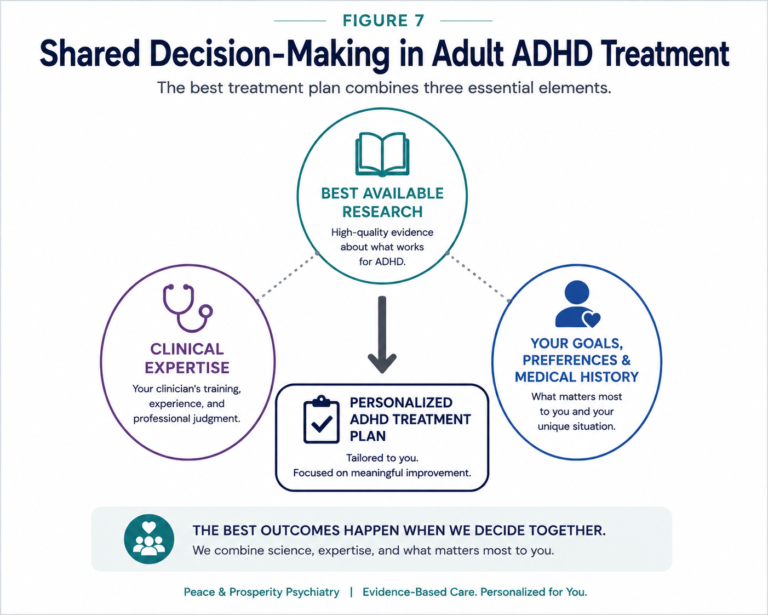
Your healthcare provider contributes the best available scientific evidence and clinical experience.
You contribute something equally important—your goals, your daily routine, your preferences, your challenges, and an honest understanding of what is realistic for your life.
Together, those conversations shape a treatment plan that is both evidence-based and practical.
Figure 7 illustrates how these three elements come together to create an individualized treatment plan.
The specific starting point will look different for every person.
Sometimes that plan begins with medication.
Sometimes it begins with therapy.
Sometimes the first priority is improving sleep or addressing another condition that’s making ADHD more difficult to manage.
Whatever the starting point, the plan doesn’t have to be perfect.
It simply needs to be thoughtful enough to begin.
As treatment progresses, you’ll learn what’s working, what isn’t, and where additional improvements are possible.
Some treatments may be added.
Others may be adjusted.
Occasionally, something that looked promising simply turns out not to fit your life—and that’s valuable information, not failure.
Good treatment plans are designed to evolve.
The goal isn’t to find the perfect treatment on the first day.
The goal is to build a treatment plan that combines the strongest scientific evidence with strategies you can realistically sustain over months and years.
That’s where meaningful, lasting improvement is most likely to occur.
Frequently Asked Questions
Can I Try Therapy Before Medication?
The short answer is yes.
Many adults choose to begin with therapy, and for some people that’s an appropriate place to start. Your preferences, medical history, treatment goals, and any coexisting conditions all play an important role in deciding where to begin.
At the same time, medication is recommended as a first-line treatment for many adults because it has the strongest scientific evidence for improving the core symptoms of ADHD. For many people, the best approach isn’t choosing medication or therapy—it’s understanding how each treatment fits into a comprehensive plan that can be adjusted over time.
Will I Have to Take Medication Forever?
The short answer is no—not necessarily.
There is no predetermined length of treatment for ADHD. Some adults continue medication because it consistently improves their quality of life. Others reduce, change, or discontinue medication over time under the guidance of their healthcare provider.
The decision should always be individualized and based on your symptoms, goals, benefits, side effects, and how well the treatment continues to fit your life.
What If the First Treatment Doesn’t Work?
The short answer is: don’t give up.
Finding the right treatment sometimes takes time. A medication may need to be adjusted, another medication may be a better fit, or additional treatments such as cognitive behavioral therapy, exercise, or coaching may help address areas that medication alone cannot.
Needing to refine your treatment plan isn’t a setback—it’s a normal and expected part of evidence-based ADHD care.
Can ADHD Be Treated Without Medication?
The short answer is yes—but there are trade-offs.
Several non-medication treatments, including cognitive behavioral therapy, regular exercise, and lifestyle interventions, have scientific evidence supporting their use. However, medication remains the treatment with the strongest evidence for improving the core symptoms of ADHD in most adults.
The goal isn’t to choose the treatment that sounds most appealing. It’s to choose the treatment plan that best fits your goals while understanding the strengths and limitations of each option.
How Long Does ADHD Treatment Take to Work?
The short answer depends on the treatment.
Stimulant medications often begin working the same day they are taken, while therapy, exercise, and lifestyle changes usually produce more gradual improvements over weeks or months as new skills and habits develop.
The most meaningful improvements often occur over time as treatment is adjusted and different strategies work together to improve both symptoms and daily functioning.
How Do I Know If My Treatment Plan Is Working?
The short answer is to look beyond symptoms.
Successful treatment isn’t simply about paying attention better. It’s about functioning better.
You may notice that you’re finishing projects more consistently, managing your time more effectively, feeling less overwhelmed, improving your relationships, or relying less on last-minute stress to meet deadlines.
Those real-life improvements are often the most meaningful signs that treatment is working.
Is It Ever Too Late to Start ADHD Treatment?
The short answer is no.
Adults are diagnosed with ADHD every day in their 30s, 40s, 50s, 60s, and beyond. While treatment can’t change the past, many people experience meaningful improvements in their work, relationships, confidence, and quality of life after beginning evidence-based care.
It’s never too late to better understand your brain and begin building a treatment plan that helps you function at your best.
What If I’m Still Struggling After Starting Treatment?
The short answer is that you’re not alone—and it doesn’t mean treatment has failed.
ADHD treatment is rarely a one-time decision. As your healthcare provider learns how you respond to treatment, your plan may be adjusted by changing a medication, adding therapy, improving lifestyle habits, or addressing other conditions that may be affecting your progress.
Sometimes meaningful improvement comes from refining the treatment plan rather than replacing it.
The most successful treatment plans are rarely the ones that are perfect from the beginning. They’re the ones that continue to evolve based on your experience, your goals, and the best available scientific evidence.
If you’re still struggling, don’t assume you’ve run out of options. It may simply be time for the next thoughtful adjustment.
Ready to Take the Next Step?
If you’ve read this guide from beginning to end, you’ve already done something important.
You’ve taken the time to understand your options.
You’ve looked beyond opinions and headlines to learn what the research actually tells us about treating adult ADHD.
That’s an excellent place to begin.
Because the best treatment decisions aren’t made out of fear or frustration.
They’re made with knowledge, thoughtful discussion, and a clear understanding of the available evidence.
The next step isn’t having every answer.
It’s finding a healthcare provider who will help you apply that knowledge to your unique situation.
Someone who will listen to your concerns.
Help you weigh the benefits and trade-offs of different treatment options.
Answer your questions honestly.
And work with you to build a treatment plan that fits your life—not someone else’s.
That’s the approach we believe in at Peace & Prosperity Psychiatry.
Every treatment recommendation begins with the best available scientific evidence.
From there, we personalize your care based on your goals, your medical history, your daily life, and your response to treatment over time.
Because good ADHD care isn’t about finding a perfect treatment.
It’s about building the right treatment plan for you.
Whether you’re considering medication, therapy, lifestyle changes, or a combination of approaches, you don’t have to make those decisions alone.
If you’re ready to move from learning about ADHD treatment to building a personalized treatment plan, we’d be honored to help.
Evidence and References
This guide was developed using current clinical practice guidelines, systematic reviews, meta-analyses, randomized controlled trials, and other high-quality peer-reviewed research. Whenever possible, treatment recommendations throughout this guide are based on the highest levels of available scientific evidence while recognizing that research continues to evolve.
Evidence-based medicine is more than simply following published research. It combines the best available evidence with clinical expertise and the individual goals, preferences, and circumstances of each patient. Throughout this guide, we’ve aimed to present the current evidence honestly—including where the evidence is strong, where it is promising but still emerging, and where additional research is needed.
The references below are provided for readers who would like to explore the scientific literature in greater depth.
Australian ADHD Professionals Association. (2022). Australian evidence-based clinical practice guideline for attention deficit hyperactivity disorder (ADHD). Australian ADHD Professionals Association.
Cortese, S., Adamo, N., Del Giovane, C., et al. (2018). Comparative efficacy and tolerability of medications for attention-deficit hyperactivity disorder in children, adolescents, and adults: A systematic review and network meta-analysis. The Lancet Psychiatry, 5(9), 727–738. https://doi.org/10.1016/S2215-0366(18)30269-4
Cortese, S., Ferrin, M., Zangani, C., et al. (2025). Neurofeedback for attention-deficit/hyperactivity disorder: A systematic review and meta-analysis of randomized clinical trials. JAMA Psychiatry. https://doi.org/10.1001/jamapsychiatry.2025.1789
Hepark, S., Janssen, L., de Vries, A., Schoenberg, P. L. A., Kan, C. C., Speckens, A. E. M., & Donders, R. (2021). Mindfulness-based cognitive therapy versus treatment as usual in adults with ADHD: A randomized controlled trial. Journal of Clinical Psychiatry, 82(6). https://doi.org/10.4088/JCP.20m13857
Janssen, L., Kan, C. C., Carpentier, P. J., et al. (2019). Mindfulness-based cognitive therapy v. treatment as usual in adults with ADHD: A multicentre, single-blind, randomised controlled trial. Psychological Medicine, 49(1), 55–65. https://doi.org/10.1017/S0033291718000429
Kim, H. H., & Jung, N. H. (2025). Mindfulness-based interventions for adults with ADHD: A systematic review and meta-analysis. Medicine, 104(37), e44308. https://doi.org/10.1097/MD.0000000000044308
Liu, Y., Zhu, F., Yu, Y., et al. (2026). A meta-analysis of the intervention effect of cognitive behavioral therapy on adult ADHD. Journal of Affective Disorders. Advance online publication. https://doi.org/10.1016/j.jad.2025.121107
López-Pinar, C., Selaskowski, B., Schulze, M., et al. (2026). Cognitive behavioral therapy effects on global functioning, domain-specific functioning, and quality of life in adult ADHD: A comprehensive meta-analysis. Behaviour Research and Therapy, 201, 105026. https://doi.org/10.1016/j.brat.2026.105026
Lopez, P. L., Torrente, F. M., Ciapponi, A., et al. (2018). Cognitive-behavioural interventions for attention deficit hyperactivity disorder (ADHD) in adults. Cochrane Database of Systematic Reviews, (3), CD010840. https://doi.org/10.1002/14651858.CD010840.pub2
Nimmo-Smith, V., Merwood, A., Hank, D., et al. (2020). Non-pharmacological interventions for adult ADHD: A systematic review. Psychological Medicine, 50(4), 529–541. https://doi.org/10.1017/S0033291720000069
Olagunju, A. E., & Ghoddusi, F. (2024). Attention-deficit/hyperactivity disorder in adults. American Family Physician, 110(2), 157–166.
Ostinelli, E. G., Schulze, M., Zangani, C., et al. (2025). Comparative efficacy and acceptability of pharmacological, psychological, and neurostimulatory interventions for ADHD in adults: A systematic review and component network meta-analysis. The Lancet Psychiatry, 12(1), 32–43. https://doi.org/10.1016/S2215-0366(24)00360-2
Posner, J., Polanczyk, G. V., & Sonuga-Barke, E. (2020). Attention-deficit hyperactivity disorder. The Lancet, 395(10222), 450–462. https://doi.org/10.1016/S0140-6736(19)33004-1
Safren, S. A., Sprich, S., Mimiaga, M. J., et al. (2010). Cognitive behavioral therapy vs relaxation with educational support for medication-treated adults with ADHD and persistent symptoms: A randomized controlled trial. JAMA, 304(8), 875–880. https://doi.org/10.1001/jama.2010.1192
Volkow, N. D., & Swanson, J. M. (2013). Adult attention deficit–hyperactivity disorder. The New England Journal of Medicine, 369(20), 1935–1944. https://doi.org/10.1056/NEJMcp1212625
Westwood, S. J., Aggensteiner, P. M., Kaiser, A., et al. (2025). Neurofeedback for attention-deficit/hyperactivity disorder: A systematic review and meta-analysis. JAMA Psychiatry.
Xu, S., Zhao, C., & Hu, L. (2026). The effects of acute and chronic exercise on executive functions and core symptoms in adults with ADHD: A systematic review and meta-analysis. Psychology of Sport and Exercise, 84, 103088. https://doi.org/10.1016/j.psychsport.2026.103088
Yang, X., Zhang, L., Yu, J., & Wang, M. (2025). Short-term and long-term effect of non-pharmacotherapy for adults with ADHD: A systematic review and network meta-analysis. Frontiers in Psychiatry, 16, 1516878. https://doi.org/10.3389/fpsyt.2025.1516878
Medical Disclaimer
The information provided in this guide is intended for educational purposes only and should not be considered a substitute for personalized medical advice, diagnosis, or treatment. Every effort has been made to present information that reflects current clinical practice guidelines and the best available scientific evidence at the time of publication. However, medical research continues to evolve, and future studies may change our understanding of ADHD and its treatment.
Evidence-based medicine is more than simply following published research. It combines the best available scientific evidence with clinical expertise and the unique goals, preferences, medical history, and circumstances of each individual patient. For that reason, no article—regardless of how comprehensive—can determine the treatment plan that is right for you.
If you think you may have ADHD, or if you’re considering treatment options, speak with a qualified healthcare professional who can perform a comprehensive evaluation and help you develop a personalized treatment plan based on your individual needs.
Our goal at Peace & Prosperity Psychiatry is to provide clear, accurate, and evidence-based information that helps you become a well-informed and confident partner in your own care. We hope this guide serves as a trusted resource as you work with your healthcare provider to make thoughtful, informed decisions about ADHD treatment.
About the Author
Troy Don, MSN, PMHNP-BC, AGACNP-BC is a double board-certified Nurse Practitioner (Psychiatric Mental Health and Adult Geriatric Acute Care Nurse Practitioner) and the founder of Peace & Prosperity Psychiatry, where he specializes in the comprehensive evaluation and evidence-based treatment of adults with ADHD. His practice is dedicated to helping adults better understand how ADHD affects their lives and developing personalized treatment plans grounded in the best available scientific evidence.
Troy believes that excellent ADHD care begins with evidence-based medicine, thoughtful clinical judgment, and shared decision-making. Rather than relying on trends, opinions, or one-size-fits-all recommendations, he works collaboratively with each patient to develop an individualized treatment plan that reflects their symptoms, medical history, goals, preferences, and response to treatment over time.
In addition to providing clinical care, Troy is committed to improving public understanding of adult ADHD through comprehensive educational resources that translate complex medical research into clear, practical guidance. His goal is to help patients become informed, confident participants in their own care by explaining not only what current research recommends, but also why those recommendations are made.
This guide is part of the Peace & Prosperity Psychiatry Adult ADHD Knowledge Series, a growing collection of evidence-based educational resources designed to help adults better understand ADHD diagnosis, treatment, and long-term management. Whether you’re just beginning your ADHD journey or refining an existing treatment plan, the goal of every guide is the same: to provide accurate, trustworthy information that helps you make informed decisions in partnership with your healthcare provider.
Continue Your ADHD Learning
You’ve just completed one of the most comprehensive evidence-based guides to adult ADHD treatment available online. If you’d like to explore specific treatment topics in greater depth, these additional resources provide practical, research-informed guidance on some of the most common questions adults ask after beginning treatment.
Medication vs. Therapy for Adult ADHD: Which Treatment Works Best?
Medication and cognitive behavioral therapy (CBT) have the strongest scientific evidence for treating adult ADHD. Learn how these approaches differ, when each may be appropriate, and why many adults achieve the greatest benefit by combining both as part of a comprehensive treatment plan.
How CBT Helps Adults With ADHD: Skills, Benefits, and What to Expect
CBT is the psychological treatment with the strongest evidence for adults with ADHD. Discover the practical skills taught in therapy, how CBT complements medication, and what you can realistically expect during treatment.
What If ADHD Medication Doesn’t Work? 5 Proven Next Steps for Adults
Not every medication works perfectly the first time. Learn why adjustments are often a normal part of treatment, the most common reasons medication may not meet expectations, and the evidence-based next steps your healthcare provider may recommend.
How Long Does ADHD Treatment Take to Work? A Realistic Timeline for Adults
Understand what improvements you can realistically expect, how quickly different treatments begin working, and why meaningful progress often continues as your treatment plan is refined over time.