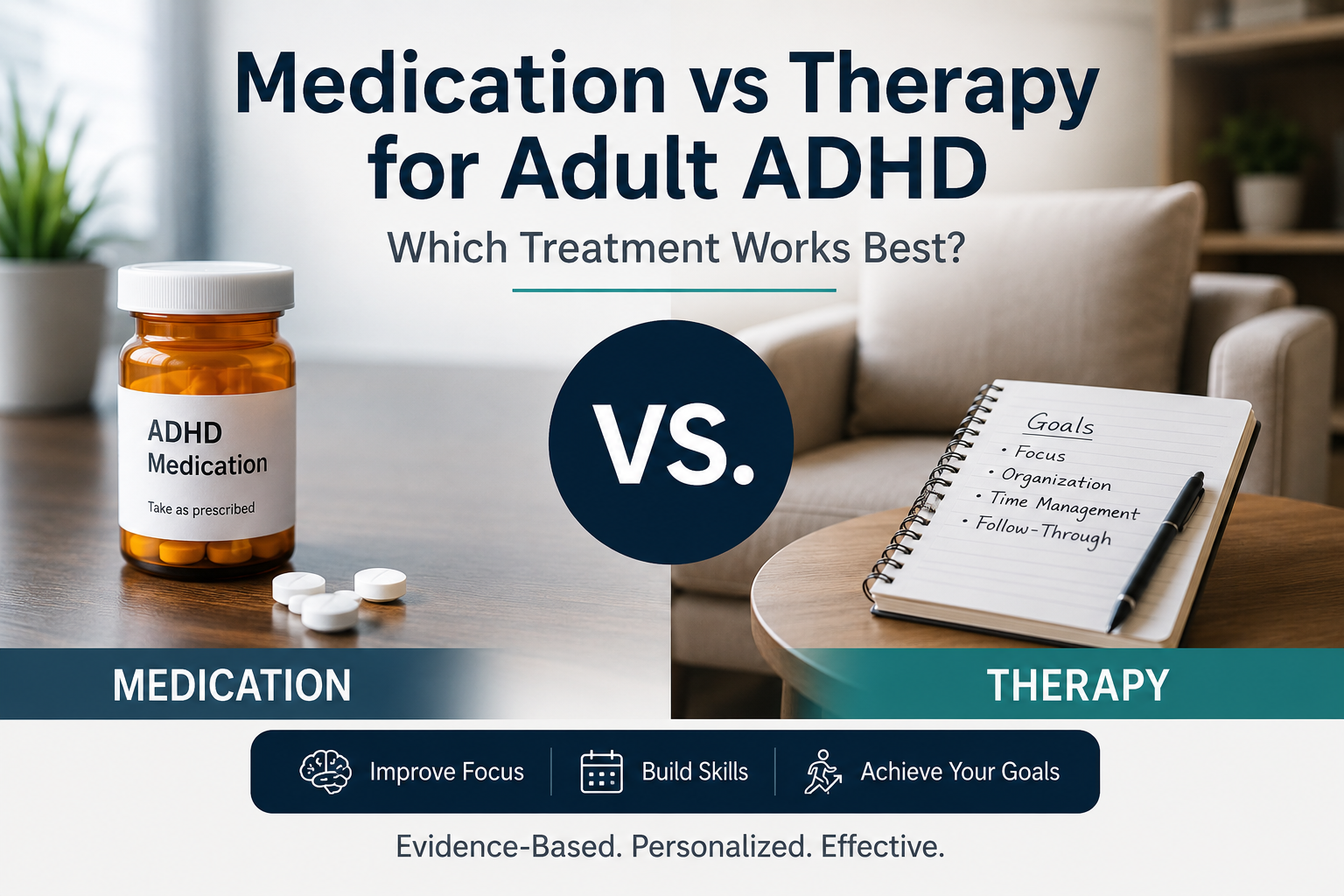

When comparing medication vs therapy for adult ADHD, one of the first questions many adults ask is, “Which treatment works best?”
If you’ve recently been diagnosed with ADHD, you’re probably wondering whether medication, cognitive behavioral therapy (CBT), or a combination of both is the right next step.
Current research—including a large network meta-analysis of 113 randomized clinical trials involving nearly 15,000 adults—suggests that stimulant medication remains the most effective first-line treatment for reducing core ADHD symptoms in the short term, while CBT offers important benefits for organization, emotional regulation, and long-term functioning. For many adults, the strongest evidence supports combining both approaches (Ostinelli et al., 2025).
Many adults who seek ADHD treatment are surprised by their diagnosis. They have built successful careers, earned advanced degrees, managed households, raised families, or achieved significant professional accomplishments. If that sounds familiar, you may want to read our article on why ADHD is often overlooked in high-achieving adults and why many successful professionals are diagnosed later in life.
The reality is that success does not rule out ADHD.
Many high-achieving adults spend years compensating for symptoms through intelligence, determination, perfectionism, or simply working longer hours than everyone around them. Over time, however, the cost of constantly compensating can become difficult to ignore. What once felt manageable may begin to look like chronic stress, burnout, overwhelm, missed deadlines, procrastination, or the feeling that everyday tasks require far more effort than they should.
Current evidence suggests that stimulant medication remains the most effective first-line treatment for reducing core ADHD symptoms in the short term, while cognitive behavioral therapy (CBT) may provide important benefits for long-term functioning, emotional regulation, and co-occurring conditions such as anxiety. The strongest evidence supports a multimodal approach that combines both treatments (Ostinelli et al., 2025).
This article reviews what current research tells us about ADHD medication, CBT for adult ADHD, long-term treatment outcomes, and how to decide which approach may be right for you.
Table of Contents
ToggleMedication vs Therapy for Adult ADHD: Quick Answer
If you’re looking for the short answer:
- ADHD medication typically provides the fastest symptom improvement.
- CBT helps adults build lasting skills for organization, planning, and emotional regulation.
- Medication is often more effective for improving core ADHD symptoms such as inattention and distractibility.
- Therapy can help translate symptom improvement into better performance at work, home, and in relationships.
- Many adults achieve the best outcomes when medication and therapy are combined.
Does Medication or Therapy Work Better for Adult ADHD?
The answer depends on what you’re hoping to improve.
If your primary goal is reducing distractibility, improving focus, and getting started on tasks more consistently, medication often provides the quickest benefit.
If your primary goal is improving organization, reducing overwhelm, managing emotions more effectively, and building sustainable routines, therapy may provide benefits that continue long after treatment ends.
The strongest evidence currently available comes from a large network meta-analysis published in The Lancet Psychiatry. Ostinelli et al. (2025) analyzed 113 randomized controlled trials involving 14,887 adults with ADHD.
Their findings were striking.
Stimulant medications were the only treatment that consistently improved ADHD symptoms according to both clinicians and patients after approximately 12 weeks of treatment. This helps explain why medication is often recommended as a first-line treatment when ADHD symptoms significantly interfere with work, school, relationships, or daily functioning.
However, symptom reduction is only part of the story.
Most adults aren’t simply asking:
- Can I focus better?
- Can I remember appointments?
They’re asking:
- Can I stop procrastinating?
- Can I finish projects?
- Can I feel less overwhelmed?
- Can I stop working nights and weekends just to keep up?
- Can I be successful without feeling exhausted all the time?
Those are the questions where therapy often becomes especially valuable.
ADHD Medication for Adults: Benefits, Risks, and Effectiveness
Medication is often the first treatment recommended for adult ADHD because it can work relatively quickly.
Many adults notice improvements within days of starting treatment, although finding the right medication and dosage sometimes takes time.
What Patients Often Notice After Starting Medication
Although everyone’s experience is different, common improvements include:
- Less mental clutter
- Improved concentration
- Better ability to stay on task
- Reduced procrastination
- Improved follow-through
- Fewer forgotten commitments
- Increased productivity
- Less impulsive decision-making
Many adults describe medication as finally helping them gain traction in areas where they have struggled for years.
Wondering how quickly ADHD medication begins working? Read our guide on How Long Does ADHD Medication Take to Work? to learn what to expect during the first few days and weeks of treatment.
Research and clinical experience suggest that approximately 70% of adults experience meaningful symptom improvement with stimulant medication, although individual responses vary considerably (Volkow & Swanson, 2013).
What About Non-Stimulant ADHD Medications?
Not everyone can or wants to take stimulant medication.
Non-stimulant options such as atomoxetine and guanfacine can also be effective and may be appropriate for individuals with certain medical conditions, side effects, or personal preferences.
While stimulant medications generally produce the strongest symptom improvement, many adults achieve meaningful benefits with non-stimulant treatments as well.
The goal of medication is not to change who you are. The goal is to reduce the symptoms that make it difficult to consistently perform at the level you know you’re capable of.
Cognitive Behavioral Therapy (CBT) for Adult ADHD: Does It Work?
Yes.
CBT is one of the most well-studied forms of therapy for adults with ADHD.
Unlike medication, CBT doesn’t directly change brain chemistry. Instead, it helps people develop practical strategies for managing the challenges ADHD creates in daily life.
CBT often focuses on:
- Time management
- Planning and prioritization
- Organization
- Reducing procrastination
- Emotional regulation
- Managing self-criticism
- Building sustainable routines
For many adults, CBT helps answer a frustrating question:
“Now that I know I have ADHD, how do I actually live differently?”
If you’re interested in learning more about how CBT works, what sessions typically involve, and which adults benefit most, read our guide: How CBT Helps Adults With ADHD: Skills, Benefits, and What to Expect. <coming soon>
Research supports its effectiveness.
A 2026 meta-analysis of 70 studies found that CBT improved overall functioning, workplace performance, and quality of life in adults with ADHD (López-Pinar et al., 2026). Interestingly, some benefits became even stronger at follow-up, suggesting that people continued building on the skills they learned during treatment.
Why CBT May Become More Important Over Time
One important limitation of medication research is that most studies follow participants for only a few months.
While medication clearly improves symptoms in the short term, we have less high-quality research examining outcomes years later.
The findings from longer-term studies are interesting.
In the Lancet Psychiatry analysis, benefits from medication were strongest in the short term. However, at longer follow-up periods, CBT and other behavioral interventions continued showing meaningful benefits on self-reported outcomes (Ostinelli et al., 2025).
This doesn’t mean therapy is better than medication.
It suggests that therapy may offer something medication alone cannot: skills that continue helping long after treatment sessions end.
Why Combining ADHD Medication and Therapy Often Works Best
The strongest evidence supports a multimodal approach that combines medication and therapy.
Research suggests that medication and CBT do not compete with one another. Instead, they often address different aspects of ADHD.
Medication can:
- Improve focus
- Reduce distractibility
- Increase task initiation
- Improve mental clarity
CBT can:
- Improve organization
- Strengthen planning skills
- Reduce procrastination
- Improve emotional regulation
- Create sustainable routines
This combination appears particularly valuable because medication alone is not always enough.
In a large randomized trial, Philipsen et al. (2015) found that many adults continued experiencing significant impairment despite medication treatment. Some studies suggest that up to 50% of individuals taking methylphenidate experience less than a 30% reduction in symptoms, highlighting the importance of additional interventions.
A separate meta-analysis found that combining CBT with medication improved quality of life, anxiety, and stress outcomes more than CBT alone (Liu et al., 2026).
For many adults, medication creates the opportunity for change while therapy helps transform that opportunity into lasting improvement.
What Do Current ADHD Treatment Guidelines Recommend?
Major ADHD treatment guidelines increasingly recommend a multimodal approach.
Organizations such as NICE and CADDRA emphasize comprehensive treatment plans that may include:
A comprehensive diagnostic evaluation
Medication when appropriate
Psychoeducation
Cognitive behavioral therapy (CBT)
ADHD coaching or skills-based interventions
Ongoing follow-up and medication management
The goal is not simply symptom reduction.
The goal is helping adults function more effectively at work, at home, and in their relationships.
The Bottom Line: Medication vs Therapy for Adult ADHD
The question is not whether medication or therapy is universally better for adult ADHD.
The better question is which treatment—or combination of treatments—is most likely to help you achieve your goals.
Current evidence suggests that stimulant medication remains the most effective treatment for improving core ADHD symptoms in the short term. CBT, meanwhile, appears particularly valuable for improving functioning, emotional regulation, workplace performance, and long-term coping skills.
For many adults, the strongest outcomes come from combining both approaches.
A comprehensive ADHD evaluation can help determine which interventions are most appropriate based on your symptoms, medical history, lifestyle, and treatment preferences.
The next step isn’t deciding whether medication or therapy is “better.” It’s getting a thorough evaluation that helps determine which treatment—or combination of treatments—is most appropriate for your unique symptoms, goals, and lifestyle. At Peace & Prosperity Psychiatry, we specialize in evaluating and treating high-achieving adults throughout California. Together, we’ll develop an evidence-based treatment plan tailored to your life, career, and long-term goals.
If you’re wondering whether ADHD may be contributing to your symptoms, learn what to expect during a comprehensive adult ADHD evaluation. When you’re ready, we’re here to help you understand your diagnosis and develop a personalized, evidence-based treatment plan.
Learn What to expect during a comprehensive Adult ADHD Evaluation
Frequently Asked Questions
Is medication or therapy better for adult ADHD?
Neither treatment is universally better for every person. ADHD medication typically provides faster improvement in core symptoms such as inattention, distractibility, and impulsivity. Cognitive behavioral therapy (CBT) helps adults develop practical skills for organization, time management, emotional regulation, and long-term functioning. Many adults achieve the best results when medication and therapy are combined.
Can adult ADHD be treated without medication?
Yes. Some adults successfully manage ADHD using CBT, ADHD coaching, exercise, sleep optimization, organizational systems, and lifestyle changes. However, research suggests that stimulant medication generally produces greater improvement in core ADHD symptoms than behavioral interventions alone.
Does CBT work for adult ADHD?
Yes. Research shows that CBT is one of the most effective psychological interventions for adults with ADHD. CBT can help improve organization, planning, procrastination, emotional regulation, and overall functioning. Studies also suggest that some benefits continue after therapy ends because individuals continue using the skills they learned.
How long does CBT take to work for ADHD?
Many adults begin noticing improvements within several weeks, although meaningful changes often develop over several months. CBT focuses on building habits and practical skills, so progress tends to accumulate over time as those strategies become part of daily life.
Do adults with ADHD need medication forever?
Not necessarily. Some adults choose to continue medication long-term because it significantly improves their quality of life and functioning. Others periodically reassess their treatment plan with their healthcare provider and may adjust or discontinue medication depending on their symptoms, goals, and circumstances.
Can therapy replace ADHD medication?
For some adults, yes. For others, medication remains an important part of treatment. The answer depends on symptom severity, functional impairment, personal preferences, and treatment goals. Many adults find that therapy and medication work best together because they address different aspects of ADHD.
What is the most effective treatment for adult ADHD?
Current evidence suggests that stimulant medication is the most effective treatment for improving core ADHD symptoms in the short term. However, many experts recommend combining medication with CBT because therapy can improve organization, emotional regulation, workplace performance, and long-term functioning. The best treatment plan is individualized to each person’s needs and goals.
References
Liu, Y., Zhu, F., Yu, Y., et al. (2026). A meta-analysis of the intervention effect of cognitive behavioral therapy on adult ADHD. Journal of Affective Disorders. Advance online publication. https://doi.org/10.1016/j.jad.2025.121107
López-Pinar, C., Selaskowski, B., Schulze, M., et al. (2026). Cognitive behavioral therapy effects on global functioning, domain-specific functioning, and quality of life in adult ADHD: A comprehensive meta-analysis. Behaviour Research and Therapy, 201, 105026. https://doi.org/10.1016/j.brat.2026.105026
Ostinelli, E. G., Schulze, M., Zangani, C., et al. (2025). Comparative efficacy and acceptability of pharmacological, psychological, and neurostimulatory interventions for ADHD in adults: A systematic review and component network meta-analysis. The Lancet Psychiatry, 12(1), 32–43. https://doi.org/10.1016/S2215-0366(24)00360-2
Philipsen, A., Jans, T., Graf, E., et al. (2015). Effects of group psychotherapy, individual counseling, methylphenidate, and placebo in the treatment of adult attention-deficit/hyperactivity disorder: A randomized clinical trial. JAMA Psychiatry, 72(12), 1199–1210. https://doi.org/10.1001/jamapsychiatry.2015.2146
Volkow, N. D., & Swanson, J. M. (2013). Adult attention deficit–hyperactivity disorder. The New England Journal of Medicine, 369(20), 1935–1944. https://doi.org/10.1056/NEJMcp1212625
Clinical Practice Guidelines
National Institute for Health and Care Excellence. (2018, updated 2025). Attention deficit hyperactivity disorder: Diagnosis and management (NG87). https://www.nice.org.uk/guidance/ng87
Canadian ADHD Resource Alliance. (2024). Canadian ADHD Practice Guidelines (5th ed.). CADDRA. https://www.caddra.ca
Medical Review & Author Information
Written and medically reviewed by Troy Don, DC, AGACNP-BC, PMHNP-BC
For additional information about clinical education, professional credentials, and background, see Clinical Credentials & Professional Background.
Last medically reviewed: June 2026
Evidence reviewed through: June 2026
Medical Disclaimer
This article is for educational purposes only and is not a substitute for individualized medical advice, diagnosis, or treatment. Do not start, stop, or change a medication based on information in this article. Medication decisions should be made with an appropriate prescribing healthcare professional.