
Imagine this.
You successfully lead an important meeting at work.
You solve problems that others on your team couldn’t.
Your colleagues see you as organized, intelligent, and dependable.
Then, on the drive home, you remember you forgot to stop by the pharmacy.
Again.
Later that evening, you spend nearly an hour searching for an important document you were certain you had put somewhere “safe.”
Before going to bed, you remember an email you promised yourself you would answer three days ago.
If this feels familiar, you’re not alone.
For many adults with ADHD, life is full of these contradictions. You may excel in situations that require creativity, problem-solving, or quick thinking while simultaneously struggling with tasks that seem simple to everyone else. Friends, family members, and coworkers often don’t see the enormous mental effort required just to stay organized and keep up with everyday responsibilities.
Receiving an ADHD diagnosis can be an enormous relief because it finally provides an explanation.
But it doesn’t immediately provide a solution.
Many adults quickly discover that understanding why they’ve struggled isn’t the same as knowing how to make everyday life easier.
That’s where cognitive behavioral therapy (CBT) can help.
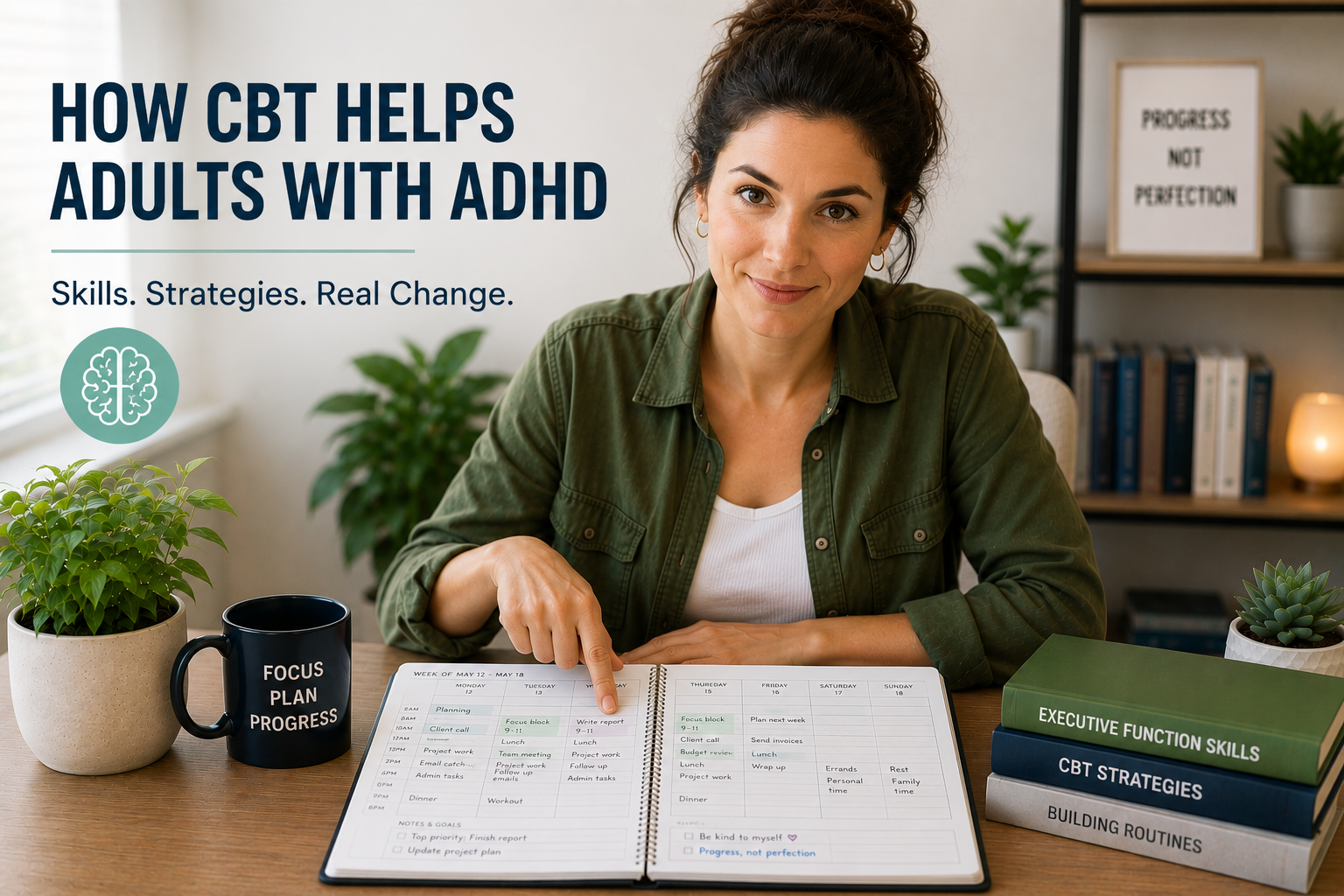
Unlike traditional talk therapy, CBT for adult ADHD focuses less on analyzing the past and more on building practical skills for the future. Rather than asking you to simply try harder or become more disciplined, CBT helps you understand how ADHD affects executive functioning and teaches realistic strategies for managing the challenges you face every day.
For many adults, that shift is life-changing.
Not because ADHD disappears.
But because life gradually becomes less exhausting.
Over the past two decades, CBT has become one of the most thoroughly studied psychological treatments for adults with ADHD. Multiple systematic reviews and meta-analyses have shown that CBT improves core ADHD symptoms while also helping many adults strengthen executive functioning, reduce anxiety and depression, improve emotional regulation, and function more effectively at work and at home (Liu et al., 2026; López-Pinar et al., 2026).
Perhaps most encouraging, these improvements often continue long after formal therapy has ended.
That’s because CBT isn’t simply about feeling better during a therapy session.
It’s about learning skills that become part of the way you live.
Whether you’ve recently been diagnosed or you’re looking for additional strategies beyond medication, understanding how CBT works can help you decide whether it’s the right next step in your ADHD treatment.
Table of Contents
ToggleKey Takeaways
- Cognitive behavioral therapy (CBT) is one of the most effective evidence-based psychological treatments for adults with ADHD.
- CBT focuses on practical skills such as organization, planning, time management, emotional regulation, and reducing procrastination.
- Research consistently shows CBT improves not only ADHD symptoms but also executive functioning and overall daily functioning (Liu et al., 2026; López-Pinar et al., 2026).
- Many adults experience the greatest benefit when CBT is combined with appropriate ADHD medication, although CBT can also be effective on its own.
- Most structured CBT programs are completed over approximately 8–12 sessions, with skills that continue providing benefits long after therapy ends.
What Is Cognitive Behavioral Therapy (CBT) for Adult ADHD?
When many people hear the word therapy, they imagine spending months talking about childhood experiences while a therapist quietly listens.
CBT for ADHD is quite different.
Although your personal history matters, the primary focus of CBT is helping you function more effectively today.
Think of it as learning a new operating system for your daily life.
Adults with ADHD often know exactly what they should be doing.
Use a planner.
Start projects earlier.
Answer emails promptly.
Stop procrastinating.
Get more sleep.
The challenge isn’t usually a lack of knowledge.
It’s consistently putting those ideas into practice.
This is one of the defining features of ADHD.
Knowing what to do and being able to do it are not always the same thing.
CBT helps bridge that gap.
Rather than relying on motivation or willpower, you’ll learn practical systems that make important tasks easier to start, easier to organize, and easier to complete.
Sessions are collaborative and goal-oriented.
Together, you and your therapist identify the situations creating the greatest difficulties in your life—whether that’s chronic procrastination, missed deadlines, emotional overwhelm, disorganization, or difficulty managing competing responsibilities.
From there, treatment focuses on building practical skills that address those specific challenges.
Importantly, CBT isn’t designed to “cure” ADHD.
ADHD is a neurodevelopmental condition, not a habit that can simply be talked away.
Instead, CBT helps reduce the impact ADHD has on your everyday life by strengthening the skills that many adults were never explicitly taught or had difficulty developing because of ADHD.
For many people, that distinction is incredibly empowering.
The goal isn’t to become someone different.
The goal is to spend less energy fighting your brain and more energy building systems that allow you to succeed.
Does CBT Really Work?
If you’re considering therapy, it’s reasonable to ask one simple question:
Does it actually work?
The encouraging answer is yes.
CBT is one of the best-studied psychological treatments available for adults with ADHD.
Researchers have now conducted dozens of randomized controlled trials examining whether CBT improves ADHD symptoms and daily functioning. More importantly, those individual studies have been combined into large systematic reviews and meta-analyses, allowing researchers to evaluate results across thousands of adults rather than relying on any single study.
The findings have been remarkably consistent.
Research shows that CBT helps many adults improve organization, planning, emotional regulation, executive functioning, and overall quality of life while also reducing core ADHD symptoms, depression, anxiety, and stress (Liu et al., 2026; Liu et al., 2023).
Why does that matter?
Because most adults don’t seek treatment simply to improve a score on an ADHD symptom checklist.
They seek treatment because they’re tired of feeling overwhelmed by paperwork, forgetting important commitments, struggling to manage their time, or wondering why everyday responsibilities require so much effort.
Those are exactly the kinds of challenges CBT is designed to address.
One of the most interesting findings from recent research is that CBT appears to improve more than symptoms alone.
A comprehensive 2026 meta-analysis involving more than 5,000 participants found meaningful improvements in overall functioning—particularly at work—and those improvements often continued after treatment had ended (López-Pinar et al., 2026).
That finding reflects something many clinicians observe in practice.
Medication can improve attention while it’s active.
CBT teaches skills that continue working long after the therapy sessions are over.
Learning how to organize your schedule, manage competing priorities, recognize patterns of procrastination, or respond differently to self-critical thoughts doesn’t disappear when therapy ends.
Those skills become tools you can continue refining throughout your life.
That may be one of CBT’s greatest strengths.
How CBT Helps Adults Build Everyday Skills
One of the biggest misconceptions about CBT is that it’s simply about changing the way you think.
While learning to recognize unhelpful thought patterns is certainly part of treatment, CBT for adult ADHD is much more practical than many people expect.
Think of it as learning a set of skills that make everyday life less difficult.
The goal isn’t perfection.
The goal is to spend less time struggling against ADHD and more time building systems that allow you to do your best work, manage your responsibilities, and enjoy your life.
Although every therapist has their own approach, most evidence-based CBT programs teach a similar set of core skills.
"I Know Exactly What I Need to Do...So Why Can't I Get Started?"
If there’s one frustration nearly every adult with ADHD recognizes, it’s this one.
You know the task needs to be done.
You understand why it’s important.
You may even think about it repeatedly throughout the day.
Yet somehow, getting started feels almost impossible.
Many adults assume this means they’re lazy or unmotivated.
In reality, difficulty initiating tasks is one of the most common executive functioning challenges associated with ADHD.
Large or poorly defined projects can quickly become mentally overwhelming. The brain struggles to decide where to begin, making avoidance feel easier than action.
CBT approaches this problem differently.
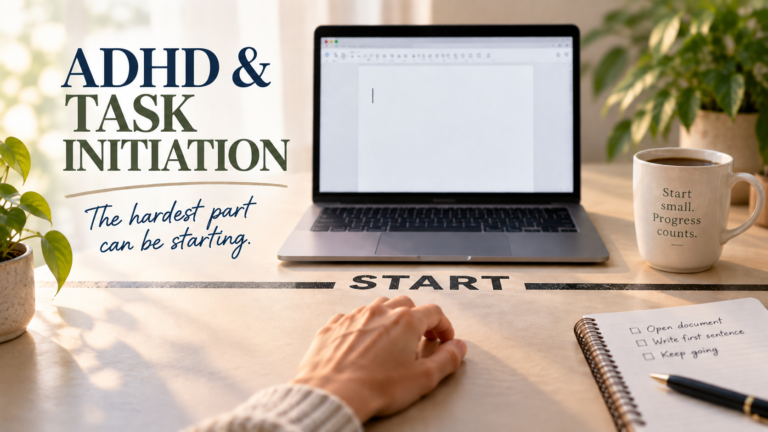
Instead of telling yourself to “just get started,” you’ll learn how to reduce the mental friction that prevents you from beginning in the first place.
For example, rather than writing “Finish quarterly report” on your to-do list, you might break it into much smaller, concrete actions:
- Open the report template.
- Review last month’s report.
- Write the first paragraph.
- Gather sales data.
Those steps may seem almost too small.
But that’s the point.
A task that feels manageable is much easier for the ADHD brain to begin than one that feels vague or overwhelming.
Over time, these techniques help replace cycles of procrastination with consistent forward progress.
"Where Does All My Time Go?"
Many adults with ADHD don’t have poor intentions.
They have difficulty seeing time accurately.
Psychologists often refer to this as time blindness—a reduced ability to estimate how long tasks will take or recognize the passage of time while working.
That’s why a quick email suddenly becomes thirty minutes.
A five-minute stop at the grocery store turns into an hour.
Or an afternoon project somehow extends late into the evening.
CBT teaches ways to make time more visible.
Rather than relying on your internal sense of time, you’ll learn to use external systems that compensate for ADHD.
These may include:
- calendars,
- timers,
- reminders,
- structured daily routines,
- scheduled work intervals,
- and realistic estimates for completing tasks.
Notice the emphasis.
The goal isn’t to force your brain to work differently.
It’s to create an environment that supports the way your brain already works.
Many adults find this perspective surprisingly freeing.
Instead of blaming themselves for poor time management, they begin building systems that reduce the need to depend on memory or willpower alone.
"Why Does Everything Feel So Disorganized?"
One of the hidden challenges of ADHD is that every task can feel equally important.
Answering an email.
Paying a bill.
Returning a phone call.
Starting a major work project.
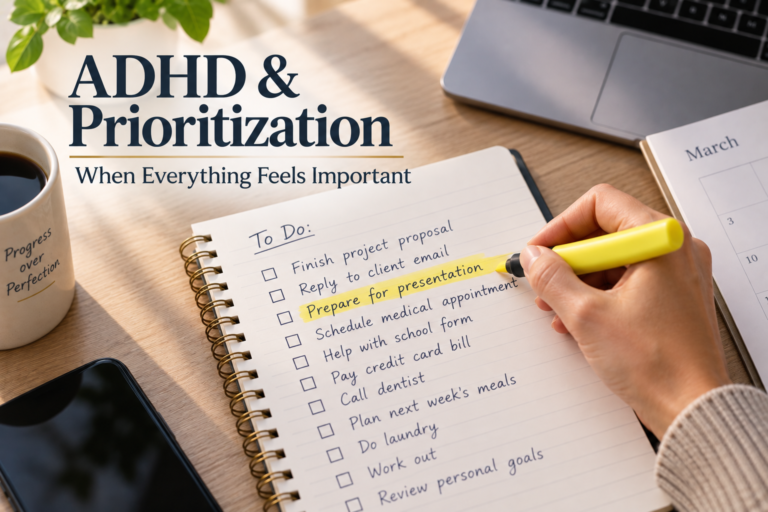
Without an organizational system, your attention naturally shifts toward whatever feels most urgent in the moment rather than what is most important.
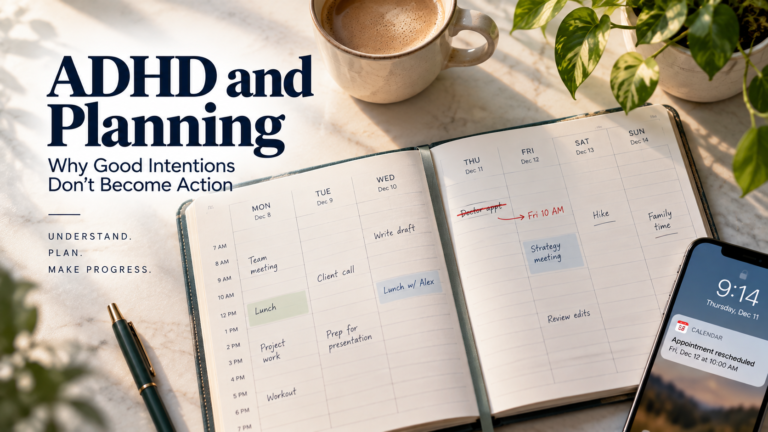
CBT helps you develop routines for planning your day before the day begins.
You might learn how to prioritize tasks, schedule focused work periods, create realistic daily goals, and review your progress at regular intervals.
The objective isn’t to become perfectly organized.
Very few people are.
Instead, it’s to create a reliable system that continues working even during stressful weeks.
Consistency matters far more than perfection.
"Why Do Small Problems Feel So Big?"
Many adults think of ADHD as a disorder of attention.
In reality, emotional regulation is often just as important.
You may notice that frustration builds quickly.
Small setbacks feel disproportionately discouraging.
Constructive criticism lingers for days.
An unexpected change in plans throws off your entire afternoon.
These reactions aren’t a sign of weakness.
They’re part of how ADHD can affect the brain’s ability to regulate emotions.
CBT helps you become more aware of these patterns before they begin controlling your behavior.
You’ll learn how to recognize emotional triggers, pause before reacting impulsively, and develop healthier ways of responding to stressful situations.
For many adults, improving emotional regulation changes far more than productivity.
It improves relationships.
It reduces conflict.
It makes everyday life feel calmer and more predictable.
"Why Am I So Hard on Myself?"
Years of untreated ADHD often leave behind something that’s much harder to recognize than missed deadlines or forgotten appointments.
They change the way people think about themselves.
Many adults arrive in therapy carrying beliefs such as:
“I’m lazy.”
“I’m unreliable.”
“I’ll never get my life together.”
“Everyone else seems to have this figured out except me.”
These thoughts rarely appear overnight.
They’re often built from years of misunderstood symptoms, repeated criticism, and comparing yourself to people whose brains work differently.
CBT doesn’t ask you to replace negative thoughts with unrealistic positive thinking.
Instead, it teaches you to examine whether those thoughts are actually accurate.
Is forgetting an appointment evidence that you’re irresponsible?
Or is it evidence that your current reminder system isn’t working?
That’s a very different question.
Learning to challenge inaccurate self-criticism often reduces shame while making it easier to build healthier habits.
After all, it’s difficult to believe you’re capable of change if every mistake reinforces the belief that you’re destined to fail.
One of the greatest gifts CBT offers isn’t simply better organization or improved time management.
For many adults, it’s the realization that ADHD has influenced how they’ve viewed themselves for years—and that those beliefs can change just as much as their daily habits.
What to Expect If You Start CBT
Beginning therapy can feel intimidating, especially if you’ve never worked with a therapist before.
Many adults worry they’ll spend months talking about childhood experiences without learning practical strategies they can actually use.
CBT for adult ADHD is typically much more structured than that.
While every therapist has their own style, most evidence-based CBT programs follow a similar approach. Sessions are collaborative, goal-oriented, and focused on helping you solve the real-world problems that interfere with your daily life.
During your first few sessions, you’ll work with your therapist to identify the challenges that have the greatest impact on your life. For one person, that may be chronic procrastination at work. For another, it may be emotional overwhelm, difficulty managing finances, or feeling constantly disorganized at home.
Together, you’ll identify patterns, explore what’s maintaining those difficulties, and begin developing practical strategies to address them.
As therapy progresses, you’ll gradually practice those strategies between sessions.
This is one of the defining features of CBT.
Learning happens in the therapy office.
Change happens in everyday life.
You may experiment with a new planning system, practice breaking large projects into smaller steps, or begin using external reminders more consistently. During your next session, you’ll discuss what worked, what didn’t, and how to adjust your approach moving forward.
The goal isn’t to complete homework perfectly.
The goal is to discover what works for you.
Most structured CBT programs for adult ADHD are completed over approximately 8 to 12 weekly sessions, although the exact length varies depending on your goals and whether you’re receiving additional treatments such as medication. Research also suggests that shorter programs may still provide meaningful benefits for many adults (Corrales et al., 2023).
By the end of treatment, most people haven’t “graduated” from ADHD.
They’ve developed a toolkit.
And that’s an important difference.
Who Benefits Most from CBT?
CBT isn’t the right treatment for every adult with ADHD.
But for many people, it addresses challenges that medication alone cannot.
The adults who often benefit most from CBT share one important characteristic.
They’re looking for practical tools—not quick fixes.
Adults Diagnosed Later in Life
Many adults spend years wondering why life seems more difficult for them than it does for everyone else.
Receiving a diagnosis often brings relief, but it can also raise difficult questions.
How different might my life have been if someone had recognized this sooner?
CBT helps shift the focus from what might have been toward what can be built moving forward.
Learning practical skills is important.
Equally important is learning to separate ADHD symptoms from years of unnecessary self-criticism.
Adults Who Feel Successful—but Constantly Overwhelmed
Some of the adults who benefit most from CBT don’t appear to be struggling at all.
They’ve built successful careers.
Raised families.
Earned graduate degrees.
Started businesses.
From the outside, everything looks fine.
Inside, however, they’re relying on enormous effort just to keep everything from falling apart.
If you’ve ever felt like you’re succeeding despite constantly running out of mental energy, CBT may help replace crisis management with systems that reduce that daily burden.
Adults Taking Medication Who Still Feel Stuck
Many people assume medication should solve every ADHD-related difficulty.
When it doesn’t, they wonder whether treatment has failed.
Often, it hasn’t.
Medication may improve attention and reduce impulsivity.
It doesn’t automatically teach planning, organization, emotional regulation, or project management.
That’s where CBT often complements medication exceptionally well.
Rather than competing with medication, CBT helps you make better use of the improvements medication provides.
Medication, CBT, or Both?
One of the most common questions adults ask after receiving an ADHD diagnosis is whether they should choose medication or therapy.
The answer depends on your symptoms, your goals, your medical history, and your personal preferences.
Medication remains one of the most effective treatments for reducing the core symptoms of ADHD.
CBT remains one of the most effective treatments for building the practical skills needed to manage ADHD in everyday life.
Those are different goals.
Research suggests many adults experience the greatest overall improvement when these treatments are combined (Liu et al., 2026).
Medication may make it easier to focus.
CBT helps you decide what to do with that improved focus.
Rather than thinking of medication and therapy as competing options, it may be more helpful to think of them as complementary parts of a comprehensive treatment plan.
If you’d like to explore this topic in greater detail, read our companion guide:
Medication vs. Therapy for Adult ADHD: Which Treatment Works Best?
Frequently Asked Questions
Can CBT help ADHD without medication?
Yes. Research suggests CBT can improve executive functioning, organization, emotional regulation, and ADHD symptoms even without medication. However, some adults find that combining CBT with medication provides greater overall improvement, particularly when symptoms are moderate to severe.
How long does CBT take to work?
Many adults begin noticing small improvements within the first few weeks as they start applying new skills. Most structured CBT programs are completed over approximately 8–12 sessions, although meaningful progress depends on consistent practice between appointments.
Is CBT only helpful after a new ADHD diagnosis?
No. Adults who were diagnosed years ago often benefit from CBT, especially if they continue struggling with procrastination, disorganization, emotional regulation, or maintaining routines despite previous treatment.
Can CBT help with procrastination?
Yes. One of CBT’s primary goals is reducing the executive functioning barriers that make starting and completing tasks so difficult. Rather than relying on motivation, CBT teaches strategies that make action easier and more consistent.
Is online CBT effective?
Research suggests that CBT delivered through telehealth can be effective for many adults with ADHD, particularly when sessions remain structured and interactive. For many busy professionals, virtual therapy also makes treatment more accessible and easier to incorporate into their schedules.
Conclusion
Living with ADHD doesn’t mean you’ll always struggle with procrastination, disorganization, missed deadlines, or feeling overwhelmed by everyday responsibilities.
While there isn’t a single treatment that works for everyone, cognitive behavioral therapy offers something many adults have been missing for years: a practical framework for building skills that make everyday life more manageable.
That distinction matters.
Most adults with ADHD already know they should use a calendar, start projects earlier, or stay more organized. The challenge isn’t simply knowing what to do.
It’s consistently putting those strategies into practice.
CBT helps bridge that gap.
By strengthening executive functioning skills, challenging unhelpful patterns of thinking, and building practical routines, CBT helps many adults spend less energy fighting their ADHD and more energy pursuing the things that matter most to them.
Progress rarely happens overnight.
More often, it happens one small change at a time.
A planner that finally becomes part of your daily routine.
A work project started before the last minute.
A difficult conversation handled more calmly.
A growing confidence that you can rely on yourself.
Those changes may seem small individually.
Together, they can fundamentally change how life feels.
Perhaps the most important lesson is this:
ADHD does not define your potential.
It simply changes the strategies that help you reach it.
Whether you’re newly diagnosed or you’ve lived with ADHD for years, learning evidence-based skills can help you move beyond simply coping with ADHD toward building a life that feels more organized, intentional, and sustainable.
If you’re considering treatment, a comprehensive ADHD evaluation can help determine whether CBT, medication, lifestyle changes, or a combination of approaches is most appropriate for your individual needs.
The goal isn’t to find the “perfect” treatment.
The goal is to find the treatment plan that helps you live the life you want.
Continue Learning About Adult ADHD
If you found this article helpful, you may also be interested in:
- Medication vs. Therapy for Adult ADHD: Which Treatment Works Best?
- Adult ADHD Diagnosis in California: What to Expect
- ADHD in High-Achieving Women: Why So Many Women Are Diagnosed Later in Life
- Executive Function Coaching for Adults with ADHD
- Can CBT Help Adults with ADHD Stop Procrastinating?
- What to Expect During CBT for Adult ADHD
References
Corrales, M., García-González, S., Richarte, V., et al. (2023). Long-term efficacy of a new 6-session cognitive behavioral therapy for adults with attention-deficit/hyperactivity disorder: A randomized, controlled clinical trial. Psychiatry Research, 331, 115642. https://doi.org/10.1016/j.psychres.2023.115642
Dittner, A. J., Hodsoll, J., Rimes, K. A., Russell, A. J., & Chalder, T. (2018). Cognitive–behavioural therapy for adult attention-deficit hyperactivity disorder: A proof of concept randomised controlled trial. Acta Psychiatrica Scandinavica, 137(2), 125–137. https://doi.org/10.1111/acps.12836
Liu, C. I., Hua, M. H., Lu, M. L., & Goh, K. K. (2023). Effectiveness of cognitive behavioural-based interventions for adults with attention-deficit/hyperactivity disorder extends beyond core symptoms: A meta-analysis of randomized controlled trials. Psychology and Psychotherapy, 96(3), 543–559. https://doi.org/10.1111/papt.12455
Liu, Y., Zhu, F., Yu, Y., et al. (2026). A meta-analysis of the intervention effect of cognitive behavioral therapy on adult ADHD. Journal of Affective Disorders, 121107. https://doi.org/10.1016/j.jad.2025.121107
López-Pinar, C., Selaskowski, B., Schulze, M., et al. (2026). Cognitive behavioral therapy effects on global functioning, domain-specific functioning, and quality of life in adult ADHD: A comprehensive meta-analysis. Behaviour Research and Therapy, 201, 105026. https://doi.org/10.1016/j.brat.2026.105026
Lopez, P. L., Torrente, F. M., Ciapponi, A., et al. (2018). Cognitive-behavioural interventions for attention deficit hyperactivity disorder (ADHD) in adults. Cochrane Database of Systematic Reviews, 3, CD010840. https://doi.org/10.1002/14651858.CD010840.pub2