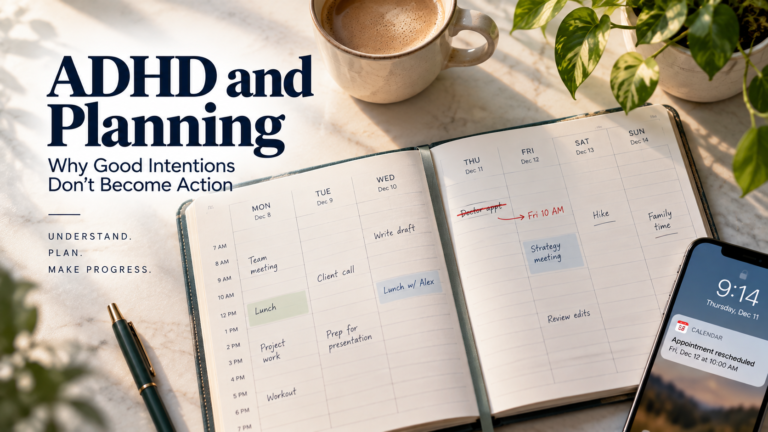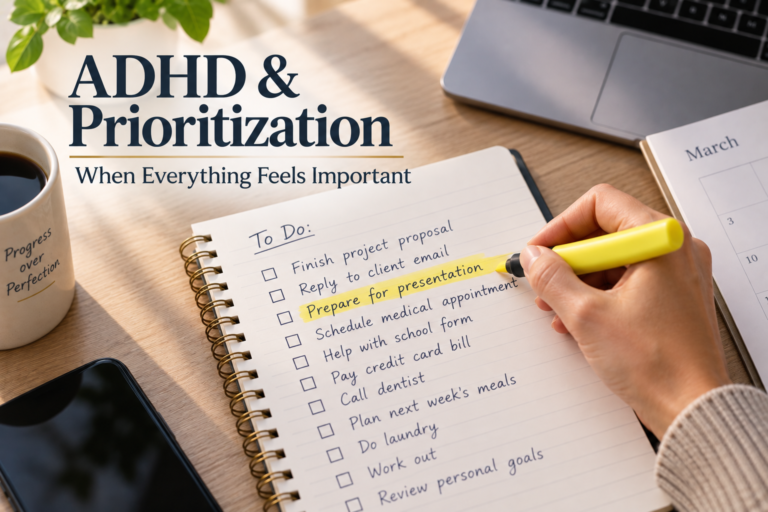


Table of Contents
ToggleAdult ADHD Care in Los Angeles, Orange County, and Throughout California via Telehealth
Maybe you have suspected ADHD for years.
You can focus intensely when something is interesting or urgent, yet struggle to begin tasks that seem simple. You may procrastinate until a deadline becomes unavoidable, lose track of appointments, underestimate how long things will take, or feel as though staying organized requires far more effort than it should.
Perhaps you have built a successful career, completed graduate school, raised a family, or developed elaborate systems that help keep everything together.
And yet you keep wondering:
“Could this actually be ADHD?”
If you are looking for adult ADHD evaluation and treatment in Southern California, the goal should not simply be to find someone who can give you an ADHD test.
A thoughtful evaluation should determine whether your difficulties are actually consistent with ADHD, consider other possible explanations, and help identify what treatment or support may be appropriate.
Peace & Prosperity Psychiatry provides adult ADHD evaluation and treatment for adults in Southern California, with telehealth appointments available throughout California.
When Should an Adult Consider an ADHD Evaluation?
There is no single experience that means someone has ADHD.
Adults seek evaluations for many different reasons.
You may have difficulty:
- Starting tasks even when you know they are important
- Maintaining attention during routine or repetitive work
- Organizing projects with multiple steps
- Remembering appointments, deadlines, or responsibilities
- Estimating how long tasks will take
- Completing projects after the interesting part is over
- Keeping track of paperwork, emails, bills, or belongings
- Managing competing responsibilities without becoming overwhelmed
- Controlling impulsive decisions or interruptions
- Feeling internally restless or constantly “on the go”
For some adults, these difficulties have been obvious since childhood.
For others, the pattern becomes much more noticeable when life becomes more complicated.
College, graduate school, a demanding career, marriage, parenthood, leadership responsibilities, or the loss of external structure can expose difficulties that were previously manageable.
That does not necessarily mean ADHD suddenly developed in adulthood. ADHD is a neurodevelopmental disorder, and diagnosis involves looking for evidence of symptoms beginning during childhood—even when those symptoms were not recognized as ADHD at the time. (CDC)
Success Does Not Rule Out ADHD
One reason some adults delay seeking an evaluation is that their life does not fit their idea of what ADHD is supposed to look like.
They may think:
“I have a career. I finished college. I manage a business. How could I have ADHD?”
Professional or academic success does not automatically exclude ADHD.
Some adults develop compensatory strategies that allow them to perform extremely well, particularly in environments that provide structure, urgency, intellectual stimulation, or accountability. CHADD notes that some bright and talented adults may compensate for ADHD symptoms until the demands of higher education, careers, or independent adult life make those difficulties harder to manage. (ChADD)
But there is an equally important point:
Being busy, stressed, distracted, or overwhelmed does not automatically mean you have ADHD.
High-achieving adults without ADHD procrastinate. Executives become overwhelmed. Parents become exhausted. Entrepreneurs become distracted. Professionals experience burnout.
The purpose of an evaluation is to determine whether there is a longstanding pattern consistent with ADHD and whether that pattern meaningfully affects your functioning.
High-Functioning ADHD in Adults: Why Success Doesn’t Rule Out ADHD
What Happens During an Adult ADHD Evaluation?
There is no single blood test, brain scan, computer test, or questionnaire that can independently diagnose ADHD.
A comprehensive adult evaluation brings together several types of information. Current CDC and CHADD resources describe assessment as including symptom ratings, developmental and behavioral history, functional impairment, and consideration of other conditions that could explain or contribute to the symptoms. (CDC)
Depending on the individual and clinician, an evaluation may include:
A Detailed Clinical Interview
Your provider will want to understand what you are experiencing now.
That includes more than asking whether you are distracted.
The conversation may explore attention, organization, procrastination, impulsivity, restlessness, time management, task completion, emotional functioning, work performance, relationships, and everyday responsibilities.
Developmental and Childhood History
ADHD begins during childhood, even when it is not diagnosed until adulthood.
Your clinician may ask what you were like in elementary school, middle school, and high school.
Old report cards, teacher comments, previous evaluations, or information from someone who knew you as a child can sometimes be helpful when available.
Not everyone has access to those records decades later. The evaluation should put the available information into context rather than depend on one document.
ADHD Rating Scales
Standardized questionnaires can help measure ADHD symptoms and patterns of functioning.
They are useful tools.
They are not diagnoses by themselves.
CHADD specifically cautions that rating scales and symptom checklists should be interpreted as part of a broader evaluation rather than used alone to diagnose ADHD. (ChADD)
Functional Impairment
Having ADHD-like traits is not the same as meeting diagnostic criteria for ADHD.
The clinician also considers whether symptoms meaningfully interfere with functioning across important areas of life.
That could include work, education, relationships, finances, household responsibilities, organization, or other daily activities. (ChADD)
For a much deeper explanation of the evaluation itself, see:
An ADHD Evaluation Is More Than an Online Test
It is easy to find an ADHD quiz online.
Some screening tools can be useful for identifying symptoms that deserve further evaluation.
But a positive screening result does not establish an ADHD diagnosis.
Difficulty concentrating, procrastination, forgetfulness, poor sleep, low motivation, and feeling overwhelmed can occur for many reasons.
That is why a professional evaluation goes beyond asking:
“Do you have ADHD symptoms?”
The more useful question is:
“What best explains these symptoms and the difficulties you are experiencing?”
What Else Can Look Like ADHD?
This is one of the most important parts of an adult ADHD evaluation.
Attention and executive-function difficulties are not unique to ADHD.
Depending on the individual, a clinician may need to consider factors such as:
- Anxiety
- Depression
- Sleep problems
- Trauma-related symptoms
- Substance use
- Learning disorders
- Other psychiatric conditions
- Certain medical conditions or medications
ADHD can also coexist with other conditions.
The question therefore is not always simply “ADHD or something else?” Sometimes more than one condition is contributing.
CDC and CHADD both emphasize evaluating other conditions that can mimic or coexist with ADHD rather than diagnosing ADHD from symptoms alone. (CDC)
ADHD vs Anxiety: How to Tell the Difference (And Why It Matters)
What Happens If You Are Diagnosed With ADHD?
Diagnosis should not be the end of the process.
It should help answer a more useful question:
What do we do with this information?
A good treatment plan considers which difficulties are having the greatest impact on your life, whether other conditions are present, your medical and psychiatric history, previous treatment experiences, your preferences, and your goals.
Treatment is individualized.
What helps one adult may not be appropriate for another.
Adult ADHD Treatment Options
Treatment for adult ADHD can involve several approaches.
CDC describes adult ADHD treatment as potentially including medication, therapy and other behavioral approaches, often in combination, with ongoing monitoring and adjustments when needed. (CDC)
Medication
Medication can be an effective component of ADHD treatment for some adults.
Depending on the individual, treatment may involve stimulant or non-stimulant medications.
Medication decisions should be made after an appropriate clinical evaluation and consideration of medical history, psychiatric history, potential benefits, risks, side effects, and other medications or conditions.
Medication is not automatically appropriate for every person who has difficulty concentrating, nor should receiving an ADHD diagnosis be viewed simply as a pathway to obtaining a prescription.
Behavioral and Organizational Strategies
Medication does not create a calendar, prioritize your projects, answer your email, or develop routines for you.
Many adults benefit from learning practical strategies for:
- Breaking large projects into manageable steps
- Creating external reminders
- Reducing reliance on working memory
- Managing time more realistically
- Prioritizing competing responsibilities
- Building repeatable routines
- Reducing environmental distractions
These strategies can be particularly valuable when they are designed around the individual’s actual patterns rather than generic productivity advice.
Psychotherapy and Treatment of Coexisting Conditions
Some adults with ADHD also experience anxiety, depression, relationship difficulties, chronic stress, or other concerns.
When another condition is present, treatment planning should account for the whole clinical picture rather than assuming every difficulty is caused by ADHD.
Lifestyle and Environmental Support
Sleep, exercise, routines, workload, environmental structure, and other aspects of daily life can influence how manageable ADHD symptoms feel.
These factors are not substitutes for appropriate clinical treatment, but they can be important parts of a broader plan.
ADHD Treatment for High-Achieving Adults
Treatment goals can look different for an adult whose life appears highly successful from the outside.
The goal may not be to “fix” a failing career.
It might be reducing the extraordinary amount of effort required to maintain that career.
It could mean being able to complete administrative work without waiting for panic to create enough urgency.
It might mean being more present at home instead of spending the evening recovering from the effort required to function professionally.
Or it may mean developing systems that are sustainable rather than depending on overwork, perfectionism, anxiety, or last-minute pressure.
For a deeper discussion of this pattern:
High-Functioning ADHD in Adults: Why Success Doesn’t Rule Out ADHD
Adult ADHD in Women
ADHD can also be overlooked in women, particularly when difficulties are primarily inattentive or when effective compensation makes those difficulties less visible to other people.
A woman may appear organized while privately relying on extensive reminders and systems to prevent things from falling apart.
She may be successful professionally but chronically overwhelmed by ordinary administrative tasks.
Or she may have previously sought treatment for anxiety, depression, or stress without ever considering whether ADHD could also be contributing.
These experiences are not proof of ADHD.
They are reasons a careful developmental and clinical history matters.
ADHD in High-Achieving Women: Why It’s Often Missed Until Adulthood
Online ADHD Evaluation and Treatment in California
For many adults, accessing ADHD care no longer necessarily requires driving across Los Angeles for every appointment.
Telehealth can make evaluation and follow-up care more accessible, particularly for busy professionals, parents, and adults who live farther from a clinician with experience treating adult ADHD.
Peace & Prosperity Psychiatry offers telehealth appointments for adults throughout California.
Depending on clinical circumstances and the type of care required, your provider can determine what aspects of evaluation and treatment are appropriate through telehealth and whether any additional in-person medical assessment or coordination of care is needed.
Choosing an Adult ADHD Provider in Southern California
The letters after a clinician’s name are not the only consideration.
Experience with adult ADHD matters.
CHADD recommends asking prospective clinicians about their training and experience evaluating adults with ADHD. (ChADD)
When considering a provider, useful questions include:
- Does the clinician regularly evaluate ADHD in adults?
- Is the evaluation more comprehensive than a brief symptom checklist?
- Does the clinician assess developmental history and functional impairment?
- Are other possible explanations for the symptoms considered?
- If ADHD is diagnosed, can the clinician also provide treatment or coordinate appropriate treatment?
- How are follow-up appointments and treatment monitoring handled?
- Is telehealth available if that is important to you?
You are not simply looking for someone willing to say yes to ADHD.
You are looking for someone willing to determine whether ADHD is actually the best explanation.
ADHD Evaluation and Treatment at Peace & Prosperity Psychiatry
Peace & Prosperity Psychiatry provides adult ADHD evaluation and treatment for adults in Southern California and through telehealth across California.
Our approach is designed to answer three fundamental questions:
- Is ADHD actually present?
- Could something else—or more than one condition—be contributing to the difficulties you’re experiencing?
- If ADHD is diagnosed, what treatment approach makes sense for you?
The goal is not to rush toward a diagnosis.
It is to reach a clinically thoughtful understanding of what is happening and determine appropriate next steps.
If you would first like to understand the California diagnosis process in greater detail, see:
How to Get an ADHD Diagnosis in California: 7 Steps for Adults
Taking the Next Step
If you have been wondering whether ADHD could be contributing to difficulties with focus, organization, procrastination, time management, or follow-through, you do not need to diagnose yourself.
A comprehensive evaluation can help determine whether your experiences are consistent with ADHD, whether something else may be contributing, and what treatment options may be appropriate.
Peace & Prosperity Psychiatry offers adult ADHD evaluation and treatment in Southern California, with telehealth appointments available throughout California.
Ready to Find Clarity?
Start with our complimentary 15-minute Right Fit Consultation to learn more about the evaluation process and determine whether our practice may be a good fit for your needs.
Learn About the Right Fit Consultation
The next step is simply determining whether an evaluation—and Peace & Prosperity Psychiatry—may be the right fit for you.
Frequently Asked Questions About Adult ADHD Evaluation and Treatment in Southern California
Can adults be diagnosed with ADHD later in life?
Yes. Many people are not diagnosed with ADHD until adulthood. However, ADHD is a neurodevelopmental condition, so an adult evaluation looks for evidence that symptoms were present during childhood, even if ADHD was not recognized or diagnosed at the time.
Can an adult ADHD evaluation be completed online in California?
In many cases, adult ADHD evaluations can be conducted through telehealth. Peace & Prosperity Psychiatry offers telehealth appointments for adults throughout California. Whether additional assessment, records, medical evaluation, or coordination of care is needed depends on the individual clinical situation.
Is an online ADHD test enough to diagnose ADHD?
No. Screening questionnaires can help identify symptoms that may warrant further evaluation, but they cannot establish an ADHD diagnosis by themselves. A comprehensive evaluation considers symptoms, developmental history, functional impairment, and other possible explanations for the difficulties you are experiencing.
[Internal link: Adult ADHD Test: 6-Question Self-Screening Tool]
What happens if I am diagnosed with ADHD?
If ADHD is diagnosed, the next step is developing an individualized treatment plan. Depending on your needs, treatment may include medication when clinically appropriate, behavioral and organizational strategies, psychotherapy or treatment of coexisting conditions, and changes to routines or environmental supports.
Do I need to be struggling at work to have adult ADHD?
No. ADHD can affect different areas of life, and professional success does not necessarily rule it out. Some adults perform very well at work while experiencing significant difficulties with organization, time management, procrastination, relationships, household responsibilities, or the amount of effort required to maintain their performance.
High-Functioning ADHD in Adults: Why Success Doesn’t Rule Out ADHD
References & Trusted ADHD Resources
Centers for Disease Control and Prevention. (2026). ADHD in adults. Centers for Disease Control and Prevention. (CDC)
Children and Adults with Attention-Deficit/Hyperactivity Disorder (CHADD). Diagnosis of ADHD in adults. National Resource Center on ADHD. (ChADD)
Children and Adults with Attention-Deficit/Hyperactivity Disorder (CHADD). Diagnosing ADHD. National Resource Center on ADHD. (ChADD)
For additional patient education: