


Table of Contents
ToggleHow to Get an ADHD Diagnosis in California: 7 Steps for Adults
What to expect from an adult ADHD evaluation—and how to get evaluated in person or online throughout California
“Do I have ADHD?” is often the first question.
Maybe you have difficulty staying focused even when the work matters. You procrastinate on important tasks despite knowing the consequences. You lose track of time, underestimate how long things will take, struggle to get started, or find yourself relying on urgency and last-minute pressure to get things finished.
Perhaps you have been successful despite these difficulties.
You may have completed college or graduate school, built a career, managed a business, raised a family, or developed elaborate systems that kept everything functioning. But as your responsibilities have increased, those systems may not work as well as they once did.
At some point, wondering whether you have ADHD leads to a more practical question:
How do I actually get an ADHD diagnosis?
For an adult in California, getting diagnosed with ADHD generally means finding a qualified clinician and completing a clinical evaluation. Depending on the clinician and your circumstances, that evaluation may take place in person or online through telehealth.
Recognizing possible ADHD symptoms and receiving an accurate ADHD diagnosis are two different things. There is no single blood test, brain scan, questionnaire, or online ADHD test that can determine by itself whether you have the condition.
A comprehensive adult ADHD evaluation looks at your symptoms, developmental history, functioning, psychiatric and medical history, and other possible explanations for what you are experiencing.
If you have been asking yourself, “Do I have ADHD?”, here is how to move from wondering about ADHD to obtaining a professional evaluation and, when appropriate, a diagnosis.
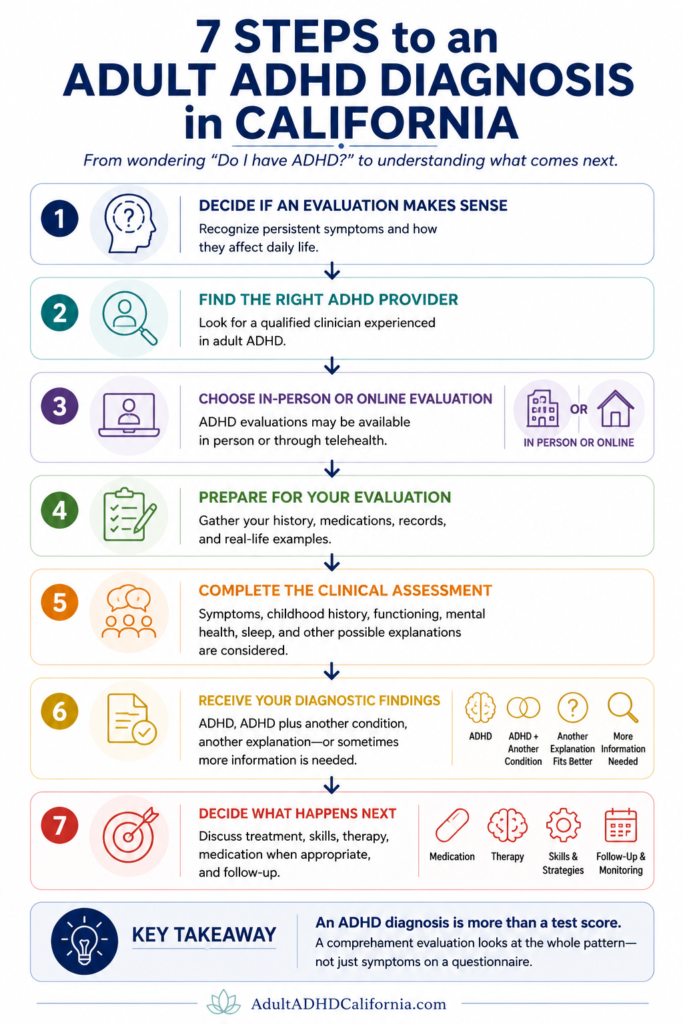
Step 1: Decide Whether an ADHD Evaluation Makes Sense
Occasionally procrastinating, forgetting an appointment, becoming distracted during a boring meeting, or struggling to concentrate after a bad night’s sleep does not necessarily mean you have ADHD.
Almost everyone experiences some ADHD-like behaviors at times.
The more important question is whether there is a persistent pattern of difficulties with attention, organization, impulsivity, restlessness, time management, task initiation, or follow-through that meaningfully interferes with everyday functioning.
For adults, these difficulties may appear in ways such as:
- repeatedly procrastinating despite serious consequences
- struggling to start tasks that feel tedious, complicated, or overwhelming
- beginning projects but having difficulty finishing them
- missing deadlines or chronically underestimating how long things will take
- frequently losing track of appointments, obligations, or important items
- needing intense deadline pressure before being able to focus
- becoming easily distracted during sustained mental work
- having difficulty organizing competing responsibilities
- making impulsive decisions or interrupting others
- feeling internally restless even if you are not outwardly hyperactive
What matters is not simply whether you recognize a few symptoms on a list.
A clinician will want to understand how persistent the pattern has been, when it began, where it occurs, and how much it affects your functioning.
If you are still at the stage of asking whether your experiences resemble ADHD, our Do I Have ADHD? article explores adult ADHD symptoms and patterns in greater detail.
What if you have been successful?
This is where ADHD can become particularly confusing for high-achieving adults.
A successful career or strong academic history does not automatically rule out ADHD.
Some adults develop compensatory systems that allow them to function well for years. They may rely heavily on calendars, reminders, rigid routines, working unusually long hours, perfectionism, deadline pressure, support from other people, or environments that happen to fit the way they work.
Problems may become more apparent when life’s demands exceed those systems.
A promotion brings more meetings, decisions, interruptions, and less external structure. Parenthood eliminates the quiet time previously used to catch up. Running a business requires simultaneously managing employees, finances, clients, deadlines, and administrative responsibilities.
A physician, attorney, executive, engineer, entrepreneur, healthcare professional, or other high-performing adult may function extremely well when work is interesting or urgent while repeatedly struggling with less stimulating but equally important responsibilities.
None of this proves ADHD.
Anxiety, depression, inadequate sleep, substance use, chronic stress, medical conditions, medication effects, and other psychiatric or cognitive problems can produce some of the same difficulties.
That is precisely why a professional ADHD evaluation can be useful.
Step 2: Find the Right ADHD Provider in California
Once you decide that an evaluation makes sense, the next step is finding an appropriately qualified clinician.
Adults may receive ADHD evaluations from different types of healthcare professionals depending on the circumstances, including psychiatrists, psychiatric mental health nurse practitioners, psychologists, and other appropriately qualified clinicians.
The professional title matters, but it should not be your only consideration.
When looking for someone to evaluate adult ADHD, consider several questions.
Does this clinician regularly evaluate ADHD in adults?
Adult ADHD can look different from the stereotypical image of an extremely hyperactive child.
Experience evaluating adults can be particularly valuable when symptoms are subtle, the person has developed extensive compensatory strategies, or other psychiatric conditions are also present.
Can the clinician consider other possible explanations?
A good ADHD evaluation should not begin with the assumption that ADHD must be the answer.
Attention and executive-function difficulties can occur with anxiety disorders, depression, bipolar disorder, sleep disorders, substance use, trauma-related conditions, medical problems, medication effects, and other conditions.
A clinician evaluating ADHD should be prepared to consider these possibilities rather than simply confirming the diagnosis you arrived expecting to receive.
What happens if ADHD is diagnosed?
Ask whether the clinician only performs evaluations or also provides ongoing treatment.
This may be especially important if you are interested in medication because prescribing authority differs according to professional licensure and practice circumstances.
Psychologists commonly provide psychological assessment and psychotherapy but generally do not prescribe medication in California.
Psychiatrists can diagnose psychiatric conditions and prescribe medication.
Appropriately qualified psychiatric nurse practitioners can evaluate and treat psychiatric conditions and may prescribe medications within applicable California scope-of-practice and prescribing requirements.
If medication might eventually be part of your treatment, understanding the clinician’s role before scheduling can prevent unnecessary handoffs later.
Do you feel comfortable working with the clinician?
ADHD care often extends beyond the initial evaluation.
Clinical competence comes first, but communication and therapeutic fit matter too. You should be able to give your clinician an accurate picture of what is working, what is not working, and what concerns you have about treatment.
Step 3: Schedule Your ADHD Evaluation — In Person or Online
Adults seeking an ADHD diagnosis in California may have two broad options for accessing care:
an in-person evaluation or an online ADHD evaluation through telehealth.
For many adults—especially busy professionals—telehealth can substantially reduce the logistical burden of obtaining psychiatric care.
Instead of driving across Los Angeles, taking several hours away from work, finding parking, sitting in a waiting room, and driving home, an appropriate appointment may be completed through secure video from a private location.
Online care can also make it possible to work with a clinician experienced in adult ADHD even when the clinician’s physical office is far from where you live.
That can be particularly valuable in a state as large as California.
Questions to ask before scheduling an ADHD evaluation
Before booking an ADHD evaluation, whether online or in person, consider asking:
- Do you regularly evaluate adults for ADHD?
- What does your ADHD evaluation include?
- Is the evaluation completed in one appointment or multiple appointments?
- How long should I expect the process to take?
- Are there forms or questionnaires to complete beforehand?
- Should I provide previous psychiatric or medical records?
- Are childhood records required?
- Do you obtain information from a spouse, parent, or another person when appropriate?
- What is the cost of the evaluation?
- Do you accept my insurance?
- If ADHD is diagnosed, do you provide ongoing treatment?
- If medication is appropriate, do you provide medication management?
The answers can tell you considerably more about the service than a website simply promising an “ADHD test.”
Step 4: Prepare for Your ADHD Evaluation
You do not need to arrive with a perfectly organized binder documenting every symptom you have experienced since elementary school.
But some preparation can make your ADHD evaluation more useful.
Before the appointment, think through your history and gather information that may help your clinician understand the larger pattern.
Think about your childhood history
ADHD is a neurodevelopmental condition, so developmental history matters.
Think about what you were like during childhood and adolescence.
Were you chronically disorganized?
Did you forget assignments?
Daydream frequently?
Lose things?
Talk excessively?
Procrastinate?
Rush through work and make avoidable mistakes?
Have difficulty sitting still?
Perform very differently depending on the subject, teacher, or level of interest?
For some adults, these patterns were obvious.
For others, difficulties may have been partially compensated for by intelligence, family structure, parental oversight, small schools, highly structured environments, or strong academic ability.
Gather school records if they are available
Old report cards, teacher comments, psychoeducational evaluations, standardized testing, or other school records can sometimes provide useful historical information.
But don’t assume you cannot receive an ADHD diagnosis because your elementary-school report cards disappeared decades ago.
A clinician can gather developmental history in several ways. When appropriate, information from a parent, sibling, spouse, or someone else familiar with your history may also be helpful.
Review previous psychiatric diagnoses and treatment
Be prepared to discuss previous diagnoses, psychotherapy, psychiatric treatment, and medications you have tried.
If you have previously been treated for anxiety or depression but continue to have significant problems with attention, organization, or follow-through, that history may be clinically relevant.
It does not automatically mean a previous diagnosis was wrong.
ADHD can coexist with other psychiatric conditions.
Know your current medications and relevant medical history
Have an accurate medication list available, including medications prescribed outside psychiatry.
Your clinician may also ask about medical conditions, previous head injuries, cardiovascular history, and other health issues depending on your symptoms and potential treatment options.
Think about sleep
Sleep deserves particular attention.
Insufficient sleep, insomnia, sleep apnea, irregular schedules, and other sleep problems can affect attention, memory, mood, motivation, and executive functioning.
Be prepared to discuss alcohol and substance use
Expect questions about alcohol, cannabis, nicotine, caffeine, and other substances.
These questions are part of a thorough psychiatric assessment because substances can affect attention, mood, sleep, and treatment decisions.
Bring examples from real life
One of the most useful ways to prepare is to identify concrete examples of how the difficulties affect you.
Instead of:
“I’m bad at time management.”
Consider:
“I routinely underestimate how long documentation will take and end up finishing it late at night.”
Instead of:
“I’m forgetful.”
Consider:
“If something isn’t immediately entered into my calendar, there’s a good chance I will forget it.”
Specific examples help establish functional impairment, which is more clinically informative than simply checking symptoms off a list.
Step 5: Complete the Clinical ADHD Assessment
This is the core of the ADHD evaluation.
A high-quality adult ADHD assessment is not simply:
Take questionnaire → score above cutoff → receive ADHD diagnosis.
The clinician is trying to answer a more complicated question:
Does ADHD best explain this person’s pattern of symptoms and impairment when we consider their history and other possible causes?
The clinical interview
Expect a detailed conversation about your current difficulties.
Your clinician may ask about attention, distractibility, organization, procrastination, impulsivity, restlessness, task initiation, task completion, time management, forgetfulness, and other aspects of daily functioning.
But symptoms are only part of the evaluation.
The clinician also needs to understand where those symptoms occur and what consequences they create.
How do they affect work?
Home?
Finances?
Relationships?
School?
Parenting?
Daily responsibilities?
Childhood and developmental history
Because ADHD begins during development, clinicians look for evidence that relevant symptoms were present during childhood, even if nobody recognized them as ADHD at the time.
Receiving an ADHD diagnosis at 37, 47, or 57 does not mean ADHD suddenly appeared during adulthood.
It may mean that longstanding symptoms were not recognized earlier—or that increasing adult demands eventually made the impairment much more visible.
ADHD rating scales and screening tests
You may be asked to complete standardized ADHD questionnaires or rating scales.
These tools can be useful.
They can organize symptom information, identify patterns, and provide standardized data for the clinician to consider.
But there is an important limitation:
An ADHD screening questionnaire does not diagnose ADHD by itself.
A person can score highly on an adult ADHD screening test for several reasons. Likewise, a questionnaire cannot adequately evaluate developmental history, functional impairment, psychiatric conditions, medical factors, sleep, substance use, or alternative explanations for the symptoms.
Screening is one source of information within an evaluation.
It is not the evaluation itself.
Psychiatric history
The clinician will generally consider other psychiatric symptoms and diagnoses.
This matters because ADHD commonly occurs alongside other conditions, and several conditions can produce symptoms that resemble ADHD.
For example, difficulty concentrating can occur with depression.
Restlessness and distractibility can occur with anxiety.
Changes in sleep, energy, activity, and concentration can occur with mood disorders.
Trauma-related symptoms, substance use, and severe stress can also affect concentration and executive functioning.
Sometimes ADHD and another condition are both present.
The goal is not to find one label as quickly as possible. It is to understand the clinical picture accurately enough to make sensible treatment decisions.
Medical history, sleep, medications, and substances
Depending on your history, the clinician may consider medical issues, sleep, medications, substance use, and other factors that could contribute to the symptoms you are experiencing.
Additional medical evaluation may occasionally be appropriate when another condition is suspected.
Differential diagnosis
This process of considering different explanations is called differential diagnosis.
It is one of the reasons a comprehensive ADHD evaluation matters.
If someone enters an appointment convinced that ADHD explains everything and the clinician’s only task is to confirm that belief, important information can be missed.
A better clinical question is:
What best explains this pattern?
Sometimes the answer is ADHD.
Sometimes it is ADHD plus something else.
And sometimes it isn’t ADHD at all.
Step 6: Receive the ADHD Diagnosis and Recommendations
After gathering the necessary information, the clinician integrates the findings.
An adult ADHD diagnosis is based on established diagnostic criteria together with clinical assessment—not simply on whether you identify with ADHD content online or obtain a particular score on an adult ADHD test.
The clinician considers factors such as:
- the nature and number of symptoms
- whether the overall pattern is consistent with ADHD
- evidence that relevant symptoms were present during childhood
- whether symptoms occur across relevant areas of life
- the degree of functional impairment
- whether another condition better explains the symptoms
There are several possible outcomes.
ADHD is the most appropriate diagnosis
If the clinical picture supports ADHD, the clinician can discuss the diagnosis, how it appears to affect your functioning, and reasonable treatment options.
ADHD and another condition are both present
ADHD does not always occur by itself.
Someone may have ADHD along with an anxiety disorder, depression, or another condition.
Treatment planning then needs to consider the complete clinical picture rather than treating every difficulty as an ADHD symptom.
Another condition better explains the difficulties
An evaluation may conclude that ADHD is not the best explanation.
That does not mean the evaluation was unsuccessful.
If sleep problems, anxiety, depression, another psychiatric condition, a medical issue, substance-related effects, or another factor better explains the symptoms, identifying that can lead to more appropriate treatment.
More information is needed
Sometimes the answer is not clear after one appointment.
The clinician may want previous records, collateral history, additional psychological or medical assessment, or another specialist’s input before reaching a conclusion.
Diagnostic uncertainty should not automatically be viewed as a problem.
Sometimes the clinically responsible answer is:
“We need more information.”
Step 7: Decide What Happens After an ADHD Diagnosis
An ADHD diagnosis is not the finish line.
Its primary value is helping determine what to do next.
Treatment should be individualized based on symptoms, impairment, medical history, co-occurring conditions, preferences, and goals.
Depending on the situation, an adult ADHD treatment plan may include some combination of the following.
Medication
Stimulant and non-stimulant medications are available for adult ADHD.
Medication decisions should be individualized and include consideration of potential benefits and risks, medical history, other medications, co-occurring psychiatric conditions, and appropriate monitoring.
Psychotherapy
Some adults benefit from psychotherapy, particularly when ADHD interacts with anxiety, depression, perfectionism, relationship problems, self-criticism, or longstanding behavioral patterns.
ADHD-focused skills and strategies
Practical strategies may target:
- planning
- prioritization
- task initiation
- time management
- organization
- reducing distractions
- breaking complex projects into manageable steps
- creating external systems for reminders and follow-through
Environmental and workplace strategies
Sometimes changing the environment is as important as trying harder within the same environment.
That might involve calendar systems, scheduled focus periods, reducing interruptions, restructuring repetitive tasks, changing notification settings, or using other external supports.
Some individuals with documented ADHD may also qualify for reasonable accommodations in appropriate settings.
Sleep and lifestyle factors
Sleep, physical activity, substance use, routines, and other health behaviors can influence attention and overall functioning and may be incorporated into treatment planning.
Ongoing monitoring
ADHD treatment is often iterative.
Medication may need adjustment. Strategies that sound good in theory may not work in someone’s actual life. New responsibilities can expose different difficulties.
Follow-up allows the treatment plan to evolve.
If you have already been diagnosed and are trying to understand your options, our ADHD Treatment for Adults resources explore treatment in greater detail.
Can You Get an ADHD Diagnosis Online in California?
Yes. Adults may be evaluated for ADHD online through telehealth in California when telehealth is clinically appropriate and the care is provided in accordance with applicable professional and legal requirements.
This is an important distinction because the phrases “online ADHD diagnosis,” “online ADHD test,” and “online ADHD evaluation” are sometimes used to describe very different things.
At one end is legitimate clinical care delivered through telehealth.
At the other is a website that asks a handful of questions, produces an automated score, and gives the impression that the score itself constitutes an ADHD diagnosis.
Those are not equivalent.
What should an online ADHD evaluation include?
The fundamentals of a good ADHD evaluation should not disappear simply because you and your clinician are communicating by video rather than sitting in the same room.
An online adult ADHD evaluation may still include:
- a detailed clinical interview
- assessment of current ADHD symptoms
- developmental and childhood history
- assessment of functional impairment
- psychiatric history
- relevant medical history
- medication history
- sleep assessment
- substance use history
- standardized ADHD rating scales when appropriate
- consideration of alternative explanations for symptoms
- collateral information or records when useful
- discussion of diagnostic conclusions and recommendations
The technology changes how the clinician and patient meet.
It should not eliminate the clinical reasoning required to make the diagnosis.
Online ADHD test vs. online ADHD evaluation
These terms are often used interchangeably on the internet, but they should not be.
An online ADHD test or screening questionnaire can help identify symptoms that may warrant further evaluation.
An online ADHD evaluation involves assessment by a qualified clinician who considers the broader clinical picture.
An ADHD diagnosis is the clinical conclusion reached after evaluating that information.
A useful way to think about the distinction is:
Screening asks:
Could ADHD be worth investigating?
Clinical evaluation asks:
Does ADHD actually explain this person’s symptoms and impairment better than the alternatives?
Those are very different questions.
Is an online ADHD diagnosis legitimate?
An ADHD diagnosis is not inherently less legitimate because the evaluation occurred through telehealth.
What matters is whether an appropriately qualified clinician performed an adequate evaluation and had sufficient information to make a responsible diagnostic decision.
A telehealth clinician should still consider developmental history, functional impairment, other psychiatric conditions, relevant medical factors, sleep, substance use, and alternative explanations when appropriate.
Be cautious of services suggesting that ADHD can be reliably diagnosed solely from a brief automated quiz or questionnaire.
Can ADHD medication be prescribed after an online evaluation?
Receiving an ADHD diagnosis does not automatically mean medication will be prescribed.
The treating clinician must determine whether medication is clinically appropriate and comply with applicable state and federal prescribing requirements. Additional legal and clinical requirements may apply to controlled medications, including stimulant medications.
Because telehealth and controlled-substance prescribing requirements can change, the prescribing clinician should determine what requirements apply when care is provided.
How Much Does an ADHD Evaluation Cost in California?
There is no single standard price for an adult ADHD evaluation in California.
Costs can vary substantially depending on factors such as:
- the clinician and type of practice
- whether insurance is accepted
- whether the evaluation is self-pay
- the complexity of the clinical history
- the number and length of appointments
- whether collateral interviews are needed
- whether psychological or neuropsychological testing is being performed
- whether a formal written report is included
- whether follow-up appointments are billed separately
This is another reason to ask exactly what an ADHD evaluation includes before scheduling.
Two services both advertised as an “ADHD evaluation” may involve very different amounts of clinician time and assessment.
If you are using insurance, ask both the clinician and your insurer about coverage, deductibles, copayments, and whether referrals or prior authorization are required.
If you are paying privately, ask for the expected cost and what that fee includes.
Who Can Diagnose and Treat ADHD in California?
Several types of qualified clinicians may participate in adult ADHD diagnosis and treatment.
The most useful question for patients is often not simply:
“Who can diagnose ADHD?”
It is:
“Who can provide the type of evaluation and treatment I may need?”
A psychiatrist is a physician who can diagnose ADHD and other psychiatric conditions and prescribe medication.
A psychiatric mental health nurse practitioner may evaluate and diagnose psychiatric conditions and, when practicing within applicable California requirements and prescribing authority, may prescribe medications.
A psychologist may provide ADHD assessment, psychological testing when indicated, and psychotherapy. Psychologists generally do not prescribe medication in California.
Other healthcare clinicians may also participate in ADHD diagnosis and treatment depending on their training, professional scope, and the individual clinical situation.
For a relatively straightforward presentation, several types of qualified clinicians may be appropriate.
For a complicated presentation involving multiple psychiatric diagnoses, unusual symptoms, significant medical issues, substance use, or substantial diagnostic uncertainty, additional expertise or collaboration may be needed.
ADHD Diagnosis for Professionals and High-Achieving Adults
One persistent misconception about adult ADHD is:
“If I really had ADHD, I couldn’t have accomplished what I’ve accomplished.”
That is not how an ADHD diagnosis is determined.
ADHD is evaluated based on patterns of symptoms, developmental history, and impairment—not job title, income, degrees, intelligence, or outward success.
Some adults compensate remarkably well.
A professional may deliver excellent work but require far more time and effort than colleagues realize.
Someone may appear highly organized because they have developed elaborate systems specifically to prevent themselves from forgetting things.
A person may perform exceptionally well during emergencies but repeatedly struggle to initiate routine administrative tasks.
Another may have excelled academically because school provided deadlines, external structure, frequent feedback, and subjects they found intellectually stimulating—only to struggle when adult life became considerably less structured.
Success can sometimes obscure the effort required to maintain that success.
If this sounds familiar, our in-depth guide, High-Functioning ADHD in Adults: Why Success Doesn’t Rule Out ADHD, explores how capable, successful adults can compensate for ADHD symptoms for years—and why those difficulties may become more apparent as responsibilities and demands increase.
But the opposite point is equally important:
Professional stress is not proof of ADHD.
Executives become overwhelmed. Physicians burn out. Attorneys procrastinate. Entrepreneurs become distracted. Parents become exhausted.
Having a demanding career and difficulty keeping up does not automatically mean you have ADHD.
The purpose of an adult ADHD evaluation is to determine whether there is a longstanding pattern consistent with ADHD that meaningfully affects functioning—and whether another explanation fits better.
Online ADHD Evaluations Throughout California
One advantage of telehealth is that psychiatric care no longer always depends on living near the clinician’s physical office.
When clinically appropriate and consistent with applicable requirements, adults may be able to complete an ADHD evaluation online from locations throughout California.
That can make specialized adult ADHD care more accessible for people living and working in areas such as:
- Los Angeles
- Pasadena
- Beverly Hills
- Santa Monica
- West Hollywood
- Orange County
- San Diego
- the San Francisco Bay Area
- Silicon Valley
- and other communities throughout California
The important question is not simply whether the clinician’s office is down the street.
It is whether the clinician is appropriately qualified, the care can legally and clinically be provided where you are located, and the evaluation is thorough enough to answer the diagnostic question responsibly.
Frequently Asked Questions About ADHD Diagnosis in California
How do I know if I should get evaluated for ADHD?
Consider discussing an ADHD evaluation with a qualified healthcare professional when persistent difficulties with attention, organization, impulsivity, restlessness, time management, procrastination, task initiation, or follow-through are interfering with work, relationships, school, home responsibilities, or other important areas of life.
Experiencing some ADHD-like symptoms does not necessarily mean you have ADHD.
The purpose of an evaluation is to determine what best explains the pattern.
Who can diagnose ADHD in California?
ADHD may be diagnosed by appropriately qualified healthcare professionals, including psychiatrists, psychiatric nurse practitioners, psychologists, and other clinicians depending on their professional qualifications, scope of practice, and the clinical circumstances.
If medication may be part of treatment, ask whether the clinician also has appropriate prescribing authority.
Can I get an ADHD diagnosis online in California?
Yes. A clinical ADHD evaluation may be conducted through telehealth in California when appropriate and consistent with applicable clinical and legal requirements.
An online clinical evaluation should not be confused with an automated ADHD quiz or screening test.
Can adults have ADHD even if they did well in school?
Yes.
Academic achievement by itself does not exclude ADHD.
Clinicians look at the broader developmental history, symptoms, compensatory strategies, functional impairment, and functioning across different settings rather than using grades alone to determine whether ADHD is present.
Do I need childhood records to get an ADHD diagnosis?
Not necessarily.
Childhood history is important because ADHD begins during development, but old report cards are not the only possible source of developmental information.
A clinician may obtain childhood history through the clinical interview, available records, and information from family members or others when appropriate.
Is an online ADHD test enough to diagnose ADHD?
No.
Online ADHD screening tools may help identify symptoms that warrant professional evaluation, but a questionnaire alone cannot establish an ADHD diagnosis.
A proper assessment considers symptoms, developmental history, functional impairment, psychiatric and medical factors, and other possible explanations.
How long does an adult ADHD evaluation take?
There is no universal duration.
The amount of time required depends on the complexity of the person’s history, the clinician’s assessment process, questionnaires or records involved, whether collateral information is needed, and whether the evaluation is completed in one visit or across multiple appointments.
A thorough evaluation should take the time necessary to answer the diagnostic question responsibly rather than attempting to meet an arbitrary time limit.
What happens if the evaluation shows I don’t have ADHD?
The next question should be:
What does explain the difficulties you are experiencing?
An evaluation may identify anxiety, depression, sleep problems, another psychiatric condition, medical factors, substance-related effects, or another explanation.
Sometimes additional assessment is necessary.
A useful evaluation should provide direction even when ADHD is not the final diagnosis.
What happens after an ADHD diagnosis?
The clinician should discuss treatment recommendations based on your individual situation.
Depending on your needs, treatment may include medication, psychotherapy, ADHD-focused skills and behavioral strategies, environmental changes, attention to sleep and lifestyle factors, workplace strategies, and ongoing follow-up.
For a deeper discussion, see our ADHD Treatment for Adults resources.
Taking the Next Step
If you have been wondering, “Do I have ADHD?”, you do not need to figure it out on your own.
A comprehensive ADHD evaluation can help clarify whether your difficulties are consistent with ADHD, whether something else may be contributing, and what next steps may be appropriate.
Peace & Prosperity Psychiatry offers adult ADHD evaluations for adults in California, including online telehealth appointments.
Ready to Find Clarity?
Start with our complimentary 15-minute Right Fit Consultation to learn more about the evaluation process and determine whether our practice may be a good fit for your needs.