
If you’re considering an adult ADHD evaluation, you may be wondering what actually happens during the appointment.
Will you have to take a test?
Do you need childhood records?
What if you did well in school?
How does a clinician decide whether you have ADHD—or whether something else may better explain what you’ve been experiencing?
And if you’re seeking an ADHD diagnosis in California, can the evaluation be completed online?
These are reasonable questions.
A comprehensive adult ADHD evaluation is not simply a symptom checklist or a quick conversation about whether you have trouble focusing. It is a clinical process designed to understand your symptoms, your history, how you function in everyday life, and whether ADHD is the most accurate explanation for the difficulties you’ve been experiencing.
This guide explains what adults in California can generally expect during that process.
Looking for the bigger picture?
If you’re still learning about adult ADHD—including symptoms, executive function, diagnosis, and treatment—start with our Complete Guide to Adult ADHD Diagnosis, Treatment, and What to Expect.
Table of Contents
ToggleWhat Is an Adult ADHD Evaluation?
An adult ADHD evaluation is a clinical assessment used to determine whether your symptoms and history are consistent with attention-deficit/hyperactivity disorder (ADHD).
There is no single blood test, brain scan, computer test, or questionnaire that can diagnose ADHD.
Instead, ADHD is diagnosed clinically.
A clinician considers multiple pieces of information, including your current symptoms, developmental history, functional impairment, and whether another medical or psychiatric condition could better explain what you’re experiencing (American Psychiatric Association, 2022).
The goal is not simply to ask:
“Do you have ADHD?”
The more useful question is:
“What best explains the pattern of difficulties you have been experiencing?”
Sometimes the answer is ADHD.
Sometimes ADHD is present alongside another condition.
And sometimes another explanation fits better.
A good evaluation should be designed to tell the difference.
What Happens During an Adult ADHD Evaluation?
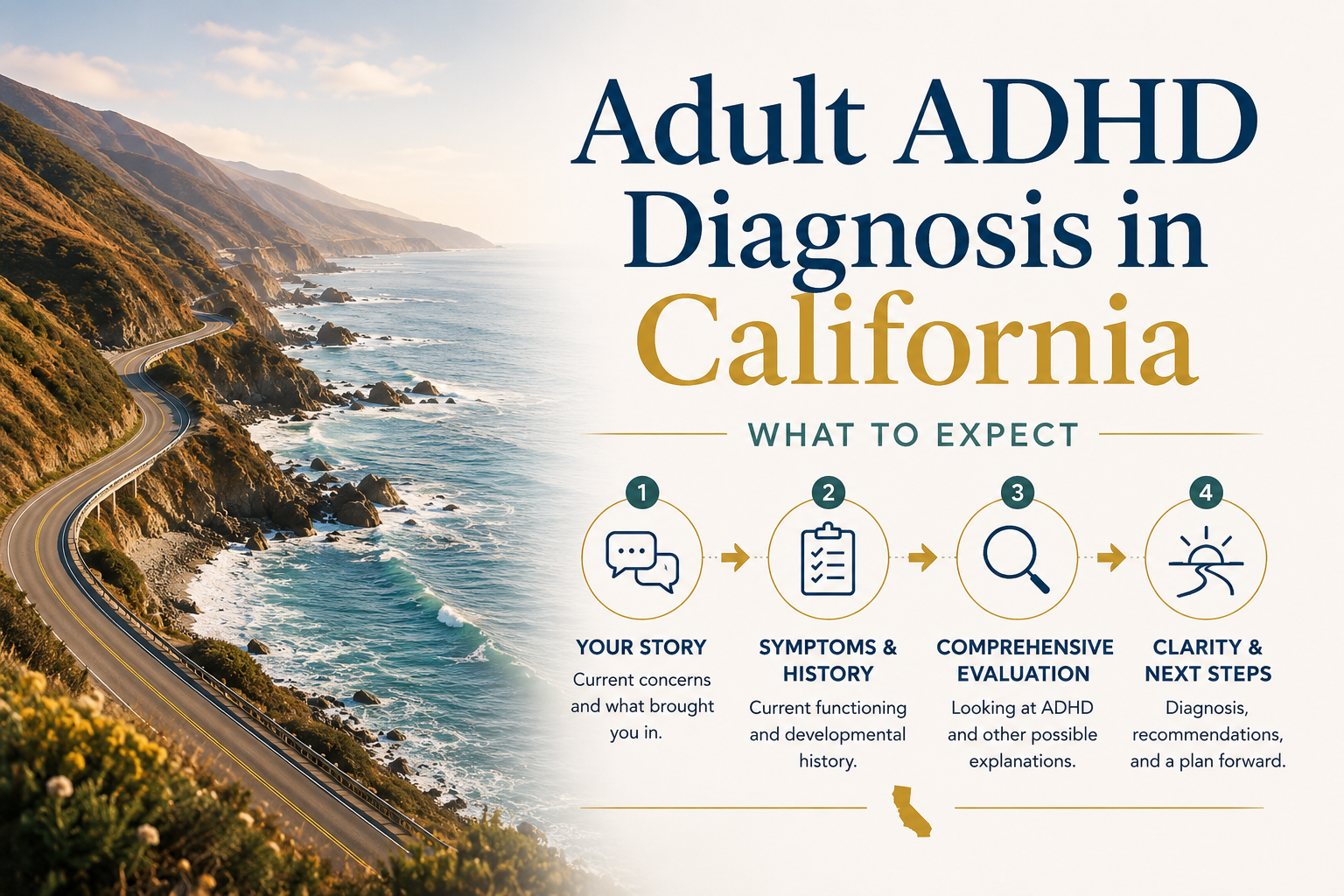
Although every clinician approaches assessment somewhat differently, a comprehensive adult ADHD evaluation generally includes several important components.
1. You Discuss What Is Bringing You In
The evaluation usually begins with your current concerns.
You may be asked what prompted you to consider ADHD and which difficulties are interfering with your life.
For example, you might describe problems with:
- staying focused during routine or repetitive tasks
- starting important tasks even when you know they need to be done
- procrastination
- organization
- time management
- forgetfulness
- losing or misplacing things
- following through on projects
- managing competing priorities
- impulsive decisions
- restlessness
- becoming overwhelmed by everyday responsibilities
But simply experiencing some of these difficulties does not establish an ADHD diagnosis.
Most people occasionally procrastinate, become distracted, forget things, or feel overwhelmed.
The clinician is looking for the pattern behind those experiences.
How long have they been happening?
How often do they occur?
Where do they occur?
And how much do they interfere with your life?
2. Your Clinician Looks at How Symptoms Affect Your Life
ADHD diagnosis is not based solely on whether certain symptoms are present.
Clinicians also consider functional impairment.
In other words:
What effect are these difficulties actually having on your life?
That can look very different from one person to another.
For one adult, impairment may involve repeatedly missing deadlines at work.
For another, it may be chronic difficulty keeping up with bills, appointments, household responsibilities, or paperwork.
Someone else may be professionally successful but spend extraordinary amounts of time and energy maintaining that success.
ADHD-related impairment may show up in areas such as:
- work
- education
- relationships
- finances
- household responsibilities
- parenting
- organization
- time management
- everyday self-management
This is an important point because success does not automatically rule out ADHD.
A person can have a degree, successful career, family, business, or significant professional responsibilities and still experience meaningful impairment.
The question is not simply what you have accomplished.
It is also how consistently you are able to function and what it costs you to maintain that functioning.
Why Your Childhood History Matters
One part of an adult ADHD evaluation sometimes surprises people:
Your clinician will probably ask about childhood.
ADHD is classified as a neurodevelopmental disorder. Under DSM-5-TR diagnostic criteria, several symptoms must have been present before age 12, although they may not have been recognized as ADHD at the time (American Psychiatric Association, 2022).
That does not mean you needed to have been diagnosed as a child.
And it does not mean you needed to have been disruptive, hyperactive, or failing in school.
Your clinician may instead explore questions such as:
Were you frequently daydreaming?
Did you lose homework or belongings?
Did adults describe you as bright but inconsistent?
Did you procrastinate until the last minute?
Did you need significant structure from parents or teachers to stay organized?
Did you struggle to listen, follow instructions, or finish assignments?
Were you chronically late?
Did you interrupt others or act impulsively?
Did you perform well academically but require unusually high effort to stay on top of things?
The purpose is not to force your childhood experiences into an ADHD narrative.
It is to determine whether your current difficulties appear to be part of a longstanding developmental pattern.
Do You Need Report Cards or Childhood Records?
Not necessarily.
Some adults have school records, previous evaluations, old report cards, or family members who can provide useful information about childhood.
Many do not.
That does not automatically prevent an adult ADHD evaluation.
Your clinician may gather developmental history from your recollection and may use additional information when it is available and clinically useful.
Old report cards can sometimes be surprisingly informative.
Comments such as:
“Does not work up to potential.”
“Needs to pay closer attention.”
“Frequently forgets assignments.”
“Talks excessively.”
“Needs to improve organization.”
may provide clues about earlier functioning.
But the evaluation is not based on finding one particular document.
The clinician is trying to reconstruct the broader developmental pattern as accurately as possible.
What If You Did Well in School?
This is one of the most common concerns among high-achieving adults.
Doing well academically does not, by itself, rule out ADHD.
Some adults were able to compensate because they were intellectually strong, interested in the material, supported by highly structured environments, or particularly effective under deadline pressure.
Others developed elaborate systems for preventing mistakes or forgetting responsibilities.
The important question is not simply:
“Were you successful?”
It is:
“What did it take to achieve that success, and was there a longstanding pattern of ADHD symptoms and impairment underneath it?”
A professional may consistently produce excellent work but routinely stay up late to meet deadlines that colleagues handle during normal working hours.
Someone may appear extremely organized because they have developed multiple calendars, alarms, reminders, lists, and backup systems specifically because they know what happens without them.
Another person may thrive in stimulating, high-pressure situations while repeatedly struggling with routine administrative work.
Success and ADHD are not mutually exclusive.
But success is not evidence of ADHD either.
A careful evaluation considers both possibilities.
ADHD in High-Functioning Adults
For some adults, achievement can make ADHD particularly difficult to recognize.
The external evidence says:
“You’re doing well.”
Their internal experience says:
“You have no idea how hard I’m working to keep this together.”
If that experience sounds familiar, you may also want to read our flagship guide:
High-Functioning ADHD in Adults: Why Success Doesn’t Rule Out ADHD
It explores how intelligence, achievement, structure, urgency, perfectionism, and compensatory systems can sometimes obscure ADHD until the demands of adult life begin exceeding those systems.
Your Medical and Mental Health History Matter Too
A comprehensive ADHD evaluation should look beyond ADHD.
Difficulty concentrating is not unique to the condition.
Attention, memory, motivation, sleep, and executive functioning can also be affected by conditions and circumstances such as:
- anxiety
- depression
- sleep problems
- trauma
- chronic stress
- substance use
- medication effects
- certain medical conditions
Some people have ADHD and another condition.
Others have symptoms that resemble ADHD but are better explained by something else.
This process of considering alternative or co-occurring explanations is called differential diagnosis.
It is one of the most important parts of a thoughtful evaluation because treatment depends on understanding what is actually causing—or contributing to—the symptoms.
ADHD vs. Anxiety: Why the Difference Can Be Difficult to Spot
Anxiety deserves particular attention because ADHD and anxiety can look remarkably similar in everyday life.
Both can contribute to difficulty concentrating.
Both can cause procrastination.
Both can leave someone feeling mentally overwhelmed.
And both can interfere with completing important tasks.
But the reasons behind those behaviors may be different.
For example, someone with ADHD may have trouble starting a task because initiating and organizing the task is difficult.
Someone experiencing anxiety may avoid the same task because they are worried about making a mistake or fear the outcome.
And some adults experience both.
That is why the evaluation should consider the mechanism behind the symptom—not simply whether the symptom exists.
Related guide: ADHD vs. Anxiety: How to Tell the Difference (And Why It Matters)
Are ADHD Questionnaires or Tests Used?
They may be.
Standardized ADHD rating scales can provide useful information during an evaluation.
They can help clinicians systematically assess symptoms and identify patterns that deserve further exploration.
But a screening questionnaire is not the same thing as a diagnosis.
You cannot reliably determine whether you have ADHD simply by accumulating enough “yes” answers on an online checklist.
Screening tools provide information.
The clinician still needs to interpret that information within the context of your history, symptoms, impairment, and other possible explanations.
This is why a comprehensive evaluation involves more than an ADHD test.
Wondering how screening differs from diagnosis?
Our Adult ADHD Test: 6-Question Self-Screening Tool can help you understand the role of screening and when a professional evaluation may be appropriate.
Do You Need Neuropsychological Testing to Diagnose ADHD?
Not every adult being evaluated for ADHD requires formal neuropsychological testing.
ADHD is fundamentally a clinical diagnosis based on a comprehensive assessment of symptoms, developmental history, impairment, and other relevant factors (American Psychiatric Association, 2022).
Additional testing may sometimes be appropriate when the clinical picture is unclear or when there are questions involving learning, cognitive functioning, or other diagnostic considerations.
But no single computerized attention test or cognitive test can independently establish whether someone has ADHD.
The appropriate evaluation depends on the individual and the clinical question being asked.
What Is the Clinician Actually Trying to Determine?
Throughout the evaluation, your clinician is assembling pieces of a larger picture.
They are considering questions such as:
Are enough symptoms consistent with ADHD present?
Were some of these symptoms present during childhood?
Do the difficulties occur in more than one setting?
Are they interfering with functioning?
Have they persisted over time?
Could another condition better explain them?
Are there other conditions occurring alongside ADHD?
No single answer determines the diagnosis.
It is the overall pattern that matters.
This is one reason a comprehensive evaluation can provide more useful information than an online test or symptom checklist.
What If the Evaluation Shows That You Don't Have ADHD?
That is still useful information.
The purpose of an ADHD evaluation should not be to confirm a predetermined diagnosis.
It should be to understand what is happening.
If ADHD does not appear to be the best explanation for your symptoms, the evaluation may identify another direction worth exploring.
That could mean addressing anxiety, depression, sleep, stress, another psychiatric condition, a medical issue, or some combination of factors.
The goal is clarity, not simply a label.
An accurate explanation gives you a better foundation for deciding what to do next.
What Happens If You Are Diagnosed With ADHD?
If the evaluation supports an ADHD diagnosis, the next step is developing an individualized treatment plan.
Treatment is not automatically synonymous with medication.
Depending on your needs, goals, medical history, symptoms, and preferences, treatment may include medication, education about ADHD, psychotherapy, ADHD coaching, executive-function strategies, lifestyle interventions, or treatment of co-occurring conditions.
Your treatment plan should be based on the areas of your life you actually want to improve.
For a deeper discussion of these options, read our Adult ADHD Treatment: The Complete Evidence-Based Guide.
Can Adults Be Evaluated for ADHD Online in California?
In many circumstances, yes.
Telehealth can make an adult ADHD evaluation more accessible for people who have difficulty traveling to an office or who live farther from their clinician.
The clinical principles remain the same.
A telehealth evaluation should still include an appropriate clinical assessment, developmental and psychiatric history, consideration of alternative explanations, and evaluation of impairment.
Whether telehealth is appropriate for a particular person depends on the clinical circumstances and the services offered by the clinician or practice.
Peace & Prosperity Psychiatry offers adult ADHD evaluations for adults located in California, including telehealth appointments when clinically appropriate.
How Should You Prepare for an Adult ADHD Evaluation?
You do not need to arrive having diagnosed yourself.
It can be useful, however, to spend some time thinking about the patterns that led you to seek an evaluation.
Consider examples from different areas of your life:
Work.
School.
Relationships.
Home.
Finances.
Organization.
Time management.
Think about when the difficulties began and whether you remember similar patterns earlier in life.
If you have old report cards, previous evaluations, medication lists, relevant medical records, or other information that you believe could help, ask your clinician whether they would like you to bring or submit them.
Most importantly, be as accurate as you can.
You do not need to prove that you have ADHD.
You are there to understand what’s happening.
Frequently Asked Questions About Adult ADHD Diagnosis in California
Can ADHD be diagnosed in adulthood?
Yes. Adults can be diagnosed with ADHD even if the condition was not identified during childhood. Because ADHD is a neurodevelopmental condition, however, the evaluation looks for evidence that symptoms were present earlier in life.
Can you have ADHD if you did well in school?
Yes. Academic or professional success does not automatically exclude ADHD. Clinicians consider symptoms, developmental history, impairment, compensatory strategies, and the amount of effort required to maintain functioning.
Is there a definitive test for adult ADHD?
No single laboratory test, brain scan, questionnaire, or computerized attention test independently diagnoses ADHD. Diagnosis is based on a comprehensive clinical assessment.
Do I need childhood records to receive an ADHD diagnosis?
Not necessarily. Childhood information is important, but it can come from multiple sources. School records or collateral information may be helpful when available, but the appropriate approach depends on the individual evaluation.
Can anxiety look like ADHD?
Yes. Anxiety can cause concentration problems, procrastination, forgetfulness, and difficulty completing tasks. ADHD and anxiety can also occur together, which is why differential diagnosis is important.
Can an adult ADHD evaluation be done through telehealth in California?
Adult ADHD evaluations may be conducted through telehealth when appropriate. The suitability of telehealth depends on the individual clinical circumstances and the clinician’s assessment.
Does an ADHD diagnosis automatically mean I need medication?
No. Treatment decisions should be individualized. Medication is one evidence-based treatment option, but a treatment plan may also involve education, therapy, executive-function strategies, coaching, lifestyle interventions, and treatment of co-occurring conditions.
The Goal of an ADHD Evaluation Is Clarity
If you have spent years wondering why organization, focus, time management, or follow-through seem to require more effort than they should, it can be tempting to search for a simple yes-or-no answer.
But a thoughtful ADHD evaluation offers something more valuable.
Context.
It looks at where your difficulties came from, how long they have been present, how they affect your life, and what best explains them.
You may discover that ADHD has been contributing to difficulties you have experienced for years.
You may discover that ADHD is only one part of the picture.
Or the evaluation may point toward another explanation entirely.
Each outcome can move you closer to understanding what you need.
Taking the Next Step
If you have been wondering whether ADHD may explain some of the difficulties you’ve experienced, you do not need to determine the diagnosis yourself.
A comprehensive ADHD evaluation can help clarify whether your symptoms are consistent with ADHD, whether another condition may be contributing, and what next steps may be appropriate.
Peace & Prosperity Psychiatry offers adult ADHD evaluations for adults in California, including online telehealth appointments when appropriate.
Ready to Find Clarity?
Start with our complimentary 15-minute Right Fit Consultation to learn more about the evaluation process and determine whether our practice may be a good fit for your needs.
Learn About the Right Fit Consultation
The next step is simply determining whether an evaluation—and Peace & Prosperity Psychiatry—may be the right fit for you.
References & Trusted ADHD Resources
References
American Psychiatric Association. (2022). Diagnostic and statistical manual of mental disorders (5th ed., text rev.; DSM-5-TR). American Psychiatric Association Publishing.
Faraone, S. V., Banaschewski, T., Coghill, D., et al. (2021). The World Federation of ADHD International Consensus Statement: 208 evidence-based conclusions about the disorder. Neuroscience & Biobehavioral Reviews, 128, 789–818.
National Institute for Health and Care Excellence. (2018). Attention deficit hyperactivity disorder: Diagnosis and management (NG87).
Trusted ADHD Resources
For additional information about ADHD, diagnosis, symptoms, and treatment, you may also find these national resources helpful:
- Centers for Disease Control and Prevention (CDC): ADHD Information — General information about ADHD, including symptoms, diagnosis, treatment, research, and resources.
CDC ADHD Information - CHADD (Children and Adults with Attention-Deficit/Hyperactivity Disorder) — Educational resources and information for adults and families affected by ADHD. The CDC also identifies CHADD’s National Resource Center on ADHD as a resource it supports.
CHADD ADHD Resources - American Psychiatric Association: What Is ADHD? — Patient education covering ADHD symptoms, diagnosis, presentation, and related information.
American Psychiatric Association ADHD Information