
Table of Contents
ToggleTake a brief adult ADHD screening—and understand what your results can and cannot tell you.
Maybe you have been wondering whether your procrastination, forgetfulness, difficulty staying organized, or inconsistent focus could be related to ADHD.
Taking an adult ADHD screening can be a reasonable place to start.
But there is an important distinction:
An ADHD screening test cannot tell you whether you have ADHD.
It can help identify patterns that may be worth discussing with a qualified clinician.
Below, we’ll look at a widely used six-question adult ADHD screening tool, what the results mean, and—equally important—what they don’t mean.
Before You Take an ADHD Test: Screening Is Not Diagnosis
People frequently search online for an “adult ADHD test.”
Clinically, a better term is ADHD screening tool.
A screening tool is designed to answer a relatively narrow question:
Are there enough ADHD-related symptoms here that further evaluation may be worth considering?
It is not designed to answer:
Does this person definitely have ADHD?
That distinction matters because problems with attention, procrastination, organization, memory, and restlessness can occur for many reasons.
ADHD is one possibility.
Anxiety, depression, inadequate sleep, chronic stress, substance use, certain medical conditions, medication effects, and other factors can sometimes produce overlapping difficulties.
So approach the questions below as a starting point for reflection, not a diagnosis.
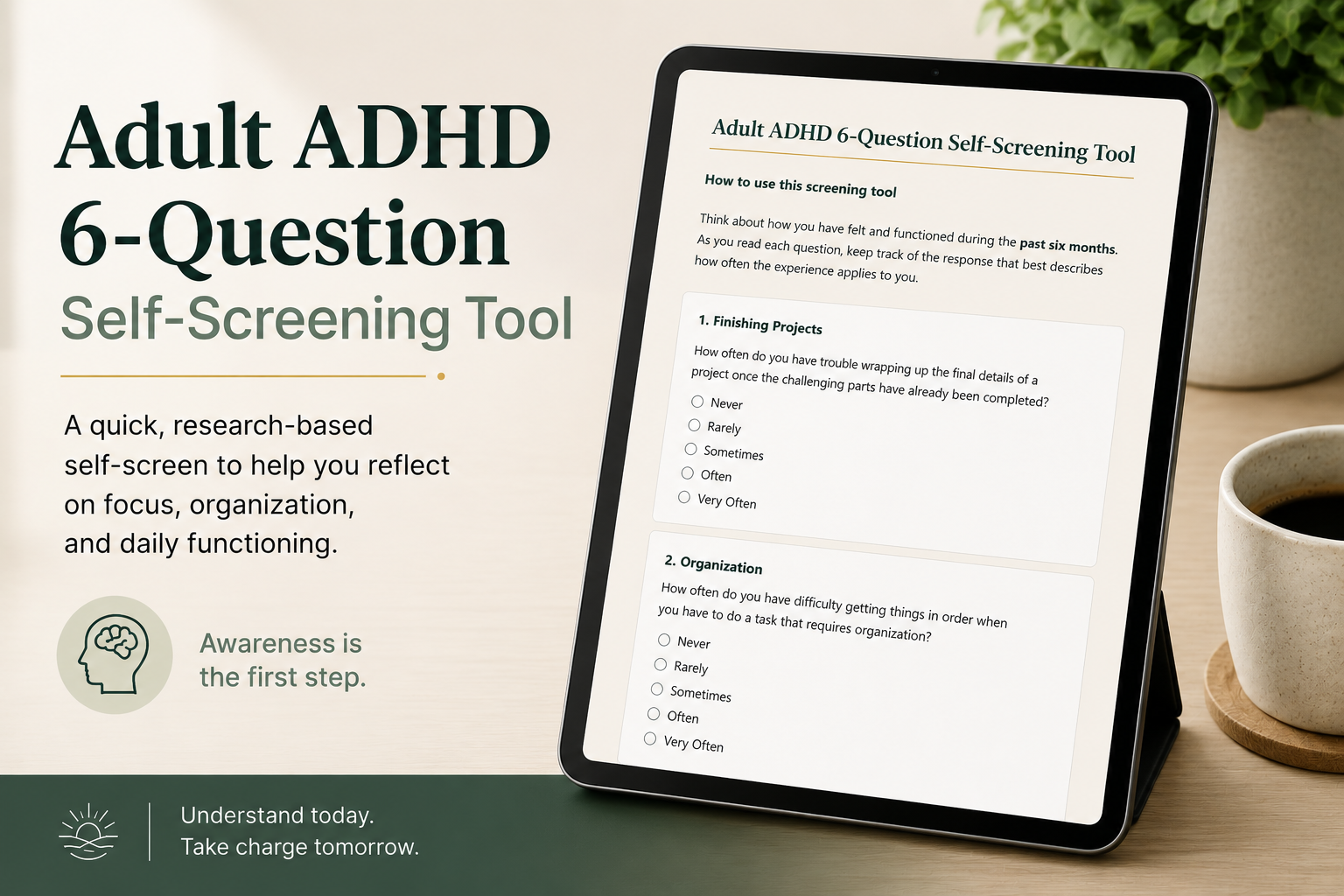
Adult ADHD 6-Question Self-Screening Tool
The following screening tool is based on the Adult ADHD Self-Report Scale Version 1.1 (ASRS-v1.1) Screener, developed in conjunction with the World Health Organization.
How to use this screening tool
Think about how you have felt and functioned during the past six months. As you read each question, keep track of the response that best describes how often the experience applies to you.
1. Finishing Projects
How often do you have trouble wrapping up the final details of a project once the challenging parts have already been completed?
○ Never
○ Rarely
○ Sometimes
○ Often
○ Very Often
1. Finishing Projects
How often do you have trouble wrapping up the final details of a project once the challenging parts have already been completed?
○ Never
○ Rarely
○ Sometimes
○ Often
○ Very Often
2. Organization
How often do you have difficulty getting things in order when you have to do a task that requires organization?
○ Never
○ Rarely
○ Sometimes
○ Often
○ Very Often
3. Remembering Appointments
How often do you have problems remembering appointments or obligations?
○ Never
○ Rarely
○ Sometimes
○ Often
○ Very Often
4. Avoiding Difficult Tasks
How often do you avoid or delay getting started on a task that requires a lot of thought?
○ Never
○ Rarely
○ Sometimes
○ Often
○ Very Often
5. Restlessness
How often do you fidget or squirm with your hands or feet when you have to sit down for a long time?
○ Never
○ Rarely
○ Sometimes
○ Often
○ Very Often
6. Feeling Overly Active
How often do you feel overly active and compelled to do things, as if you were driven by a motor?
○ Never
○ Rarely
○ Sometimes
○ Often
○ Very Often
How Is the Adult ADHD Screening Scored?
The traditional ASRS-v1.1 screener uses different response thresholds for different questions.
That means it is not as simple as counting every “Often” or “Very Often” answer.
On the official screening form, certain responses appear within shaded areas. Four or more responses within those designated areas indicate that the person’s symptoms may be consistent with adult ADHD and that discussing an evaluation with a healthcare professional may be beneficial. (Harvard Medical School HCP)
The ASRS developers have also published an updated scoring approach.
Under that approach:
- Never = 0
- Rarely = 1
- Sometimes = 2
- Often = 3
- Very Often = 4
The six answers are added together for a score ranging from 0 to 24.
The updated guidance describes:
0–9: Low negative range
10–13: High negative range
14–17: Low positive range
18–24: High positive range
A score of 14 or higher falls within the positive screening range under this scoring method. (Harvard Medical School HCP)
But this brings us to the most important part of this article.
What Does a Positive ADHD Screen Actually Mean?
A positive ADHD screen means:
Your answers suggest that further evaluation for ADHD may be reasonable.
It does not mean:
You have ADHD.
That difference can be easy to overlook when taking online ADHD tests.
The ASRS is a screening instrument. Screening tools are intentionally designed to identify people who may warrant further assessment.
They are not substitutes for that assessment.
In research used to develop a newer DSM-5 version of the ASRS, a six-question screener demonstrated high sensitivity and specificity at its selected threshold. However, its positive predictive value varied depending on the population being screened—illustrating why the context in which a screening tool is used matters. (JAMA Network)
In practical terms:
A positive result is a reason to ask more questions—not the final answer.
Why a Positive ADHD Test Doesn't Necessarily Mean ADHD
Suppose your screening result falls into the positive range.
There are several possibilities.
You may have ADHD.
You may have symptoms that resemble ADHD but are primarily related to something else.
You may have ADHD and another condition affecting your attention or executive functioning.
Or your symptoms may not ultimately meet the full diagnostic criteria for ADHD.
This is why a screening questionnaire cannot replace a clinical evaluation.
A clinician needs to look beyond your score and ask:
When did these problems begin?
Have they persisted over time?
Do they occur in multiple areas of your life?
Are they actually interfering with your functioning?
Could something else better explain them?
Those questions provide context that a six-item questionnaire cannot.
What Makes ADHD More Worth Investigating?
If your screening result raises concerns, consider the larger pattern.
Four features are particularly important.
1. The Pattern Goes Back to Childhood
ADHD is a neurodevelopmental disorder.
Adults may not have been diagnosed during childhood, but current diagnostic criteria require evidence that several symptoms were present before age 12.
The signs may not have been obvious.
Perhaps you were frequently daydreaming.
Maybe homework was routinely forgotten or completed at the last minute.
You might have lost belongings, struggled with organization, talked excessively, or needed considerable support from parents or teachers to stay on track.
A professional evaluation looks backward because ADHD does not simply begin for the first time after a stressful month at work.
2. The Difficulties Are Persistent
Everyone goes through periods of poor concentration.
Sleep deprivation, overwhelming workloads, relationship problems, grief, anxiety, depression, and significant stress can all affect attention.
ADHD generally involves a more persistent pattern.
If the difficulties you are experiencing today resemble difficulties you experienced in high school, college, earlier jobs, relationships, and other periods of your life, that history becomes more relevant.
3. The Pattern Shows Up in More Than One Setting
ADHD generally isn’t limited to one very specific circumstance.
For example, struggling only in one unusually chaotic workplace would not necessarily indicate ADHD.
A more consistent pattern might appear in different forms across:
Work.
School.
Home.
Relationships.
Finances.
Household responsibilities.
Personal projects.
The difficulties don’t have to look identical everywhere, but clinicians look for evidence that the underlying pattern extends beyond a single situation.
4. The Symptoms Affect Your Functioning
Having ADHD-like traits is not the same as having ADHD.
Clinicians look for meaningful effects on social, academic, occupational, or other important areas of functioning.
And impairment isn’t always obvious.
You might have a successful career but routinely work late into the evening because ordinary administrative tasks take you hours.
You might never miss appointments—but only because you maintain several calendars, alarms, and reminders.
You might perform extremely well under deadline pressure while repeatedly struggling to begin work until urgency becomes overwhelming.
The final outcome isn’t the only thing that matters.
Sometimes the amount of effort required to produce that outcome tells an important part of the story.
What If I Recognize Myself in These Questions?
If several of these questions feel unusually familiar, you may want to look beyond the six-item screen and examine the broader pattern.
Ask yourself:
Have I struggled with similar issues for years?
Do these problems appear in several parts of my life?
Do I rely heavily on deadlines, pressure, reminders, or elaborate systems to function?
Are these difficulties creating consequences—or requiring enormous effort to prevent consequences?
Were there signs of similar difficulties when I was younger?
We’ve created a separate guide specifically for this stage of the process:
Do I Have ADHD? Adult ADHD Symptoms and Self-Assessment
That article goes deeper into what adult ADHD can look like in everyday life and how to distinguish a persistent ADHD-like pattern from occasional distraction or procrastination.
What If My ADHD Screening Is Negative?
A negative screen generally makes ADHD less likely, but a screening questionnaire should not be used in isolation to dismiss significant concerns.
If you are experiencing substantial problems with concentration, memory, organization, impulsivity, restlessness, or executive functioning, those difficulties may still deserve attention—whether ADHD ultimately explains them or not.
The goal shouldn’t be to obtain a particular label.
The goal should be to understand what is causing the difficulty.
What Happens If My ADHD Screen Is Positive?
You do not have to rush into treatment.
The next step is usually clarification.
A comprehensive adult ADHD evaluation considers much more than the results of a questionnaire.
Depending on the individual and clinical circumstances, an evaluation may examine current symptoms, developmental history, functional impairment, psychiatric history, possible coexisting conditions, and alternative explanations for attention or executive-function difficulties.
If you’d like to understand that process in more detail:
Adult ADHD Diagnosis in California: What to Expect
And if you’re ready to understand the practical steps involved in pursuing an evaluation:
How to Get an ADHD Diagnosis in California: 7 Steps for Adults
Frequently Asked Questions About Adult ADHD Tests
Is there an accurate online test for adult ADHD?
Validated screening tools such as the ASRS can help identify symptoms that may warrant further evaluation. However, an online ADHD screening cannot establish an ADHD diagnosis on its own.
What is the ASRS?
The Adult ADHD Self-Report Scale (ASRS) is an adult ADHD screening instrument developed by a World Health Organization work group. The ASRS-v1.1 includes an 18-question symptom checklist and a shorter six-question screener. (Harvard Medical School HCP)
Does a positive ASRS result mean I have ADHD?
No. A positive result means your responses indicate that further assessment may be appropriate. Diagnosis requires additional clinical information.
Can anxiety cause a positive ADHD screen?
Potentially. Attention and executive-function difficulties are not unique to ADHD, and other psychiatric, medical, sleep-related, and situational factors can produce overlapping symptoms.
If you’re particularly unsure about ADHD versus anxiety, see:
ADHD vs Anxiety: How to Tell the Difference (And Why It Matters)
Can successful adults screen positive for ADHD?
Yes. Occupational or academic success does not automatically rule out ADHD. Some adults compensate through extensive structure, unusually high effort, deadline pressure, or other strategies.
High-Functioning ADHD in Adults: Why Success Doesn’t Rule Out ADHD
Can I have ADHD even if I wasn’t diagnosed as a child?
Yes. ADHD can first be diagnosed in adulthood. However, because ADHD is a neurodevelopmental disorder, an adult evaluation looks for evidence that symptoms were present during childhood.
Taking the Next Step
If you took an ADHD screening because something in your life has not been adding up, the result is only one piece of information.
Whether your screen was positive or negative, the more important question is:
What best explains the difficulties you’re experiencing?
For some adults, the answer is ADHD.
For others, it may be anxiety, depression, sleep difficulties, stress, another condition, or a combination of factors.
A comprehensive evaluation is designed to sort through those possibilities rather than simply confirm a diagnosis you already suspect.
Peace & Prosperity Psychiatry provides adult ADHD evaluations for adults in California, including secure telehealth appointments.
Ready to Find Clarity?
Start with our complimentary 15-minute Right Fit Consultation to learn more about the evaluation process and determine whether Peace & Prosperity Psychiatry may be a good fit for your needs.
References
Kessler, R. C., Adler, L., Ames, M., et al. (2005). The World Health Organization Adult ADHD Self-Report Scale (ASRS). Psychological Medicine, 35(2), 245–256.
Kessler, R. C., Adler, L. A., Gruber, M. J., Sarawate, C. A., Spencer, T., & Van Brunt, D. L. (2007). Validity of the World Health Organization Adult ADHD Self-Report Scale (ASRS) Screener in a representative sample of health plan members. International Journal of Methods in Psychiatric Research, 16(2), 52–65.
Ustun, B., Adler, L. A., Rudin, C., et al. (2017). The World Health Organization Adult Attention-Deficit/Hyperactivity Disorder Self-Report Screening Scale for DSM-5. JAMA Psychiatry, 74(5), 520–526. (JAMA Network)
Official ASRS Resources:
Adult ADHD Self-Report Scale (ASRS) resources