

Table of Contents
ToggleYou know what needs to be done. You may genuinely want to do it. So why can turning intention into action feel so difficult?
The report is open.
The deadline is getting closer.
You know what needs to be done. You understand why it matters. You may have even blocked off time specifically to do it.
But instead of writing the first sentence, you check one more email. You reorganize your notes. You get something to drink. Or you sit there staring at the screen, waiting for yourself to begin.
This can be especially confusing when you are otherwise capable and successful. You manage a career, take care of your family, and solve complicated problems every day.
So why can starting one relatively simple task feel so difficult?
For many adults with ADHD, the problem is not a lack of knowledge, intelligence, or concern. ADHD and task initiation difficulties can create a frustrating gap between knowing what needs to be done and actually beginning it.
That transition depends on several interacting processes. Executive functioning, working memory, planning, self-regulation, perceived effort, reward timing, and emotion can all play a role. There is no single explanation that applies to every person with ADHD—or every task (Faraone et al., 2024; Posner et al., 2020).
Understanding that distinction can change the question from:
“Why can’t I just make myself do this?”
to:
“What is making this particular task difficult to start?”
That is a much more useful question.
What Is Task Initiation?
Task initiation is the ability to begin a goal-directed action without excessive delay. In everyday language, it is the bridge between “I intend to do this” and taking the first observable step.
Task initiation falls within the broader group of mental skills commonly called executive functions. These skills help us hold goals in mind, plan and sequence actions, resist competing distractions, shift between activities, monitor progress, and regulate behavior over time.
For a broader introduction to these skills, see What Is Executive Dysfunction?
Task initiation is closely related to planning and prioritization, but the three are not interchangeable. Planning helps you determine the steps needed to accomplish something. Prioritization helps you decide which task deserves your attention first. Task initiation is the point at which the selected plan becomes action.
That distinction helps explain an experience many adults with ADHD find confusing. You can understand an assignment, create a reasonable plan, decide that it is important, put it on your calendar—and still struggle to begin.
Researchers sometimes describe this broader problem as an intention–action gap. One transdiagnostic framework describes successful voluntary initiation as an interaction among executive function, volition, and the capacity to produce action. Difficulty in any part of that system may interfere with getting started (Buckle et al., 2022).
In other words, deciding to do something and actually starting it are related, but they are not the same process.
Why Can Starting Be Difficult With ADHD?
There is no single “task initiation center” in the brain that explains why adults with ADHD sometimes get stuck. ADHD itself is heterogeneous, which means the mechanisms contributing to initiation difficulty can vary from person to person and even from task to task.
Current evidence supports a multimechanism explanation. Executive control interacts with working memory, motivation, reward timing, perceived effort, emotional state, and the demands of the situation (Cortese et al., 2025; Faraone et al., 2024).
Several of these processes may be operating at the same time.
The Goal Has to Stay Active
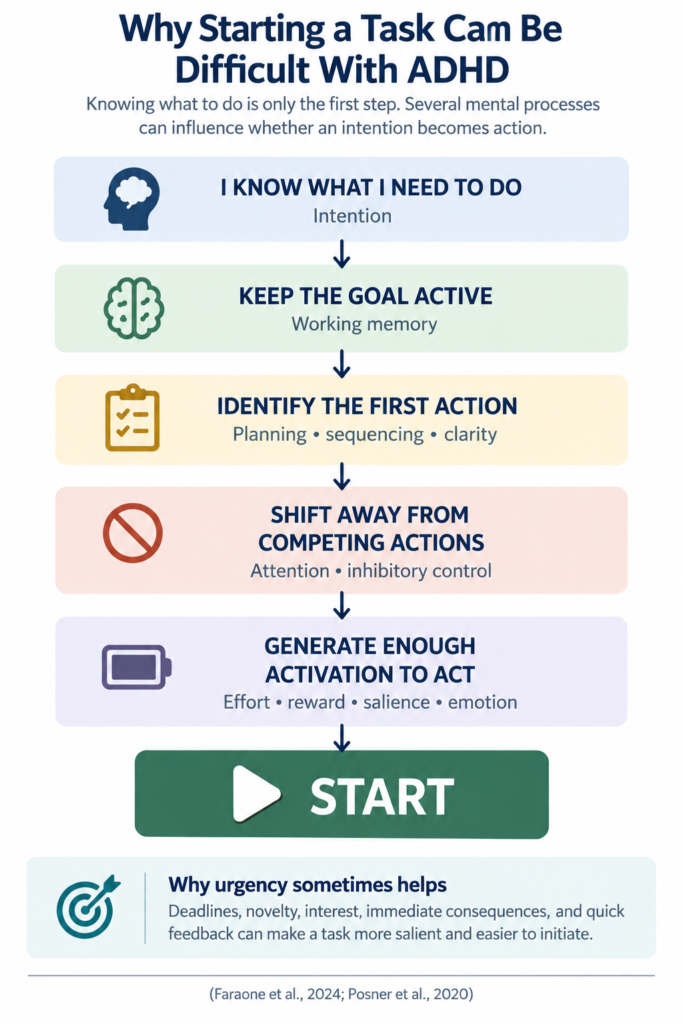
Working memory helps keep an intention mentally available while you organize what to do next.
Imagine deciding, “After lunch, I need to submit that reimbursement form.” Then the phone rings. A coworker asks a question. You see an email that needs a response.
Twenty minutes later, the reimbursement form has effectively disappeared from your mental workspace.
If a goal drops out of awareness or becomes crowded out by competing information, initiation may never happen. This is one reason an external list or visible reminder can sometimes work better than repeatedly telling yourself to remember.
You can learn more about this process in Working Memory and ADHD.
The First Action Has to Be Clear
Consider the instruction:
“Prepare for the meeting.”
It sounds like one task. But it may contain several hidden decisions.
Which document should you open? What information do you need? What should you review first? Do you need notes? How much preparation is enough?
Each unanswered question adds friction before action can begin.
What looks like a task-initiation problem may therefore include difficulty with planning, sequencing, prioritization, or cognitive flexibility. You may know perfectly well that you need to prepare for the meeting while still lacking a sufficiently clear action to execute.
This distinction matters when choosing a strategy. If the real barrier is an unclear first step, trying harder to “get motivated” may not solve the problem.
Starting One Thing Usually Means Stopping Another
Task initiation does not happen in a vacuum.
Starting the report may require you to stop answering email. Beginning your workout may mean getting off the couch. Opening the tax documents may require putting down your phone or disengaging from another task that feels easier.
Email, social media, conversations, and even other productive activities may offer clearer cues or faster feedback than the intended task. Inhibitory and attentional control can therefore contribute to initiation. You have to disengage from what you are currently doing, resist competing alternatives, and redirect behavior toward the selected goal.
Effort Has a Cost
Tasks differ in how effortful they feel, and perceived effort may influence whether we act.
In a small controlled study, adults with ADHD who were tested off their usual amphetamine medication were less willing than controls to invest cognitive and physical effort for rewards. Medication increased their willingness to exert effort (Chong et al., 2023).
This does not mean adults with ADHD are unwilling to work hard, nor does it establish effort valuation as the explanation for task-initiation problems. Perceived effort appears to be one relevant mechanism among several.
It may also help explain why two tasks that take the same amount of time do not necessarily feel equally easy to begin. A clearly defined task with an obvious endpoint may create less initiation friction than a vague task requiring repeated decisions along the way.
Future Consequences May Feel Weak Right Now
Many important adult tasks have delayed benefits.
Finish the report today, and next week’s meeting will be easier. Organize your tax documents now, and April will be less stressful. Exercise consistently, and your health may improve over time.
The effort happens now. Much of the reward comes later.
Research on delay discounting examines how the subjective value of a reward changes as the wait for that reward increases. Steeper delay discounting has been associated with ADHD, although it is also found across other psychiatric conditions and is not specific enough to explain ADHD by itself (Amlung et al., 2019).
This may help explain a familiar experience: a report that has been difficult to start for two weeks suddenly becomes much easier at 9:00 p.m. the night before it is due.
The report did not become more interesting. The consequence became more immediate and more salient.
Dopamine Is Part of the Story—Not the Whole Story
ADHD is sometimes reduced to a simple explanation:
“People with ADHD do not have enough dopamine, so they can only do things that interest them.”
That is not an adequate description of ADHD.
ADHD is heterogeneous, and its neurobiology involves interacting catecholamine systems, distributed brain networks, development, and environmental context. Reward and motivation differences matter, but they coexist with differences involving cognitive control and executive functioning (Faraone et al., 2024; Posner et al., 2020).
Reward processing is still relevant. The important point is that it operates alongside attention, working memory, executive control, perceived effort, and the characteristics of the task itself. That helps explain why changing the conditions around a task can sometimes change how easy it is to begin.
A more accurate conclusion is that ADHD can make the regulation of goal-directed behavior less consistent. That is different from saying a person does not care, lacks motivation, or is biologically incapable of starting an uninteresting task.
Why Are Some Tasks Much Easier to Start?
You may be able to respond immediately when a client or coworker calls with an urgent problem, then spend three days avoiding the routine documentation associated with that same work.
You may handle a complicated crisis without hesitation but struggle to begin a simple expense report.
From the outside, this can look contradictory.
“If you can do that, why can’t you just do this?”
But the two tasks may create very different conditions for action.
Tasks may be easier to start when they are interesting or personally meaningful, novel, urgent, clearly defined, emotionally engaging, associated with immediate consequences, or followed by quick feedback or reward.
This pattern is better understood as sensitivity to context than as a rule that adults with ADHD “only do what interests them.” Interest, novelty, urgency, clear structure, and immediate reinforcement can sometimes provide motivational weight or external cues that vague, repetitive, delayed-payoff tasks do not.
This is also one reason deadline-driven productivity can become confusing. If urgency repeatedly makes starting easier, a person may come to believe:
“I work better under pressure.”
And sometimes the work produced under pressure really is good.
But relying on urgency to make tasks actionable has a cost. It can create unnecessary stress, compress the time available to recover from mistakes, and make consistent planning much harder.
Why Ambiguity and Task Size Matter
Compare these two instructions:
- Work on the presentation.
- Open the presentation, add three section headings, and write one question each section needs to answer.
The first instruction is shorter, but cognitively it may be much larger.
“Work on the presentation” names a project. It does not identify an executable action. Before starting, you still have to decide where to begin, what to work on, how much to accomplish, and what would count as progress.
The second instruction has already removed several of those decisions.
This is where task chunking can help. The goal is not to divide every project into dozens of tiny steps. The goal is to reduce the project to an action that is concrete enough to perform without another round of planning.
Instead of “deal with taxes,” the next action might be “download last month’s bank statement.”
Instead of “clean the garage,” it might be “put one empty box beside the workbench.”
Instead of “work on the proposal,” it might be “open the proposal and write the three section headings.”
For a step-by-step approach, see Task Chunking for ADHD.
Task Initiation vs. Prioritization vs. Procrastination vs. ADHD Paralysis
These experiences often occur together, which makes them easy to confuse. But keeping them separate helps identify what is actually going wrong.
Prioritization is about deciding what deserves attention first. You have five responsibilities and cannot determine which one should come first.
Task initiation occurs after that decision. You selected the report as your priority, but you still have not opened it.
Procrastination refers to delaying an intended action despite expecting negative consequences from the delay. Initiation difficulty can contribute to procrastination, but procrastination can also involve low task value, emotional avoidance, perfectionism, or other factors.
ADHD paralysis is different again. It is a commonly used lived-experience term for feeling stuck or unable to act; it is not a formal diagnosis. What someone calls ADHD paralysis may involve problems with initiation, prioritization, working memory, emotional regulation, overwhelm, or several of these processes at once.
These concepts overlap, but they are not synonyms.
For deeper discussions, see Why Do Adults With ADHD Procrastinate? and What Is ADHD Paralysis?
Anxiety, Perfectionism, and Emotional Avoidance
Not every difficulty starting a task is caused by ADHD.
Sometimes the barrier is not simply what the task requires. It is what you expect beginning the task to feel like.
A presentation may trigger fear of being judged. An email may involve conflict. A financial task may bring up shame. A perfectionistic standard may make a first draft feel threatening because anything less than excellent seems unacceptable.
In those situations, avoiding the task can provide immediate emotional relief—even though the delay creates more stress later.
Emotional regulation difficulties are common and clinically important in adults with ADHD, although researchers continue to debate exactly how they should be conceptualized within the disorder. A systematic review found more frequent use of maladaptive emotion-regulation strategies among adults with ADHD while also emphasizing limitations and heterogeneity in the available literature (Soler-Gutiérrez et al., 2023).
Anxiety, perfectionism, fear of failure, emotional avoidance, and ADHD-related executive dysfunction can therefore interact without being the same thing.
This matters when you are trying to understand why you cannot start. Breaking a project into smaller steps may help when the barrier is ambiguity. It may be less effective when the primary barrier is intense anxiety about what will happen once you begin.
For additional distinctions, see ADHD vs Anxiety in Adults.
A Practical Framework for Starting
Understanding the problem is useful. But when you are sitting in front of a task you still cannot begin, you need something you can actually use.
The CUE–STEP–START–REWARD framework offers a practical way to reduce common barriers between intending to do something and actually beginning.
It is not a validated treatment protocol, and the evidence is not equally strong for every component. Think of it as a structured way to identify and reduce common barriers to starting.
First, Reduce Obvious Friction
Before using the four steps, make the intended action easier to reach.
Close unrelated tabs. Put the document you need on the screen. Move your phone out of reach. Place necessary materials where you can see them. Decide where you will work and write down the first step in advance.
Each change removes a decision or competing option at the moment you need to begin.
Environmental restructuring is commonly incorporated into adult ADHD CBT, which addresses practical difficulties involving planning, scheduling, organization, distraction, and procrastination (Cortese et al., 2025).
You do not need a perfect workspace. You are simply trying to reduce unnecessary friction before the moment of initiation arrives.
1. CUE: Decide When Starting Happens
“I’ll do it later” leaves another decision waiting for you later.
A more useful plan connects the behavior to a recognizable cue:
“When my 1:00 p.m. meeting ends, I will sit at my desk, put my phone in the drawer, and open the presentation.”
These types of implementation intentions connect a specific situation with a predetermined response. A meta-analysis of 94 tests found that if–then plans improved goal attainment, including by helping people initiate goal pursuit when the relevant cue appeared (Gollwitzer & Sheeran, 2006).
Calendars, reminders, and environmental prompts can help make the cue visible. Time Blocking for ADHD can also help turn an intention into a scheduled action.
But the calendar entry should tell you what starting means.
Instead of:
2:00–3:00 — Presentation
try:
2:00 — Open presentation and draft three section headings.
2. STEP: Define the Smallest Concrete Next Action
Ask yourself:
“What could someone watch me do next?”
“Get organized” is difficult to execute because it describes an outcome rather than an action. “Put tomorrow’s appointments into my calendar” is an action.
“Deal with taxes” is vague. “Open the tax folder and find my W-2” is concrete.
The next step should be small enough that it requires little additional planning. If you still have to stop and figure out what the instruction means, make the step more specific.
3. START: Lower the Commitment to Beginning
Sometimes the size of the commitment creates part of the resistance.
If starting the report feels like committing to two hours of difficult work, try committing to a brief, defined starting period instead. Five or ten minutes may be enough to determine whether much of the barrier is concentrated at the transition point.
The purpose is not to trick yourself into working for hours. You are allowed to stop when the planned period ends.
A short starting period is a reasonable practical extension of task chunking and behavioral activation principles. However, specific “five-minute rules” have less direct adult ADHD trial evidence than established interventions such as medication and structured CBT.
A strategy can be sensible and useful without being presented as a proven ADHD treatment.
4. REWARD: Make Progress Visible Now
If the benefit of completing a task is weeks away, bringing some feedback closer to the action may help.
You might check off the first step immediately, use a visible progress marker, pair starting with a modest reward, send an accountability message after beginning, or record what you completed before deciding what comes next.
These strategies are consistent with evidence involving reward timing and delay sensitivity, but direct evidence varies considerably among specific techniques. Accountability methods and “body doubling,” for example, have limited direct trial evidence as stand-alone ADHD interventions.
They are better described as evidence-informed supports, not established treatments.
A Worked Adult Example
Maya is a healthcare manager with a demanding schedule, two children, and a strong professional record. She needs to prepare a presentation for an executive meeting.
For three evenings, “work on presentation” remains on her list.
She cares about the meeting and knows the delay will make the rest of her week harder. But each time she opens her laptop, she answers easier emails instead.
Her problem is not simply that she has forgotten the presentation or decided it is unimportant. Her original plan contains too many hidden decisions and no clear starting cue.
So she changes the conditions around the task:
Reduce friction: Close email before 7:00 p.m. and put the phone in another room.
Cue: “When the children begin homework at 7:00 p.m., I will sit at the dining table and open the presentation.”
Step: “Write three section headings: current problem, options, recommendation.”
Start: Set a timer for eight minutes. Finishing the presentation is not required.
Reward: Mark the start on the calendar and make tea when the timer ends.
Maya has not made the presentation easy, and she has not manufactured perfect motivation. She has changed “I need to work on the presentation” into a cue and an executable behavior.
If she stops after eight minutes, she has still initiated the task. She has also created a clearer reentry point for the next work period.
Evidence-Based Treatment for Adult ADHD
Practical strategies can make starting easier, but they are not substitutes for individualized treatment when ADHD symptoms cause significant impairment.
Medication has the strongest short-term evidence for reducing core adult ADHD symptoms. A major 2025 review of 113 randomized controlled trials found that stimulants and atomoxetine outperformed placebo in both clinician-rated and self-reported short-term core ADHD symptom outcomes (Cortese et al., 2025).
Medication does not automatically solve task-initiation problems, and treatment decisions require individualized consideration of potential benefits and risks, medical history, co-occurring conditions, and patient preferences.
ADHD-focused cognitive behavioral therapy is another evidence-based treatment approach. CBT can teach compensatory strategies for organization, planning, scheduling, distraction, procrastination, and unhelpful beliefs. Evidence supports CBT for adult ADHD, although study quality, outcome measures, and evidence about long-term maintenance vary (Cortese et al., 2025).
When Difficulty Starting Tasks May Warrant an ADHD Evaluation
Everyone has difficulty starting tasks sometimes.
Task-initiation problems alone do not establish an ADHD diagnosis.
A comprehensive evaluation may be appropriate when difficulties with starting, organizing, remembering, sustaining attention, managing time, or regulating behavior form part of a chronic pattern that causes meaningful impairment.
Clinicians evaluating adult ADHD look for a broader pattern of inattention and/or hyperactivity-impulsivity. They also consider whether symptoms occur across settings and whether several symptoms were present before age 12.
Adult ADHD diagnosis is clinical. No single questionnaire, brain scan, blood test, or computerized performance test can confirm it.
Other explanations must also be considered. Difficulty initiating tasks can occur with anxiety, depression, insufficient or disrupted sleep, chronic stress or burnout, substance use, medication effects, thyroid disease and other medical conditions, trauma-related symptoms, and other psychiatric, learning, neurological, or cognitive conditions.
More than one condition can also be present.
A careful evaluation considers developmental history, current symptoms, impairment, functioning across settings, alternative explanations, and co-occurring conditions. Rating scales can support that process, but screening is not diagnosis.
Neuropsychological testing can sometimes clarify cognitive strengths, weaknesses, or alternative conditions. However, it generally should not be used alone to diagnose ADHD (Pettersson et al., 2018).
For more information, see Adult ADHD Diagnosis in California: What to Expect and ADHD Evaluation and Treatment in Southern California.
The Important Reframe
Difficulty starting a task is not proof of laziness, weak character, or lack of caring.
For many adults with ADHD, initiation becomes harder under certain conditions—especially when a task is vague, effortful, emotionally uncomfortable, low in immediate reward, or associated with consequences that still feel far away.
The practical question is therefore not simply:
“How can I force myself to care more?”
A more useful sequence is:
- What is blocking the transition into action?
- What is the smallest visible next step?
- What cue will tell me to begin?
- How can I reduce competing friction?
- What immediate feedback will make progress visible?
This shifts the problem from a vague demand to “try harder” toward identifying the barrier and changing the conditions that make starting difficult.
You may already know exactly what needs to be done.
The next goal is to make the start specific enough, visible enough, and close enough to act on.
Frequently Asked Questions About ADHD and Task Initiation
Is difficulty starting tasks a symptom of ADHD?
Difficulty starting tasks can occur in adults with ADHD, particularly as part of broader difficulties with executive functioning and self-regulation. However, task-initiation problems are not specific to ADHD and, by themselves, do not establish a diagnosis. Anxiety, depression, poor sleep, chronic stress, and other conditions can also make it difficult to begin tasks.
Why can people with ADHD start some tasks easily but not others?
Task initiation can be influenced by the characteristics of the task and the situation. Interest, novelty, urgency, clear expectations, immediate consequences, and quick feedback may make some tasks easier to begin, while vague, repetitive, effortful, or delayed-reward tasks may be harder. This inconsistency does not necessarily mean the person cares more about one responsibility than another.
Is ADHD task initiation just procrastination?
Not exactly. Task initiation refers to moving from an intention to the first action. Procrastination involves delaying an intended action despite expecting negative consequences from the delay. Difficulty initiating a task can contribute to procrastination, but procrastination can also involve anxiety, perfectionism, emotional avoidance, low task value, and other factors.
Does ADHD medication help with task initiation?
ADHD medications have strong evidence for reducing core ADHD symptoms in adults, but medication does not automatically eliminate every executive-function difficulty. Some people may find it easier to direct attention, regulate behavior, or engage with effortful tasks when their ADHD is effectively treated, while still benefiting from behavioral strategies and environmental supports. Treatment should be individualized with a qualified healthcare professional.
What can help when ADHD makes it difficult to start a task?
It may help to identify the smallest concrete next action, connect starting to a specific cue, reduce distractions and unnecessary decisions, and make progress immediately visible. For example, replace “work on presentation” with “open the presentation and write three section headings.” Strategies should be matched to the actual barrier, since ambiguity, distraction, anxiety, and perceived effort may require different approaches.
Medical Review & Author Information
Written and medically reviewed by Troy Don, DC, AGACNP-BC, PMHNP-BC
For additional information about clinical education, professional credentials, and background, see Clinical Credentials & Professional Background.
Last medically reviewed: September 2026
Evidence reviewed through: September 2026
Medical Disclaimer
The information provided in this article is for educational and informational purposes only and is not intended to replace professional medical advice, diagnosis, or treatment. Reading this article does not establish a healthcare provider–patient relationship with Troy Don, AdultADHDCalifornia.com, or Peace & Prosperity Psychiatry, APNC.
ADHD symptoms and treatment recommendations vary from person to person. Decisions regarding diagnosis, medication, and other treatment options should always be made in consultation with a qualified healthcare professional who is familiar with your individual medical history and circumstances.
References
Amlung, M., Marsden, E., Holshausen, K., Morris, V., Patel, H., Vedelago, L., Naish, K. R., Reed, D. D., & McCabe, R. E. (2019). Delay discounting as a transdiagnostic process in psychiatric disorders: A meta-analysis. JAMA Psychiatry, 76(11), 1176–1186. https://doi.org/10.1001/jamapsychiatry.2019.2102
Buckle, K. L., Poliakoff, E., & Gowen, E. (2022). The blind men and the elephant: The case for a transdiagnostic approach to initiation. Frontiers in Psychology, 13, 1113579. https://doi.org/10.3389/fpsyg.2022.1113579
Chong, T. T.-J., Fortunato, E., & Bellgrove, M. A. (2023). Amphetamines improve the motivation to invest effort in attention-deficit/hyperactivity disorder. Journal of Neuroscience, 43(41), 6898–6908. https://doi.org/10.1523/JNEUROSCI.0982-23.2023
Cortese, S., Bellgrove, M. A., Brikell, I., et al. (2025). Attention-deficit/hyperactivity disorder (ADHD) in adults: Evidence base, uncertainties and controversies. World Psychiatry, 24(3), 347–371. https://doi.org/10.1002/wps.21374
Faraone, S. V., Bellgrove, M. A., Brikell, I., et al. (2024). Attention-deficit/hyperactivity disorder. Nature Reviews Disease Primers, 10, 11. https://doi.org/10.1038/s41572-024-00495-0
Gollwitzer, P. M., & Sheeran, P. (2006). Implementation intentions and goal achievement: A meta-analysis of effects and processes. Advances in Experimental Social Psychology, 38, 69–119. https://doi.org/10.1016/S0065-2601(06)38002-1
Netzer Turgeman, R., & Pollak, Y. (2026). What are you waiting for?! Roles of motivation, goal orientation, and emotion regulation in explaining the link between ADHD and procrastination. Journal of Attention Disorders, 30(5), 694–704. https://doi.org/10.1177/10870547251408120
Pettersson, R., Söderström, S., & Nilsson, K. W. (2018). Diagnosing ADHD in adults: An examination of the discriminative validity of neuropsychological tests and diagnostic assessment instruments. Journal of Attention Disorders, 22(11), 1019–1031. https://doi.org/10.1177/1087054715618788
Posner, J., Polanczyk, G. V., & Sonuga-Barke, E. (2020). Attention-deficit hyperactivity disorder. The Lancet, 395(10222), 450–462. https://doi.org/10.1016/S0140-6736(19)33004-1
Soler-Gutiérrez, A. M., Pérez-González, J. C., & Mayas, J. (2023). Evidence of emotion dysregulation as a core symptom of adult ADHD: A systematic review. PLOS ONE, 18(1), e0280131. https://doi.org/10.1371/journal.pone.0280131
Suriano, R. (2026). A systematic review on the association between ADHD and procrastination. Research in Developmental Disabilities, 175, 105342. https://doi.org/10.1016/j.ridd.2026.105342
Zhou, X., Wider, W., Wu, H., et al. (2026). Beyond positive thinking: A randomized trial of mental contrasting with implementation intentions to curb academic procrastination. Acta Psychologica, 262, 106168. https://doi.org/10.1016/j.actpsy.2025.106168