
Table of Contents
ToggleYou know what needs to get done. You may even have a plan. So why does everything still seem to fall apart somewhere between intention and action?
You know what needs to happen.
You have every intention of doing it.
You may even have written it on your calendar or told someone you’ll have it done by Friday.
But somewhere between “I need to get this done” and figuring out when, how, and in what order it will actually happen, the plan begins to fall apart.
The deadline gets closer. The task is still sitting on your list:
Finish the presentation.
Handle the insurance issue.
Get the house ready for the inspection.
But underneath that task, there may be no actual plan. No defined steps. No clear order. No realistic sense of how long each part will take.
By the time you finally sit down to work on it, you may no longer be planning at all. You’re improvising under pressure with far less time than you intended to give yourself.
For many adults with ADHD, this gap between having an intention and building a workable plan can be a recurring source of frustration.
ADHD and planning difficulties are not simply about motivation or organization. Planning depends on several executive functions working together—including attention, working memory, sequencing, inhibition, and the ability to monitor and adjust what you are doing.
Research suggests that adults with ADHD, on average, experience more difficulty with some of these processes. But there is also substantial individual variation. Not every adult with ADHD struggles with planning in the same way, and there is no single “planning center” that explains the difficulty (Cortese et al., 2025; Mohamed et al., 2021).
Understanding what planning actually requires can help explain why good intentions sometimes fail to become action—and what may make planning more workable.
What Is Planning?
Planning is one part of the broader set of mental abilities known as executive functions—the processes that help us direct our behavior toward a future goal rather than simply respond to whatever is happening in the moment (Cortese et al., 2025).
A goal tells you where you want to go.
A plan helps determine how you are going to get there.
Turning an intention into a workable plan requires several processes to operate together. You may need to:
- hold the goal and important information in mind
- identify the steps required
- put those steps in a useful sequence
- anticipate what needs to happen before something else can happen
- estimate how much time the steps will require
- resist distractions or competing activities
- monitor your progress
- revise the plan when circumstances change
Researchers can study parts of this process with neuropsychological tasks that require people to mentally organize and sequence actions before carrying them out. Prospective-memory research can also separate planning from later stages such as remembering the plan, initiating it, and completing it.
The important point is that planning is not one mental action.
It is a coordinated process.
That helps explain why someone can fully understand what needs to be accomplished—and still have difficulty constructing a realistic path from intention to completion.
Why Can Planning Be Difficult With ADHD?
Research does support differences in planning and organization among adults with ADHD compared with adults without ADHD.
But the evidence is more nuanced than saying, “People with ADHD are bad at planning.”
Studies using neuropsychological planning tasks have found that adults with ADHD may make more planning errors or take longer to develop efficient plans. At the same time, these differences tend to be modest, results vary considerably between individuals, and many adults with ADHD perform within the normal range on laboratory planning tasks (Cortese et al., 2025; Onandia-Hinchado et al., 2021).
That variability matters.
Having ADHD does not mean every executive function is impaired, nor does difficulty planning necessarily mean that someone lacks the ability to plan.
Instead, planning may become harder because it depends on several other processes that can themselves be affected by ADHD.
One study illustrates this particularly well. When researchers accounted for more basic cognitive processes such as processing speed and distractibility, much of the apparent ADHD-related difference in complex functions such as planning was reduced (Mohamed et al., 2021).
In practical terms, what looks like a planning problem may sometimes be partly the downstream effect of difficulties with attention, working memory, inhibition, or processing information efficiently.
This is one reason two adults with ADHD can experience planning very differently.
One person may have difficulty keeping all the steps of a project mentally available.
Another may create a reasonable plan but repeatedly lose track of it when competing demands appear.
Someone else may know the steps but underestimate how much time the project will require.
The outcome may look similar—the plan falls apart—even though the underlying bottleneck is different.
Working Memory: Keeping the Plan Available
Working memory is particularly important because planning requires you to temporarily hold information in mind while doing something with it.
Imagine planning a presentation.
You may simultaneously be thinking about:
What is the main point?
Which data do I need?
What has to happen before I build the slides?
Who needs to review them?
How long will that take?
When do I actually have time to do each part?
That is a significant working-memory demand.
Research consistently identifies working-memory differences in ADHD, particularly when tasks require more active manipulation and updating of information rather than simply remembering something for a few seconds (Ortega et al., 2020; Onandia-Hinchado et al., 2021).
This does not mean an adult with ADHD cannot understand a complicated project.
The problem may arise when the entire structure of that project has to remain mentally available while the person is simultaneously deciding what comes next.
If one part drops out of that mental workspace, the plan can become incomplete.
This is one reason externalizing a plan—getting steps, deadlines, and dependencies out of your head and into a visible system—can be so useful. We will return to that strategy later.
For a deeper look at this particular executive function, see Working Memory and ADHD.
Prospective Memory: Remembering to Follow Through
Planning also interacts with prospective memory—our ability to remember and carry out intentions in the future.
This is the system involved when you tell yourself:
I need to send that email after the meeting.
I need to call the pharmacy tomorrow.
I need to bring that document when I leave for work.
Prospective memory is the ability to remember and carry out intended actions in the future. Fuermaier and colleagues (2013) examined this process in adults with ADHD by separating it into planning, remembering the plan, initiating it, and carrying it out. The largest ADHD-related difference appeared during planning itself, while differences in the later stages were considerably smaller.
That distinction is useful.
Sometimes what feels like “I forgot to follow through” may have begun earlier: the intention was never converted into a sufficiently concrete plan.
Compare:
I need to call the insurance company tomorrow.
with:
Tomorrow after my 10 a.m. meeting, I’ll call the insurance company from my office. The phone number and policy number are already in the note on my desk.
The second version gives the future intention more structure.
Emerging research also suggests that strategies involving episodic future thinking—mentally imagining the future situation in which an intended action will occur—may improve everyday prospective-memory performance in adults with ADHD, although this research is still developing (Altgassen et al., 2026; Stelz et al., 2026).
The broader lesson is simple:
An intention becomes easier to act on when the future action has already been made more concrete.
Why Large or Vague Goals Create Problems
There is a meaningful difference between a goal and a plan.
Consider:
Goal: Get ready for the presentation.
That tells you what you want to accomplish.
But it does not tell you what to do.
A workable plan might need to answer:
What information still needs to be collected?
Which data need to be updated?
What should the presentation cover?
Who needs to review it?
Which steps depend on something else happening first?
How much time will each part realistically take?
When will each part happen?
A four-word task on a to-do list may actually contain twenty decisions.
And until those decisions are made, much of the executive work is still hidden inside the task.
This is particularly important in ADHD because vague, multistep projects require the person to generate their own structure. The task itself does not provide the sequence, starting point, timing, or external cues.
Clinical ADHD interventions commonly address this by teaching people to break large projects into smaller, named steps and create more external structure around them (Lopez et al., 2018; Adamou et al., 2021). Adults participating in CBT have also described large, undefined tasks as overwhelming and reported benefits from dividing them into smaller components.
Consider the difference between:
Do the taxes.
and:
Download W-2s → gather mortgage statement → download investment tax forms → identify missing documents → send documents to accountant.
The first version names an outcome.
The second begins to create a path.
That distinction becomes especially important when we separate planning from two related executive-function difficulties.
ADHD Planning vs. Prioritization vs. Task Initiation
Planning, prioritization, and task initiation often occur close together, so it is easy to treat them as the same problem.
They are not.
Prioritization asks:
What deserves my attention first?
Planning asks:
How will I actually accomplish it?
Task initiation asks:
Can I transition from intending to do it into actually beginning?
Someone can succeed at one and struggle with another.
Imagine that you have a client proposal due Friday.
You correctly decide that completing the proposal matters more than reorganizing your inbox.
Prioritization succeeded.
You identify the sections the proposal needs, determine which information must be collected first, decide who needs to review it, and put the work into your calendar.
Planning succeeded.
Tuesday morning arrives. The document is open.
And forty-five minutes later, you still haven’t started writing.
Task initiation is now the problem.
Research and clinical executive-function measures treat these abilities as related but distinguishable processes.
Understanding the difference matters because the solution depends partly on where the process is breaking down.
If everything feels equally important, see [ADHD and Prioritization: What to Do When Everything Feels Important].
If you already know what to do and have a workable plan but still cannot seem to begin, see [ADHD and Task Initiation: Why Starting Is So Difficult].
ADHD, Planning, and Time
A plan does not only need steps.
It also needs time.
And this is another place where ADHD can complicate planning.
Research has found differences in several aspects of time perception and temporal processing among people with ADHD. A large meta-analysis found differences across tasks involving time discrimination, estimation, production, and reproduction, although findings vary depending on the specific task and population studied (Marx et al., 2022).
Adult studies have also found differences in reproducing time intervals, while reviews of the adult literature emphasize that results are not uniform and that the evidence should not be interpreted as meaning every adult with ADHD experiences time in the same way (Mette, 2023; Taş Dölek et al., 2021; Pironti et al., 2016).
In everyday life, these differences may contribute to a familiar planning problem:
The plan may look reasonable on paper because the time estimates inside it are not realistic.
You might think:
That report should take about an hour.
But the estimate may not include opening the files, finding missing information, answering a question that emerges halfway through, formatting the document, checking the numbers, sending it for review, and making revisions afterward.
The plan contains the obvious task.
It does not contain the hidden time around the task.
What About “Time Blindness”?
The term time blindness is commonly used in ADHD discussions to describe difficulty noticing, estimating, or responding to the passage of time.
It can be a useful shorthand for a lived experience.
But it is not a formal ADHD diagnosis or a single established scientific construct.
Research instead examines more specific processes such as time estimation, time reproduction, duration discrimination, and future-oriented behavior (Marx et al., 2022; Mette, 2023).
That distinction matters because saying someone is “time blind” can make the problem sound like one fixed deficit.
The evidence suggests something more variable.
Different people may have difficulty with different aspects of using time effectively, and those difficulties can interact with attention, working memory, motivation, and the demands of the situation.
Do Adults With ADHD Have a Bigger “Planning Fallacy”?
The planning fallacy describes a broader human tendency to underestimate how long future tasks will take.
It is tempting to assume ADHD simply produces a more extreme version of this effect.
The evidence is not strong enough to say that confidently.
Adults with ADHD do show documented difficulties with aspects of time estimation and time management. But direct research demonstrating that adults with ADHD specifically have a greater classic planning fallacy—or systematically fail to account for intermediate steps—is limited.
That distinction is worth preserving.
We do not need to exaggerate the research to recognize the practical problem.
If your plan repeatedly assumes the best-case version of how long something will take, it may leave very little room for transitions, interruptions, missing information, or ordinary complications.
A more useful planning question may therefore be:
“How long has something like this actually taken me before?”
rather than:
“How long should this take?”
And even a well-constructed plan can still encounter another problem:
Reality changes.
That brings us to what happens when the plan itself needs to change—and what adults with ADHD can do to build plans that are easier to follow, adjust, and recover.
Why a Good Plan Can Still Fall Apart
Creating the plan is only part of planning.
The plan also has to survive contact with reality.
A meeting runs long. A task takes twice as much time as expected. Someone sends you information that changes what needs to happen next. An urgent problem takes over the afternoon.
Now the original plan no longer fits.
For some adults with ADHD, this is where another executive-function challenge can emerge: adjusting the plan without abandoning it.
Cognitive flexibility—the ability to shift strategies or approaches when circumstances change—has shown differences in adults with ADHD in several studies (Onandia-Hinchado et al., 2021; Somogyi et al., 2024). This provides one possible explanation for why recovering from interruptions or reorganizing a plan after something changes can sometimes be difficult. However, research specifically examining plan repair and interruption recovery in adults with ADHD remains limited.
Consider what happens when Wednesday’s scheduled work does not get done.
One response is:
I’m already behind. This week is shot. I’ll start over Monday.
Another is:
Wednesday didn’t happen. What still matters? What needs to move? What can be dropped?
The second response requires more than persistence. It requires updating the mental representation of the plan and deciding what the new plan should be.
That is why an effective planning system should not assume the original plan will work perfectly.
Plans are working drafts, not contracts.
Needing to revise a plan does not mean the plan failed. In many cases, the ability to revise it is part of successful planning.
What Actually Helps With ADHD Planning?
The strongest treatment evidence for adult ADHD supports medication and cognitive-behavioral approaches, with structured behavioral interventions often directly targeting organization, planning, and time management.
Medication can improve ADHD symptoms and some aspects of executive functioning. A systematic review and meta-analysis found that longer-term ADHD medication treatment was associated with improvements across several executive-function domains, although effects varied by medication and cognitive domain (Isfandnia et al., 2024).
CBT provides another important piece of the picture. Adult ADHD CBT commonly teaches practical skills involving planning, organization, time management, prioritization, and breaking complex tasks into manageable components. Evidence from randomized trials and meta-analyses supports CBT for adult ADHD, including improvements in executive functioning and everyday functioning (Liu et al., 2026; Lopez et al., 2018; Pan et al., 2022).
The useful question for this article, however, is more specific:
What can someone actually do differently when building a plan?
Several strategies appear repeatedly within evidence-based or evidence-informed ADHD interventions:
- Put the plan somewhere visible instead of relying on memory alone.
- Break large goals into specific actions.
- Identify which steps depend on other steps happening first.
- Estimate how long individual steps will take.
- Allow additional time for transitions, interruptions, and unexpected complications.
- Use external reminders and cues.
- Reduce unnecessary distractions in the environment.
- Check progress and revise the plan when needed.
These strategies are generally studied as part of larger treatment packages rather than as isolated interventions, so we should be careful about claiming that any single technique has independently been proven to improve ADHD planning (Lopez et al., 2018; Adamou et al., 2021).
But together, they point toward a useful principle:
A good ADHD plan should require less information to stay inside your head, make time more visible, and expect revision rather than treating it as failure.
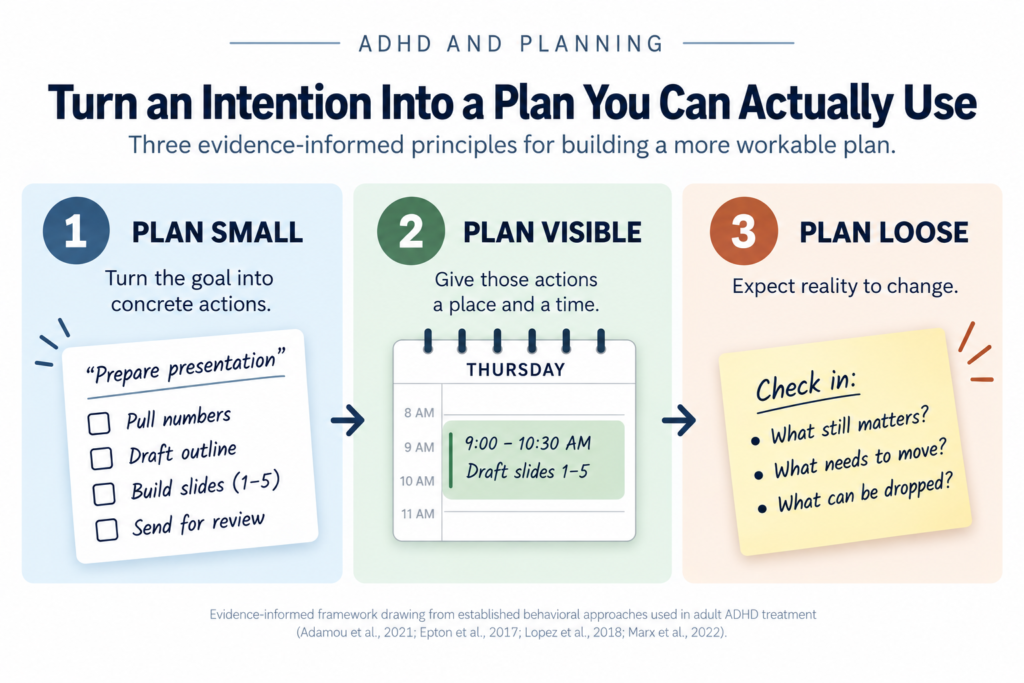
A Simple Framework: Plan Small, Plan Visible, Plan Loose
One way to put these ideas into practice is to use three questions when turning an intention into a plan:
Can I make the plan smaller?
Can I make the plan visible?
Can I leave enough flexibility for the plan to change?
This gives us a simple framework:
1. Plan Small
Start by converting the goal into a small number of concrete, named actions.
Instead of:
Prepare presentation
try:
Pull last quarter’s numbers.
Draft presentation outline.
Build slides 1–5.
Build slides 6–10.
Send draft to Sarah for review.
Revise slides after feedback.
Breaking a larger goal into smaller actions reduces the amount of structure you have to generate while you are trying to work.
There is strong broader behavior-change evidence supporting goal setting and subgoal formation, and task decomposition is commonly incorporated into adult ADHD CBT and occupational interventions. However, research isolating task decomposition as a standalone intervention specifically in adults with ADHD is limited (Epton et al., 2017; Rai et al., 2023; Lopez et al., 2018).
The practical test is:
Could I look at each step and immediately know what “doing it” means?
If not, the step may still be too vague.
2. Plan Visible
Once the steps exist, move them outside your head.
Put them somewhere you will actually see and use them—a calendar, planner, task manager, whiteboard, or another system that fits your life.
This matters because externalizing information reduces the need to keep the entire plan active in working memory. Written plans, calendars, lists, cues, and reminders are commonly incorporated into CBT and compensatory approaches for adults with ADHD (Lopez et al., 2018).
But visibility involves more than writing down the names of the tasks.
Give the steps time.
Instead of:
Thursday: Work on presentation
try:
Thursday, 9:00–10:30: Draft slides 1–5.
And when possible, base your time estimate on experience rather than optimism.
Ask:
How long did something similar actually take me last time?
Then consider whether the plan needs room for setup, transitions, interruptions, or unexpected problems.
The goal is not to create a perfect schedule.
It is to make the invisible parts of the plan more visible before they become emergencies.
3. Plan Loose
Finally, assume something will change.
Build a checkpoint into the plan before you need one.
For example:
Friday at 4:00: Review what was completed and adjust next week’s plan.
The purpose is not to judge whether you followed the plan correctly.
It is to ask:
What actually happened?
What still matters?
What needs to move?
What no longer needs to happen?
This turns revision into part of the planning process rather than something you do only after the plan has “failed.”
Research on cognitive flexibility and ADHD provides a reasonable clinical basis for this approach, while progress monitoring and plan revision are also incorporated into structured ADHD interventions. The specific Plan Small, Plan Visible, Plan Loose framework, however, has not itself been tested as a clinical intervention.
It is an evidence-informed organizing tool, not a validated ADHD treatment protocol. Its components draw from research and established behavioral approaches involving task decomposition, externalization, time management, monitoring, and plan revision (Lopez et al., 2018; Adamou et al., 2021; Epton et al., 2017; Marx et al., 2022).
A Worked Example
Consider Maya, a healthcare administrator preparing a continuing-education presentation that is due in three weeks.
Her intention is clear:
I want to get this presentation finished early so I’m not scrambling at the end.
She puts this on her calendar:
Saturday: Work on presentation.
It feels like a plan.
But it is mostly an intention with a time attached to it.
“Work on presentation” does not specify what Maya will actually do. It does not identify which parts need to happen first, how long they will take, or where feedback and revision fit into the timeline.
When Saturday arrives, the project is almost as undefined as it was when she put it on the calendar.
Now apply the framework.
Plan Small
Maya identifies the actual work:
- Confirm topic and learning objectives.
- Find the three key studies.
- Build the presentation outline.
- Draft the first half of the slides.
- Draft the second half.
- Develop the case example.
- Complete a practice run.
- Revise the presentation.
Now “presentation” is no longer one enormous task.
It is a sequence.
Plan Visible
Maya assigns the steps to specific blocks across the next three weeks rather than putting the entire project into one weekend.
She also looks at how long similar work has taken her previously instead of estimating how quickly she thinks she should be able to do it.
And she leaves some room between completing the draft and the final deadline.
Now the calendar reflects more of the project’s actual workload.
Plan Loose
At the end of the first week, Maya schedules a brief review.
She planned to have the outline and first slides finished.
Instead, gathering the research took longer than expected.
The old response might have been:
I’m behind already.
The new question is:
What does the plan need to become now?
She moves one block, shortens another part of the presentation, and preserves the time she needs for the practice run.
The plan changed.
The goal did not.
That distinction is important.
Maya’s motivation was present from the beginning. What changed was the structure between wanting the presentation completed and knowing what she would actually do next, when she would do it, and how she would adjust when reality differed from the original plan.
When Planning Difficulties May Warrant an ADHD Evaluation
Difficulty planning does not, by itself, mean someone has ADHD.
Planning and other executive-function difficulties can occur with a number of conditions, including anxiety, depression, bipolar disorder, PTSD, sleep disorders, substance use, traumatic brain injury, and some medical conditions. Medication effects, chronic stress, major life changes, and sustained occupational or family demands can also affect attention and executive functioning (Cortese et al., 2025; Olagunju & Ghoddusi, 2024).
This is one reason a good ADHD evaluation looks beyond whether someone currently has difficulty concentrating, organizing, or planning.
ADHD is a neurodevelopmental disorder. In adults, evaluation generally considers whether ADHD symptoms were present during childhood, whether difficulties occur across more than one area of life, whether they cause meaningful impairment, and whether another condition better explains the symptoms.
A comprehensive adult ADHD evaluation may include a detailed clinical history, DSM-5-TR criteria, validated ADHD rating scales, information about childhood functioning, collateral information when available, and careful assessment for other conditions that can resemble or coexist with ADHD (Olagunju & Ghoddusi, 2024; Cortese et al., 2025).
Formal neuropsychological testing is not routinely required to diagnose adult ADHD, and normal performance on an executive-function test does not necessarily rule ADHD in or out. The diagnosis depends on the broader developmental and clinical picture.
If planning difficulties are part of a larger, longstanding pattern involving attention, organization, time management, impulsivity, task initiation, or other executive-function difficulties, a comprehensive evaluation can help clarify whether ADHD—or something else—may be contributing.
For more information, see Adult ADHD Diagnosis in California: What to Expect and ADHD Evaluation and Treatment in Southern California.
If anxiety seems to be a major part of the picture, see ADHD vs Anxiety.
ADHD and Planning: The Bottom Line
You can know what needs to happen.
You can care about the outcome.
You can fully intend to get it done.
And still have difficulty building the bridge between intention and action.
For some adults with ADHD, that bridge becomes harder to construct because planning depends on several executive processes operating together: keeping information available, generating steps, sequencing them, estimating time, resisting competing demands, monitoring progress, and adjusting when circumstances change.
The goal is not to create a perfect plan.
It is to create a plan that asks less of memory, makes the next steps and time demands more visible, and can survive when real life does not cooperate.
That may mean remembering three ideas:
Plan Small.
Make the work concrete enough that you can see what actually needs to happen.
Plan Visible.
Put the steps and the time somewhere outside your head.
Plan Loose.
Expect to revise the plan rather than interpreting revision as failure.
Because a useful plan is not the one that looks perfect when you create it.
It is the one that still helps you know what to do next when the week stops going according to plan.
Frequently Asked Questions
Is difficulty planning a symptom of adult ADHD?
Planning and organization difficulties are commonly associated with ADHD and are often addressed in adult ADHD treatment. However, they are not universal, and planning difficulty by itself does not establish an ADHD diagnosis. Research shows substantial variability in executive functioning among adults with ADHD (Cortese et al., 2025; Onandia-Hinchado et al., 2021).
Why can I make plans but never follow them?
There can be several reasons. The plan may be too vague, rely heavily on working memory, underestimate how long tasks will take, or fail to account for interruptions and changing priorities. In other cases, the planning itself may be adequate and the difficulty may instead involve task initiation, attention, motivation, or another executive process.
Is “time blindness” part of ADHD?
“Time blindness” is commonly used to describe ADHD-related difficulties with experiencing or managing time, but it is not a formal diagnostic construct. Research does support differences in specific processes such as time estimation, time reproduction, and temporal processing in ADHD, although these differences vary between individuals (Marx et al., 2022; Mette, 2023).
Are planners and calendars effective for adults with ADHD?
External calendars, planners, lists, reminders, and other organizational tools are commonly included in evidence-based behavioral interventions for adult ADHD. They can reduce reliance on working memory and make future intentions more visible. However, most of these strategies have been studied as components of broader treatment programs rather than as isolated interventions (Lopez et al., 2018).
Can ADHD medication improve planning?
ADHD medication can improve core ADHD symptoms and may improve some aspects of executive functioning, including working memory and self-reported planning or organization. Effects vary between individuals and medications, and medication does not automatically teach planning skills or organizational systems (Isfandnia et al., 2024).
What is the difference between ADHD planning problems and procrastination?
Planning involves determining how a goal will be accomplished. Procrastination involves delaying an intended action despite expecting negative consequences from the delay. The two can interact, but they are not the same process. Someone can procrastinate despite having a good plan, or struggle to plan without intentionally delaying the task.
Medical Review & Author Information
Written and medically reviewed by Troy Don, DC, AGACNP-BC, PMHNP-BC
Learn more about the author’s training, clinical experience, and professional background on the Clinical Credentials & Professional Background page.
Last medically reviewed: September 2026
Evidence reviewed through: September 2026
Medical Disclaimer
This article is for educational purposes only and is not a substitute for individualized medical advice, diagnosis, or treatment. If you have questions about ADHD, mental health symptoms, medications, or treatment options, discuss them with an appropriate healthcare professional.
References
Adamou, M., Asherson, P., Arif, M., et al. (2021). Recommendations for occupational therapy interventions for adults with ADHD: A consensus statement from the UK Adult ADHD Network. BMC Psychiatry, 21(1), 72. https://doi.org/10.1186/s12888-021-03070-z
Altgassen, M., Heinrich, H., & Edel, M. A. (2026). Episodic future thinking improves everyday prospective memory performance in adults with a previous diagnosis of attention deficit hyperactivity disorder by community providers. Journal of Attention Disorders, 30(5), 705–721. https://doi.org/10.1177/10870547261416467
Cortese, S., Bellgrove, M. A., Brikell, I., et al. (2025). Attention-deficit/hyperactivity disorder (ADHD) in adults: Evidence base, uncertainties and controversies. World Psychiatry, 24(3), 347–371. https://doi.org/10.1002/wps.21374
Epton, T., Currie, S., & Armitage, C. J. (2017). Unique effects of setting goals on behavior change: Systematic review and meta-analysis. Journal of Consulting and Clinical Psychology, 85(12), 1182–1198. https://doi.org/10.1037/ccp0000260
Fuermaier, A. B. M., Tucha, L., Koerts, J., et al. (2013). Complex prospective memory in adults with attention deficit hyperactivity disorder. PLOS ONE, 8(3), e58338. https://doi.org/10.1371/journal.pone.0058338
Isfandnia, F., El Masri, S., Radua, J., & Rubia, K. (2024). The effects of chronic administration of stimulant and non-stimulant medications on executive functions in ADHD: A systematic review and meta-analysis. Neuroscience & Biobehavioral Reviews, 162, 105703. https://doi.org/10.1016/j.neubiorev.2024.105703
Liu, Y., Zhu, F., Yu, Y., et al. (2026). A meta-analysis of the intervention effect of cognitive behavioral therapy on adult ADHD. Journal of Affective Disorders, 121107. https://doi.org/10.1016/j.jad.2025.121107
Lopez, P. L., Torrente, F. M., Ciapponi, A., et al. (2018). Cognitive-behavioural interventions for attention deficit hyperactivity disorder (ADHD) in adults. Cochrane Database of Systematic Reviews, (3), CD010840. https://doi.org/10.1002/14651858.CD010840.pub2
Marx, I., Cortese, S., Koelch, M. G., & Hacker, T. (2022). Meta-analysis: Altered perceptual timing abilities in attention-deficit/hyperactivity disorder. Journal of the American Academy of Child & Adolescent Psychiatry, 61(7), 866–880. https://doi.org/10.1016/j.jaac.2021.12.004
Mette, C. (2023). Time perception in adult ADHD: Findings from a decade—A review. International Journal of Environmental Research and Public Health, 20(4), 3098. https://doi.org/10.3390/ijerph20043098
Mohamed, S. M. H., Butzbach, M., Fuermaier, A. B. M., et al. (2021). Basic and complex cognitive functions in adult ADHD. PLOS ONE, 16(9), e0256228. https://doi.org/10.1371/journal.pone.0256228
Olagunju, A. E., & Ghoddusi, F. (2024). Attention-deficit/hyperactivity disorder in adults. American Family Physician, 110(2), 157–166.
Onandia-Hinchado, I., Pardo-Palenzuela, N., & Diaz-Orueta, U. (2021). Cognitive characterization of adult attention deficit hyperactivity disorder by domains: A systematic review. Journal of Neural Transmission, 128(7), 893–937. https://doi.org/10.1007/s00702-021-02302-6
Ortega, R., López, V., Carrasco, X., et al. (2020). Neurocognitive mechanisms underlying working memory encoding and retrieval in attention-deficit/hyperactivity disorder. Scientific Reports, 10(1), 7771. https://doi.org/10.1038/s41598-020-64678-x
Pan, M. R., Zhang, S. Y., Qiu, S. W., et al. (2022). Efficacy of cognitive behavioural therapy in medicated adults with attention-deficit/hyperactivity disorder in multiple dimensions: A randomised controlled trial. European Archives of Psychiatry and Clinical Neuroscience, 272(2), 235–255. https://doi.org/10.1007/s00406-021-01236-0
Pironti, V. A., Lai, M. C., Morein-Zamir, S., et al. (2016). Temporal reproduction and its neuroanatomical correlates in adults with attention deficit hyperactivity disorder and their unaffected first-degree relatives. Psychological Medicine, 46(12), 2561–2569. https://doi.org/10.1017/S003329171600101X
Rai, A., Sharif, M. A., Chang, E. H., Milkman, K. L., & Duckworth, A. L. (2023). A field experiment on subgoal framing to boost volunteering: The trade-off between goal granularity and flexibility. Journal of Applied Psychology, 108(4), 621–634. https://doi.org/10.1037/apl0001040
Somogyi, S., Kilencz, T., Szőcs, K., et al. (2024). Differential neurocognitive profiles in adult attention-deficit/hyperactivity disorder subtypes revealed by the Cambridge Neuropsychological Test Automated Battery. European Archives of Psychiatry and Clinical Neuroscience, 274(7), 1741–1758. https://doi.org/10.1007/s00406-023-01702-x
Stelz, S., Edel, M. A., & Altgassen, M. (2026). The impact of process- versus outcome-focused episodic future thinking on everyday prospective memory in individuals with and without attention-deficit/hyperactivity disorder (ADHD). Journal of Experimental Psychology: Applied. Advance online publication. https://doi.org/10.1037/xap0000586
Taş Dölek, G., Ozel-Kizil, E. T., Bastug, G., Baran, Z., & Colak, B. (2021). Impaired auditory and visual time reproduction in adult patients with attention deficit-hyperactivity disorder. Journal of Clinical and Experimental Neuropsychology, 43(2), 176–186. https://doi.org/10.1080/13803395.2021.1898549