
Table of Contents
ToggleUnderstanding Difficulty Prioritizing With Adult ADHD—and What Can Make It Easier
You know what needs to get done.
- The client email needs a response….
- The presentation is due next week…
- You need to call your child’s school,
- review a bill,
- refill a prescription,
- prepare for tomorrow’s meeting,
- answer the message you have avoided for three days,
- and somehow make progress on the project that could actually matter most for your career.
None of these things is unimportant.
That is the problem.
ADHD and prioritization can become especially frustrating in moments like this: you know several things genuinely matter, but deciding what deserves your attention first is surprisingly difficult.
You look at the list and cannot tell what deserves your attention first. You reorganize it. You make a new list. You color-code it. You start with a small task because at least it is clear. Then an email arrives, something becomes urgent, and suddenly you can work for three hours straight—usually on the thing that is now closest to becoming a problem.
For some adults with ADHD or suspected ADHD, difficulty prioritizing may reflect a combination of executive-function and motivational demands: holding competing responsibilities in mind, comparing consequences, resisting more immediately rewarding alternatives, estimating time, and turning a decision into action.
Difficulty prioritizing with ADHD is not necessarily a lack of ambition, intelligence, or awareness. You may know exactly what matters and still struggle to consistently select and begin the task that deserves your attention first.
There is a reason this can happen. There are also practical ways to make ADHD prioritization easier.
Prioritizing Is More Than Making a List
Prioritization is the process of deciding what should receive attention now, what can wait, and what does not need to be done at all.
That sounds straightforward, but several mental operations are involved.
- You need to hold possible tasks in mind,
- estimate their importance and consequences,
- consider what may happen later if you delay them,
- resist competing options,
- decide on a sequence,
- and begin the selected task.
Decision-making models describe interactions among executive control, prospective thinking, and the evaluation of available choices (Sonuga-Barke et al., 2016). In everyday life, that can look like deciding whether to prepare for an important meeting next week, complete an expense report due tomorrow, respond to an emotionally charged text, or clean the kitchen because it is visible and immediately satisfying.
For an adult with ADHD, that ranking process may sometimes be more effortful or more vulnerable to what is happening in the moment.
This helps explain why knowing what is important is not always the same as being able to act on it.
A high-achieving professional with ADHD may fully understand that preparing a strategic proposal has more long-term value than checking messages. Yet when it is time to work, the inbox is visible, provides immediate feedback, offers small moments of completion, and may contain an urgent problem.
The proposal is still important. It simply has more competition for attention.
ADHD is associated with difficulties in self-regulation and consistent goal-directed behavior. In practice, this can create a frustrating gap between knowing what you intend to do and reliably carrying out that intention when it matters (Posner et al., 2020; Cortese et al., 2025).
Why ADHD and Prioritization Can Be Difficult
ADHD is associated with differences in executive functioning, although the pattern varies substantially from person to person. Not every adult with ADHD has the same executive-function profile, and not every difficulty with planning, organization, or prioritization is caused by ADHD (Cortese et al., 2025).
Still, several executive-function domains can make ADHD task prioritization more difficult.
Working memory: Keeping priorities visible
Working memory is the mental workspace used to temporarily hold and manipulate information. It helps when you are trying to compare several tasks—their deadlines, consequences, estimated demands, and next steps (Posner et al., 2020).
When that mental workspace becomes overloaded, maintaining a stable picture of competing responsibilities can become more difficult.
One task may dominate your attention when you see it, only to fade from awareness when something else appears. Another may remain vague because its deadline is distant or because you have not yet broken it into specific steps.
This can contribute to the experience that everything feels important.
That does not mean working-memory difficulty has been proven to be the single cause of this experience. Prioritization involves multiple processes. But reducing how much information must be held internally is a reasonable practical strategy.
A written list, calendar, visual cue, or reminder can make important information visible without requiring you to continuously keep every responsibility in mind.
Planning and organization: Turning a priority into a sequence
A task can be important and still be difficult to start.
“Prepare the quarterly report” is not one action. It may involve finding data, deciding on a structure, reviewing prior reports, scheduling time, drafting slides, asking for feedback, and revising.
If the task remains a large, undefined project, beginning requires additional decisions.
Planning and organization difficulties are common functional concerns in adults with ADHD and can affect sequencing and follow-through (Roselló et al., 2020).
The practical implication is simple: once you identify a priority, define what actually happens next.
“Work on the quarterly report” is vague.
“Open last quarter’s report and write the three-section outline at 9:00 a.m.” is actionable.
Inhibition and cognitive flexibility: Resisting the competing option
Prioritizing also requires resisting alternatives.
You may intend to review a contract but first check one message. That message leads to another email, then a quick online search, then a task that feels easier or more interesting.
The diversion does not necessarily mean you stopped caring about the contract.
Adults with ADHD can experience difficulties with inhibitory control and maintaining goal-directed behavior in the presence of competing stimuli, although findings vary across individuals and tasks (Posner et al., 2020; Cortese et al., 2025).
Emerging research has also examined whether some inhibitory-control difficulties in adults with ADHD may involve delayed preparation of goal-directed responses, potentially allowing automatic responses more opportunity to influence behavior (Osborne et al., 2026). This is an evolving area of research rather than a complete explanation of everyday ADHD behavior.
In practical terms, whatever is visible, stimulating, or immediately actionable can sometimes compete successfully with what you had intended to do.
Time estimation: Why “not urgent” can feel distant
Many adults with ADHD use the phrase “time blindness” to describe difficulty sensing, estimating, or planning around time. It is not a formal diagnosis.
Research has identified differences in aspects of time perception among adults with ADHD, although findings are heterogeneous and should not be assumed to apply identically to every person (Weissenberger et al., 2021; Mette, 2023).
In everyday life, difficulties estimating or planning around time may make distant deadlines harder to incorporate into current decisions.
A project due next month can remain abstract even when you know it deserves attention. As the deadline approaches, the consequences become immediate and the task becomes harder to ignore.
This can contribute to a cycle of reactive productivity:
- Important work feels distant or difficult to start.
- Smaller or more immediate tasks take over.
- The deadline approaches.
- The consequences become harder to ignore.
- The task finally receives sustained attention—often under significant pressure.
Being able to perform well under pressure does not necessarily mean pressure is a healthy or sustainable productivity strategy. Urgency may simply change how strongly the task competes for attention in the present.
Why Urgency, Interest, and Immediate Reward Can Influence Priorities
ADHD research has examined differences in how immediate and delayed outcomes influence decision-making and motivation.
Studies of adults with ADHD have found evidence of reward-delay impulsivity and altered decision-making involving immediate versus delayed outcomes, although these findings should be understood as group-level tendencies rather than rules that explain every individual behavior (Chen et al., 2024; Koirala et al., 2024).
This does not mean adults with ADHD do not care about long-term goals.
Rather, a delayed consequence may sometimes have difficulty competing in the present with something that provides immediate feedback, stimulation, relief, emotional relevance, or an approaching consequence.
Consider two tasks:
- Draft a plan that could improve your team’s operations over the next quarter.
- Respond to an email that takes two minutes and produces an immediate sense of relief.
The plan may matter more.
But the email is visible, finite, socially relevant, and immediately actionable. The plan is delayed, uncertain, cognitively demanding, and may provide little immediate feedback.
This is one reason ADHD productivity can appear inconsistent. Someone may struggle to begin an important administrative task yet become highly engaged in an urgent crisis, an interesting problem, or a task with immediate consequences.
Clinical guidance for adults with ADHD recognizes that distractibility and competing activities can interfere with planned behavior and recommends organizational and environmental strategies to help maintain attention to intended tasks (Adamou et al., 2021).
The practical response is not simply to demand more motivation from yourself.
It is to make an important task more visible, specific, time-bound, and connected to an immediate next action.
Prioritization, Overwhelm, Paralysis, Procrastination, and Anxiety
These experiences can overlap, but they are not interchangeable.
Difficulty prioritizing means having trouble ranking tasks and deciding what should happen first.
ADHD overwhelm is a useful way to describe the experience of demands feeling too numerous, vague, or emotionally loaded to manage effectively. Competing demands, executive-function difficulties, and emotional distress can all contribute.
ADHD paralysis is a common lived-experience term for becoming stuck—wanting or needing to act but having difficulty selecting or initiating a task. It is not a formal diagnosis. It may occur alongside overwhelm, competing demands, unclear first steps, or emotional distress. Learn more about ADHD paralysis.
Procrastination means delaying an intended task despite expecting that the delay may have negative consequences. A recent systematic review found a consistent positive association between ADHD symptoms and procrastination, particularly symptoms of inattention (Suriano, 2026). Executive-function difficulties, emotion regulation, motivation, and task value may contribute to this relationship (Netzer Turgeman & Pollak, 2026). Learn more about ADHD and Procrastination.
Anxiety can add another layer. Worry may make choices feel unusually high-stakes. You may overanalyze, seek certainty, fear making the wrong decision, or avoid beginning because the task feels risky.
Depression, sleep disruption, major stress, medical conditions, medication effects, substance use, and other concerns can also affect attention, motivation, and organization (Olagunju & Ghoddusi, 2024; Volkow & Swanson, 2013).
An adult can have ADHD, anxiety, both, or neither. Their symptoms can overlap, which is one reason a careful clinical evaluation looks at the pattern, history, context, and causes of attention difficulties rather than assuming that difficulty concentrating automatically means ADHD (Pagán et al., 2023).
Read more about ADHD vs Anxiety in adults.
Perfectionism can make prioritization even harder. If you believe you must choose the ideal task, complete it perfectly, or avoid every mistake, deciding what to do next can become another source of delay.
You do not need to identify the perfect priority.
You need a reasonable priority and a next action you can actually begin. Read more about ADHD and Perfectionism.
The PACE Method for ADHD and Prioritization
When everything feels important, a complicated productivity system may create another layer of decisions.
A simpler approach is to reduce what must be held mentally, evaluate consequences, choose a specific action, and make that action visible in your environment.
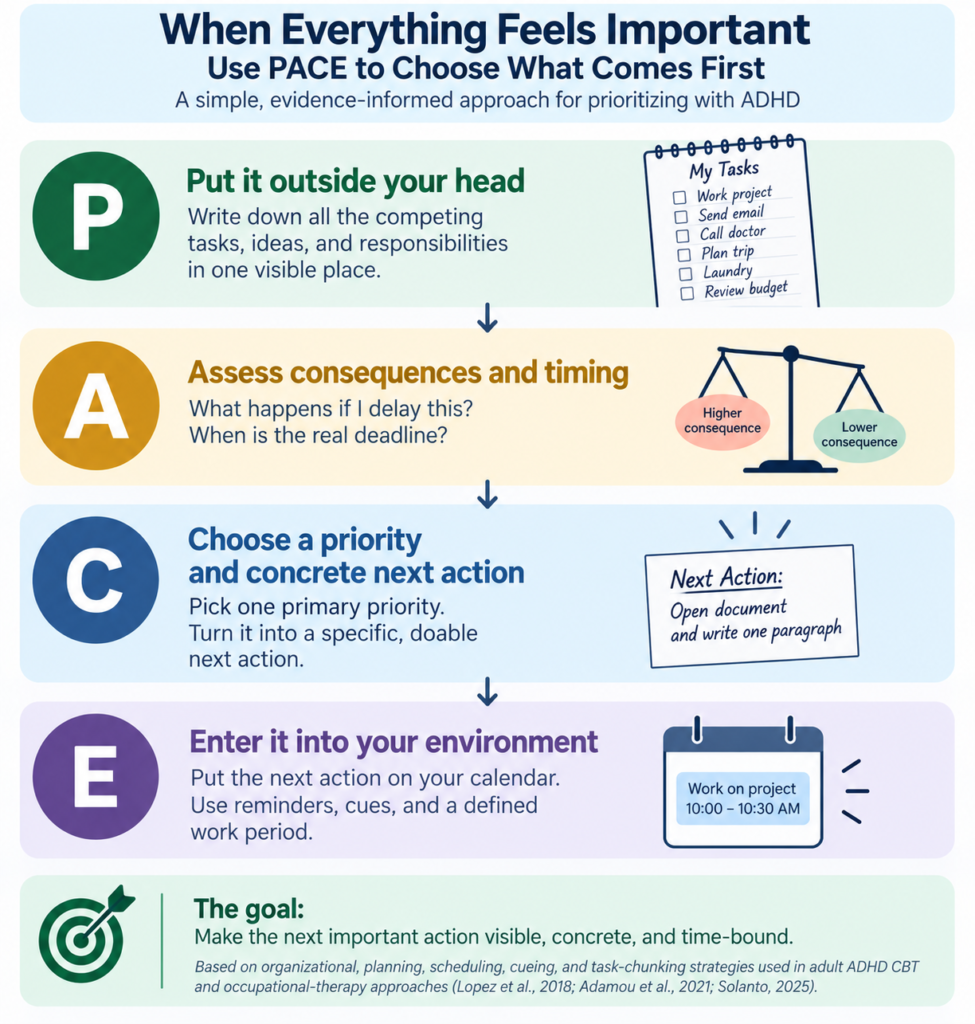
Use PACE:
- P — Put it outside your head.
- A — Assess consequences and timing.
- C — Choose a priority and concrete next action.
- E — Enter it into your environment.
PACE is an evidence-informed practical framework based on organizational, planning, scheduling, cueing, and task-chunking strategies used in adult ADHD cognitive behavioral therapy (CBT) and occupational-therapy approaches (Lopez et al., 2018; Adamou et al., 2021; Solanto, 2025).
The PACE acronym itself—and the recommendation to limit the day to one primary priority plus a small number of secondary priorities—has not been separately validated as an ADHD treatment. It is a practical way to apply broader evidence-informed organizational principles.
P: Put it outside your head
Start with one capture list.
Write down the active demands competing for your attention. You can use paper, a notes app, a task manager, or another system you reliably review.
Do not try to rank everything while you are still trying to remember everything.
A short list might look like this:
- Review contract before Friday meeting
- Submit expense report
- Refill prescription
- Schedule child’s dental appointment
- Prepare presentation outline
- Respond to client email
- Pay utility bill
A list is not yet a plan.
Its first purpose is to make the competing responsibilities visible so you do not have to continually reconstruct them from memory.
A: Assess consequences and timing
Now ask three questions:
- What happens if I do not address this soon?
- When is the actual deadline or consequence?
- Is there something I can do now that prevents a larger problem later?
This helps distinguish importance from urgency.
A task may deserve priority when continued delay creates a meaningful consequence: a missed deadline, financial penalty, relationship problem, lost opportunity, safety concern, or preventable future crisis.
For example:
- A prescription refill may take only a few minutes but be time-sensitive because running out could have a health consequence.
- A quarterly strategy project may not be due today, but starting early may prevent a stressful last-minute rush.
- Clearing every email may feel urgent without being the most consequential use of the next hour.
Once you have considered consequences and timing, choose:
- One primary priority: the task that most needs meaningful progress now.
- Up to two secondary priorities: smaller but important tasks that can realistically fit around it.
There is no ADHD-specific trial establishing that three is the ideal number of daily priorities. This is simply a practical way to create a usable daily view when a much larger list is creating overload.
C: Choose a priority and concrete next action
Once you know the priority, turn it into something you can actually do.
A project is not a next action.
Instead of:
- “Prepare for the board meeting”
- “Get finances organized”
- “Work on marketing”
- “Deal with insurance”
Try:
- “Open the board-meeting agenda and list the three decisions I need to prepare for.”
- “Download the last two bank statements into the tax folder.”
- “Draft five bullet points for the services-page update.”
- “Call the insurer and ask whether prior authorization is required.”
Make the first action small and specific enough that beginning it does not require another planning session.
If you still feel stuck, reduce the first step further.
The immediate goal is not necessarily to finish the entire project. It is to make the beginning clear enough to act on.
Breaking larger activities into manageable steps is consistent with CBT and occupational-therapy approaches for adults with ADHD that emphasize planning, sequencing, organization, and external supports (Lopez et al., 2018; Adamou et al., 2021).
E: Enter it into your environment
A priority remains vulnerable when it exists only on a task list.
Give the next action a place and time.
Put it on your calendar. Use an alarm or reminder when helpful. Make the necessary materials easy to access. Reduce unrelated visual or digital distractions during the work period.
For example:
Tuesday, 9:00 a.m.: Open the proposal template and draft the problem statement.
This does not guarantee that you will feel motivated when the calendar reminder appears.
It does reduce the need to make the entire prioritization decision again in that moment.
Short work blocks can also make an unclear or intimidating task easier to approach. The appropriate length depends on the task and the person; the important point is to create a realistic starting period rather than waiting for an ideal stretch of uninterrupted time.
If you miss the planned block, reassess and reschedule it rather than automatically allowing the task to disappear from the plan.
For a more detailed strategy, see time blocking for ADHD.
Reassess on a schedule—not every few minutes
Priorities sometimes need to change.
A client calls with an emergency. Your child becomes sick. A deadline moves. New information changes what matters.
The goal is not rigid adherence to yesterday’s plan.
But repeatedly reorganizing the list can consume time without moving important work forward. Instead, consider reviewing priorities at defined points—for example, at the beginning of the day and during a planned weekly review—while allowing genuine new information to change the plan when necessary.
This gives you flexibility without requiring continuous reprioritization.
A Worked Example
Jordan is a 42-year-old healthcare administrator who is respected at work, manages a busy household, and is often described as highly capable.
On Thursday morning, Jordan has:
- A strategic proposal due next Wednesday.
- A compliance report due tomorrow at 4:00 p.m.
- Sixteen unanswered emails.
- A child’s school form due Monday.
- A bill that must be paid today to avoid a late fee.
- A presentation idea that feels exciting and easy to work on.
- A vague intention to “get caught up.”
Jordan feels overwhelmed and starts reorganizing the task list.
Using PACE, Jordan first puts every task in one place.
Next comes consequences and timing:
Task | Consequence of delay | Timing | Decision |
Compliance report | Missed work deadline; may affect team workflow | Tomorrow at 4:00 p.m. | Primary priority |
Bill payment | Late fee or service issue | Today | Secondary priority |
School form | Child may miss a school-related deadline | Monday | Secondary priority |
Strategic proposal | Important long-term project value | Next Wednesday | Protected early block tomorrow |
Inbox | Some messages may matter, but not all require immediate response | Ongoing | Triage later in a contained block |
Presentation idea | Interesting but not time-sensitive | No deadline | Capture the idea; do not begin today |
The school form remains a secondary priority because it is deadline-bound and can be completed without displacing the larger primary work block. The strategic proposal is also important, but Jordan protects time for it the following morning rather than allowing it to compete with tomorrow’s compliance deadline.
Jordan then converts the primary priority into a concrete next action:
9:15 a.m.: Open the compliance-report template, pull up the source data, and complete the first section.
Jordan enters the block on the calendar, silences notifications, and keeps a notepad nearby for unrelated thoughts.
After the work block, Jordan pays the bill and completes the school form during two short administrative periods.
The strategic proposal has not been forgotten. It has been given a protected starting point on Friday morning:
Friday, 9:00 a.m.: Write the proposal outline and identify missing information.
The objective is not to solve every demand at once.
It is to make the most useful next decision visible, concrete, and time-bound.
Common Traps for Prioritization and ADHD for Adults
Some common productivity habits can create more friction instead of more clarity.
Endless task lists
A list with 40 items does not tell you what deserves attention first.
Keep a master capture list if you need one, but consider creating a much shorter daily view containing your primary priority and a small number of secondary tasks.
Vague labels
“Catch up,” “organize,” and “work on the project” are not actions.
Each requires another round of decisions before you can begin.
Convert the priority into a visible next step.
Treating every task as urgent
If every task is labeled high priority, the system no longer distinguishes consequences.
Reserve urgency for genuine near-term deadlines, significant consequences, safety concerns, or time-sensitive opportunities.
Then ask a different question about important work that is not yet urgent:
What needs to begin now so that it does not become tomorrow’s emergency?
Relying on memory
Important tasks are easier to act on when they are visible at the appropriate time.
Calendars, lists, reminders, progress monitoring, and environmental modifications are commonly included in CBT and occupational-therapy approaches for adults with ADHD (Lopez et al., 2018; Adamou et al., 2021).
Use those tools to support your plan rather than requiring yourself to continually remember and reconstruct it.
Rebuilding the system every week
A new app, planner, or color-coding system can feel promising.
But repeatedly changing tools creates additional setup, learning, and decisions.
The best system is not necessarily the most sophisticated one. A simple calendar and one consistently reviewed task list may be more useful than an elaborate system you rarely open.
Waiting to feel ready
Important work may be boring, uncertain, cognitively demanding, or emotionally uncomfortable.
Instead of waiting for the task to become appealing, reduce the first step.
Open the document. Pull up the data. Write the first heading. Place the phone call.
The goal is to make beginning easier rather than waiting for motivation to arrive first.
When Professional Help May Be Useful
Everyone struggles to prioritize at times, particularly during periods of high demand, poor sleep, illness, major stress, or transition.
Persistent difficulty prioritizing does not automatically mean ADHD.
However, a professional ADHD evaluation may be worth considering when difficulties with attention, organization, prioritization, time management, task initiation, or follow-through are longstanding and meaningfully interfere with work, finances, relationships, education, health, or everyday functioning.
A comprehensive adult ADHD evaluation looks beyond your current to-do list.
It considers developmental and childhood history, symptoms across settings, functional impairment, medical and mental health history, and other possible explanations for similar symptoms.
Anxiety, depression, sleep disorders, thyroid dysfunction, medication effects, substance use, major stress, and prior brain injury can all contribute to attention or executive-function difficulties and may need to be considered during assessment (Olagunju & Ghoddusi, 2024; Volkow & Swanson, 2013).
For California residents, adult ADHD diagnosis in California explains what a comprehensive evaluation may involve.
AdultADHDCalifornia.com also provides information about ADHD evaluation and treatment services in California.
ADHD and Prioritization: The Bottom Line
Difficulty prioritizing with ADHD can be frustrating precisely because you may already know what matters.
The challenge is not always identifying your goals intellectually. Prioritization also depends on executive functions, planning, time-related processes, self-regulation, and the ability to maintain goal-directed behavior when other demands compete for attention.
When everything feels important, do not require yourself to solve the entire list internally.
Use PACE:
- Put the competing demands outside your head.
- Assess consequences and actual timing.
- Choose a priority and concrete next action.
- Enter that action into your calendar and environment.
The goal is not perfect productivity.
It is to build a more reliable bridge between knowing what matters and doing the next thing that supports it.
For a broader understanding of how skills such as working memory, planning, inhibition, task initiation, and self-regulation interact in ADHD, see The Complete Guide to Executive Function in Adult ADHD (availalbe soon).
Frequently Asked Questions About ADHD and Prioritization
Why is prioritizing difficult with ADHD?
Prioritizing requires several mental processes to work together, including working memory, planning, inhibition, estimating future consequences, and maintaining goal-directed behavior. Adults with ADHD can experience difficulties in some of these areas, which may make it harder to consistently decide what deserves attention first (Posner et al., 2020; Cortese et al., 2025).
Why does everything feel equally important with ADHD?
There is not one proven ADHD mechanism that makes every task feel equally important. However, competing demands can become harder to rank when working memory is overloaded, deadlines are difficult to incorporate into present decisions, or more immediate and salient tasks compete for attention. Externalizing tasks and comparing their consequences can make those priorities easier to evaluate.
Why do people with ADHD sometimes wait until something becomes urgent?
ADHD research has identified differences in how immediate and delayed outcomes can influence motivation and decision-making. For some adults, an approaching deadline makes the consequences of a task more immediate, allowing it to compete more effectively for attention. This may help explain why important work is sometimes easier to engage with once it becomes urgent (Chen et al., 2024; Koirala et al., 2024).
How can I prioritize tasks when I have ADHD?
Start by putting competing tasks outside your head in one visible place. Then compare their consequences and actual deadlines, choose a primary priority, turn it into a specific next action, and schedule that action. Strategies involving external reminders, task breakdown, scheduling, and organizational supports are commonly used in evidence-based CBT and occupational-therapy approaches for adults with ADHD (Lopez et al., 2018; Adamou et al., 2021).
Does difficulty prioritizing mean I have ADHD?
No. Difficulty prioritizing can occur with stress, inadequate sleep, anxiety, depression, medical conditions, substance use, and other circumstances. ADHD evaluation considers a broader pattern of symptoms, including developmental history, impairment, symptoms across settings, and alternative explanations—not prioritization difficulty alone (Olagunju & Ghoddusi, 2024; Volkow & Swanson, 2013).
Medical Review & Author Information
Written and medically reviewed by Troy Don, DC, AGACNP-BC, PMHNP-BC
For additional information about clinical education, professional credentials, and background, see Clinical Credentials & Professional Background.
Last medically reviewed: September 2026
Evidence reviewed through: September 2026
Medical Disclaimer
This article is for educational purposes only and is not a substitute for individualized medical advice, diagnosis, or treatment. If you have questions about ADHD, mental health symptoms, medications, or treatment options, discuss them with an appropriate healthcare professional.
References
Adamou, M., Asherson, P., Arif, M., et al. (2021). Recommendations for occupational therapy interventions for adults with attention-deficit/hyperactivity disorder: A consensus statement from the UK adult ADHD network. BMC Psychiatry, 21, 72. https://doi.org/10.1186/s12888-021-03070-z
Chen, C., Zhang, S., Hong, H., et al. (2024). Psychometric properties of the Chinese version of the Quick Delay Questionnaire (C-QDQ) and ecological characteristics of reward-delay impulsivity of adults with ADHD. BMC Psychiatry, 24, 251. https://doi.org/10.1186/s12888-024-05706-2
Cortese, S., Bellgrove, M. A., Brikell, I., et al. (2025). Attention-deficit/hyperactivity disorder (ADHD) in adults: Evidence base, uncertainties and controversies. World Psychiatry, 24(3), 347–371. https://doi.org/10.1002/wps.21374
Koirala, S., Grimsrud, G., Mooney, M. A., et al. (2024). Neurobiology of attention-deficit hyperactivity disorder: Historical challenges and emerging frontiers. Nature Reviews Neuroscience, 25(12), 759–775. https://doi.org/10.1038/s41583-024-00869-z
Lopez, P. L., Torrente, F. M., Ciapponi, A., et al. (2018). Cognitive-behavioural interventions for attention deficit hyperactivity disorder (ADHD) in adults. Cochrane Database of Systematic Reviews, 3, CD010840. https://doi.org/10.1002/14651858.CD010840.pub2
Mette, C. (2023). Time perception in adult ADHD: Findings from a decade—a review. International Journal of Environmental Research and Public Health, 20(4), 3098. https://doi.org/10.3390/ijerph20043098
Netzer Turgeman, R., & Pollak, Y. (2026). What are you waiting for?! Roles of motivation, goal orientation, and emotion regulation in explaining the link between ADHD and procrastination. Journal of Attention Disorders, 30(5), 694–704. https://doi.org/10.1177/10870547251408120
Olagunju, A. E., & Ghoddusi, F. (2024). Attention-deficit/hyperactivity disorder in adults. American Family Physician, 110(2), 157–166.
Osborne, J. B., Sellers, J., Zhang, H., et al. (2026). Delayed goal-directed processing underlies inhibitory control challenges in adult ADHD. Scientific Reports, 16, 13706. https://doi.org/10.1038/s41598-026-42307-3
Pagán, A. F., Huizar, Y. P., Short, T. R., Gotcher, Z., & Schmidt, A. T. (2023). Adult attention-deficit/hyperactivity disorder: A narrative review of biological mechanisms, treatments, and outcomes. Current Neurology and Neuroscience Reports, 23(8), 451–460. https://doi.org/10.1007/s11910-023-01280-4
Posner, J., Polanczyk, G. V., & Sonuga-Barke, E. (2020). Attention-deficit hyperactivity disorder. The Lancet, 395(10222), 450–462. https://doi.org/10.1016/S0140-6736(19)33004-1
Roselló, B., Berenguer, C., Baixauli, I., et al. (2020). Empirical examination of executive functioning, ADHD associated behaviors, and functional impairments in adults with persistent ADHD, remittent ADHD, and without ADHD. BMC Psychiatry, 20, 134. https://doi.org/10.1186/s12888-020-02542-y
Solanto, M. V. (2025). The efficacy of cognitive-behavioral therapy for adults with ADHD. World Psychiatry, 24(3), 378–379. https://doi.org/10.1002/wps.21349
Sonuga-Barke, E. J. S., Cortese, S., Fairchild, G., & Stringaris, A. (2016). Annual research review: Transdiagnostic neuroscience of child and adolescent mental disorders—Differentiating decision making in attention-deficit/hyperactivity disorder, conduct disorder, depression, and anxiety. Journal of Child Psychology and Psychiatry, 57(3), 321–349. https://doi.org/10.1111/jcpp.12496
Suriano, R. (2026). A systematic review on the association between ADHD and procrastination. Research in Developmental Disabilities, 175, 105342. https://doi.org/10.1016/j.ridd.2026.105342
Volkow, N. D., & Swanson, J. M. (2013). Adult attention-deficit/hyperactivity disorder. New England Journal of Medicine, 369(20), 1935–1944. https://doi.org/10.1056/NEJMcp1212625
Weissenberger, S., Schonova, K., Büttiker, P., et al. (2021). Time perception is a focal symptom of attention-deficit/hyperactivity disorder in adults. Medical Science Monitor, 27, e933766. https://doi.org/10.12659/MSM.933766