

You can be successful, educated, organized on the outside, and still have ADHD. For some high-achieving women, the question isn’t whether they can perform—it’s how much effort it takes to keep performing.
Table of Contents
ToggleYou’re Successful—So Why Does Everything Feel So Hard?
From the outside, your life may look like it’s working.
You have a career. You meet deadlines. People depend on you. Maybe you did well in school, earned an advanced degree, built a business, raised a family, or became the person everyone else counts on.
And yet, privately, things may feel very different.
You may constantly feel behind.
Simple tasks take more effort than you think they should.
You procrastinate until the pressure becomes impossible to ignore.
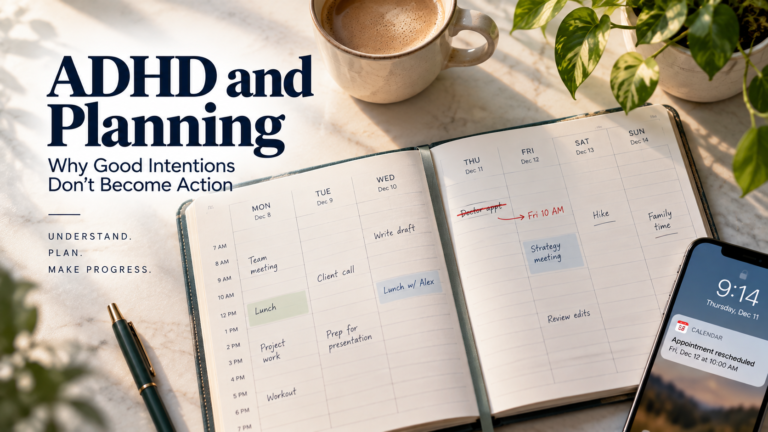
You depend on calendars, reminders, lists, alarms, and routines to keep everything from slipping through the cracks.
You may accomplish a lot—but finish the day wondering why maintaining your life seems to require so much effort.
Eventually, a surprising question may arise:
Could I have ADHD?
And that question is often followed immediately by another:
How could I have ADHD if I’ve been successful all my life?
For some women, that apparent contradiction is one reason ADHD isn’t recognized until adulthood.
Research suggests that girls and women with ADHD have historically been under-recognized, are more likely to show less disruptive or more inattentive symptoms, and may receive other mental health diagnoses before ADHD is considered (Hinshaw et al., 2022; Young et al., 2020).
At the same time, intelligence, academic success, professional achievement, and outward competence do not rule out ADHD. Research involving highly intelligent adults has found that ADHD remains a valid diagnosis even among people with high IQ and substantial cognitive strengths (Antshel et al., 2009; Rommelse et al., 2016).
Understanding ADHD in high-achieving women requires looking beyond what someone has accomplished.
Sometimes we need to ask a different question:
What has it taken for her to accomplish it?
Why ADHD in Women Can Be Missed
For decades, the cultural image of ADHD centered heavily on the disruptive, hyperactive school-aged boy.
But not everyone with ADHD looks like that.
Girls with ADHD are more likely than boys with ADHD to show predominantly inattentive symptoms and internalizing difficulties that may attract less attention from parents, teachers, and clinicians (Hinshaw et al., 2022).
Instead of disrupting the classroom, a girl may have been:
- Daydreaming
- Forgetful
- Quietly disorganized
- Losing belongings
- Struggling to start homework
- Taking much longer than expected to complete assignments
- Mentally drifting during conversations
- Working extremely hard to compensate
If she was intelligent, motivated, or supported by a highly structured environment, those difficulties may not have resulted in obvious academic failure.
She may have gotten good grades.
And because she got good grades, nobody asked what it took to get them.
Research supports a meaningful sex difference in ADHD recognition. A large study of healthcare records found that the male-to-female diagnostic gap was much larger in childhood than among people diagnosed as adults, with females also receiving diagnoses later on average (Martin et al., 2024).
That doesn’t mean every woman diagnosed later was necessarily “missed” as a child.
But it does help explain why some women reach their 30s, 40s, or beyond before ADHD is seriously considered.
High Achievement Does Not Rule Out ADHD
This point deserves emphasis:
Success is not an ADHD screening test.
A successful career does not prove that someone doesn’t have ADHD.
Neither does a college degree.
Neither does intelligence.
Neither does being responsible.
Studies of highly intelligent people with ADHD have found meaningful impairment despite their cognitive strengths. Research suggests that high intelligence may sometimes compensate for ADHD-related weaknesses, potentially making those difficulties less obvious (Antshel et al., 2009; Rommelse et al., 2016; Despature & Galiana, 2023).
This is particularly important when we talk about high-achieving adults with ADHD.
Achievement tells us something about the person’s outcomes.
It doesn’t necessarily tell us about the process required to produce those outcomes.
Two people can produce equally impressive work while having very different experiences getting there.
One finishes a project steadily over several weeks.
The other struggles to begin, thinks about it constantly, falls behind, works until 2 a.m. before the deadline, produces excellent work—and then spends the weekend recovering.
The outcome looks the same.
The experience does not.
If you’d like to explore this distinction more deeply, read our deep dive guide to High-Achieving Adults With ADHD.
ADHD in High-Achieving Women Can Hide Behind Compensation
One reason ADHD can be difficult to recognize in accomplished women is compensation.
Over time, people naturally develop ways of working around their weaknesses.
For someone with ADHD, that might mean relying heavily on:
- Detailed calendars
- Multiple alarms and reminders
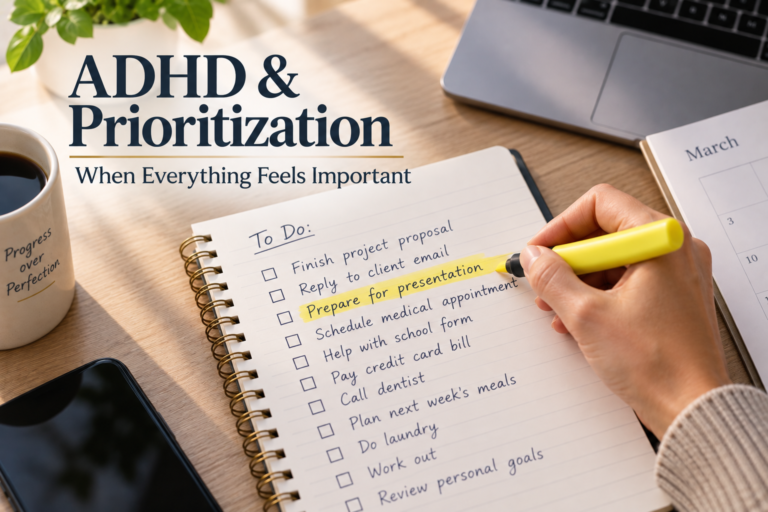
- Extensive to-do lists
- Strict routines
- Over-preparation
- Working longer than colleagues
- External deadlines
- Other people for accountability
- Constant checking and rechecking
Some women also describe masking—trying to conceal difficulties so other people don’t notice them.
The scientific literature around ADHD masking and compensation is still developing, so we should be careful not to treat every perfectionistic or highly organized behavior as evidence of ADHD.
But compensation itself is an important concept.
A woman can appear organized because she has built an elaborate system to prevent herself from becoming disorganized.
She can appear punctual because she is intensely afraid of being late and arrives 30 minutes early.
She can appear excellent at meeting deadlines because she repeatedly works late into the night to meet them.
She can appear calm in a meeting while internally struggling to follow the conversation and remember what she wanted to say.
The visible result may be competence.
The invisible experience may be considerable effort.
What ADHD May Look Like in a High-Achieving Woman
There isn’t a separate diagnosis called “high-functioning ADHD” or a special ADHD subtype for high-achieving women.
And being ambitious, busy, perfectionistic, or overwhelmed does not mean someone has ADHD.
But ADHD can sometimes look different from the stereotype people expect.
A high-achieving woman with ADHD may experience longstanding difficulties with:
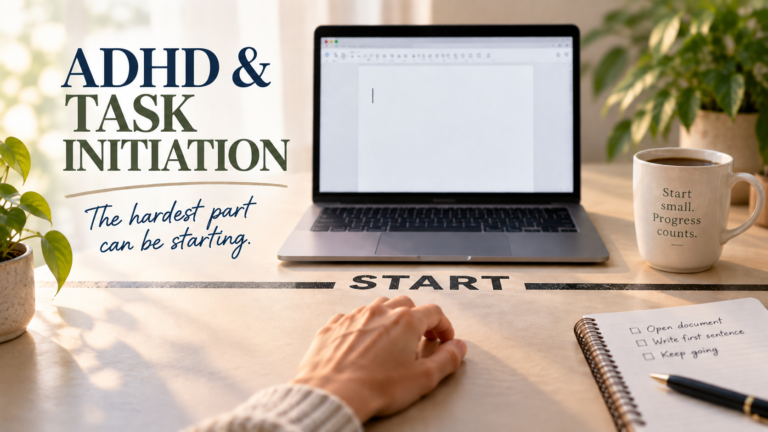
Task initiation
You know exactly what needs to be done.
You genuinely intend to do it.
But starting can feel disproportionately difficult—particularly when the task is repetitive, tedious, complicated, or lacks an immediate deadline.
Time management
You consistently underestimate how long things will take.
You rush.
You run late.
Or you’ve learned to compensate by giving yourself enormous time buffers because you no longer trust your internal sense of time.
Organization
You may be exceptionally organized in one area because you’ve learned that you have to be.
Meanwhile, another part of your life may feel chaotic.
Your work files are immaculate.
Your laundry hasn’t been put away in two weeks.
Working memory
You walk into a room and forget why you’re there.
You think of something important during a conversation and lose it before you can say it.
You depend heavily on writing things down because you don’t trust yourself to remember them.
Sustaining attention
You can sometimes become deeply engaged in something interesting while struggling to maintain attention on tasks that feel routine or unrewarding.
That variability can be confusing.
It can also lead to criticism:
“You can focus when you want to.”
But difficulties regulating attention are more complicated than simply choosing whether to pay attention.
For a deeper explanation of these difficulties, read What Is Executive Dysfunction? A Guide for Adults With ADHD.
Why ADHD May Become Harder to Compensate for in Adulthood
Sometimes ADHD wasn’t exactly invisible earlier in life.
It was simply manageable within the environment the person had at the time.
Childhood and adolescence often provide substantial external structure.
Someone else determines when school starts.
Teachers establish deadlines.
Parents may provide reminders.
The day follows a predictable schedule.
Then adulthood arrives.
Now you have to create the structure yourself.
You may need to simultaneously manage:
work,
appointments,
finances,
relationships,
meals,
household responsibilities,
children,
email,
healthcare,
deadlines,
and dozens of small obligations that nobody else is tracking.
As responsibilities accumulate and external structure decreases, previously manageable difficulties may become much more noticeable.
This can help explain why some women begin seriously questioning ADHD during college, demanding career transitions, parenthood, or other periods when their previous coping systems are no longer enough.
It isn’t necessarily that ADHD suddenly appeared.
The demands may finally have exceeded the systems that were helping contain it.
ADHD, Perfectionism, and Overachievement
This is an area where we need some nuance.
You will often see claims online that perfectionism, people-pleasing, or overachievement are “signs of ADHD in women.”
That’s too simplistic.
Perfectionism is not a diagnostic symptom of ADHD.
Neither is people-pleasing.
Neither is professional ambition.
However, some people may develop perfectionistic or over-preparatory behaviors as ways of compensating for difficulties they have experienced.
If you’ve forgotten important things repeatedly, you may start checking everything three times.
If you’ve been criticized for careless mistakes, you may become unusually concerned about making another one.
If you know you struggle with deadlines, you may compensate by placing enormous pressure on yourself.
Those behaviors can become part of someone’s experience without being ADHD symptoms themselves.
That distinction matters because we don’t want to turn every successful, anxious, perfectionistic woman into someone who “must have undiagnosed ADHD.”
ADHD vs Anxiety in High-Achieving Women
Another reason ADHD can be difficult to recognize in women is that anxiety and depression commonly coexist with ADHD.
And anxiety itself can cause problems with:
- Concentration
- Sleep
- Memory
- Procrastination
- Restlessness
- Decision-making
- Feeling overwhelmed
That means these symptoms do not automatically point toward ADHD.
One useful distinction is to consider what is interfering with attention.
Someone with anxiety may struggle to concentrate because worry repeatedly consumes their attention.
Someone with ADHD may experience attention-regulation difficulties even when she feels relatively calm.
Childhood history also matters because ADHD is a neurodevelopmental disorder. Clinicians look for evidence that some symptoms were present during childhood rather than appearing for the first time during a stressful period of adulthood.
And importantly, a woman can have both ADHD and an anxiety disorder.
Research consistently shows elevated rates of anxiety and depression among people with ADHD, including women (Tung et al., 2016; Hartman et al., 2023).
So the question isn’t always:
ADHD or anxiety?
Sometimes it is:
ADHD, anxiety, or both?
For a deeper comparison, read ADHD vs Anxiety in Adults: 7 Key Differences You Need to Know.
“But I Did Well in School.”
This is one of the most common reasons successful adults dismiss the possibility of ADHD.
They remember:
I got good grades.
I wasn’t in trouble.
I graduated from college.
I couldn’t possibly have had ADHD.
But an ADHD evaluation doesn’t simply ask whether you failed academically.
A clinician may look for subtler childhood patterns.
Did you procrastinate chronically?
Did you complete assignments at the last minute?
Were you frequently daydreaming?
Did you lose things?
Were you disorganized?
Did your parents have to constantly remind you?
Did homework take far longer than it seemed to take other students?
Did you perform well because the subjects were interesting or because your environment provided strong structure?
Were there repeated comments about careless mistakes, talking, forgetfulness, organization, or “not working up to your potential”?
Good grades don’t establish ADHD.
But they don’t automatically rule it out either.
DSM-5-TR diagnostic criteria require evidence that several ADHD symptoms were present before age 12. For adults who weren’t evaluated as children, reconstructing that history can require careful clinical interviewing and, when available, information from parents, report cards, school records, or others who knew the person during childhood (Olagunju & Ghoddusi, 2024).
The Hidden Cost of Looking “High Functioning”
One of the most important questions isn’t simply:
“Are you functioning?”
It may be:
“What does functioning cost you?”
Imagine someone who performs extremely well at work but regularly stays up until midnight finishing tasks.
Or someone whose calendar looks impeccably organized because she checks it 20 times per day out of fear she’ll forget something.
Or someone who successfully manages everyone else’s needs but has little energy left for herself.
Outward performance doesn’t always capture internal distress or the amount of effort required to sustain that performance.
At the same time, we need to be careful here.
Feeling exhausted, overwhelmed, or overworked does not automatically mean ADHD.
These experiences can occur with anxiety, depression, chronic stress, sleep deprivation, caregiving responsibilities, demanding workplaces, medical problems, and ordinary periods of excessive life stress.
That’s why the goal isn’t to recognize yourself in a list and diagnose yourself.
It’s to determine whether there is a persistent developmental pattern consistent with ADHD.
How Is ADHD Diagnosed in a High-Achieving Woman?
There isn’t a blood test, brain scan, or online quiz that can diagnose adult ADHD.
A comprehensive ADHD evaluation typically considers:
- Current ADHD symptoms
- Childhood and developmental history
- Whether symptoms occur across multiple settings
- Functional impairment
- Academic and occupational history
- Relationships and daily responsibilities
- Anxiety, depression, and other psychiatric conditions
- Sleep
- Substance use
- Medications
- Relevant medical conditions
- Family history
- Standardized ADHD rating scales
- Collateral information when available
This is particularly important in a high-achieving adult because impairment isn’t always obvious from a résumé.
A clinician may need to understand not only what you’ve accomplished but how you’ve accomplished it.
How much time does it take?
What systems are required?
What happens when those systems disappear?
Are some areas of life functioning well while others consistently suffer?
Were similar patterns present during childhood?
And could another condition better explain what you’re experiencing?
If you’re curious about the diagnostic process, read Adult ADHD Diagnosis in California: What to Expect.
When Should a High-Achieving Woman Consider an ADHD Evaluation?
You don’t need to be failing at work or falling apart at home before asking whether ADHD could be contributing to your difficulties.
An evaluation may be worth considering if you recognize a longstanding pattern of difficulties with attention, organization, time management, forgetfulness, impulsivity, restlessness, task initiation, or follow-through that is interfering with your life.
It may be particularly worth exploring if you’ve spent years wondering:
Why does everything take me so much effort?
Why can I accomplish difficult things but struggle with basic ones?
Why do I constantly need pressure to get moving?
Why am I successful but always feel behind?
Why have organization and time management been difficult for as long as I can remember?
Those questions don’t establish an ADHD diagnosis.
But they may justify asking the question more formally.
If you’re at the beginning of that process, our Adult ADHD Test: 6-Question Self-Screening Tool can help you reflect on common symptoms. A screening result cannot diagnose ADHD, but it can help you decide whether a professional evaluation may be worth considering.
Frequently Asked Questions About ADHD in High-Achieving Women
Can you have ADHD and still be successful?
Yes. Academic achievement, intelligence, and professional success do not rule out ADHD. Some people with ADHD develop effective compensatory strategies or rely on substantial structure and effort to maintain their performance. What matters diagnostically is not simply what someone has achieved, but whether a persistent pattern of ADHD symptoms causes meaningful impairment or requires disproportionate effort to manage.
Can you have ADHD if you did well in school?
Yes. Good grades alone do not rule out ADHD. Some women may have benefited from intelligence, strong family support, structured environments, or considerable effort that helped compensate for difficulties with attention, organization, or time management. An adult ADHD evaluation looks for evidence of symptoms beginning in childhood rather than simply asking whether you received poor grades.
Why is ADHD often diagnosed later in women?
Research suggests several factors may contribute. Girls with ADHD are more likely to show inattentive and less disruptive symptoms that may attract less attention from parents and teachers. Anxiety, depression, and other internalizing symptoms may also receive attention before ADHD is considered. Some women develop compensatory strategies that make their difficulties less visible until the demands of adulthood become harder to manage.
What does undiagnosed ADHD look like in high-achieving women?
There is no single presentation. Some women describe chronic problems with procrastination, time management, organization, forgetfulness, task initiation, or maintaining attention despite appearing successful from the outside. Others rely heavily on reminders, routines, deadlines, or extensive preparation to maintain that performance. These experiences can also have other causes, however, so they are not enough to diagnose ADHD on their own.
Is “high-functioning ADHD” a real diagnosis?
No. High-functioning ADHD is not a formal ADHD diagnosis or DSM-5-TR subtype. The phrase is sometimes used informally to describe someone who appears successful or capable while experiencing significant ADHD-related difficulties. A person’s accomplishments alone do not establish how much impairment, compensation, or effort may exist behind those accomplishments.
How do I know if I have ADHD or if I’m just overwhelmed?
Feeling overwhelmed is not specific to ADHD. Anxiety, depression, inadequate sleep, chronic stress, demanding responsibilities, medical conditions, and other factors can also affect concentration and executive functioning. ADHD generally involves a persistent developmental pattern, with several symptoms beginning during childhood and difficulties occurring across more than one area of life. A comprehensive evaluation can help distinguish among these possibilities.
ADHD in High-Achieving Women: The Bottom Line
Perhaps the biggest misconception about ADHD in high-achieving women is that success and ADHD are incompatible.
They aren’t.
A woman can earn excellent grades, build a successful career, manage significant responsibilities, and still have ADHD.
The more useful question isn’t simply:
“What have you accomplished?”
It’s also:
“What has it taken to accomplish it?”
For some women, intelligence, structure, compensatory systems, extraordinary effort, and years of self-monitoring may make ADHD less visible.
For others, similar struggles may be better explained by anxiety, depression, chronic stress, inadequate sleep, or something else entirely.
That’s why neither professional success nor a list of relatable symptoms can answer the diagnostic question.
A comprehensive evaluation looks at the whole pattern—including childhood history, current symptoms, impairment across different areas of life, compensatory strategies, and alternative explanations.
Sometimes getting that fuller picture finally explains why a woman who has accomplished so much has spent years wondering why accomplishing it has felt so hard.
Learn More About Adult ADHD
High-Achieving Adults With ADHD
Explore why intelligence, professional success, and outward competence don’t necessarily rule out ADHD—and what ADHD can look like in accomplished adults.
ADHD vs Anxiety in Adults: 7 Key Differences You Need to Know
Learn how concentration problems, procrastination, restlessness, and overwhelm can arise from ADHD, anxiety, or both.
What Is Executive Dysfunction? A Guide for Adults With ADHD
Learn how executive functioning affects task initiation, planning, organization, working memory, time management, and follow-through.
Adult ADHD Test: 6-Question Self-Screening Tool
Use a brief adult ADHD self-screening tool and learn what your responses can—and cannot—tell you.
Adult ADHD Diagnosis in California: What to Expect
Learn what happens during a comprehensive adult ADHD evaluation and how clinicians distinguish ADHD from other conditions.
References
Antshel, K. M., Faraone, S. V., Maglione, K., Doyle, A., Fried, R., Seidman, L., & Biederman, J. (2009). Is adult attention deficit hyperactivity disorder a valid diagnosis in the presence of high IQ? Psychological Medicine, 39(8), 1325–1335. https://doi.org/10.1017/S0033291708004959
Despature, I., & Galiana, A. (2023). Clinical and cognitive features of attention deficit hyperactivity disorder with intellectual giftedness: A systematic review. Developmental Neuropsychology, 48(7), 347–360. https://doi.org/10.1080/87565641.2023.2279117
Hartman, C. A., Larsson, H., Vos, M., et al. (2023). Anxiety, mood, and substance use disorders in adult men and women with and without attention-deficit/hyperactivity disorder: A substantive and methodological overview. Neuroscience & Biobehavioral Reviews, 151, 105209. https://doi.org/10.1016/j.neubiorev.2023.105209
Hinshaw, S. P., Nguyen, P. T., O’Grady, S. M., & Rosenthal, E. A. (2022). Annual research review: Attention-deficit/hyperactivity disorder in girls and women: Underrepresentation, longitudinal processes, and key directions. Journal of Child Psychology and Psychiatry, 63(4), 484–496. https://doi.org/10.1111/jcpp.13480
Martin, J., Langley, K., Cooper, M., et al. (2024). Sex differences in attention-deficit hyperactivity disorder diagnosis and clinical care: A national study of population healthcare records in Wales. Journal of Child Psychology and Psychiatry, 65(12), 1648–1658. https://doi.org/10.1111/jcpp.13987
Olagunju, A. E., & Ghoddusi, F. (2024). Attention-deficit/hyperactivity disorder in adults. American Family Physician, 110(2), 157–166.
Rommelse, N., van der Kruijs, M., Damhuis, J., et al. (2016). An evidenced-based perspective on the validity of attention-deficit/hyperactivity disorder in the context of high intelligence. Neuroscience & Biobehavioral Reviews, 71, 21–47. https://doi.org/10.1016/j.neubiorev.2016.08.032
Tung, I., Li, J. J., Meza, J. I., et al. (2016). Patterns of comorbidity among girls with ADHD: A meta-analysis. Pediatrics, 138(4)*, e20160430. https://doi.org/10.1542/peds.2016-0430
Young, S., Adamo, N., Ásgeirsdóttir, B. B., et al. (2020). Females with ADHD: An expert consensus statement taking a lifespan approach providing guidance for the identification and treatment of attention-deficit/hyperactivity disorder in girls and women. BMC Psychiatry, 20, 404. https://doi.org/10.1186/s12888-020-02707-9