
Table of Contents
ToggleUnderstanding Executive Function, Motivation, and Getting Started
Estimated reading time: 8–10 minutes
Many adults with ADHD spend years believing they are simply lazy, undisciplined, or lacking motivation.
They may watch coworkers complete projects with apparent ease while they struggle to begin. They may stare at an important email for hours before sending it, delay paying bills despite fully understanding the consequences, or wait until the night before a major deadline before suddenly becoming remarkably productive.
These experiences often lead to intense frustration and self-criticism.
Many adults eventually conclude that something is wrong with their character.
But for people with ADHD, procrastination is usually not a reflection of laziness or a lack of caring. Instead, it often reflects differences in how the brain manages executive functioning, motivation, reward processing, time perception, and emotional regulation (Posner et al., 2020).
Understanding these differences doesn’t eliminate procrastination overnight. However, it can replace years of self-blame with a more accurate explanation and open the door to strategies that work with the ADHD brain instead of constantly fighting against it.
Why ADHD Procrastination Is More Than "Not Feeling Like It"
Everyone procrastinates occasionally.
Most people postpone unpleasant or tedious tasks from time to time. They may avoid doing taxes, delay cleaning the garage, or put off making a difficult phone call.
Adults with ADHD, however, often experience procrastination that is more frequent, more impairing, and much more difficult to overcome.
One of the most common statements heard during an ADHD evaluation is:
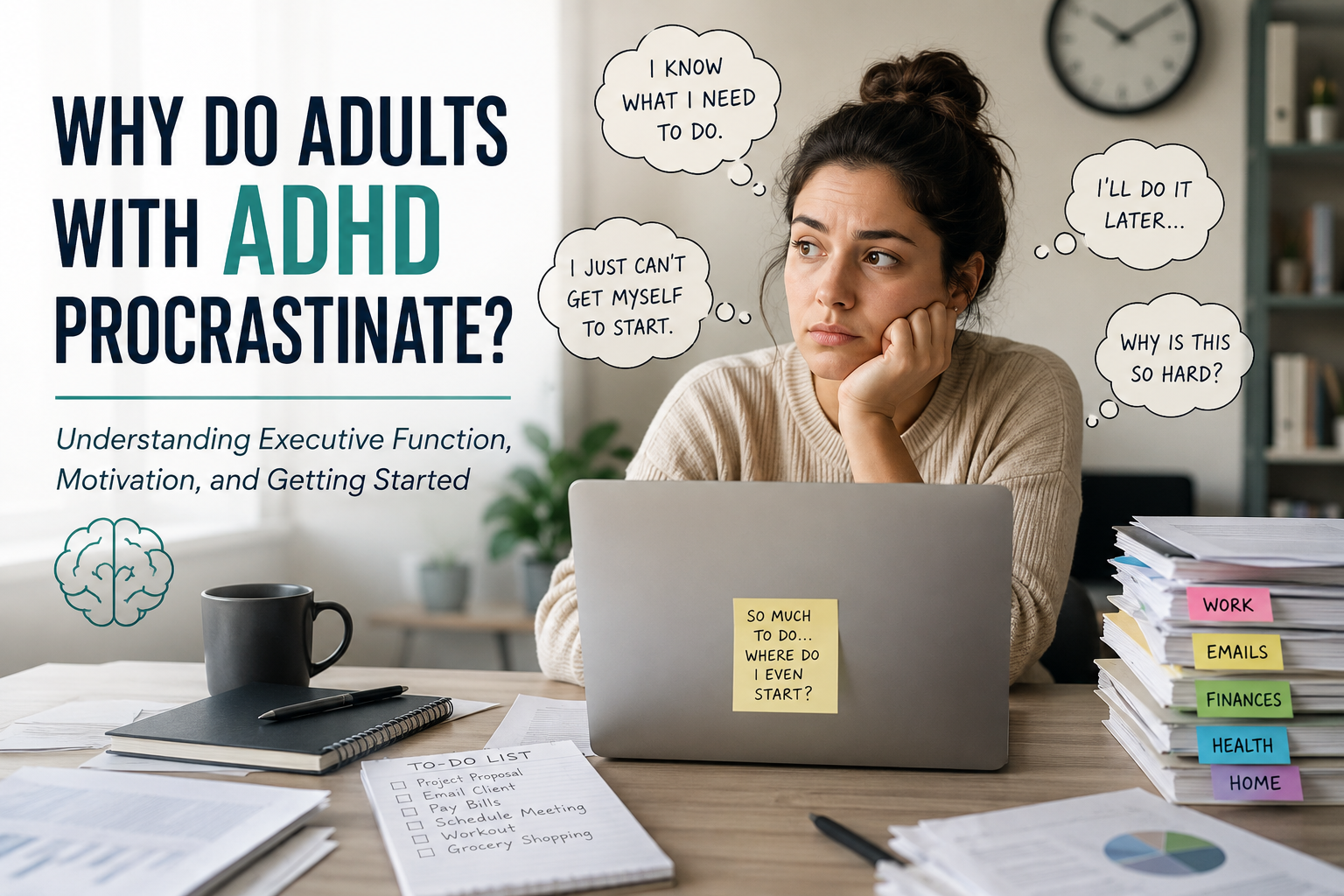
“I know exactly what I need to do. I just can’t get myself to start.”
That distinction is important.
The problem often isn’t knowing what needs to be done. It isn’t even a lack of desire.
Instead, the challenge frequently lies in activating the mental processes that allow a person to begin and sustain goal-directed behavior.
Understanding this difference is one reason many adults experience tremendous relief after receiving an accurate ADHD diagnosis.
Executive Function: The Brain's Management System
One of the defining features of ADHD is difficulty with executive functioning.
Executive functions are the brain’s self-management skills that help us:
- initiate tasks
- organize information
- prioritize competing demands
- hold information in working memory
- regulate attention
- shift between activities
- monitor progress
- complete tasks
Think of executive functioning as the brain’s project manager.
Imagine an experienced manager trying to coordinate dozens of employees, deadlines, phone calls, and unexpected problems throughout the day.
If that manager struggles to organize information or decide what should happen next, the entire project slows—even if every employee is intelligent and highly motivated.
For many adults with ADHD, something similar occurs internally.
The knowledge is often present.
The desire is often present.
The ability to translate intention into action is what becomes inconsistent.
Research has consistently shown that executive function difficulties—particularly impairments in planning, organization, problem solving, and time management—help explain why procrastination is so common among adults with ADHD (Bolden & Fillauer, 2020).
Importantly, executive functioning is not a single skill. Some individuals struggle primarily with organization, while others have greater difficulty initiating tasks, maintaining working memory, or shifting attention between competing demands (Posner et al., 2020).
This variability helps explain why ADHD can look very different from one person to another.
Task Initiation Is Different From Motivation
Perhaps the biggest misconception about ADHD procrastination is that people simply don’t want to do the task.
In reality, many adults with ADHD desperately want to begin.
They know the project matters.
They understand the consequences of waiting.
They may even think about the task constantly.
Yet they still struggle to take the first step.
This difficulty is known as task initiation, one of the executive functions most consistently affected in ADHD (Posner et al., 2020).
Patients often describe the experience in remarkably similar ways:
- “It feels like my brain won’t engage.”
- “The task feels physically heavy.”
- “I keep telling myself to start, but nothing happens.”
- “I can work all day on other things except the one thing that actually matters.”
These experiences can be confusing because the desire to succeed remains intact.
The disconnect lies between intention and activation, not between desire and effort.
Recognizing this difference is important because it shifts the conversation from “Why am I so lazy?” to “What is making it difficult for my brain to get started?”
That question leads to much more effective solutions.
Why the ADHD Brain Keeps Choosing "Later"
Another important reason procrastination is common in ADHD involves how the brain processes reward.
Most people naturally weigh the benefits of completing a task against the effort required.
Adults with ADHD often experience this calculation differently.
Research has found that people with ADHD tend to place much greater value on immediate rewards than rewards that occur in the future—a phenomenon known as delay discounting (Oguchi et al., 2023).
For example:
- Completing a quarterly report may lead to praise next month.
- Studying today may improve an exam score next week.
- Exercising consistently may improve health over several months.
Although these rewards are meaningful, they are delayed.
By contrast:
- checking social media
- answering an unrelated email
- organizing a desk drawer
- watching a short video
provide immediate stimulation and immediate feedback.
The ADHD brain often finds these instantly rewarding activities much easier to engage with, even when they are objectively less important.
Recent research has shown that three factors strongly help explain procrastination among adults with ADHD:
- increased sensitivity to delay
- perceiving tasks as having low immediate value
- shifting attention toward more immediately rewarding goals (Netzer Turgeman & Pollak, 2026).
In other words, procrastination often reflects differences in motivational processing—not a lack of intelligence or ambition.
Emotional Avoidance Is Often the Hidden Driver
Many people think procrastination is primarily a problem of poor time management.
In reality, it is often just as much a problem of emotion regulation.
Starting a difficult task frequently triggers uncomfortable emotions:
- fear of failure
- uncertainty
- boredom
- frustration
- self-doubt
- overwhelm
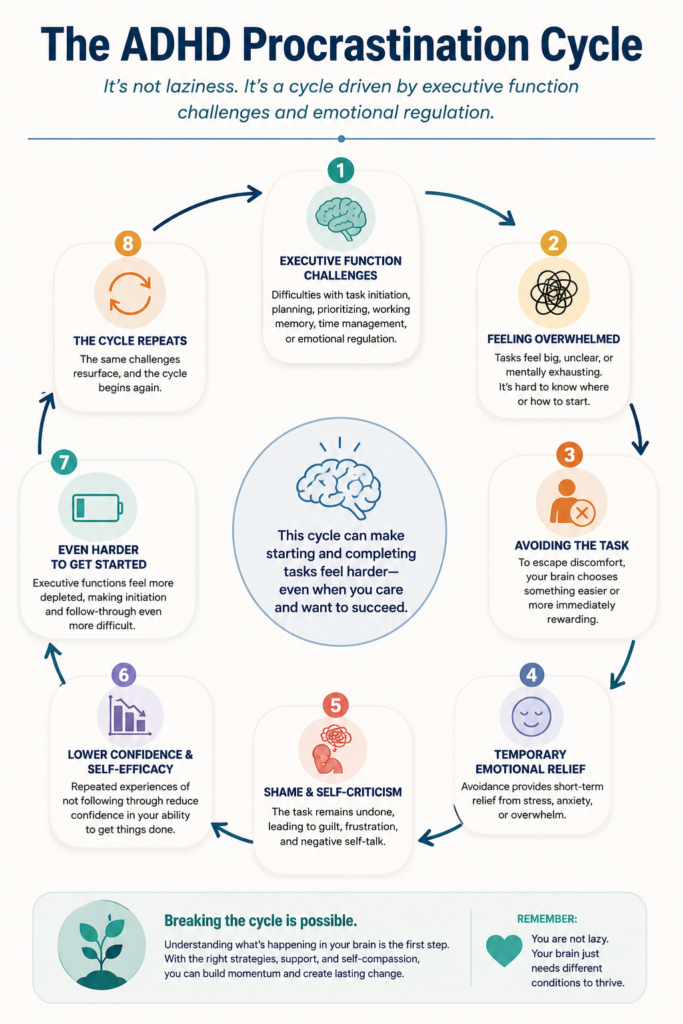
Avoiding the task temporarily reduces those uncomfortable feelings.
That relief feels rewarding.
Unfortunately, it also teaches the brain that avoidance works.
Over time, this creates a self-reinforcing cycle.
Repeated missed deadlines, forgotten responsibilities, and unfinished projects gradually shape a person’s self-image.
Many adults begin believing:
- “I’m unreliable.”
- “I’m never going to get this together.”
- “I’m just lazy.”
- “Everyone else can do this except me.”
Research suggests that repeated experiences of underperformance can contribute to lower self-esteem and negative beliefs about one’s own abilities, which then make future procrastination even more likely (López et al., 2018; Malinowska & Rodzeń, 2026).
In this way, procrastination becomes much more than simply delaying work.
It becomes part of a cycle involving executive dysfunction, emotional distress, avoidance, shame, and further procrastination.
Perfectionism Can Also Fuel Procrastination
Perfectionism may seem like the opposite of ADHD.
After all, ADHD is often associated with distractibility and impulsivity rather than exceptionally high standards.
Yet many high-achieving adults with ADHD postpone important work because they believe they need to complete it perfectly.
A report cannot simply be “good.”
It must be exceptional.
An email cannot simply be sent.
It must be rewritten repeatedly until every sentence feels exactly right.
Ironically, these high expectations can make beginning feel emotionally risky.
If starting creates the possibility of making mistakes or disappointing others, avoiding the task may temporarily feel safer.
Unfortunately, waiting until the last minute usually increases stress and makes perfection even less attainable.
This combination of executive function challenges and perfectionistic thinking is particularly common among adults who are diagnosed later in life, especially those who spent years compensating through intelligence, overpreparation, or last-minute effort.
Time Blindness: When Time Doesn't Feel Real
Another major contributor to ADHD procrastination is time blindness.
Time blindness refers to difficulty accurately sensing the passage of time or estimating how long tasks will take.
For many adults with ADHD, tomorrow doesn’t feel very different from next week.
A project due in fourteen days may seem comfortably distant—until suddenly it is due tomorrow.
Research increasingly suggests that altered time perception is one of the core cognitive features of adult ADHD (Weissenberger et al., 2021; Mette, 2023).
People with ADHD often:
- underestimate how long tasks will require
- overestimate how much can be accomplished later
- lose track of passing time
- struggle to appreciate future deadlines until they become immediate
These differences make planning substantially more difficult than they appear from the outside.
Time blindness isn’t simply poor scheduling.
It reflects measurable differences in how the ADHD brain experiences time itself (Ptacek et al., 2019).
Why Deadlines Suddenly Make Everything Possible
Perhaps the most confusing aspect of ADHD procrastination is this:
Someone may struggle for weeks to begin an important project, only to complete most of it in a single night before the deadline.
Many adults interpret this as proof that they were capable of starting all along.
The science suggests something different.
As deadlines approach, urgency increases.
The task becomes emotionally significant.
Immediate consequences become unavoidable.
These changes increase physiological arousal and temporarily activate the motivational systems that the ADHD brain often struggles to engage under ordinary circumstances (Oguchi et al., 2023; Netzer Turgeman & Pollak, 2026).
In other words, urgency can temporarily substitute for the internal activation that was missing earlier.
Although this last-minute productivity can sometimes produce impressive results, it comes at a cost.
Living from crisis to crisis increases stress, disrupts sleep, contributes to anxiety, and over time may increase the risk of ADHD-related burnout.
Is ADHD Procrastination Different From Ordinary Procrastination?
Everyone procrastinates occasionally.
Putting off an unpleasant task from time to time is part of being human. Busy schedules, fatigue, stress, or competing priorities can cause almost anyone to delay responsibilities.
ADHD-related procrastination, however, tends to look different.
It is often:
- persistent across many areas of life
- present despite genuine intentions to begin
- accompanied by significant distress or shame
- linked to executive function challenges rather than simply poor motivation
- temporarily improved by urgency or deadlines
- associated with other ADHD symptoms, such as distractibility, working memory difficulties, and time blindness (Posner et al., 2020; Mette, 2023).
Importantly, procrastination alone does not mean someone has ADHD.
Many other conditions—including anxiety disorders, depression, chronic stress, sleep deprivation, perfectionism, and burnout—can also contribute to difficulty starting or completing tasks.
A comprehensive ADHD evaluation looks for a broader lifelong pattern of symptoms involving attention, executive functioning, impulsivity, organization, and functional impairment across multiple settings—not procrastination in isolation (Posner et al., 2020).
Understanding this distinction helps reduce both overdiagnosis and unnecessary self-blame.
Evidence-Based Strategies That Work With the ADHD Brain
There is no single technique that eliminates ADHD procrastination.
Instead, effective strategies reduce the demands placed on executive functioning and make it easier for the brain to initiate action. Many of these approaches are incorporated into cognitive behavioral therapy (CBT) programs developed specifically for adults with ADHD (López et al., 2018).
Break Large Tasks into Activation Steps
Large projects create cognitive overload.
Instead of writing “Complete quarterly report,” define the smallest possible first action:
- Open the document.
- Write the title.
- Create three headings.
- Spend five minutes gathering notes.
Reducing the size of the first step lowers the mental effort required for task initiation. Once people begin moving, continuing often becomes much easier.
Reduce Activation Energy
Every additional barrier makes starting less likely.
Preparing the environment ahead of time can make initiation easier.
Examples include:
- leaving the document open on your computer
- placing workout clothes beside the bed
- putting medications beside your toothbrush
- gathering all materials before beginning a project
These small environmental changes reduce the number of executive decisions required before work actually begins.
Externalize Your Memory
Adults with ADHD often rely too heavily on working memory—a system that is frequently inconsistent.
Rather than expecting yourself to remember everything internally, move information into your environment.
Helpful tools include:
- calendars
- reminder apps
- whiteboards
- sticky notes
- visual checklists
- recurring alarms
External reminders reduce cognitive load and free mental resources for completing tasks rather than remembering them.
Use Time Blocking Instead of Waiting to “Feel Motivated”
Many people wait until they feel ready.
Unfortunately, motivation often follows action rather than preceding it.
Scheduling dedicated work periods creates external structure that compensates for inconsistent internal motivation.
The goal is not rigid perfection.
The goal is creating predictable opportunities to begin.
Try Body Doubling
One of the more interesting ADHD strategies supported by both clinical experience and emerging research is body doubling.
Body doubling simply means working while another person is quietly present—either in the same room or virtually.
The other person does not need to help with the task.
Their presence provides gentle accountability, reduces distractions, and helps maintain attention for many adults with ADHD.
Although more formal research is still developing, body doubling has become a widely used behavioral strategy in ADHD coaching and clinical practice because many patients find it remarkably effective.
Design Your Environment Instead of Depending on Willpower
Willpower is an unreliable resource for everyone.
It is particularly unreliable when executive functioning is impaired.
Instead of relying solely on self-control, make the desired behavior easier than the competing distraction.
Examples include:
- silencing unnecessary notifications
- keeping frequently used materials visible
- removing distracting apps during focused work
- creating dedicated workspaces for specific activities
Changing the environment often requires less ongoing mental effort than trying to resist distractions repeatedly throughout the day.
Practice Self-Compassion
Perhaps the most overlooked intervention is also one of the most important.
Years of unfinished projects and missed deadlines often convince adults with ADHD that they are lazy or incapable.
These beliefs become an additional obstacle.
Research suggests that lower self-efficacy—the belief that one can successfully accomplish goals—is associated with greater procrastination among adults with ADHD (Malinowska & Rodzeń, 2026).
Self-compassion is not making excuses.
It means recognizing that understanding why something is difficult allows you to choose better strategies rather than repeatedly blaming yourself.
Replacing the question,
“Why am I so lazy?”
with
“What is making this task difficult to start?”
often leads to far more productive problem-solving.
Understanding Is the Beginning—Not the End
Learning why ADHD procrastination happens does not excuse missed deadlines or unfinished responsibilities.
But it does change where solutions begin.
For decades, many adults have been told they simply need more discipline, stronger motivation, or better time management.
Those messages often increase shame without addressing the underlying problem.
When procrastination reflects executive function differences, effective treatment focuses on improving those systems—not criticizing character.
For many adults, meaningful improvement comes through a combination of:
- accurate diagnosis
- education about ADHD
- medication when appropriate
- cognitive behavioral therapy
- environmental supports
- realistic expectations
- consistent self-compassion (López et al., 2018; Posner et al., 2020).
If you have spent years believing you simply lacked discipline, consider another possibility.
You may not need more willpower.
You may need a better understanding of how your brain works.
That understanding is often the first step toward lasting change.
Frequently Asked Questions
Is procrastination a symptom of ADHD?
Procrastination is not one of the diagnostic criteria for ADHD. However, it commonly develops because ADHD affects executive functioning, including task initiation, planning, working memory, time management, and emotional regulation (American Psychiatric Association, 2022; Posner et al., 2020).
Why can I work well under pressure but not before?
Many adults with ADHD experience improved focus when deadlines become immediate because urgency increases emotional significance and activates motivational systems that are less responsive during routine tasks (Oguchi et al., 2023; Netzer Turgeman & Pollak, 2026).
Does procrastination mean I’m lazy?
No.
Laziness implies a lack of desire to act.
Many adults with ADHD genuinely want to complete important tasks but struggle to initiate action because of executive function differences (Posner et al., 2020).
Can ADHD medication reduce procrastination?
For individuals with ADHD, medication may improve attention, executive functioning, and task initiation, making procrastination easier to manage. Medication is often most effective when combined with behavioral strategies and, for many people, cognitive behavioral therapy (López et al., 2018; Posner et al., 2020).
Why do simple tasks sometimes feel impossible?
Even seemingly simple activities often require multiple executive functions, including planning, sequencing, prioritizing, remembering, and initiating action.
When several of these systems are taxed simultaneously, surprisingly small tasks can feel overwhelming (Bolden & Fillauer, 2020).
Is perfectionism common in adults with ADHD?
Yes.
Many adults diagnosed later in life develop perfectionistic tendencies after years of compensating for executive function challenges. Ironically, fearing mistakes can increase avoidance and make procrastination even worse.
When should I consider an ADHD evaluation?
If lifelong problems with procrastination occur alongside persistent difficulties with attention, organization, forgetfulness, time management, or impulsivity—and these symptoms interfere with work, school, or relationships—it may be worthwhile to seek a comprehensive ADHD evaluation. A qualified clinician will consider your developmental history, current symptoms, and other possible explanations before making a diagnosis (American Psychiatric Association, 2022).
Continue Your ADHD Education
Understanding adult ADHD is a journey, not a single article. If you found this article helpful, these evidence-based guides can help you continue building your understanding.
Start Here
New to learning about adult ADHD?
Begin with our orientation guide to understand where to start and which topics are most relevant to you. Read: Start Here
The Complete Guide to Adult ADHD Diagnosis
Learn how ADHD is diagnosed in adults, what to expect during a comprehensive evaluation, and how clinicians distinguish ADHD from anxiety, depression, and other conditions. Read: The Complete Guide to Adult ADHD Diagnosis
The Complete Guide to Adult ADHD Treatment
Explore evidence-based treatment options, including medication, cognitive behavioral therapy, lifestyle strategies, executive function coaching, and practical tools for managing ADHD. Read: The Complete Guide to Adult ADHD Treatment
Can You Be Successful and Still Have ADHD?
Many adults are diagnosed later in life because they’ve learned to compensate for their symptoms. Discover why professional success does not rule out ADHD. Read: Can You Be Successful and Still Have ADHD?
References
American Psychiatric Association. (2022). Diagnostic and statistical manual of mental disorders (5th ed., text rev.; DSM-5-TR). American Psychiatric Association Publishing. https://doi.org/10.1176/appi.books.9780890425787
Bolden, J., & Fillauer, J. P. (2020). “Tomorrow Is the Busiest Day of the Week”: Executive functions mediate the relation between procrastination and attention problems. Journal of American College Health, 68(8), 854–863. https://doi.org/10.1080/07448481.2019.1626399
López, P. L., Torrente, F. M., Ciapponi, A., Lischinsky, A. G., Cetkovich-Bakmas, M., Rojas, J. I., Romano, M., & Manes, F. (2018). Cognitive-behavioural interventions for attention deficit hyperactivity disorder (ADHD) in adults. Cochrane Database of Systematic Reviews, (3), CD010840. https://doi.org/10.1002/14651858.CD010840.pub2
Malinowska, A., & Rodzeń, W. (2026). The mediation effect of general self-efficacy in relation to procrastination and sense of coherence among adults with attention deficit hyperactivity disorder. PLOS ONE, 21(1), e0339965. https://doi.org/10.1371/journal.pone.0339965
Mette, C. (2023). Time perception in adult ADHD: Findings from a decade—a review. International Journal of Environmental Research and Public Health, 20(4), 3098. https://doi.org/10.3390/ijerph20043098
Netzer Turgeman, R., & Pollak, Y. (2026). What are you waiting for?! Roles of motivation, goal orientation, and emotion regulation in explaining the link between ADHD and procrastination. Journal of Attention Disorders, 30(5), 694–704. https://doi.org/10.1177/10870547251408120
Oguchi, M., Takahashi, T., Nitta, Y., & Kumano, H. (2021). The moderating effect of attention-deficit hyperactivity disorder symptoms on the relationship between procrastination and internalizing symptoms in the general adult population. Frontiers in Psychology, 12, 708579. https://doi.org/10.3389/fpsyg.2021.708579
Oguchi, M., Takahashi, T., Nitta, Y., & Kumano, H. (2023). Moderating effect of attention deficit hyperactivity disorder tendency on the relationship between delay discounting and procrastination in young adulthood. Heliyon, 9(4), e14834. https://doi.org/10.1016/j.heliyon.2023.e14834
Posner, J., Polanczyk, G. V., & Sonuga-Barke, E. J. S. (2020). Attention-deficit hyperactivity disorder. The Lancet, 395(10222), 450–462. https://doi.org/10.1016/S0140-6736(19)33004-1
Ptacek, R., Weissenberger, S., Braaten, E., Klicperova-Baker, M., Goetz, M., Raboch, J., & Stefano, G. B. (2019). Clinical implications of the perception of time in attention deficit hyperactivity disorder (ADHD): A review. Medical Science Monitor, 25, 3918–3924. https://doi.org/10.12659/MSM.914225
Weissenberger, S., Schönova, K., Büttiker, P., et al. (2021). Time perception is a focal symptom of attention-deficit/hyperactivity disorder in adults. Medical Science Monitor, 27, e933766. https://doi.org/10.12659/MSM.933766