
Table of Contents
ToggleWhy Many Adults Feel Mentally Exhausted—and What Current Research Tells Us
Research Review
Why Does Life Feel So Mentally Exhausting?
If you have ADHD, you may know what it’s like to feel mentally exhausted in a way that’s difficult to explain.
Not the kind of exhaustion that follows a demanding week or a few nights of poor sleep.
The kind that lingers.
The kind that makes ordinary responsibilities feel surprisingly difficult. The kind that turns simple decisions into mental work. The kind that leaves you wondering why you’re working so hard just to keep up with everyday life.
Many adults describe reaching a point where they feel as though their brain has simply run out of energy.
You may still be going to work.
You may still be paying your bills.
You may still be taking care of your family.
From the outside, it may even look like you’re functioning well.
But inside, it feels as though every task requires more effort than it used to.
By the end of the day, there’s almost nothing left.
Many people have started calling this experience ADHD burnout.
Whether you’ve used that phrase yourself—or this is the first time you’ve heard it—you’ve probably wondered the same thing thousands of other adults with ADHD have wondered:
Why do I feel this way?
It’s an important question.
And over the past several years, researchers have begun asking it too.
What Does the Research Actually Say?
The answer is probably more encouraging—and more nuanced—than you might expect.
Current research does not recognize ADHD burnout as a formal medical diagnosis. It does not appear in the Diagnostic and Statistical Manual of Mental Disorders (5th ed., text rev.; DSM-5-TR), and researchers have not established universally accepted diagnostic criteria (American Psychiatric Association [APA], 2022).
At first glance, that might seem disappointing.
If ADHD burnout isn’t an official diagnosis, does that mean what people are experiencing isn’t real?
Not at all.
In medicine, the absence of a formal diagnosis doesn’t mean an experience is imaginary. It often means researchers are still working to understand it.
That’s exactly what’s happening here.
Rather than trying to prove that ADHD burnout is a distinct disorder, researchers have been investigating a different question:
Can current research help explain why so many adults with ADHD describe profound mental exhaustion?
To answer that question, they haven’t focused on burnout alone.
Instead, they’ve studied many of the individual experiences that people describe when they talk about burnout.
They’ve asked questions like:
- Do adults with ADHD experience higher levels of stress?
- Does living with ADHD require greater cognitive effort?
- Is fatigue more common?
- Does the workplace affect adults with ADHD differently?
- Do emotional regulation difficulties contribute to chronic exhaustion?
- Are ADHD traits associated with greater burnout symptoms?
Each study answers only one small question.
Together, they begin telling a much larger story.
Following the Evidence
One of the most interesting things about reviewing the literature is discovering that researchers didn’t all start in the same place.
Some were studying workplace stress.
Others were trying to better understand executive functioning.
Some focused on fatigue.
Others investigated emotional regulation or occupational outcomes.
Only recently have researchers begun examining burnout symptoms more directly (Arthur Cully et al., 2025).
At first, these studies may seem unrelated.
But when you step back and look at them together, a pattern begins to emerge.
Adults with ADHD consistently appear to experience many of the same factors that researchers have long associated with burnout, including higher perceived stress, greater executive function demands, chronic fatigue, emotional regulation challenges, and increased occupational difficulties (Posner et al., 2020; Rogers et al., 2017; Park et al., 2026; Fuermaier et al., 2021).
That’s an important observation.
It doesn’t prove that ADHD causes burnout.
It doesn’t establish ADHD burnout as a new diagnosis.
What it does suggest is that researchers are beginning to uncover plausible explanations for experiences that many adults with ADHD have been describing for years.
In other words, the science is beginning to catch up with the questions patients have been asking.
Before We Continue...
One word of caution is important.
Feeling mentally exhausted does not automatically mean someone is experiencing burnout.
Persistent exhaustion can also occur with depression, anxiety disorders, sleep disorders, chronic medical conditions, medication side effects, and many other health problems. Similar symptoms do not always have the same cause.
That’s one reason a thoughtful medical evaluation is so important.
The goal isn’t simply to put a label on how someone feels.
The goal is to understand why they feel that way.
That same principle guides good research.
Rather than assuming every adult with ADHD who feels exhausted is experiencing the same condition, researchers have been carefully examining the different biological, psychological, and environmental factors that may contribute to mental exhaustion.
As you’ll see throughout this review, no single study provides the answer.
Instead, the strongest evidence comes from something much more interesting.
Multiple independent areas of research—conducted by different investigators, in different countries, asking different questions—have begun pointing toward remarkably similar conclusions.
The remainder of this article follows that evidence, one question at a time.
We’ll start with one of the most consistent findings in the literature:
Why do adults with ADHD seem to experience more stress than their peers?
Why Does Everything Feel Like It Takes So Much More Effort?
One of the most common questions adults with ADHD ask isn’t about attention.
It’s about effort.
Why does an ordinary workday leave me mentally exhausted?
Why do simple tasks seem to require so much planning?
Why do I feel like I’m working twice as hard just to accomplish what everyone else seems to do automatically?
Researchers have been studying this question for decades, although they haven’t always framed it in terms of burnout.
Instead, they’ve focused on one of the defining features of ADHD:
Executive functioning.
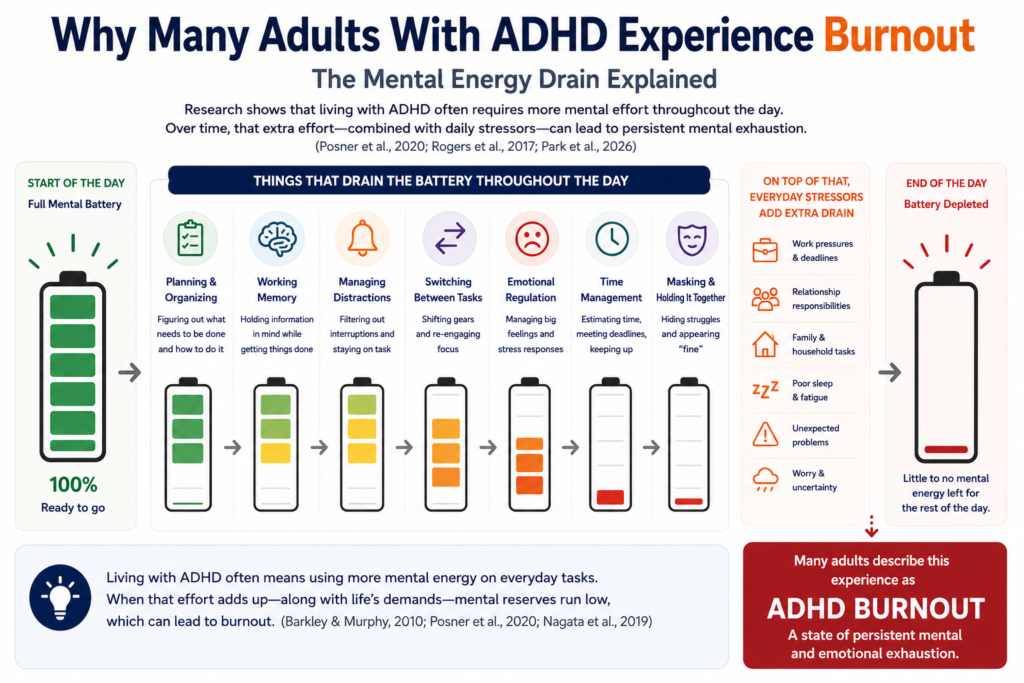
Executive functions are often described as the brain’s management system. They allow us to organize information, prioritize competing demands, plan ahead, shift attention when circumstances change, hold information in mind while solving problems, and regulate our behavior toward long-term goals (Posner et al., 2020).
These are not isolated mental skills.
They’re involved in almost everything we do.
Planning a meeting.
Remembering a grocery list.
Switching between emails and a phone call.
Deciding which task deserves attention first.
Even getting out the door on time depends on multiple executive functions working together.
For many adults with ADHD, these processes are less automatic. They often require greater conscious effort, more external reminders, and more deliberate self-monitoring than they do for someone without ADHD (Barkley & Murphy, 2010).
That difference may seem small.
Repeated hundreds of times each day, it probably isn’t.
Imagine spending the entire day making decisions that most people never notice they’re making.
Should I answer this email first?
Did I forget that meeting?
Where did I put my keys?
What was I about to do?
How do I get back on track after being interrupted?
Most people occasionally experience these moments.
For many adults with ADHD, they represent a constant background workload.
Researchers sometimes refer to this as cognitive load—the amount of mental effort required to complete a task. Although cognitive load has many causes, executive function differences may increase that workload throughout the day, even when performance appears outwardly successful (Posner et al., 2020; Barkley & Murphy, 2010).
From the outside, two people may complete exactly the same amount of work.
Internally, one may have spent substantially more mental energy getting there.
An Interesting Discovery from Burnout Research
Burnout researchers arrived at a surprisingly similar conclusion—but from an entirely different direction.
Rather than studying ADHD, they examined what prolonged occupational stress does to the brain.
Their findings were striking.
Individuals experiencing burnout demonstrated measurable difficulties with executive functioning, particularly processes involved in planning, self-monitoring, and metacognition—the ability to think about and regulate one’s own thinking. EEG studies also identified differences in neural activity during executive tasks, suggesting that chronic stress may alter how the brain manages complex cognitive work (Pihlaja et al., 2023).
Importantly, these studies were not conducted in adults with ADHD.
They cannot tell us whether ADHD causes burnout or whether burnout worsens ADHD symptoms.
What they do suggest is that both conditions appear to involve many of the same cognitive systems.
Putting the Pieces Together
This is where the research becomes particularly interesting.
For years, ADHD researchers and burnout researchers were asking completely different questions.
One group wanted to understand executive functioning in ADHD.
The other wanted to understand what chronic stress does to the brain.
Yet both groups arrived at findings involving many of the same mental processes.
That doesn’t prove these conditions are identical.
It doesn’t even prove they develop for the same reasons.
But it does suggest a plausible explanation for something many adults describe:
If everyday life already requires greater cognitive effort because of ADHD, and chronic stress places additional strain on those same executive systems, it’s understandable why some people eventually feel mentally depleted.
Researchers are still testing exactly how these pathways interact.
The important point is that the idea is no longer based only on personal stories.
It is increasingly supported by converging lines of scientific evidence.
At this point, it helps to step back and look at the larger picture. Current research doesn’t suggest that ADHD automatically leads to burnout. Instead, it suggests that the extra mental effort required to manage ADHD—combined with everyday life stressors—may gradually drain the brain’s mental energy over time.
Why Doesn't Rest Always Solve the Problem?
Many people assume burnout is simply the result of working too hard.
Work less.
Sleep more.
Take a vacation.
Problem solved.
Yet many adults with ADHD describe something different.
They may sleep through the weekend and still wake up feeling mentally exhausted.
They take time off work but don’t feel fully restored.
They wonder whether they’re simply lazy—or whether something else is happening.
Researchers have wondered the same thing.
One of the strongest studies examining fatigue in adults with ADHD included 243 participants and found that 62% met criteria for clinically significant fatigue (Rogers et al., 2017).
That finding surprised many clinicians because fatigue has historically received much less attention than inattention or hyperactivity.
Participants with significant fatigue also reported substantial functional impairment, reduced confidence in their ability to manage everyday challenges, and psychological profiles resembling those observed in individuals with chronic fatigue syndrome (Rogers et al., 2017).
The study wasn’t designed to explain burnout.
But it raises an important possibility.
If many adults with ADHD begin with a higher baseline level of mental fatigue, they may have less reserve when prolonged stress, family responsibilities, illness, or workplace demands are added.
Imagine two smartphones beginning the day.
One starts with a full battery.
The other begins at 60%.
Both may function perfectly well for several hours.
But the one with less reserve reaches empty much sooner.
Researchers don’t yet know whether fatigue represents one of the mechanisms linking ADHD and burnout.
However, studies like this suggest it deserves much more attention than it has traditionally received.
Putting the Pieces Together
Notice how the evidence is beginning to build.
The workplace studies suggested that adults with ADHD often experience higher levels of perceived stress.
Executive function research suggests many everyday activities require greater cognitive effort.
Now fatigue research suggests many adults with ADHD may also begin with fewer mental reserves.
None of these studies proves burnout.
Together, however, they begin describing the conditions under which burnout might reasonably develop.
That is one of the most important themes emerging from today’s literature.
Why Can Stress Feel So Overwhelming?
Stress is part of life.
No one avoids it completely.
The more interesting question is why the same situation can feel manageable for one person and overwhelming for another.
Researchers studying ADHD have consistently found that adults with the condition report higher levels of perceived stress than adults without ADHD (Beaton et al., 2022; Park et al., 2026).
That doesn’t necessarily mean life is objectively more stressful.
It may mean that maintaining attention, staying organized, regulating emotions, recovering after interruptions, and managing competing demands require more sustained effort.
Those demands are often invisible.
Coworkers may only see that the work gets done.
They rarely see the mental effort required to make that happen.
Recent research has also begun exploring the role of rumination and mind wandering.
Kandeğer and colleagues (2024) found that excessive mind wandering and rumination partially explained the relationship between ADHD symptoms and anxiety and depression. Individuals with greater ADHD symptoms also reported lower levels of mindfulness.
Why might that matter?
Imagine finishing a difficult day at work.
One person mentally leaves work behind.
Another spends the evening replaying conversations, worrying about unfinished tasks, or mentally rehearsing tomorrow’s responsibilities.
Even though the workday has ended, the brain hasn’t fully disengaged.
Researchers cannot yet conclude that rumination causes burnout.
They can say that prolonged mental engagement with stressful experiences represents another pathway through which cognitive resources may gradually become depleted.
Where the Evidence Is Leading
By this point, a pattern is becoming difficult to ignore.
Researchers studying executive function…
Fatigue…
Stress…
Workplace demands…
Emotional regulation…
…were asking different questions.
Yet many reached remarkably similar conclusions.
Adults with ADHD appear to experience greater cognitive demands, higher perceived stress, more fatigue, and increased occupational challenges than adults without ADHD.
No single study explains why someone feels mentally exhausted.
Viewed together, however, these findings provide one of the clearest scientific frameworks currently available for understanding why so many adults with ADHD describe that experience.
The next question naturally follows:
If the evidence suggests these pathways contribute to burnout, what does current research tell us about reducing that risk?
What Does Current Research Suggest May Help?
If you’ve recognized yourself in the research we’ve discussed so far, you might also be wondering something else.
What can I actually do about it?
It’s an understandable question.
Unfortunately, it’s also where the evidence becomes less certain.
Researchers have not yet identified a treatment specifically for ADHD burnout, largely because ADHD burnout itself has not been established as a distinct medical condition. There are no large clinical trials testing therapies designed specifically for burnout in adults with ADHD, and no professional guidelines currently recommend a standardized treatment approach.
That may sound discouraging.
Fortunately, it isn’t the whole story.
Although researchers have not studied ADHD burnout directly, they have spent decades studying the individual factors that appear to contribute to it. That means the strongest evidence currently focuses on reducing stress, improving executive functioning, addressing fatigue, supporting emotional regulation, and creating environments that reduce unnecessary cognitive load.
In other words, while we may not yet know how to treat ADHD burnout as a single condition, we know considerably more about treating the factors that appear to increase its likelihood.
What the Evidence Suggests About Treating ADHD
One conclusion emerges repeatedly throughout the literature.
When ADHD symptoms improve, many of the daily demands associated with those symptoms improve as well.
This may sound obvious, but it has important implications.
Throughout this review, we’ve discussed how researchers believe executive function demands, chronic stress, and fatigue may gradually contribute to mental exhaustion.
If those demands can be reduced, it stands to reason that the overall burden placed on the brain may also decrease.
Decades of research have shown that stimulant medications improve attention, impulsivity, and executive functioning for many adults with ADHD, while cognitive behavioral therapy (CBT) can improve organization, planning, time management, and coping skills (Posner et al., 2020).
Notice what these treatments have in common.
They don’t simply improve attention.
They reduce the amount of effort required to navigate everyday life.
Researchers have not yet demonstrated that treating ADHD prevents burnout.
However, reducing the daily cognitive demands associated with ADHD represents one of the most biologically plausible strategies currently supported by the evidence.
The Workplace May Be Part of the Treatment
One of the most surprising themes to emerge from the research is that burnout isn’t explained only by what’s happening inside a person’s brain.
The environment matters too.
In fact, two of the strongest occupational studies reviewed in this article identified job control as one of the most important protective factors for adults with ADHD (Nagata et al., 2019; Park et al., 2026).
Job control refers to the amount of influence someone has over how they perform their work.
Can they organize their day?
Can they minimize interruptions?
Can they decide when to complete cognitively demanding tasks?
Do they have flexibility in how they solve problems?
These questions may seem unrelated to burnout.
The research suggests otherwise.
Adults with ADHD appeared particularly sensitive to workplace environments that limited autonomy or provided little social support. Conversely, environments offering greater flexibility appeared to reduce psychological distress more effectively in adults with ADHD than in workers without ADHD symptoms (Nagata et al., 2019; Park et al., 2026).
Taken together, these findings suggest something important.
Burnout is not simply a personal failure to cope with stress.
Sometimes it reflects a mismatch between the demands of an environment and the way a person’s brain works.
That distinction can be remarkably freeing.
Instead of asking,
“Why can’t I handle this?”
the research encourages a different question:
“What changes might reduce the mental effort required to do this well?”
Recovery Requires More Than Time Off
One of the assumptions many people make about burnout is that recovery simply requires rest.
Sleep more.
Take a vacation.
Slow down.
Sometimes those strategies help.
Sometimes they don’t.
The research we’ve reviewed suggests one possible reason why.
If mental exhaustion reflects the combined effects of executive function demands, chronic stress, emotional regulation, and fatigue, then addressing only one of those factors may not fully restore a person’s cognitive reserves.
Recent evidence examining stimulant treatment in chronically stressed adults illustrates this complexity.
Amiri and colleagues (2026) found that stimulant medications continued to improve attention and task performance, but their functional benefits appeared less robust in individuals exposed to higher levels of psychosocial stress. Highly stressed individuals also experienced relatively more sleep disturbance, irritability, and fatigue, leading the authors to recommend careful attention to sleep, medication timing, workload, and treatment of co-occurring conditions.
This doesn’t mean medication causes burnout.
Nor does it suggest medication alone can prevent it.
Instead, it reinforces a theme that has appeared throughout this review.
Burnout appears to develop through the interaction of multiple factors.
Recovery may require addressing multiple factors as well.
Putting the Pieces Together
Notice how the recommendations emerging from the literature mirror the pathways we’ve already discussed.
Researchers studying stress emphasize reducing unnecessary demands.
Researchers studying executive functioning emphasize improving cognitive efficiency.
Researchers studying workplace health emphasize autonomy and social support.
Researchers studying fatigue emphasize recovery and restoration.
Although these investigators approached the problem from different directions, their conclusions complement one another.
Rather than searching for one treatment that solves everything, the evidence increasingly supports reducing the overall burden placed on the brain.
What Researchers Still Don't Know
One of the defining characteristics of good science is the willingness to acknowledge uncertainty.
In many ways, the unanswered questions surrounding ADHD and burnout are just as interesting as the findings themselves.
For example, researchers still cannot answer one of the questions patients ask most often:
Is ADHD burnout a distinct condition, or is it the combined effect of several well-established processes?
At present, the evidence isn’t sufficient to say.
Most available studies are cross-sectional, meaning they measure people at a single point in time. These studies are valuable for identifying relationships, but they cannot determine cause and effect. We still don’t know whether ADHD directly increases burnout risk, whether burnout worsens ADHD symptoms, or whether both are influenced by additional factors that have yet to be identified.
Researchers also measure burnout in different ways.
Some use the Maslach Burnout Inventory.
Others use the Shirom-Melamed Burnout Questionnaire.
Still others measure fatigue, perceived stress, executive functioning, occupational impairment, or psychological distress.
Each approach contributes useful information.
Each also captures a slightly different aspect of the problem.
As a result, comparing studies isn’t always straightforward.
Another limitation is time.
Most studies tell us what people are experiencing today.
Far fewer tell us how they arrived there.
Long-term studies following adults with ADHD over many years will be essential for understanding why some individuals remain remarkably resilient while others develop persistent mental exhaustion despite receiving similar treatment.
Future research will hopefully answer questions that matter directly to patients.
Can earlier diagnosis reduce burnout risk?
Are certain workplace accommodations consistently protective?
Do some ADHD presentations carry greater risk than others?
Can interventions targeting executive functioning or emotional regulation prevent burnout before it develops?
Those answers will come.
The encouraging news is that researchers are finally asking the questions.
Where the Evidence Leaves Us
If you’ve read this far, you may have noticed something interesting.
Researchers didn’t begin by trying to prove that ADHD burnout exists.
They began by asking smaller questions.
Does ADHD increase stress?
Does it affect executive functioning?
Is fatigue more common?
Does the workplace matter?
Does emotional regulation influence resilience?
Individually, each study answered only part of the story.
Collectively, they describe something much larger.
Across multiple countries, different research teams, and several independent fields of study, adults with ADHD consistently appear to experience greater cognitive demands, higher perceived stress, more fatigue, and increased occupational challenges than adults without ADHD (Park et al., 2026; Rogers et al., 2017; Barkley & Murphy, 2010; Fuermaier et al., 2021).
No single finding explains why someone feels mentally exhausted.
Taken together, however, these studies provide one of the clearest scientific frameworks currently available for understanding an experience that countless adults with ADHD have described for years.
The research does not tell us that ADHD burnout is a new diagnosis.
It tells us something arguably more valuable.
It tells us that persistent mental exhaustion deserves to be taken seriously.
Not because of what people call it.
But because a growing body of evidence suggests there are understandable reasons why it may occur.
Understanding those reasons is often the first step toward changing them.
Key Takeaways
- ADHD burnout is not currently an official medical diagnosis. However, many adults with ADHD describe a pattern of persistent mental exhaustion that researchers are increasingly trying to understand (American Psychiatric Association [APA], 2022).
- Current research suggests that adults with ADHD experience many factors known to increase burnout risk, including higher perceived stress, greater executive function demands, chronic fatigue, emotional regulation challenges, and occupational difficulties (Park et al., 2026; Rogers et al., 2017; Posner et al., 2020).
- No single study proves that ADHD causes burnout. Instead, multiple independent lines of research point toward a remarkably consistent pattern that may help explain why many adults with ADHD describe feeling mentally exhausted.
- Workplace factors matter. Greater job control, flexibility, and social support appear especially important for adults with ADHD and may help reduce psychological distress (Nagata et al., 2019; Park et al., 2026).
- Executive function differences may increase everyday cognitive effort. Over months and years, that additional mental workload may contribute to chronic stress and fatigue (Barkley & Murphy, 2010; Posner et al., 2020).
- Fatigue deserves more attention. Nearly two-thirds of adults with ADHD in one study met criteria for clinically significant fatigue, suggesting that mental exhaustion is more than simply “being busy” (Rogers et al., 2017).
- Much remains unknown. Researchers still cannot determine whether ADHD burnout represents a distinct clinical condition or the combined effects of chronic stress, executive function challenges, fatigue, and environmental demands.
- Perhaps the most encouraging finding is this: the research increasingly suggests that persistent mental exhaustion in adults with ADHD is understandable—not a sign of laziness, lack of motivation, or personal failure.
Frequently Asked Questions
Is ADHD burnout a real medical diagnosis?
Not at this time. ADHD burnout is not recognized as an official diagnosis in the DSM-5-TR. However, research increasingly suggests that adults with ADHD experience many of the same factors associated with burnout, including chronic stress, executive function challenges, fatigue, and occupational strain.
Is ADHD burnout different from ordinary burnout?
Possibly.
Traditional burnout research has focused primarily on chronic workplace stress. Adults with ADHD often describe a broader pattern of mental exhaustion that extends beyond work into everyday life. Researchers are still determining whether this represents a distinct phenomenon or reflects the interaction between ADHD and well-established burnout pathways.
Why does everything seem to require so much mental effort?
Research suggests that executive functions—including planning, organizing, prioritizing, working memory, and attention regulation—often require greater conscious effort in adults with ADHD (Posner et al., 2020; Barkley & Murphy, 2010). Over time, that increased cognitive workload may contribute to mental exhaustion.
Can ADHD medication prevent burnout?
There is currently no evidence that medication specifically prevents ADHD burnout. However, effective treatment may reduce the everyday cognitive demands associated with ADHD, making life less mentally taxing. Treatment decisions should always be individualized and discussed with your healthcare provider.
Why don’t weekends or vacations always help?
Mental exhaustion is rarely caused by a single factor. Research suggests that executive function demands, chronic stress, fatigue, emotional regulation, sleep quality, and workplace factors may all contribute. Simply taking time away from work may not address all of these underlying issues.
Is ADHD burnout the same as depression?
No.
Although both conditions can involve fatigue, reduced concentration, and decreased motivation, depression is a diagnosable mood disorder with different diagnostic criteria and treatment approaches. Because symptoms overlap, persistent exhaustion should always be evaluated carefully.
What kind of work environment appears to reduce burnout risk?
Current evidence suggests that adults with ADHD may benefit particularly from workplaces offering greater autonomy, flexibility, clear expectations, and supportive supervision (Nagata et al., 2019; Park et al., 2026).
Is mental exhaustion a sign that my ADHD is getting worse?
Not necessarily.
Mental exhaustion can result from many factors, including prolonged stress, poor sleep, life transitions, anxiety, depression, medical illnesses, medication effects, or untreated ADHD. A comprehensive evaluation is often the best way to determine the underlying cause.
Can ADHD burnout be prevented?
Researchers do not yet have a definitive answer. Current evidence suggests that effectively treating ADHD, protecting sleep, reducing unnecessary cognitive load, creating supportive work environments, and managing chronic stress may all help reduce burnout risk.
When should I seek professional help?
If mental exhaustion is interfering with your work, relationships, health, or quality of life—or if it persists despite adequate rest—it’s worth discussing with a qualified healthcare professional. Persistent exhaustion deserves evaluation rather than dismissal.
Where to go next
Burnout is only one part of understanding adult ADHD. The following evidence-based guides can help you continue learning.
New to Adult ADHD?
Start Here
If you’re just beginning your ADHD journey, this page provides an overview of adult ADHD, common symptoms, diagnosis, treatment options, and how to use this website.
Understanding Adult ADHD
The Complete Guide to Adult ADHD Diagnosis
Learn how ADHD is diagnosed in adults, what a comprehensive evaluation should include, why so many adults are diagnosed later in life, and what to expect during the assessment process.
ADHD Treatment
The Complete Guide to Adult ADHD Treatment
Explore the evidence behind ADHD medications, therapy, coaching, lifestyle strategies, and other treatment options supported by current research.
High-Achieving Adults with ADHD
Can You Be Successful and Still Have ADHD?
Many physicians, attorneys, entrepreneurs, executives, and graduate students aren’t diagnosed until adulthood. Learn why success does not rule out ADHD.
Understanding Executive Function, Motivation, and Getting Started
Why Do Adults With ADHD Procrastinate?
Understand the neuroscience of procrastination, task initiation, motivation, and executive dysfunction.
References
American Psychiatric Association. (2022). Diagnostic and statistical manual of mental disorders (5th ed., text rev.). American Psychiatric Association Publishing.
Amiri, D., Briziarelli, L., Shah, S. J., et al. (2026). Central stimulants in a stressed brain: Evidence synthesis of benefits, burnout risk, and clinical safeguards in ADHD. Neuropsychiatric Disease and Treatment, 22, 567670. https://doi.org/10.2147/NDT.S567670
Arthur Cully, S., Hatinova, K., van de Leur, J. C., Björnsdotter, M., et al. (2025). Factors associated with symptom severity in stress-induced exhaustion disorder: Cohort characterization and cross-sectional correlations. Frontiers in Psychiatry, 16, 1548967. https://doi.org/10.3389/fpsyt.2025.1548967
Barkley, R. A., & Murphy, K. R. (2010). Impairment in occupational functioning and adult ADHD: The predictive utility of executive function ratings versus executive function tests. Archives of Clinical Neuropsychology, 25(3), 157–173. https://doi.org/10.1093/arclin/acq014
Beaton, D. M., Sirois, F., & Milne, E. (2022). The role of self-compassion in the mental health of adults with ADHD. Journal of Clinical Psychology, 78(12), 2497–2512. https://doi.org/10.1002/jclp.23354
Fuermaier, A. B. M., Tucha, L., Butzbach, M., et al. (2021). ADHD at the workplace: ADHD symptoms, diagnostic status, and work-related functioning. Journal of Neural Transmission, 128(7), 1021–1031. https://doi.org/10.1007/s00702-021-02309-z
Jangmo, A., Kuja-Halkola, R., Pérez-Vigil, A., et al. (2021). Attention-deficit/hyperactivity disorder and occupational outcomes. PLOS ONE, 16(3), e0247724. https://doi.org/10.1371/journal.pone.0247724
Kandeğer, A., Odabaş Ünal, Ş., Ergün, M. T., & Yavuz Ataşlar, E. (2024). Excessive mind wandering, rumination, and mindfulness mediate the relationship between ADHD symptoms and anxiety and depression in adults with ADHD. Clinical Psychology & Psychotherapy, 31(1), e2940. https://doi.org/10.1002/cpp.2940
Nagata, M., Nagata, T., Inoue, A., Mori, K., & Matsuda, S. (2019). Effect modification by attention deficit hyperactivity disorder symptoms on the association of psychosocial work environments with psychological distress and work engagement. Frontiers in Psychiatry, 10, 166. https://doi.org/10.3389/fpsyt.2019.00166
Park, J., Murray, R., Duffy, R. D., & Zhou, Z. E. (2026). Longitudinal relationship of childhood attention-deficit/hyperactivity disorder symptoms with perceived stress and job satisfaction in adulthood. Child Psychiatry and Human Development. Advance online publication. https://doi.org/10.1007/s10578-026-02036-0
Pihlaja, M., Peräkylä, J., Erkkilä, E. H., et al. (2023). Altered neural processes underlying executive function in occupational burnout: Basis for a novel EEG biomarker. Frontiers in Human Neuroscience, 17, 1194714. https://doi.org/10.3389/fnhum.2023.1194714
Posner, J., Polanczyk, G. V., & Sonuga-Barke, E. (2020). Attention-deficit hyperactivity disorder. The Lancet, 395(10222), 450–462. https://doi.org/10.1016/S0140-6736(19)33004-1
Rogers, D. C., Dittner, A. J., Rimes, K. A., & Chalder, T. (2017). Fatigue in an adult attention deficit hyperactivity disorder population: A trans-diagnostic approach. British Journal of Clinical Psychology, 56(1), 33–52. https://doi.org/10.1111/bjc.12119