
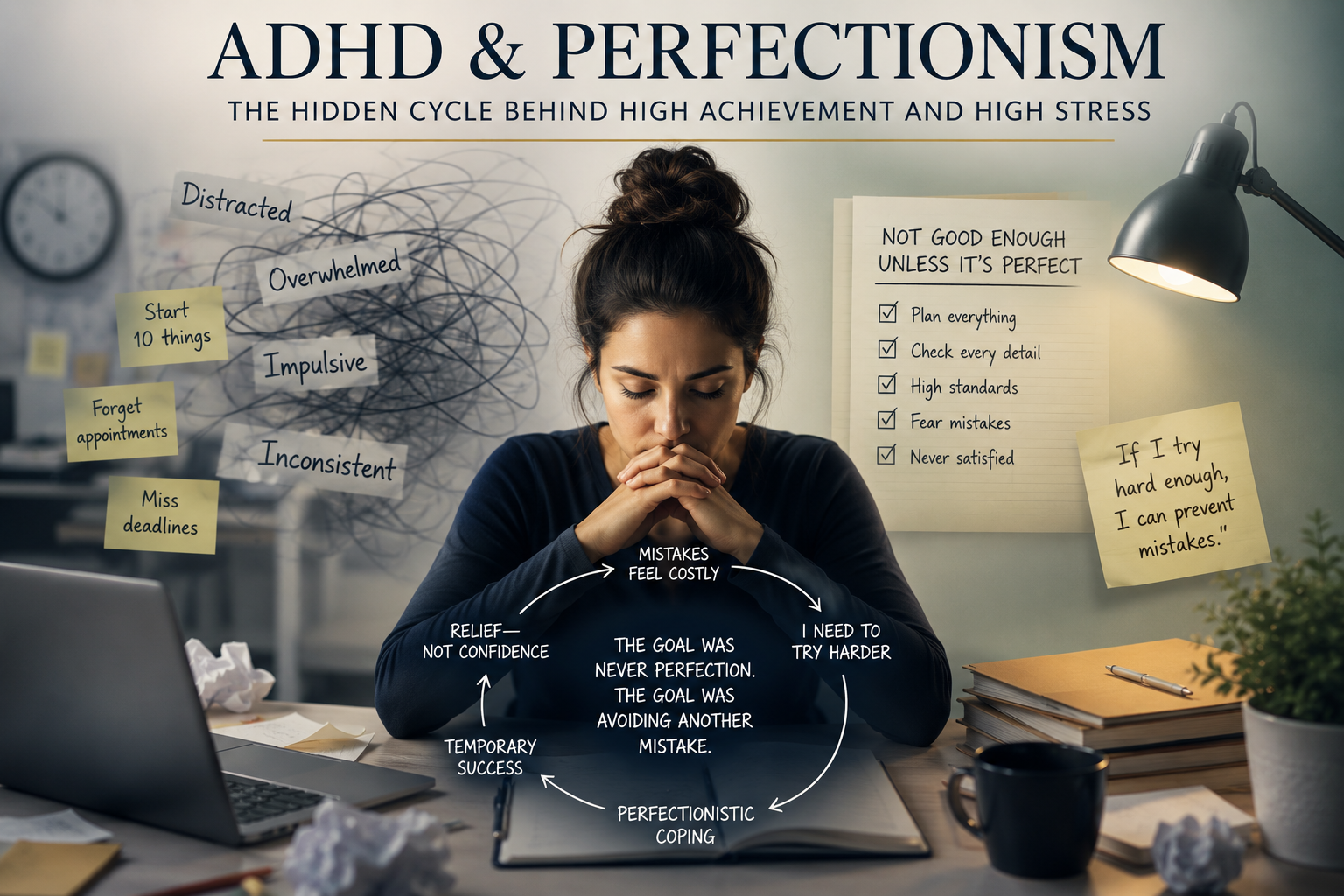

Table of Contents
ToggleWhat Current Research Reveals About Perfectionism, Compensation, and the Emotional Cost of Living With Adult ADHD
Imagine finishing another successful week.
You met your deadlines.
You solved difficult problems.
Maybe you even received praise from your manager or a grateful email from a client.
From the outside, it looks like you’re doing well.
So why doesn’t it feel that way?
For many adults, that question becomes more persistent with every achievement.
Instead of enjoying what you accomplished, your mind keeps returning to the one email you forgot to answer.
The presentation that wasn’t quite as polished as you wanted.
The conversation where you wish you had chosen different words.
Before long, you’re already thinking about everything you need to do next week—and all the ways you might fall behind.
If this feels familiar, you’re not alone.
Many adults with ADHD describe living with an exhausting contradiction. Other people see someone who is capable, intelligent, and successful. They see someone who gets things done.
What they don’t see is how much effort it took to get there.
They don’t see the hours spent rewriting an email before sending it.
They don’t see the anxiety that comes from worrying you’ll forget something important.
They don’t see how difficult it can be to relax because your brain is already scanning for the next problem to solve.
For years, many people have assumed this simply means they’re perfectionists.
Others have wondered if they’re just too hard on themselves.
Some have spent decades believing that if they could just become a little more organized, a little more disciplined, or a little more productive, the constant feeling of falling short would finally disappear.
But what if perfectionism isn’t the whole story?
What if those impossibly high standards developed for a reason?
Over the past decade, researchers have begun asking those same questions.
Instead of viewing perfectionism as simply a personality trait, scientists have started exploring whether it sometimes develops as a response to living with ADHD. Could years of missed deadlines, forgotten appointments, inconsistent performance, criticism, and self-doubt gradually teach someone that the only way to avoid failure is to work harder than everyone else—or expect more from themselves than anyone else ever could?
Emerging research suggests that, for many adults, the answer may be yes (Merkt et al., 2015; Christian et al., 2021; de Melo & Franca, 2026).
That doesn’t mean perfectionism is part of ADHD.
It isn’t.
The Diagnostic and Statistical Manual of Mental Disorders, Fifth Edition, Text Revision (DSM-5-TR) does not list perfectionism among the diagnostic criteria for ADHD (American Psychiatric Association, 2022).
But that doesn’t mean the relationship between ADHD and perfectionism isn’t real.
In fact, it may help explain one of the most confusing experiences many adults describe after they’re diagnosed.
They’ve spent years believing they were simply perfectionists.
The research suggests they may have been survivors instead.
Not survivors of a single traumatic event.
But survivors of thousands of small moments.
Forgotten homework.
Missed deadlines.
Critical teachers.
Frustrating report cards.
Being told they had so much potential but just needed to apply themselves.
Watching other people seem to accomplish the same work with half the effort.
Over time, those experiences can begin to change how a person thinks.
Mistakes stop feeling like normal parts of learning.
They start feeling dangerous.
Success doesn’t bring peace.
It brings temporary relief.
Then the cycle starts all over again.
If you’ve ever wondered why your accomplishments never seem to quiet your inner critic for very long…
…you’re asking a question that researchers are finally beginning to answer.
What Is Perfectionism?
The word perfectionism gets used so often that it’s easy to assume everyone means the same thing.
In reality, they don’t.
Ask ten people what a perfectionist looks like, and you’ll probably hear descriptions like:
Someone who’s organized.
Someone who pays attention to detail.
Someone who has exceptionally high standards.
Someone who refuses to settle for mediocre work.
None of those definitions are entirely wrong.
They’re just incomplete.
Psychologists define perfectionism differently.
Research suggests perfectionism isn’t simply about wanting to do things well. It’s about what happens when your sense of worth becomes tied to meeting impossibly high standards—and when even small mistakes begin to feel much larger than they really are (Limburg et al., 2017).
That’s an important distinction.
Someone can pursue excellence because they enjoy learning, solving problems, or mastering a skill.
Someone else may produce equally impressive work while constantly worrying they’ll disappoint someone, be exposed as inadequate, or discover they were never as capable as everyone believed.
From the outside, those two people often look exactly the same.
On the inside, they’re living completely different experiences.
Why This Matters
One of the biggest misconceptions about perfectionism is that the problem is having high standards.
It isn’t.
Healthy ambition has helped countless people build meaningful careers, relationships, and lives.
The problem begins when those standards stop being a source of motivation and become a source of fear.
When every mistake feels like evidence that you’re failing.
When every success feels temporary.
When your self-worth rises and falls with your performance.
Understanding that distinction becomes especially important when we begin talking about ADHD.
Because here’s where the story takes an unexpected turn.
Perfectionism isn’t actually one of the symptoms of ADHD.
Why Do So Many Adults With ADHD Become Perfectionists?
One of the most confusing things about ADHD and perfectionism is how contradictory they can appear.
ADHD is often associated with distractibility, impulsivity, inconsistent performance, and difficulty following through.
Perfectionism seems to suggest the opposite: careful planning, rigid standards, excessive control, and an intense concern with getting everything right.
Yet many adults with ADHD experience both.
They miss deadlines—and then spend an entire weekend trying to make the next project flawless.
They forget important details—and then check every email five times before pressing “Send.”
They procrastinate for days—and then stay awake until two in the morning trying to ensure that every sentence is perfect.
This can leave people asking:
How can I be so disorganized and such a perfectionist at the same time?
For years, researchers often treated impulsivity and perfectionism as psychological opposites.
Then Christian and colleagues asked a different question.
Rather than assuming that people must fall into one category or the other, they examined whether distinct combinations of impulsivity and perfectionism might exist within the same population. Their analysis of 1,353 participants identified four profiles: high perfectionism, high impulsivity, low levels of both, and a combined impulsivity-perfectionism profile (Christian et al., 2021).
The combined group was not an unusual exception.
It was the largest group in the study.
These participants also reported some of the highest levels of ADHD symptoms, anxiety, depression, obsessive-compulsive symptoms, post-traumatic stress symptoms, and eating pathology (Christian et al., 2021).
The study did not establish that ADHD causes perfectionism. Nor did it prove that everyone with ADHD develops perfectionistic tendencies.
But it challenged an important assumption.
Impulsivity and perfectionism are not necessarily opposites. A person can struggle with inconsistent control in some moments while attempting to impose rigid control in others.
For many adults with ADHD, perfectionism may represent an effort to manage the very inconsistency that makes daily life feel unpredictable.
A Note from the Author
Research rarely comes in neat, easy-to-understand diagrams.
Instead, each study helps explain one piece of a much larger picture.
As I reviewed the research for this article, I found myself mentally connecting ideas from several different investigators. No single paper fully explained the pattern many adults describe, but together the findings began to tell a remarkably consistent story.
The illustration below is simply my attempt to organize those complementary ideas into one visual that is easier to understand.
It isn’t a new psychological theory or a validated clinical model. Think of it simply as a map that helps organize the research discussed throughout this review.
I hope it helps you see the bigger picture as clearly as it helped me understand it.
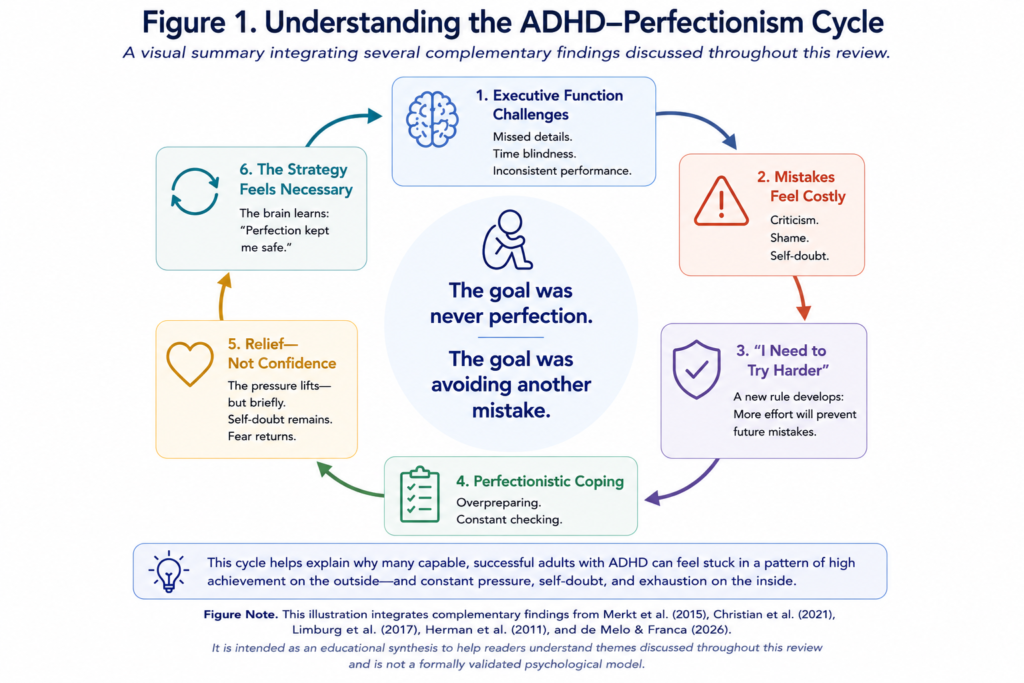
Although every person’s experience is different, this framework helps explain why perfectionism can feel less like a personality trait and more like a learned way of coping with repeated challenges.
Why This Matters
You do not have to choose between being “the disorganized person” and “the perfectionist.”
Both patterns can exist within the same person.
You may forget an appointment and become extraordinarily rigid about your calendar afterward.
You may submit one assignment late and then overprepare for every assignment that follows.
You may act impulsively in one situation and spend hours second-guessing yourself in another.
Seen from the outside, these behaviors may appear inconsistent.
Seen through the lens of adaptation, they begin to make more sense.
The perfectionism may not contradict the ADHD.
It may be an attempt to contain it.
Researchers Began Asking a More Important Question
For much of ADHD’s clinical history, attention focused on the symptoms other people could observe.
Could the person sit still?
Did they interrupt?
Could they complete assignments?
Were they organized?
Did they miss deadlines?
Those questions remain important. But they do not capture everything that happens after someone has lived with ADHD-related difficulties for years.
Eventually, researchers began asking a different question:
How do people adapt?
What happens when a bright child repeatedly forgets homework despite genuinely trying?
What happens when an intelligent college student studies twice as long because sustaining attention is so difficult?
What happens when a capable professional creates increasingly elaborate systems because they are terrified of overlooking something important?
Those experiences do not simply disappear once the immediate problem is resolved.
They can shape the way a person approaches future tasks.
They can shape what mistakes come to mean.
And they can create internal rules such as:
- Double-check everything.
- Never let anyone see you unprepared.
- Work harder than everyone else.
- Do not let them know how difficult this really is.
In 2015, Jan Merkt and colleagues introduced a framework for understanding these adaptations. They described psychological compensation as the process through which a person develops skills, strategies, or patterns of behavior that help offset an underlying difficulty (Merkt et al., 2015).
Compensation can be intentional.
A person may recognize that they forget appointments and begin using several calendars, alarms, and written reminders.
But compensation can also develop gradually and almost invisibly.
Someone may spend years overpreparing, checking, rehearsing, or working longer than everyone around them without ever recognizing these behaviors as adaptations.
Eventually, the strategy no longer feels like something they do.
It feels like who they are.
They do not think:
I developed perfectionistic habits because mistakes became costly.
They think:
I have always been a perfectionist.
Merkt and colleagues’ framework offers another possibility.
What feels like personality may sometimes be a compensation strategy that became automatic.
Compensation can be remarkably effective.
It can also be remarkably expensive.
Why This Matters
Many adults say, “I have always been this way,” as though longevity proves that a pattern must be an unchangeable part of their personality.
But a coping strategy can be old without being innate.
It may have developed so early, or been reinforced so often, that it became difficult to separate from identity.
Understanding compensation creates room for a more compassionate question.
Instead of asking:
Why am I like this?
You can begin asking:
What was this pattern helping me prevent?
Perhaps it helped you avoid another missed deadline.
Another disappointing grade.
Another criticism.
Another moment of feeling less capable than everyone believed you should be.
That does not make the strategy irrational.
It means it may have developed for a reason.
The Hidden Cost of Looking Successful
Success can hide suffering.
Sometimes it hides it remarkably well.
Imagine two attorneys preparing for the same court hearing.
Both arrive well prepared.
Both perform exceptionally well.
Both receive praise afterward.
From the outside, their performance looks identical.
What no one sees is what it took to get there.
One attorney prepared efficiently over several days.
The other spent nights rereading documents because they were terrified of missing something important.
They rewrote arguments repeatedly.
Checked their calendar again and again.
Rehearsed every possible question.
Slept poorly.
Arrived exhausted.
The outcome looked the same.
The psychological cost was completely different.
More recently, Isabela Helena de Melo and Gustavo Franca used the phrase “high functioning, yet high suffering” to describe adults whose outward achievement can obscure the amount of effort, distress, and self-monitoring required to maintain that performance (de Melo & Franca, 2026).
Their argument highlights a diagnostic and emotional blind spot.
When clinicians, teachers, employers, or family members look only at outcomes, they may conclude that someone is functioning well.
The degree was completed.
The deadlines were met.
The career progressed.
The household remained organized.
But outcomes do not reveal the energy required to produce them.
A person may appear highly organized because they have built a system that cannot tolerate even a small disruption.
They may appear consistently prepared because they spend far more time preparing than anyone realizes.
They may appear calm because they have learned to conceal the anxiety occurring underneath.
They may appear successful because the compensation is working.
The suffering remains invisible precisely because the strategy is effective.
This is one reason high-achieving adults may struggle to recognize their own impairment.
They see what they have accomplished and conclude that they have no right to find it difficult.
They compare their internal struggle with other people’s external performance.
And they often decide that the problem must be a lack of discipline, resilience, or gratitude.
But achievement and ease are not the same thing.
Success tells us what someone accomplished.
It does not tell us what the accomplishment cost.
Readers interested in the relationship between chronic compensation and emotional exhaustion may also find Understanding ADHD Burnout helpful.
Why This Matters
Many adults spend years judging themselves by the amount of effort they require rather than the outcomes they achieve.
They see a colleague finish a project in six hours.
It takes them sixteen.
Both projects are excellent.
Yet instead of recognizing the additional cognitive effort involved, they conclude that they must be less capable.
The same comparison occurs in graduate school, medicine, law, engineering, entrepreneurship, and executive leadership.
Other people see the presentation.
They do not see the weekend lost to preparing it.
They see the promotion.
They do not see the anxiety behind every meeting.
They see someone who appears composed.
They do not see the hours spent rehearsing conversations beforehand.
This is the hidden cost of looking successful.
The achievement is real.
So is the exhaustion.
How Repeated Experiences Can Change the Meaning of Mistakes
Perfectionism does not usually begin with someone deciding that flawless performance would be a good life philosophy.
More often, mistakes gradually become emotionally loaded.
A forgotten assignment may be inconvenient once.
Repeated forgotten assignments can begin to feel like evidence.
A missed deadline may be manageable.
Repeated deadlines, criticism, or disappointed reactions can gradually shape the belief that mistakes reveal something deeper about a person’s intelligence, reliability, or worth.
Research on the developmental origins of perfectionism offers clues about how this process may unfold.
Kathleen Herman and colleagues followed African American children from first through sixth grade to examine how different perfectionism profiles developed over time. Children who later developed a more critical and maladaptive pattern of perfectionism had earlier shown higher levels of attention problems, hyperactivity, shyness, and peer rejection (Herman et al., 2011).
This study was not designed specifically to prove that ADHD causes perfectionism. Its findings also came from a particular population and cannot automatically be generalized to every child or adult.
But it raises an important possibility.
Early attention and behavioral difficulties may contribute to experiences—such as criticism, academic frustration, or social rejection—that later shape harsh self-evaluation and fear of mistakes.
In other words, perfectionism may not begin with high standards.
It may begin with repeated moments of feeling that ordinary mistakes are unusually visible, unusually costly, or unusually difficult to explain.
Over time, the person may begin trying to prevent those moments at almost any cost.
The standard becomes:
I cannot afford to get this wrong.
Why This Matters
Many adults assume they are distressed by mistakes because they care too much about excellence.
That may not be the full story.
The emotional response may also reflect everything the mistake has come to represent.
A forgotten meeting is no longer just a forgotten meeting.
It becomes evidence that you are unreliable.
A delayed project is no longer just a delayed project.
It becomes evidence that everyone else is more capable.
A small correction from a supervisor is no longer just feedback.
It becomes confirmation of the fear that you have been failing all along.
The mistake may be small.
The meaning attached to it is not.
The ADHD Perfectionism Cycle
There is no single, universally accepted scientific model called the “ADHD Perfectionism Cycle.”
The framework below is an educational synthesis rather than a formally validated diagnostic theory.
It brings together findings from research on psychological compensation, maladaptive perfectionism, developmental experiences, executive functioning, and the coexistence of impulsivity and perfectionistic control (Christian et al., 2021; Herman et al., 2011; Limburg et al., 2017; Merkt et al., 2015).
For many adults, the pattern may look something like this:
1. Executive Function Challenges
ADHD can make it harder to organize, estimate time, sustain attention, remember obligations, begin tasks, and maintain consistent performance.
2. Unexpected Mistakes or Inconsistency
Important details are missed.
Deadlines slip.
Performance varies from one day to another.
A person may succeed brilliantly on one task and struggle unexpectedly with another.
3. Criticism, Shame, or Self-Doubt
The individual receives criticism from others—or begins supplying it internally.
They may hear that they are careless, lazy, unreliable, or not living up to their potential.
4. A New Rule Develops
The person concludes:
I need to try harder.
I need to be more careful.
I cannot make that mistake again.
5. Perfectionistic Standards Take Over
Standards become increasingly rigid.
Preparation becomes excessive.
Self-worth becomes tied to producing the correct result.
6. Overpreparing and Constant Self-Monitoring
The person checks, revises, rehearses, anticipates problems, and tries to control every possible outcome.
7. Mental Exhaustion
The strategy consumes time and cognitive energy.
Tasks begin to feel heavier.
Recovery becomes more difficult.
8. Avoidance or Procrastination
The pressure to perform perfectly makes starting more threatening.
The person delays because they do not yet feel prepared, focused, confident, or capable of meeting the standard.
For a deeper explanation of this relationship, see Why Do Adults With ADHD Procrastinate?
9. Last-Minute Urgency
As the deadline approaches, urgency temporarily increases focus.
The person works intensely, often at the expense of sleep, health, or emotional well-being.
10. Temporary Success
The project is completed.
The presentation goes well.
The deadline is met.
Other people may even praise the result.
11. Relief Replaces Confidence
The person does not conclude:
I am capable.
They conclude:
I survived because I pushed myself hard enough.
The perfectionistic strategy is reinforced.
12. Burnout Becomes More Likely
The cycle repeats until the effort is no longer sustainable.
Why This Matters
Perhaps the most important idea in this pattern is this:
The goal was never perfection.
The goal was avoiding another mistake.
For many adults with ADHD, perfectionism is not driven by a love of flawless work.
It is driven by the memory of what mistakes have cost before.
The criticism.
The embarrassment.
The lost opportunity.
The sense of having disappointed someone.
The fear that the next mistake will confirm every negative belief they have carried about themselves.
Seen this way, perfectionism begins to look less like a personality flaw and more like an understandable attempt to create safety and predictability.
That does not mean the strategy remains helpful forever.
A coping pattern can protect you at one stage of life and exhaust you at another.
Nor does this mean that every adult with ADHD becomes perfectionistic. Individual experiences, personality, environment, family expectations, co-occurring anxiety, and many other factors likely influence who develops these patterns.
But the cycle may help explain why so many intelligent and capable adults feel trapped between two fears:
The fear that perfectionism is destroying their well-being.
And the fear that without it, everything will fall apart.
Breaking the ADHD and Perfection Cycle
If perfectionism develops over years of adapting to ADHD, an obvious question follows.
Can those patterns change?
For many adults, that question feels deeply personal.
Perhaps you’ve spent decades believing your perfectionism is the only thing holding your life together.
Maybe you’ve wondered what would happen if you stopped checking everything three times.
If you stopped rewriting every email.
If you stopped demanding so much from yourself.
Would everything fall apart?
Or would you finally be able to breathe?
Researchers have been asking similar questions.
Although there is no single treatment designed specifically for what we might call “ADHD perfectionism,” several evidence-based approaches appear to target the very processes that keep the cycle going.
Perhaps the most encouraging finding is this:
None of these approaches ask people to stop caring about doing meaningful work.
Instead, they aim to reduce the psychological cost of getting there.
ADHD Treatment Changes More Than Attention
One of the biggest misconceptions about ADHD treatment is that it simply improves concentration.
In reality, effective treatment often changes much more than that.
Think back to the cycle we discussed earlier.
If someone spends years checking every appointment because they frequently forget them, what happens when remembering becomes easier?
If someone no longer needs extraordinary effort simply to stay organized, what happens to the fear that has been driving so much of their perfectionism?
For many people, those compensatory strategies don’t disappear overnight.
Beliefs that develop over years rarely do.
But when the underlying executive functioning difficulties improve, the need to rely on some of those strategies may gradually begin to decrease (Volkow & Swanson, 2013).
Treatment doesn’t simply improve attention.
It can reduce the burden that made perfectionistic compensation feel necessary in the first place.
Why This Matters
Many adults assume they must first “fix” their perfectionism before ADHD treatment can really help.
Current evidence suggests the relationship may actually work in the opposite direction.
Sometimes improving ADHD symptoms creates enough stability that perfectionistic coping strategies begin to loosen on their own.
That doesn’t mean the beliefs disappear overnight.
But it often creates space for healthier ways of working, planning, and responding to mistakes.
Readers interested in the full range of evidence-based treatment options—including medication, psychotherapy, coaching, lifestyle interventions, and executive function supports—may also find The Complete Guide to Adult ADHD Treatment helpful.
Cognitive Behavioral Therapy: Changing the Rules You Learned
Medication can reduce ADHD symptoms.
It cannot rewrite years of learned beliefs.
This is where cognitive behavioral therapy (CBT) becomes especially important.
Over the past two decades, researchers have consistently found that CBT helps adults with ADHD improve organization, planning, time management, emotional regulation, and overall functioning (Lopez et al., 2018).
One of the pioneers in this work, psychologist Dr. Steven Safren, helped develop an ADHD-specific CBT approach that combines practical executive functioning strategies with cognitive techniques designed to identify and challenge the beliefs that often develop after years of struggling with ADHD.
Rather than simply teaching someone to become more organized, CBT asks questions like:
“Where did this rule come from?”
“Do I really have to work twice as hard to be good enough?”
“What evidence supports that belief?”
Researchers such as Dittner and colleagues have also demonstrated that CBT can help adults examine the core beliefs that often emerge after repeated experiences of ADHD-related difficulties, including:
“I’m unreliable.”
“I always disappoint people.”
“If I make a mistake, people will realize I’m not as capable as they think.”
Instead of replacing these thoughts with unrealistic optimism, CBT encourages people to test them through real-life behavioral experiments and gradually develop more accurate, balanced beliefs (Dittner et al., 2018).
Why This Matters
Perhaps the greatest strength of CBT is that it recognizes an important truth:
The problem isn’t simply forgetting things.
The problem is the meaning you’ve learned to attach to forgetting them.
CBT helps separate the event from the interpretation.
A missed deadline becomes something to understand and address—not proof that you’re fundamentally inadequate.
If you’d like to explore this treatment in greater depth—including what ADHD-focused CBT sessions typically involve and why it differs from traditional talk therapy—see How CBT Helps Adults with ADHD.
Treating Perfectionism Itself
As researchers learned more about perfectionism, another question naturally emerged.
What happens if we treat perfectionism directly?
Among the leaders in this field, psychologist Dr. Roz Shafran and colleagues developed a cognitive behavioral approach specifically for clinical perfectionism.
Their work challenged another common misconception.
The goal is not to convince people to lower their standards.
Instead, the goal is to help people recognize when high standards stop serving them and begin controlling them.
Treatment often focuses on:
- Understanding how perfectionism developed.
- Broadening self-worth beyond achievement alone.
- Testing perfectionistic predictions through behavioral experiments.
- Reducing harsh self-criticism.
- Learning that “good enough” is sometimes both realistic and highly effective (Rozental, 2020; Podina, 2020).
For many adults with ADHD, this approach feels surprisingly different from what they expected.
It isn’t about becoming less ambitious.
It’s about becoming more flexible.
Why This Matters
One of the biggest fears people express is:
“If I’m not hard on myself, won’t I become lazy?”
Current research provides little evidence that self-criticism is what creates long-term success.
In fact, maladaptive perfectionism often increases procrastination, anxiety, burnout, and emotional exhaustion (Limburg et al., 2017).
Replacing perfectionism with healthier standards doesn’t mean lowering expectations.
It means removing the constant fear that every mistake threatens your worth.
Learning to Respond to Yourself Differently
Imagine making a mistake at work.
What happens next?
For many adults with ADHD, the external mistake lasts only a few moments.
The internal response can last for days.
Researchers have become increasingly interested in what happens during those internal conversations.
One important contributor to this work is Danielle Beaton and colleagues, who found that adults with ADHD report significantly lower levels of self-compassion than adults without ADHD.
Even more importantly, lower self-compassion helped explain part of the relationship between ADHD symptoms and higher levels of depression and anxiety (Beaton et al., 2022).
Why does this matter?
Because perfectionism often isn’t maintained by high standards alone.
It’s maintained by what happens immediately after something goes wrong.
Some people think,
“That didn’t go the way I hoped. What can I learn?”
Others think,
“I can’t believe I did that. I’ll never get this right.”
Those two responses create very different emotional futures.
Self-compassion interventions—including Compassion-Focused Therapy and Acceptance and Commitment Therapy (ACT)—do not encourage people to ignore mistakes.
They encourage people to respond to mistakes with honesty, perspective, and humanity rather than relentless self-judgment (Ong et al., 2021).
Why This Matters
Many adults believe their inner critic has been the engine behind every accomplishment.
Current evidence suggests another possibility.
The inner critic may not be the reason you’ve succeeded.
It may simply be the price you’ve been paying along the way.
What Researchers Still Don't Know
One of the defining characteristics of good science is its willingness to acknowledge uncertainty.
Although our understanding of ADHD and perfectionism has grown substantially over the past decade, important questions remain.
Researchers still do not know why some adults with ADHD develop significant perfectionistic coping strategies while others do not.
They are still exploring how personality, childhood experiences, family expectations, anxiety, emotional regulation, and cultural influences interact over time.
Many of the studies discussed throughout this review are also cross-sectional.
That means they can identify meaningful relationships but cannot prove that one factor caused another.
The newer concepts of psychological compensation introduced by Merkt and colleagues (2015) and “high functioning, yet high suffering” proposed by de Melo and Franca (2026) are particularly promising because they offer frameworks for understanding experiences that many adults recognize immediately.
At the same time, these ideas represent emerging areas of research rather than settled scientific consensus.
That distinction matters.
Scientific humility isn’t a weakness.
It’s one of the reasons science continues to improve.
Why This Matters
You may have noticed that this review often uses phrases like:
“Current evidence suggests…”
“Researchers increasingly believe…”
“Emerging research indicates…”
Those phrases are intentional.
Good science distinguishes between what we know with reasonable confidence and what we are still learning.
That doesn’t make the findings less valuable.
It makes them more trustworthy.
Final Thoughts
If you’ve recognized yourself throughout this review, you may also be realizing something else.
For years, you may have believed your perfectionism was simply part of your personality.
Perhaps you described yourself as driven.
Maybe other people described you that way too.
You may have assumed the constant pressure, endless self-monitoring, and relentless inner criticism were simply the price of being successful.
Current research offers a more compassionate possibility.
For some adults with ADHD, perfectionism may not reflect who they are.
It may reflect what they learned they needed to become.
Not because they wanted to be perfect.
But because, over time, mistakes began to feel increasingly costly.
The forgotten assignment.
The missed deadline.
The criticism that lingered long after everyone else had forgotten it.
The exhausting effort required just to appear as though everything was under control.
These experiences can shape the rules we live by.
They can also shape the stories we tell ourselves.
“I have to work harder.”
“I can’t let anyone see me struggle.”
“If I make one mistake, people will realize I don’t belong here.”
For many adults, those beliefs become so familiar that they stop feeling like beliefs.
They begin to feel like identity.
One of the most encouraging messages emerging from current research is that learned patterns do not have to remain permanent patterns.
The strategies that once helped you survive school, build a career, or meet other people’s expectations may not be the same strategies that will help you build a healthier, more sustainable future.
Understanding how these patterns developed does not erase ADHD.
It does not eliminate the challenges of executive functioning.
And it certainly does not mean you should stop striving to do meaningful work.
What it can do is replace years of self-blame with something much more useful:
Understanding.
Perhaps that is the greatest lesson from the research.
The goal was never perfection.
The goal was avoiding another mistake.
Once you understand the difference, you can begin asking a different question.
Not,
“How do I become perfect?”
But,
“How do I build a life that no longer requires perfection to feel enough?”
That may be one of the most important questions researchers—and all of us—are still learning to answer.
Key Takeaways
- Perfectionism is not a diagnostic symptom of ADHD. The DSM-5-TR does not include perfectionism among the diagnostic criteria for ADHD (American Psychiatric Association, 2022).
- Current research suggests that perfectionism may develop as a coping strategy rather than a defining feature of ADHD. Researchers increasingly believe that some adults develop perfectionistic beliefs and behaviors while adapting to years of executive functioning challenges, inconsistent performance, criticism, and repeated experiences of trying harder to avoid mistakes (Merkt et al., 2015; de Melo & Franca, 2026).
- Psychological compensation helps explain an apparent contradiction. Adults with ADHD can experience both impulsivity and perfectionism because compensatory strategies often develop in response to executive functioning difficulties rather than in opposition to them (Christian et al., 2021; Merkt et al., 2015).
- Success does not necessarily reflect ease. Emerging research suggests that many high-achieving adults maintain exceptional performance through extraordinary effort, constant self-monitoring, and invisible psychological costs—a phenomenon described as “high functioning, yet high suffering” (de Melo & Franca, 2026).
- Healthy ambition and maladaptive perfectionism are not the same thing. Research consistently distinguishes striving for excellence from perfectionism driven by fear of mistakes, harsh self-criticism, and conditional self-worth (Limburg et al., 2017).
- Effective treatment is not about lowering your standards. Evidence-based approaches such as ADHD-focused cognitive behavioral therapy (CBT), treatment for clinical perfectionism, and interventions that cultivate self-compassion aim to reduce the emotional burden of perfectionism while preserving healthy achievement (Beaton et al., 2022; Dittner et al., 2018; Lopez et al., 2018; Rozental, 2020).
- Perhaps the most important takeaway is this: The goal was never perfection. The goal was avoiding another mistake.
Continue Learning
Understanding ADHD is a journey, not a single article. If this review resonated with you, these evidence-based resources may help you explore related topics in greater depth.
Start Here
- Start Here
- The Complete Guide to Adult ADHD Diagnosis, Treatment, and What to Expect
- The Complete Guide to Adult ADHD Treatment
If This Article Described You
- High-Achieving Adults with ADHD: When Success Hides the Struggle
- Can You Be Successful and Still Have ADHD?
Evidence-Based Treatments
Related Research Reviews
References
American Psychiatric Association. (2022). Diagnostic and statistical manual of mental disorders (5th ed., text rev.). American Psychiatric Association Publishing.
Beaton, D. M., et al. (2022). [Complete publication information to be verified during final APA audit].
Burcaş, S., & Creţu, R. Z. (2021). Perfectionism and neuroticism: Evidence for a common genetic and environmental etiology. Journal of Personality, 89(4), 819–830. https://doi.org/10.1111/jopy.12617
Christian, C., Bridges-Curry, Z., Hunt, R. A., et al. (2021). Latent profile analysis of impulsivity and perfectionism dimensions and associations with psychiatric symptoms. Journal of Affective Disorders, 283, 293–301. https://doi.org/10.1016/j.jad.2021.01.076
de Melo, I. H., & Franca, G. (2026). High functioning, yet high suffering: The need to incorporate invisible struggles in adult ADHD diagnostic assessment/criteria. Frontiers in Psychiatry, 17, Article 1813029. https://doi.org/10.3389/fpsyt.2026.1813029
Dittner, A. J., et al. (2018). [Complete publication information to be verified during final APA audit].
Herman, K. C., Trotter, R., Reinke, W. M., & Ialongo, N. (2011). Developmental origins of perfectionism among African American youth. Journal of Counseling Psychology, 58(3), 321–334. https://doi.org/10.1037/a0023108
Katzenmajer-Pump, L., Farkas, B. F., Varga, B. A., Jansma, J. M., & Balázs, J. (2021). Low level of perfectionism as a possible risk factor for suicide in adolescents with attention-deficit/hyperactivity disorder. Frontiers in Psychiatry, 12, Article 707831. https://doi.org/10.3389/fpsyt.2021.707831
Krieger, V., Amador-Campos, J. A., & Guàrdia-Olmos, J. (2020). Executive functions, personality traits and ADHD symptoms in adolescents: A mediation analysis. PLOS ONE, 15(5), e0232470. https://doi.org/10.1371/journal.pone.0232470
Limburg, K., Watson, H. J., Hagger, M. S., & Egan, S. J. (2017). The relationship between perfectionism and psychopathology: A meta-analysis. Journal of Clinical Psychology, 73(10), 1301–1326. https://doi.org/10.1002/jclp.22435
Lopez, P. L., Torrente, F. M., Ciapponi, A., et al. Cognitive-behavioural interventions for attention deficit hyperactivity disorder (ADHD) in adults. Cochrane Database of Systematic Reviews. [Year, issue, article number to be verified during final APA audit].
Merkt, J., Reinelt, T., & Petermann, F. (2015). A framework of psychological compensation in attention deficit hyperactivity disorder. Frontiers in Psychology, 6, Article 1580. https://doi.org/10.3389/fpsyg.2015.01580
Ong, C. W., et al. (2021). [Complete publication information to be verified during final APA audit].
Podina, I. R. (2020). Concluding commentary: Treating perfectionism transdiagnostically with an eye on the future. Journal of Clinical Psychology, 76(11), 2109–2115. https://doi.org/10.1002/jclp.23061
Rozental, A. (2020). Beyond perfect? A case illustration of working with perfectionism using cognitive behavior therapy. Journal of Clinical Psychology, 76(11), 2041–2054. https://doi.org/10.1002/jclp.23039
Volkow, N. D., & Swanson, J. M. (2013). Adult attention deficit–hyperactivity disorder. The New England Journal of Medicine, 369(20), 1935–1944. https://doi.org/10.1056/NEJMcp1212625
Medical Review & Author Information
Written and medically reviewed by Troy Don, DC, AGACNP-BC, PMHNP-BC
For additional information about clinical education, professional credentials, and background, see Clinical Credentials & Professional Background.
Last medically reviewed: August 2026
Evidence reviewed through: August 2026
Medical Disclaimer
This article is for educational purposes only and is not a substitute for individualized medical advice, diagnosis, or treatment. If you have questions about ADHD, mental health symptoms, medications, or treatment options, discuss them with an appropriate healthcare professional.