
Table of Contents
ToggleWhy You Feel Stuck Even When You Know What Needs to Be Done
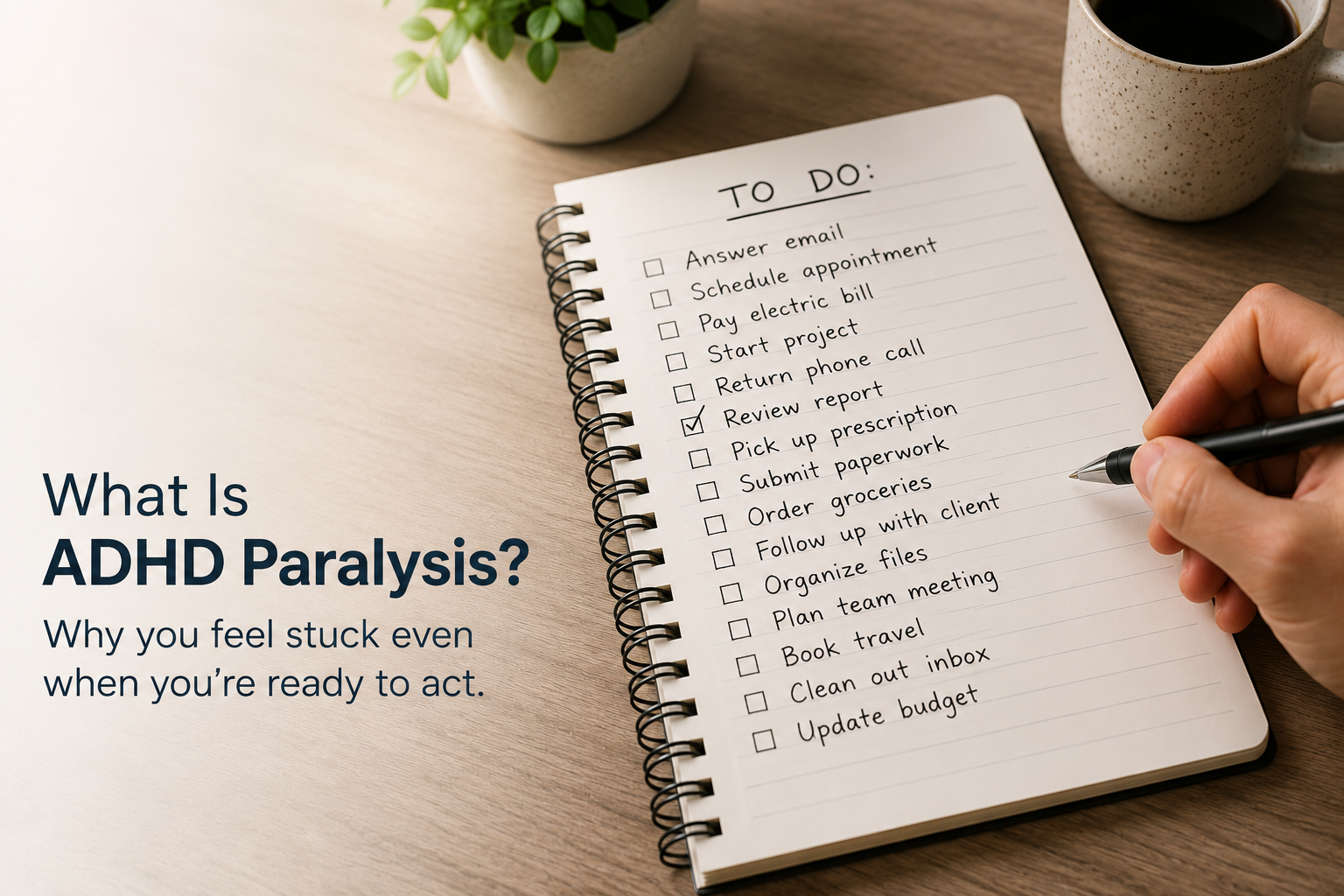
Are you suffering with ADHD Paralysis? Does this sound familiar?
You need to answer an email.
Pay a bill.
Schedule an appointment.
Start a work project you’ve been putting off for days.
None of these tasks are impossible. In fact, some would only take a few minutes.
Yet you find yourself sitting there, unable to begin.
Minutes turn into hours. Frustration builds. You know exactly what needs to happen, but you can’t seem to make yourself start.
Many adults with ADHD describe this experience as ADHD paralysis.
If you’ve ever felt frozen despite wanting to take action, you’re not alone. ADHD paralysis is a common experience among adults with ADHD, and understanding why it happens is often the first step toward overcoming it.
What Is ADHD Paralysis?
ADHD paralysis is not an official medical diagnosis found in the DSM-5. Instead, it is a commonly used term within the ADHD community.
People use the term to describe feeling mentally stuck, frozen, overwhelmed, or unable to start a task despite wanting to take action.
Someone experiencing ADHD paralysis may:
- Know exactly what needs to be done
- Understand why the task matters
- Want to complete the task
- Still feel unable to begin
Although the term itself is informal, the experience it describes is very real.
Many adults with ADHD report feeling trapped between intention and action. They know what they want to do, but something seems to block the transition from thinking about a task to actually starting it.
Is ADHD Paralysis the Same as Laziness?
No.
Laziness implies a lack of effort, concern, or desire to act.
ADHD paralysis is different.
Most people experiencing ADHD paralysis genuinely want to move forward. They often care deeply about the task and may spend hours worrying about it, thinking about it, or criticizing themselves for not doing it.
Common thoughts include:
“Why can’t I just get started?”
“This should be easy.”
“I know what I need to do, so why am I not doing it?”
This internal conflict is one reason ADHD paralysis can be so distressing.
The problem is usually not a lack of motivation or caring. Instead, it often reflects difficulties with the brain systems responsible for planning, prioritizing, organizing, and initiating action.
Understanding this distinction can help reduce the guilt and shame that many adults with ADHD carry.
What Causes ADHD Paralysis?
There is rarely a single cause.
Researchers believe that several ADHD-related challenges can contribute to feeling stuck or frozen.
Executive Dysfunction
One of the most important contributors is executive dysfunction.
Executive functions are the mental processes that help us:
- Plan
- Organize
- Prioritize
- Initiate tasks
- Hold information in working memory
- Monitor progress
- Shift attention when needed
When these systems are struggling, starting a task can become much harder than it appears from the outside.
From a clinical perspective, ADHD paralysis is often best understood as a manifestation of executive dysfunction. The person is not choosing not to act. Rather, the brain is having difficulty organizing and launching goal-directed behavior.
For a deeper explanation, see What Is Executive Dysfunction?
Decision Fatigue
Sometimes the problem is not the task itself.
It’s the number of decisions surrounding the task.
Which project should you start first?
What’s the best approach?
Which email should you answer?
What deserves your attention right now?
When the brain is forced to evaluate too many options, decision-making can become exhausting. The result may be avoidance, procrastination, or feeling completely stuck.
Learn more in ADHD and Decision Fatigue.
Overwhelm
Large projects often trigger paralysis.
Tasks such as “finish taxes,” “clean the house,” or “complete the report” contain many smaller steps.
When the brain cannot clearly identify the next action, the entire project can feel overwhelming.
As overwhelm increases, action often decreases.
Perfectionism
Many adults with ADHD also struggle with perfectionism.
They may worry about:
- Making mistakes
- Producing imperfect work
- Choosing the wrong approach
- Letting others down
When the stakes feel high, avoidance can become a way of protecting against perceived failure.
Learn more in ADHD and Perfectionism.
Emotional Factors
Emotions play a larger role in ADHD than many people realize.
Anxiety, frustration, shame, fear of failure, and self-doubt can all make it harder to begin a task.
Sometimes the task itself is not the biggest obstacle. The emotions attached to the task become the barrier.
For more information, see Adult ADHD and Emotional Regulation.
Motivation and Interest
Research suggests that ADHD is not simply an attention problem. It also involves differences in motivation, reward processing, and activation.
Many adults notice that ADHD paralysis is most likely to occur when a task feels:
- Boring
- Repetitive
- Overwhelming
- Ambiguous
- Disconnected from an immediate reward
The task may be important, but the ADHD brain can struggle to generate enough activation to get started when the reward feels distant or unclear.
What Does ADHD Paralysis Look Like?
ADHD paralysis can show up in many areas of life.
At Work
Examples include:
- Staring at a project without starting
- Re-reading the same email repeatedly
- Constantly planning without executing
- Switching between tasks without making progress
At Home
ADHD paralysis may look like:
- Avoiding household chores
- Ignoring paperwork
- Delaying bills
- Putting off important appointments
In Everyday Life
Many adults report:
- Spending excessive time deciding what to do first
- Getting stuck between multiple responsibilities
- Feeling overwhelmed by simple tasks
- Knowing exactly what needs to happen but being unable to begin
To others, these situations may look like procrastination.
Internally, however, they often feel more like being frozen.
How Is ADHD Paralysis Related to Executive Dysfunction?
This is perhaps the most important thing to understand.
For many adults, ADHD paralysis is best understood as a manifestation of executive dysfunction.
Executive functions act as the brain’s management system. They help coordinate thoughts, prioritize information, organize actions, and translate intentions into behavior.
When executive functioning is impaired, several challenges can emerge:
- Difficulty starting tasks
- Difficulty creating a plan
- Difficulty prioritizing competing demands
- Difficulty holding multiple steps in working memory
- Difficulty shifting attention between activities
As a result, the person may feel stuck.
Importantly, they are not frozen because they don’t understand the task.
They are not frozen because they don’t care.
They are not frozen because they are lazy.
They are frozen because the executive system responsible for organizing action is struggling to move from intention to execution.
This helps explain why so many adults with ADHD say:
“I know exactly what I need to do. I just can’t get myself to do it.”
ADHD affects people differently, and not everyone experiences the same executive-function challenges. However, task initiation difficulties are among the most common reasons adults with ADHD report feeling stuck.
If this concept resonates with you, What Is Executive Dysfunction? is the best next article to read.
What Can Help ADHD Paralysis?
There is no single solution, but several ADHD-friendly strategies can help restore momentum.
Identify the Next Action
Avoid focusing on the entire project.
Instead of:
Finish taxes
Try:
Open tax folder
Instead of:
Write report
Try:
Create document and write title
The smaller and more concrete the action, the easier it is for the brain to begin.
Break Tasks Into Smaller Pieces
Large projects create cognitive overload.
Breaking them into smaller, manageable steps can reduce overwhelm and increase follow-through.
Learn more in Task Chunking for ADHD.
Reduce Decisions
Decision fatigue can contribute to paralysis.
Using routines, checklists, and systems can reduce the number of decisions your brain must make throughout the day.
Learn more in Time Blocking for ADHD.
Lower the Activation Barrier
Sometimes the goal is not to finish the task.
The goal is simply to start.
Many adults find it helpful to commit to just five minutes of effort rather than focusing on the entire project.
See How to Start Tasks With ADHD: The Five-Minute Activation Exercise for a practical approach.
Treat Underlying ADHD
Addressing ADHD symptoms directly can improve executive functioning and task initiation.
Treatment may include:
- ADHD medication
- Cognitive behavioral therapy (CBT)
- ADHD coaching
- Skills training
- Psychoeducation
If ADHD symptoms are significantly affecting work, relationships, or daily functioning, a professional evaluation may be helpful.
Key Takeaways
- ADHD paralysis is a common experience among adults with ADHD.
- Although it is not an official medical diagnosis, it describes the very real experience of feeling mentally stuck, overwhelmed, or unable to start a task despite wanting to act.
- ADHD paralysis is not laziness. Most people experiencing it care deeply about the task and are often frustrated by their inability to begin.
- For many individuals, ADHD paralysis is best understood as a manifestation of executive dysfunction. Difficulties with task initiation, planning, prioritization, organization, and working memory can make action feel surprisingly difficult.
- Other factors—including decision fatigue, overwhelm, perfectionism, anxiety, emotional stress, and differences in motivation and reward processing—can contribute as well.
- The good news is that effective ADHD strategies exist. Learning skills such as task chunking, time blocking, and five-minute activation can help create momentum and make it easier to move from intention to action.
Frequently Asked Questions About ADHD Paralysis
Is ADHD paralysis a real medical condition?
ADHD paralysis is not an official medical diagnosis found in the DSM-5. However, it is a widely used term that describes a very real experience reported by many adults with ADHD: feeling mentally stuck or unable to start a task despite wanting to act.
Why can’t I start tasks even when I know they are important?
For many adults with ADHD, difficulties with task initiation are related to executive dysfunction. The challenge is often not understanding the task’s importance but organizing thoughts, prioritizing actions, and generating enough activation to begin.
Is ADHD paralysis the same as procrastination?
Not exactly. Procrastination involves delaying a task, while ADHD paralysis often feels like being mentally frozen. Many people experiencing ADHD paralysis want to start but feel unable to take the first step.
What triggers ADHD paralysis?
Common triggers include overwhelm, decision fatigue, perfectionism, anxiety, competing priorities, and large tasks with multiple steps. Low-interest or repetitive tasks may also increase the likelihood of feeling stuck.
How can I break out of ADHD paralysis?
Many people find it helpful to identify the smallest possible next action, break large projects into smaller steps, reduce unnecessary decisions, and use structured ADHD strategies such as task chunking, time blocking, and the Five-Minute Activation Exercise.
If You're Feeling Stuck, Read These Next
If ADHD paralysis feels familiar, these resources can help you better understand why it happens and what to do about it.
Start Here: Understand What’s Happening
What Is Executive Dysfunction?
Learn how difficulties with planning, prioritization, working memory, and task initiation contribute to ADHD paralysis.
Next: Understand Why You Feel Stuck
ADHD and Decision Fatigue
Discover how too many choices and competing priorities can make it difficult to start even simple tasks.
Why Do Adults With ADHD Procrastinate?
Explore the differences between procrastination, avoidance, and executive dysfunction.
Understand the Emotional Side
Adult ADHD and Emotional Regulation
Learn how anxiety, frustration, shame, and emotional overwhelm can contribute to feeling frozen.
ADHD and Perfectionism
See how fear of mistakes and unrealistic standards can keep you from getting started.
Build Practical Skills
Task Chunking for ADHD
Learn how to break overwhelming projects into manageable next steps.
Time Blocking for ADHD
Create structure and reduce decision fatigue throughout your day.
How to Start Tasks With ADHD: The Five-Minute Activation Exercise
Use a simple strategy to lower the barrier to action and build momentum.
References
American Psychiatric Association. (2022). Diagnostic and statistical manual of mental disorders (5th ed., text rev.).
Faraone, S. V., Banaschewski, T., Coghill, D., Zheng, Y., Biederman, J., Bellgrove, M. A., Newcorn, J. H., Gignac, M., Al Saud, N. M., Manor, I., Rohde, L. A., Yang, L., Cortese, S., Almagor, D., Stein, M. A., Albatti, T. H., Aljoudi, H. F., Kamal, M., Reding, A., et al. (2021). The World Federation of ADHD International Consensus Statement: 208 evidence-based conclusions about the disorder. Neuroscience & Biobehavioral Reviews, 128, 789–818.
Posner, J., Polanczyk, G. V., & Sonuga-Barke, E. (2020). Attention-deficit hyperactivity disorder. The Lancet, 395(10222), 450–462.
Thapar, A., & Cooper, M. (2016). Attention deficit hyperactivity disorder. The Lancet, 387(10024), 1240–1250.
Willcutt, E. G., Doyle, A. E., Nigg, J. T., Faraone, S. V., & Pennington, B. F. (2005). Validity of the executive function theory of attention-deficit/hyperactivity disorder: A meta-analytic review. Biological Psychiatry, 57(11), 1336–1346.
Medical Review & Author Information
Written and medically reviewed by Troy Don, DC, AGACNP-BC, PMHNP-BC
For additional information about clinical education, professional credentials, and background, see Clinical Credentials & Professional Background.
Last medically reviewed: August 2026
Evidence reviewed through: August 2026
Medical Disclaimer
This article is for educational purposes and is not a substitute for individualized medical advice, diagnosis, or treatment. Dietary supplements can cause side effects and interact with medications or medical conditions. Decisions about supplementation, laboratory testing, or changes to ADHD treatment should be discussed with an appropriate healthcare professional.