
Table of Contents
ToggleHow to Start a Task When Your Brain Feels Completely Stuck
Learning how to start tasks with ADHD can feel overwhelming, especially when executive dysfunction makes getting started difficult. You may know exactly what needs to be done but still feel unable to take the first step, leading to frustration, procrastination, and self-criticism. This experience is common for adults with ADHD and is not a sign of laziness or a lack of motivation. In this lesson, you’ll learn the Five-Minute Activation Exercise, an evidence-informed strategy designed to help you overcome task initiation difficulties, build momentum, and take action—even when your brain feels completely stuck.
How to Start Tasks With ADHD: Quick Start
Lesson: The Five-Minute Activation Exercise
ADHD Skills Library Lesson
A practical ADHD task initiation skill for getting started when your brain feels stuck.
Lesson ID: SL-001
📄 Download the Companion Practice Sheet PDF: SL-001 The Five-Minute Activation Exercise
Use This Skill When…
Try this skill if you:
☐ Know what you need to do but can’t get started.
☐ Keep putting off an important task.
☐ Feel overwhelmed before you even begin.
☐ Are waiting to “feel motivated.”
☐ Keep thinking about the task instead of doing it.
What You’ll Do
- Pick one task.
- Set a timer for five minutes.
- Start immediately.
- Don’t worry about finishing.
- When the timer ends, decide whether to keep going.
What Success Looks Like
✅ You started the task.
Not…
❌ You finished everything.
Today’s goal is simply to get moving.
Why This Skill Matters
If you’ve ever sat on the couch thinking about everything you need to do—but still couldn’t get yourself to start—you’re not lazy.
You’re not unmotivated.
And you’re definitely not alone.
Many adults with ADHD describe this as feeling “stuck.” They know exactly what needs to be done. They may even want to do it. But somehow, getting started feels almost impossible.
The longer they wait, the bigger the task seems. Guilt grows. Stress grows. And starting becomes even harder.
The good news is that getting started is a skill. Like any skill, it can be practiced.
The Five-Minute Activation Exercise is designed to lower the barrier to starting. Instead of asking yourself to finish a project, you’re only asking yourself to begin.
That small shift can make a surprisingly big difference.
Why This Works
If you’re wondering how something as simple as five minutes could make a difference, you’re asking an important question.
Many adults with ADHD don’t struggle because they don’t know what to do. They struggle because getting started feels much harder than it should.
Clinicians and researchers often refer to this as task activation—the brain’s ability to shift from intending to do something to actually beginning the task. Task activation is part of the brain’s executive functioning system and relies on regulating attention, motivation, mental energy, and goal-directed behavior (Barkley, 1997; Isaac et al., 2023).
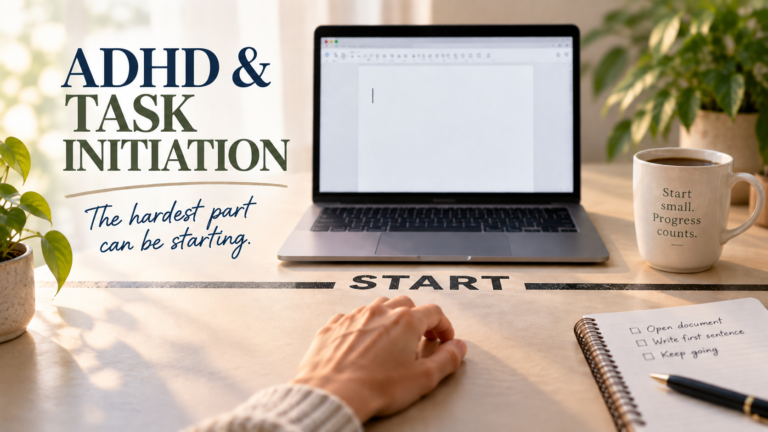
When task activation is impaired, even simple tasks can feel surprisingly difficult to begin. You might spend twenty minutes thinking about unloading the dishwasher but only five minutes actually doing it. Or you may stare at a blank computer screen, unable to write the first sentence of an email, even though finishing the rest would take only a few minutes.
This isn’t a character flaw or a lack of willpower. It’s a well-recognized feature of ADHD that has been described in both neuropsychological research and clinical practice (Asherson et al., 2016; Barkley, 2010).
The good news is that task initiation is a skill that can be improved.
One of the most effective non-medication treatments for adult ADHD is cognitive behavioral therapy (CBT). Rather than relying on motivation alone, CBT teaches practical strategies that reduce the barriers to starting tasks by breaking them into manageable steps, using external cues, scheduling work periods, and addressing the thoughts that reinforce procrastination (Lopez et al., 2018; Olagunju & Ghoddusi, 2024).
The Five-Minute Activation Exercise applies these same evidence-based behavioral principles in a simple, practical way.
Instead of asking yourself to finish a report, clean the entire kitchen, or organize your garage, you make a much smaller commitment: work for just five minutes.
Lowering the size of the commitment makes the task feel less overwhelming. Once you’ve started, many people find that continuing is easier than beginning. Sometimes you’ll keep working after the timer ends. Sometimes you’ll stop after five minutes.
Both outcomes are successes.
The purpose of this exercise isn’t to trick yourself into working longer.
The purpose is to strengthen your ability to begin.
Like any skill, task initiation improves through repeated practice. Each successful start teaches your brain that getting moving is possible, making it easier to activate the next time you face a difficult task.
Clinical Pearl
Many adults with ADHD believe they need to feel motivated before they can begin.
In reality, research and clinical experience suggest that the opposite is often true: taking action often creates motivation—not the other way around (Lopez et al., 2018).
The Skill
The Five-Minute Activation Exercise is designed to make starting feel easier.
You are not trying to finish the task.
You are only practicing the skill of beginning.
Follow these steps.
Step 1: Choose One Specific Task
Pick one task that you’ve been avoiding.
Good examples include:
- Reply to one email.
- Fold one basket of laundry.
- Wash the dishes.
- Pay one bill.
- Write the first paragraph of a report.
Avoid choosing something vague like:
❌ “Get my life organized.”
The more specific the task, the easier it is to begin.
Step 2: Make the First Step Obvious
Before you start, ask yourself:
“What is the very first physical action?”
Examples:
Instead of:
Write my paper.
Start with:
- Open my laptop.
- Open the document.
- Write one sentence.
Instead of:
Clean the kitchen.
Start with:
- Walk into the kitchen.
- Fill the sink with warm water.
- Wash one plate.
Reducing uncertainty makes it easier for your brain to activate.
Step 3: Set a Timer for Five Minutes
Use your phone, watch, or a kitchen timer.
Set it for five minutes.
Not four.
Not ten.
Five minutes is long enough to get started but short enough that your brain is less likely to resist.
Step 4: Begin Immediately
When the timer starts, begin.
Don’t wait until you feel ready.
Don’t wait until you’re motivated.
Don’t spend another five minutes planning.
The timer is your cue to take action.
If you catch yourself thinking instead of doing, gently return to the very next physical step.
Step 5: Stop When the Timer Ends
When the timer goes off, pause.
Now ask yourself:
“Do I want to keep going?”
You have three options:
✅ Keep working.
✅ Take a short break.
✅ Stop and come back later.
All three are acceptable.
The only rule is this:
Don’t judge yourself based on whether you finished.
Judge yourself based on whether you started.
If You Get Stuck
If you notice yourself frozen again, don’t start over.
Simply ask:
“What’s the next smallest action?”
Then do only that.
Sometimes the next smallest action is:
- Open the document.
- Pick up the laundry basket.
- Put one dish in the sink.
- Read one paragraph.
- Write one sentence.
Progress almost always begins with something smaller than your brain expects.
Clinical Pearl
Adults with ADHD often overestimate how difficult a task will feel before they begin and underestimate how much easier it becomes once they’re engaged. The goal of this exercise is not to eliminate discomfort—it is to make the first step small enough that your brain is willing to take it.
When This Feels Hard
If this exercise feels difficult at first, you’re not doing it wrong.
The ability to start a task is one of the core challenges for many adults with ADHD. Learning a new skill takes practice, and it’s normal to run into obstacles along the way.
Here are some of the most common roadblocks—and what you can do when they happen.
“I Still Couldn’t Get Started.”
If five minutes still feels overwhelming, the problem usually isn’t the timer.
The problem is that the first step is still too big.
Research shows that adults with ADHD often struggle with task activation—the ability to mobilize the mental energy needed to begin goal-directed behavior (Barkley, 1997; Isaac et al., 2023).
Instead of asking yourself:
“How do I finish this?”
Ask:
“What’s the smallest physical action I can take right now?”
For example:
Instead of: Clean the kitchen.
Try:
- Walk into the kitchen.
- Turn on the light.
- Fill the sink with warm water.
- Wash one plate.
The smaller the first step, the easier it is for your brain to begin.
“I Spent Five Minutes Planning Instead of Doing.”
Planning is important.
But for many people with ADHD, planning can quietly become another form of procrastination.
If you notice yourself making lists, researching, reorganizing, or trying to create the “perfect” plan, pause and ask:
“What action could I take in the next 30 seconds?”
Then do that before making another plan.
Remember:
Action creates information.
You can always improve your plan once you’ve started.
“I Forgot to Use the Skill.”
This happens to almost everyone.
ADHD affects prospective memory—the ability to remember to do something in the future. That’s why relying on memory alone often doesn’t work.
Instead, build reminders into your environment.
You might:
- Set a recurring reminder on your phone.
- Leave a sticky note on your computer.
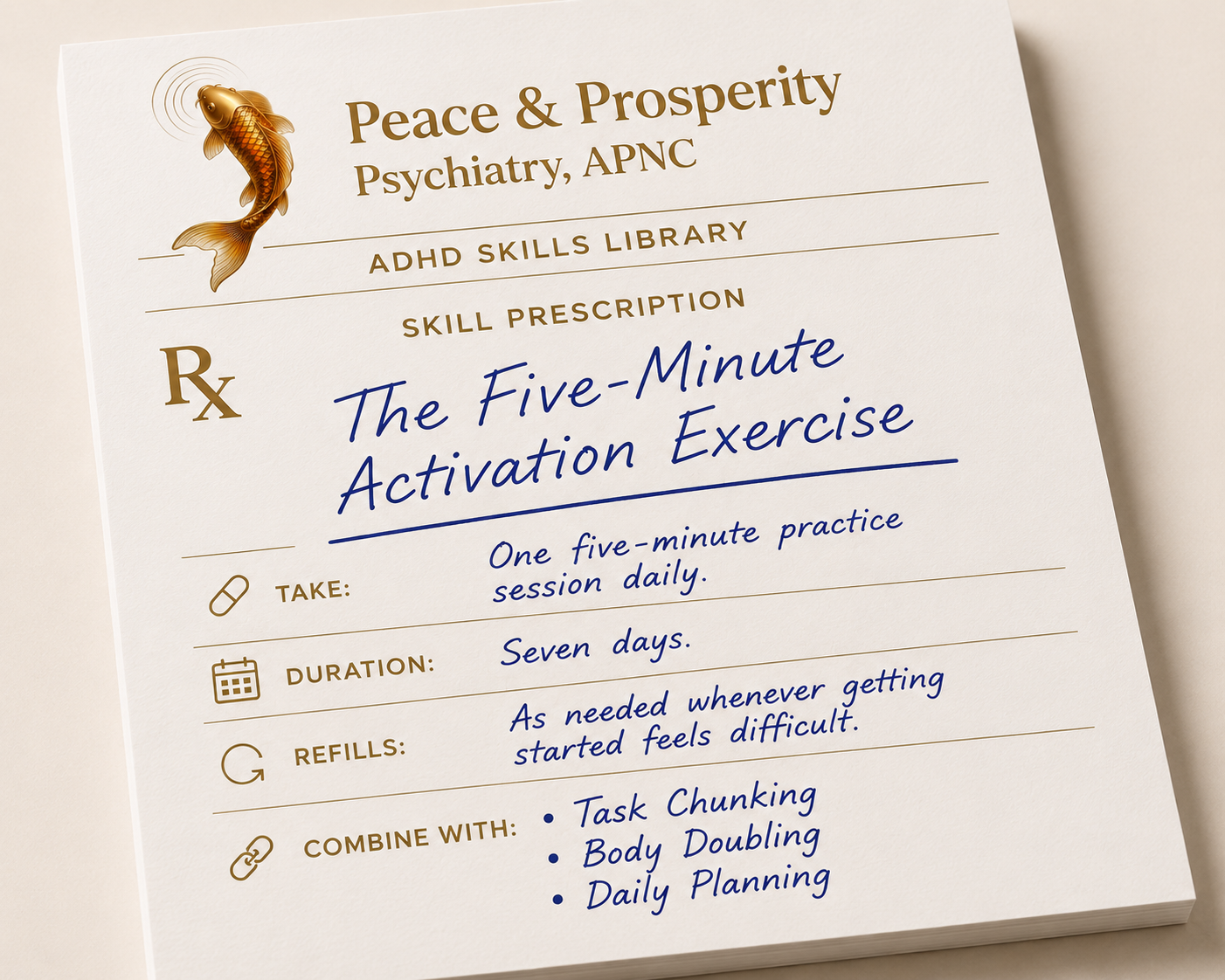
- Keep a printed copy of your Skill Prescription where you work.
- Pair this exercise with an existing daily habit, such as sitting down at your desk or finishing your morning coffee.
The goal is to make the skill easier to remember until it becomes more automatic.
“I Stopped After Five Minutes.”
That’s okay.
In fact, that’s exactly what the exercise allows you to do.
Many people believe they have failed unless they finish the entire task.
That’s not the goal.
The goal is to strengthen your ability to begin.
Every successful start is practice.
Sometimes you’ll keep going.
Sometimes you’ll stop after five minutes.
Both outcomes count as success because you’ve practiced the skill of task initiation.
“I Kept Waiting Until I Felt Motivated.”
This is one of the most common traps in ADHD.
Many people believe they need to feel motivated before they can begin.
Research and clinical experience suggest the opposite is often true.
Taking action often creates motivation rather than waiting for motivation to create action (Lopez et al., 2018).
If you catch yourself thinking,
“I’ll start when I feel more motivated,”
try changing the question to:
“Can I do just the first step for five minutes?”
Often, that’s enough to get moving.
Clinical Pearl
Don’t measure success by how much you accomplished. Measure success by whether you practiced the skill.
Every time you begin a task—even for just five minutes—you are strengthening your brain’s ability to initiate action. Like any skill, improvement comes through repetition, not perfection.
Myth vs. Fact
Myth: “If I stop after five minutes, the exercise didn’t work.”
Fact: The purpose of this exercise is not to finish the task. It is to practice getting started. Finishing is a bonus. Starting is the skill.
Practice Prescription
Your Assignment This Week
For the next 7 days, practice the Five-Minute Activation Exercise once each day.
Choose one task you’ve been putting off.
Set a timer for five minutes.
Begin.
That’s it.
Remember:
Your goal is not to finish the task.
Your goal is to practice starting.
Research consistently shows that repeated practice of behavioral skills is one of the key reasons cognitive behavioral therapy (CBT) is effective for adults with ADHD (Lopez et al., 2018).
Week 1: Build the Habit
This week, focus on small, low-risk tasks.
Good examples include:
- Reply to one email.
- Empty the dishwasher.
- Fold one basket of laundry.
- Read one page.
- Pay one bill.
- Put away one load of groceries.
Choose tasks that feel achievable.
Success builds confidence.
Confidence builds consistency.
After Each Practice Session
Take one minute to reflect.
Ask yourself:
✓ Did I start?
✓ How difficult was it to begin?
✓ What helped me get started?
✓ What almost got in my way?
Don’t judge yourself by how much you accomplished.
Judge yourself by whether you practiced the skill.
If You Miss a Day
Missing one day doesn’t erase your progress.
Don’t try to “catch up.”
Simply resume the exercise the next day.
Long-term consistency is much more important than perfect attendance.
Progressive Loading
Just as you wouldn’t begin a strength-training program by lifting the heaviest weight in the gym, you don’t have to begin by tackling your hardest task.
As your confidence grows, gradually increase the challenge.
Week 1
Practice with small, everyday tasks.
Week 2
Use the exercise with tasks you’ve been avoiding for several days.
Week 3
Practice with larger projects by focusing only on the first five minutes.
Week 4
Combine this exercise with other ADHD skills, such as:
- Breaking large projects into smaller steps
- Time blocking
- Body doubling
- Environmental modifications
Each week builds on the last.
You’re strengthening a skill—not testing your willpower.
How You’ll Know You’re Making Progress
Many people expect progress to look like:
“I’m finishing everything.”
Instead, look for signs like these:
✓ You begin tasks more quickly.
✓ You spend less time thinking about starting.
✓ Starting feels slightly less overwhelming.
✓ You recover more quickly after getting stuck.
These small changes are signs that your task initiation skills are improving.
Clinical Pearl
Repetition changes behavior.
Cognitive behavioral therapy doesn’t work because people learn information. It works because they repeatedly practice new behaviors until they become easier and more automatic (Lopez et al., 2018).
Your Weekly Goals
By the end of this week, aim to:
☐ Practice the exercise at least five times
☐ Identify one obstacle that commonly keeps you from starting
☐ Discover one strategy that makes starting easier
☐ Celebrate every successful start, even if you stopped after five minutes
Remember:
You’re not trying to become productive overnight.
You’re training your brain to become better at beginning.
Measuring Progress
When you’re learning a new skill, progress isn’t always obvious.
You may still have difficult days.
You may still procrastinate.
You may even stop after five minutes.
That doesn’t mean the exercise isn’t working.
The goal of this lesson isn’t to eliminate procrastination overnight.
The goal is to strengthen your ability to begin.
That’s why it’s important to measure the right things.
Signs You’re Making Progress
Progress often shows up in small ways before it becomes obvious.
You might notice that:
- You spend less time thinking about starting.
- You begin tasks a little sooner.
- Starting feels slightly less overwhelming.
- You recover more quickly after getting stuck.
- You avoid fewer tasks.
- You catch yourself using the Five-Minute Activation Exercise without needing a reminder.
These changes may seem small, but they are meaningful. They suggest that your brain is becoming more comfortable with task initiation through repeated practice.
What Should You Measure?
Many people naturally focus on one question:
“Did I finish the task?”
For this skill, that’s the wrong question.
Instead, ask yourself:
- Did I start?
- Did I use the Five-Minute Activation Exercise?
- Did starting feel any easier than it did last week?
Those are much better measures of progress because they reflect the skill you’re actually trying to develop.
As your ability to start improves, you’ll often find that completing tasks becomes easier as well—but completion is a downstream result, not the first goal.
Reflect on Your Week
At the end of each week, spend a few minutes looking back.
Consider questions such as:
- Which tasks were easiest to start?
- Which tasks still felt difficult?
- What helped you begin?
- What got in your way?
- What would you like to try differently next week?
You don’t need to write a long journal entry.
A few honest observations are enough.
The purpose isn’t to grade yourself.
The purpose is to better understand how your ADHD works and what strategies help you move forward.
Clinical Pearl
Behavior change is easier to sustain when you measure the behavior you’re trying to improve.
For this lesson, success isn’t measured by how many tasks you completed. It’s measured by how consistently you practiced getting started. Over time, those small repetitions help build confidence, reduce avoidance, and make task initiation feel more natural.
Looking Ahead
As your ability to start tasks improves, you’ll be ready for the next step.
In the next lesson, you’ll learn how to break overwhelming projects into small, manageable actions. Together, these two skills make even large or intimidating tasks feel much more approachable.
What the Research Shows
One of the goals of the Peace & Prosperity Psychiatry Skills Library is to clearly distinguish evidence-based research from clinical application. This lesson is an example of that approach.
What We Know
Difficulty getting started is one of the most common and impairing challenges experienced by adults with ADHD. Researchers often describe this as a problem with task activation—the ability to generate enough mental energy and behavioral momentum to begin a goal-directed task (Barkley, 1997; Isaac et al., 2023).
Research over the past two decades has consistently shown that cognitive behavioral therapy (CBT) helps adults with ADHD improve organization, time management, procrastination, and task initiation. Rather than relying on motivation or willpower, CBT teaches structured behavioral strategies such as breaking tasks into smaller steps, reducing barriers to getting started, using external reminders, and practicing new behaviors repeatedly (Lopez et al., 2018; Yang et al., 2025; Olagunju & Ghoddusi, 2024).
Regular physical exercise also appears to improve attention, executive functioning, and self-regulation in adults with ADHD. While most studies have examined longer periods of moderate-to-vigorous exercise, the findings support the broader idea that movement can temporarily enhance the brain systems involved in attention and behavioral activation (Kuo et al., 2024; Svedell et al., 2025).
How This Lesson Uses That Research
The Five-Minute Activation Exercise itself has not been studied as a standalone intervention in clinical trials.
Instead, it combines several evidence-supported principles into a practical exercise:
- reducing the barrier to getting started
- committing to a brief period of work rather than the entire task
- using structured behavioral activation instead of waiting for motivation
- encouraging repeated practice to strengthen task initiation over time
These principles are widely used in evidence-based CBT programs for adult ADHD and are consistent with current understanding of executive functioning, behavioral activation, and task initiation (Lopez et al., 2018; Isaac et al., 2023).
Why This Matters
Many people with ADHD believe they struggle to start tasks because they lack motivation, discipline, or willpower.
The research suggests something different.
Task initiation is influenced by executive functioning, arousal regulation, and behavioral activation—brain processes that are commonly affected by ADHD (Barkley, 1997; Isaac et al., 2023).
Understanding this shifts the question from:
“Why can’t I just make myself do it?”
to:
“What strategy will help my brain get started?”
That shift is important because self-criticism rarely improves task initiation. Learning and practicing effective behavioral strategies does.
Your Next Skill
Learning to start a task is one of the most important skills for managing ADHD—but it’s only the beginning.
Many people notice that once they finally get started, they quickly run into a new challenge:
The task still feels overwhelming.
Large projects, long to-do lists, and complicated responsibilities can be difficult to organize, even after you’ve taken the first step.
That’s why the next lesson focuses on Breaking Big Tasks into Tiny Steps.
In that lesson, you’ll learn a simple method for turning overwhelming projects into clear, manageable actions. Instead of asking your brain to tackle an entire project at once, you’ll learn how to identify the next small step that moves you forward.
Together, these two skills work hand in hand:
- The Five-Minute Activation Exercise helps you get started.
- Breaking Big Tasks into Tiny Steps helps you keep going without becoming overwhelmed.
Before moving on, spend several days practicing the Five-Minute Activation Exercise. You don’t need to master it perfectly, but becoming more comfortable with starting tasks will make the next skill easier to learn and apply.
Continue to Lesson 2 → Breaking Big Tasks into Tiny Steps (Comming soon)
References
Barkley, R. A. (1997). Behavioral inhibition, sustained attention, and executive functions: Constructing a unifying theory of ADHD. Psychological Bulletin, 121(1), 65–94. https://doi.org/10.1037/0033-2909.121.1.65
Isaac, V., Lopez, V., & Escobar, M. J. (2023). Arousal dysregulation and executive dysfunction in attention deficit hyperactivity disorder (ADHD). Frontiers in Psychiatry, 14, 1336040. https://doi.org/10.3389/fpsyt.2023.1336040
Kuo, H. I., Nitsche, M. A., Wu, Y. T., Chang, J. C., & Yang, L. K. (2024). Acute aerobic exercise modulates cognition and cortical excitability in adults with attention-deficit hyperactivity disorder (ADHD) and healthy controls. Psychiatry Research, 340, 116108. https://doi.org/10.1016/j.psychres.2024.116108
Lopez, P. L., Torrente, F. M., Ciapponi, A., Lischinsky, A. G., Cetkovich-Bakmas, M., Rojas, J. I., & Manes, F. (2018). Cognitive-behavioural interventions for attention deficit hyperactivity disorder (ADHD) in adults. Cochrane Database of Systematic Reviews, 2018(3), CD010840. https://doi.org/10.1002/14651858.CD010840.pub2
Olagunju, A. E., & Ghoddusi, F. (2024). Attention-deficit/hyperactivity disorder in adults. American Family Physician, 110(2), 157–166.
Svedell, L. A., Lindvall, M. A., Holmqvist, K. L., Cao, Y., & Msghina, M. (2025). Physical exercise as add-on treatment in adults with ADHD – The START study: A randomized controlled trial. Frontiers in Psychiatry, 16, 1690216. https://doi.org/10.3389/fpsyt.2025.1690216
Volkow, N. D., & Swanson, J. M. (2013). Adult attention deficit–hyperactivity disorder. The New England Journal of Medicine, 369(20), 1935–1944. https://doi.org/10.1056/NEJMcp1212625
Yang, X., Zhang, L., Yu, J., & Wang, M. (2025). Short-term and long-term effect of non-pharmacotherapy for adults with ADHD: A systematic review and network meta-analysis. Frontiers in Psychiatry, 16, 1516878. https://doi.org/10.3389/fpsyt.2025.1516878