

Many adults leave an ADHD evaluation with two emotions that seem to contradict one another.
Relief.
Because there is finally a name for years of struggles that never quite made sense.
Disbelief.
Because one question immediately follows:
“How could I have ADHD and no one—not my parents, teachers, doctors, or even me—recognized it until now?”
If you’ve ever wondered, “Why wasn’t my ADHD diagnosed until adulthood?” you’re far from alone.
In fact, being diagnosed in adulthood has become increasingly common as researchers and clinicians have gained a better understanding of how ADHD presents across the lifespan—particularly in women, high-achieving professionals, and adults with predominantly inattentive symptoms (National Institute for Health and Care Excellence [NICE], 2018, 2025; Young et al., 2020).
For many people, receiving an ADHD diagnosis does not rewrite their life story.
It helps explain it.
Events that once seemed unrelated—chronic procrastination, difficulty staying organized, cycles of burnout, perfectionism, emotional overwhelm, or feeling as though everyday tasks required extraordinary effort—often begin to fit together in a way they never had before.
This article explores one of the most common questions adults ask after diagnosis:
“Was it really there all along?”
The short answer is often yes—but the longer answer is much more interesting.
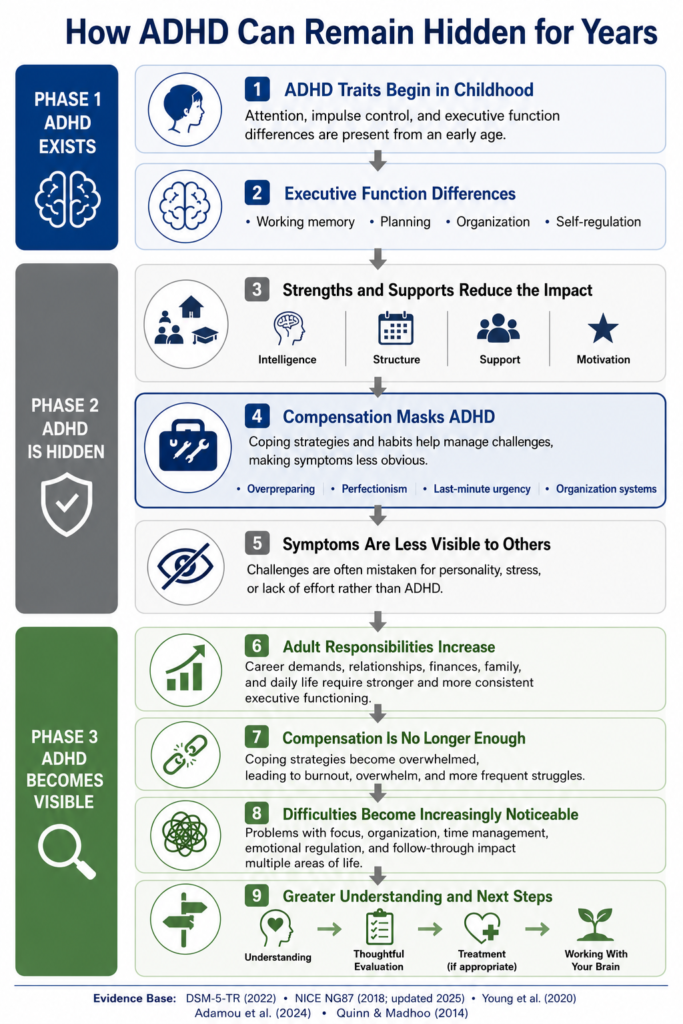
Research suggests that ADHD is frequently overlooked not because it is absent, but because it can be successfully compensated for during childhood and early adulthood. Intelligence, supportive families, structured school environments, strong motivation, and effective coping strategies can all reduce the outward appearance of ADHD while quietly increasing the effort required to keep up (Adamou et al., 2024; American Psychiatric Association [APA], 2022).
ADHD is classified as a neurodevelopmental condition, meaning that it begins during childhood, even when it is not recognized at the time (American Psychiatric Association [APA], 2022). Current diagnostic criteria ask clinicians to identify evidence that symptoms were present before age 12, even when someone is first evaluated decades later.
For many adults, however, that can feel difficult to reconcile with their memories.
Instead of remembering obvious ADHD, they remember hearing things like:
- “You’re so smart—you just need to apply yourself.”
- “You’re doing well; you just need to be more organized.”
- “You have so much potential.”
These comments were usually intended as encouragement.
Looking back, however, they sometimes reveal something else.
The challenges were present.
They simply weren’t being understood through the lens of ADHD.
Instead, they were explained as personality, motivation, anxiety, stress, or unrealized potential (Quinn & Madhoo, 2014; Young et al., 2020).
For many adults, the diagnosis is new—but the pattern is not.
The label arrives later.
The underlying differences have often been present since childhood.
Understanding that distinction can be surprisingly powerful.
A diagnosis cannot change the past.
But it can change how the past is interpreted.
Replacing years of self-blame with a more accurate understanding is often one of the most meaningful parts of the diagnostic process.
Table of Contents
ToggleWhy So Many Adults Discover They Have ADHD Later in Life
One of the biggest misconceptions about adult ADHD is the idea that if someone truly had ADHD, someone would have noticed it during childhood.
While that may seem intuitive, decades of research and clinical experience suggest otherwise.
Many adults who are diagnosed later in life did show signs of ADHD as children. Those signs, however, were often subtle, misunderstood, or successfully compensated for by supportive environments, strong intelligence, high motivation, or personality traits that masked the underlying challenges.
Rather than asking,
“How could everyone have missed it?”
a more helpful question is:
“What factors made it difficult to recognize?”
For many adults, the answer is not one single reason, but the combination of several factors occurring at the same time.
ADHD Can Hide in Plain Sight
ADHD does not look the same in every child.
Some children are highly active, impulsive, and disruptive in the classroom.
Others are quiet, thoughtful, and academically successful, yet struggle internally with attention, organization, working memory, or completing tasks efficiently.
When symptoms do not fit the stereotypical image of ADHD, they are often attributed to other explanations.
A child who forgets homework may be viewed as absent-minded.
A student who procrastinates but still earns good grades may be seen as simply working best under pressure.
A bright child who appears distracted might be described as “bored” rather than struggling with attention regulation.
Because many adults eventually diagnosed with ADHD were intelligent and capable, they often developed ways to compensate for executive functioning difficulties long before anyone considered ADHD as a possible explanation.
These strategies may have included:
- Spending far more time studying than classmates.
- Relying on last-minute deadlines to generate motivation.
- Creating elaborate organizational systems.
- Choosing careers that matched their strengths.
- Depending on highly structured environments.
- Working significantly harder than others to achieve similar results.
From the outside, these individuals often appeared successful.
What others rarely saw was the tremendous mental effort required to maintain that success.
Success Can Sometimes Delay Recognition
One of the most persistent myths surrounding ADHD is that academic or professional success rules out the diagnosis.
Current evidence does not support this assumption.
Many adults with ADHD earn advanced degrees, build successful careers, lead organizations, or excel in highly demanding professions.
Success and ADHD are not mutually exclusive.
In many cases, success reflects years of extraordinary effort, effective coping strategies, supportive environments, or personal determination rather than the absence of executive functioning challenges.
For some individuals, maintaining that success requires significantly more mental energy than those around them realize.
As responsibilities continue to increase, the strategies that once compensated for ADHD may become increasingly difficult to sustain.
This is one reason many adults first seek evaluation during periods of major life transition, such as starting a demanding career, becoming a parent, returning to school, or assuming greater leadership responsibilities.
Rather than creating ADHD, these life changes often reveal challenges that had been successfully managed—sometimes for decades.
ADHD Doesn't Always Look Like the Stereotype
For many years, public understanding of ADHD was shaped by a familiar image: a young boy who could not sit still, frequently interrupted others, and struggled to stay focused in school.
Although that presentation certainly exists, it represents only one way ADHD can appear.
Modern research has shown that ADHD is remarkably diverse. Some individuals are outwardly hyperactive and impulsive, while others experience their greatest challenges internally through inattention, distractibility, disorganization, forgetfulness, or difficulty managing executive functions (American Psychiatric Association [APA], 2022).
Because these internal struggles are less visible, they are often mistaken for personality traits rather than symptoms of a neurodevelopmental condition.
A child who daydreams may simply be described as “quiet.”
A student who forgets assignments may be considered disorganized.
Someone who appears overwhelmed by everyday responsibilities may be viewed as anxious, overly emotional, or lacking confidence.
Over time, these explanations can become part of a person’s identity rather than prompting consideration of ADHD.
Many adults later describe spending years believing they were:
- lazy
- careless
- unmotivated
- scattered
- overly emotional
- “just bad at adulting”
When viewed through the lens of ADHD, however, these lifelong experiences often take on an entirely different meaning.
Why Women Are Often Diagnosed Later
One of the clearest examples of how ADHD can be overlooked is the experience of women.
Historically, much of the early ADHD research focused on young boys with disruptive behaviors. As a result, many girls whose symptoms were quieter, more internalized, or less disruptive simply did not fit the profile clinicians expected to see.
Research now shows that women are significantly more likely to receive an ADHD diagnosis during adolescence or adulthood than men (Quinn & Madhoo, 2014; Young et al., 2020).
Several factors likely contribute to this pattern.
Many girls develop strong organizational habits, become highly conscientious, or work exceptionally hard to compensate for executive functioning challenges.
Others become skilled at masking their difficulties by carefully observing classmates, overpreparing for assignments, or relying on perfectionism to avoid making mistakes.
While these strategies can be remarkably effective for a time, they often come at a considerable psychological cost.
Maintaining the appearance of competence may require far more mental effort than others recognize.
As responsibilities increase in adulthood, those compensatory strategies may no longer be enough.
Many women first seek evaluation after major life transitions such as:
- beginning a demanding career
- entering graduate school
- becoming a parent
- managing a household
- balancing multiple caregiving roles
These events do not suddenly create ADHD.
Instead, they increase the demands placed on executive functioning until previously hidden challenges become much more difficult to compensate for.
Looking Beyond Childhood Report Cards
Many adults assume that if they earned good grades, stayed out of trouble, or were considered “successful,” they could not possibly have ADHD.
In reality, academic performance tells only part of the story.
Some students succeed because school provides:
- predictable routines
- external accountability
- frequent deadlines
- structured schedules
- clear expectations
For individuals with ADHD, these external supports often help compensate for executive functioning differences.
Problems may not become obvious until those supports disappear.
College, graduate school, professional careers, and independent adulthood typically require much greater self-management.
Planning long-term projects, organizing competing priorities, managing finances, maintaining relationships, and balancing work with personal responsibilities all depend heavily on executive functioning.
For many adults, this is when lifelong patterns finally become impossible to ignore.
Looking back, they often realize that the signs were present all along.
What changed was not the presence of ADHD.
What changed was the environment—and the increasing demands it placed on the brain.
What Changes in Adulthood?
If ADHD begins during childhood, why do so many people first seek evaluation in their thirties, forties, or even later?
The answer often has less to do with ADHD changing and more to do with life becoming increasingly complex.
During childhood and adolescence, many responsibilities are organized by someone else.
Parents establish routines.
Teachers provide structure.
School schedules create predictable expectations.
Assignments have regular deadlines.
Daily life contains numerous external supports that help compensate for executive functioning differences.
As adulthood progresses, however, many of those external supports gradually disappear.
Instead, people are expected to create their own structure.
They must decide what deserves attention, estimate how long tasks will take, organize competing priorities, manage finances, maintain relationships, remember appointments, plan for the future, and recover from setbacks—often while balancing careers and family responsibilities.
These demands rely heavily on executive functioning, the collection of cognitive skills responsible for planning, organization, working memory, self-monitoring, emotional regulation, and flexible problem-solving.
For many adults with ADHD, these increasing expectations eventually exceed the coping strategies that had allowed them to function successfully for years.
The ADHD has not suddenly appeared.
Rather, the demands of life have finally become greater than the systems that once compensated for it.
When Compensation Is No Longer Enough
Many adults describe reaching what feels like a tipping point.
For years they were able to stay afloat by working harder, staying up later, relying on last-minute urgency, or maintaining elaborate organizational systems.
Eventually, however, those strategies begin to lose their effectiveness.
This often happens during periods of major life transition, including:
- Starting a demanding career.
- Accepting greater leadership responsibilities.
- Entering graduate or professional school.
- Becoming a parent.
- Caring for aging family members.
- Managing a household.
- Experiencing significant changes in health or relationships.
Each new responsibility places additional demands on executive functioning.
Rather than adding together, these demands frequently compound one another.
A person may continue to perform well professionally while simultaneously feeling overwhelmed at home.
Another may maintain excellent grades but struggle to manage daily responsibilities outside the classroom.
Others find themselves constantly exhausted—not because they lack ability, but because sustaining their level of performance requires extraordinary mental effort.
Many readers will recognize these experiences from other topics discussed throughout this educational library, including burnout, perfectionism, procrastination, and emotional regulation.
These challenges often do not exist in isolation.
Instead, they interact with one another, creating cycles that become increasingly difficult to maintain over time.
Recognizing the Pattern
One of the most meaningful moments during an adult ADHD evaluation often occurs before any diagnosis is made.
It happens when people begin recognizing patterns that have quietly repeated throughout their lives.
They may realize they have always:
- underestimated how long tasks would take.
- relied on urgency to get started.
- struggled to stay organized despite sincere effort.
- forgotten important responsibilities.
- felt emotionally overwhelmed by seemingly small frustrations.
- worked much harder than others to achieve similar results.
Individually, none of these experiences necessarily indicates ADHD.
Taken together—and viewed across childhood, adolescence, and adulthood—they may reveal a consistent pattern that deserves thoughtful evaluation.
This is one reason a comprehensive assessment looks beyond current symptoms alone.
Rather than asking only, “What is happening today?”, clinicians also explore “Has this pattern been present throughout your life?”
Understanding those lifelong patterns is often far more informative than focusing on any single symptom in isolation.
Why a Comprehensive Evaluation Matters
Reading an article like this can be validating.
Many people recognize themselves in these descriptions.
At the same time, it is important to remember that ADHD is only one possible explanation for difficulties with attention, organization, emotional regulation, or executive functioning.
Other medical conditions, mental health conditions, sleep disorders, learning differences, and life stressors can produce similar symptoms.
That is why a thoughtful evaluation does far more than determine whether someone “has ADHD.”
It seeks to understand the whole person.
A comprehensive assessment typically includes:
- A detailed discussion of current concerns and how they affect daily life.
- Exploration of childhood history, education, work, relationships, and coping strategies.
- Review of medical and mental health history.
- Consideration of other conditions that may better explain—or coexist with—ADHD.
- Use of validated rating scales as one component of the assessment, rather than the assessment itself.
The goal is not simply to assign a diagnosis.
The goal is to arrive at the most accurate understanding possible so that any recommendations for treatment are individualized, evidence-based, and appropriate for the person’s unique circumstances.
Making Sense of Your Story
Learning about adult ADHD can be both validating and unsettling.
For many people, a diagnosis—or even the possibility of one—changes how they view experiences stretching back decades.
Moments that once felt disconnected begin to fit together.
The forgotten assignments.
The last-minute deadlines.
The endless effort required to stay organized.
The feeling that life always seemed harder than it looked for everyone else.
It is natural to wonder what might have been different if ADHD had been recognized sooner.
While those questions are understandable, they are often less important than the opportunities that come next.
A diagnosis cannot change the past.
But it can change how the past is understood.
Many adults describe replacing years of self-criticism with curiosity.
Instead of asking,
“What’s wrong with me?”
they begin asking,
“What if my brain has been working differently all along?”
That shift in perspective does not erase life’s challenges.
It does, however, create the possibility of approaching those challenges with greater understanding, self-compassion, and evidence-based strategies rather than continued frustration and self-blame.
Whether ADHD ultimately explains your experiences or not, seeking thoughtful answers is never a sign of weakness.
Understanding yourself more clearly is often the first step toward building a life that works with your brain instead of constantly fighting against it.
Key Takeaways
If you remember only a few ideas from this article, let them be these:
- ADHD begins in childhood, but it is not always recognized during childhood. Many adults meet diagnostic criteria even though their symptoms were never identified when they were young.
- Strong intelligence, supportive environments, and effective coping strategies can temporarily mask ADHD. Success does not rule out ADHD—it may simply hide how much effort daily life requires.
- Adult responsibilities often reveal challenges that were easier to compensate for earlier in life. As work, relationships, finances, and family responsibilities become more complex, executive functioning demands increase.
- A late diagnosis does not make ADHD any less real. It often reflects how our understanding of ADHD has evolved, particularly in women, high-achieving adults, and people with predominantly inattentive symptoms.
- A comprehensive evaluation is about understanding your lifelong story—not simply checking boxes on a questionnaire. Whether ADHD ultimately explains your experiences or not, thoughtful assessment can provide valuable clarity and guide appropriate treatment.
Frequently Asked Questions
Can someone really have ADHD if they were successful in school?
Yes. Academic success does not exclude ADHD. Many people succeed through intelligence, strong motivation, supportive environments, or extraordinary effort while still experiencing significant executive functioning challenges.
Why are so many adults diagnosed later in life?
Growing awareness of adult ADHD, improved understanding of different symptom presentations, and increasing life demands all contribute to more adults recognizing longstanding patterns and seeking evaluation.
Does a late diagnosis mean my ADHD is less severe?
Not necessarily. Some adults compensate effectively for years before increasing responsibilities overwhelm those coping strategies. The timing of diagnosis does not determine the validity or significance of ADHD symptoms.
Can anxiety or depression look like ADHD?
Yes. Several medical and mental health conditions can produce symptoms that overlap with ADHD. A comprehensive evaluation helps determine whether ADHD, another condition, or multiple conditions best explain your experiences.
Why do many adults only begin struggling later in life?
As responsibilities become more complex, executive functioning demands increase. Many adults discover that strategies that once worked are no longer sufficient to manage work, family, finances, and everyday life simultaneously.
Should I diagnose myself after reading this article?
No. Educational articles can help you better understand your experiences, but they cannot determine whether you have ADHD. If these patterns feel familiar, consider discussing your concerns with a clinician experienced in evaluating adult ADHD.
Continue Learning
If this article resonated with you, these resources provide a deeper understanding of adult ADHD and many of the challenges discussed here.
Start Here
If you’re new to AdultADHDCalifornia.com, begin with our Start Here page for an overview of the educational library and guidance on where to begin.
Flagship Guides
- The Complete Guide to Adult ADHD Diagnosis, Treatment, and What to Expect
- The Complete Guide to Adult ADHD Treatment
- The Complete Guide to ADHD in High-Achieving Adults
Research Reviews
Explore the science behind many of the experiences adults with ADHD commonly describe:
- Understanding ADHD Burnout
- Understanding ADHD and Perfectionism
- Understanding Emotional Dysregulation in Adult ADHD
- Time Blindness in Adult ADHD
- Executive Function in Adult ADHD
Knowledge Modules
Continue exploring common questions about adult ADHD:
References
Adamou, M., Asherson, P., Arif, M., Buckley, A., Dannan, P., Pitt, M., … & Young, S. (2024). The adult ADHD assessment quality assurance standard. BJPsych Open, 10(1), e13. https://doi.org/10.1192/bjo.2023.632
American Psychiatric Association. (2022). Diagnostic and statistical manual of mental disorders (5th ed., text rev.; DSM-5-TR). American Psychiatric Association Publishing.
National Institute for Health and Care Excellence. (2018, updated 2025). Attention deficit hyperactivity disorder: Diagnosis and management (NICE Guideline NG87). https://www.nice.org.uk/guidance/ng87
Faraone, S. V., Banaschewski, T., Coghill, D., Zheng, Y., Biederman, J., Bellgrove, M. A., … & Wang, Y. (2021). The World Federation of ADHD International Consensus Statement: 208 evidence-based conclusions about the disorder. Neuroscience & Biobehavioral Reviews, 128, 789–818. https://doi.org/10.1016/j.neubiorev.2021.01.022
Young, S., Adamo, N., Ásgeirsdóttir, B. B., Branney, P., Beckett, M., Colley, W., … & Woodhouse, E. (2020). Females with ADHD: An expert consensus statement taking a lifespan approach providing guidance for the identification and treatment of attention-deficit/hyperactivity disorder in girls and women. BMC Psychiatry, 20, 404. https://doi.org/10.1186/s12888-020-02707-9
Quinn, P. O., & Madhoo, M. (2014). A review of attention-deficit/hyperactivity disorder in women and girls: Uncovering this hidden diagnosis. Primary Care Companion for CNS Disorders, 16(3). https://doi.org/10.4088/PCC.13r01596
Barkley, R. A. (2015). Attention-deficit hyperactivity disorder: A handbook for diagnosis and treatment (4th ed.). Guilford Press.
Asherson, P., Akehurst, R., Kooij, J. J. S., Huss, M., Beusterien, K., Sasané, R., … & Hodgkins, P. (2012). Under diagnosis of adult ADHD: Cultural influences and societal burden. Journal of Attention Disorders, 16(5 Suppl), 20S–38S. https://doi.org/10.1177/1087054711435360
Kooij, J. J. S., Bijlenga, D., Salerno, L., Jaeschke, R., Bitter, I., Balázs, J., … & Asherson, P. (2019). Updated European Consensus Statement on diagnosis and treatment of adult ADHD. European Psychiatry, 56, 14–34. https://doi.org/10.1016/j.eurpsy.2018.11.001
Medical Review & Author Information
Written and medically reviewed by Troy Don, DC, AGACNP-BC, PMHNP-BC
For additional information about clinical education, professional credentials, and background, see Clinical Credentials & Professional Background.
Last medically reviewed: August 2026
Evidence reviewed through: August 2026
Medical Disclaimer
This article is for educational purposes only and is not a substitute for individualized medical advice, diagnosis, or treatment. If you have questions about ADHD, mental health symptoms, medications, or treatment options, discuss them with an appropriate healthcare professional.