


Table of Contents
ToggleWhy Time Feels Different, Why It Matters, and How to Stop Blaming Yourself
Adult ADHD and time blindness often go together, even though many people have never heard the term. If you’ve ever looked at the clock and wondered where the afternoon went, you’re not alone.
“I Know How to Tell Time. So Why Can’t I Seem to Manage It?”
Where did the last three hours go?
You only meant to answer one email.
Somehow, the afternoon disappeared.
Or maybe you’ve had the opposite experience.
You look at a project and think, “This shouldn’t take more than an hour.”
Three hours later, you’re only halfway finished.
You tell yourself you’ll start earlier next time.
You’ll use a better planner. Set more reminders. Finally get organized.
But somehow it keeps happening.
Deadlines seem comfortably far away until they suddenly feel urgent. Appointments sneak up on you. Simple tasks take far longer than expected, while hours can disappear without you noticing.
It’s frustrating.
It’s embarrassing.
And after enough years, it’s easy to start believing the problem is you.
“I’m lazy.”
“I’m irresponsible.”
“Why can’t I get my life together?”
If you’ve had thoughts like these, you’re far from alone.
Many adults with ADHD spend years feeling as though everyone else received a rulebook for managing time—one they somehow never got.
Research suggests there may be a different explanation.
Although time blindness is not an official medical diagnosis, researchers have found that many people with ADHD experience differences in how they estimate time, notice the passage of time, plan for future events, and organize their behavior over time (Barkley, 1997; Marx et al., 2021). These differences don’t mean someone doesn’t care about deadlines or responsibilities. Instead, they suggest that the brain may experience and manage time differently.
Understanding time blindness doesn’t eliminate responsibility.
It changes the question.
Instead of asking,
“Why can’t I manage my time?”
you can begin asking,
“What if my brain experiences time differently?”
That shift doesn’t solve the problem overnight.
But it can replace years of self-blame with understanding—and that’s often the first step toward finding strategies that actually work.
In this article, we’ll explore what researchers have learned about time blindness in adults with ADHD, why it affects so many areas of daily life, what questions scientists are still trying to answer, and how evidence-based treatments can help you build a healthier relationship with time.
Understanding Adult ADHD and Time Blindness
If you’ve spent any time reading about ADHD, you’ve probably come across the term time blindness.
For many adults, it immediately resonates. It gives a name to something they’ve struggled to explain for years.
You know how to read a clock.
You understand schedules and deadlines.
Yet somehow, time still seems to slip away before you realize it.
Time blindness is not an official medical diagnosis.
You won’t find it listed as a symptom in the Diagnostic and Statistical Manual of Mental Disorders, Fifth Edition, Text Revision (DSM-5-TR) (American Psychiatric Association, 2022).
Instead, it is a descriptive term used by many clinicians, researchers, and people living with ADHD to describe a common experience: difficulty accurately estimating, sensing, planning, and managing time.
The term itself can be a little misleading.
People with ADHD are not literally “blind” to time. They know what time it is. They can read a clock just as well as anyone else.
The challenge is that their internal experience of time doesn’t always match the clock on the wall.
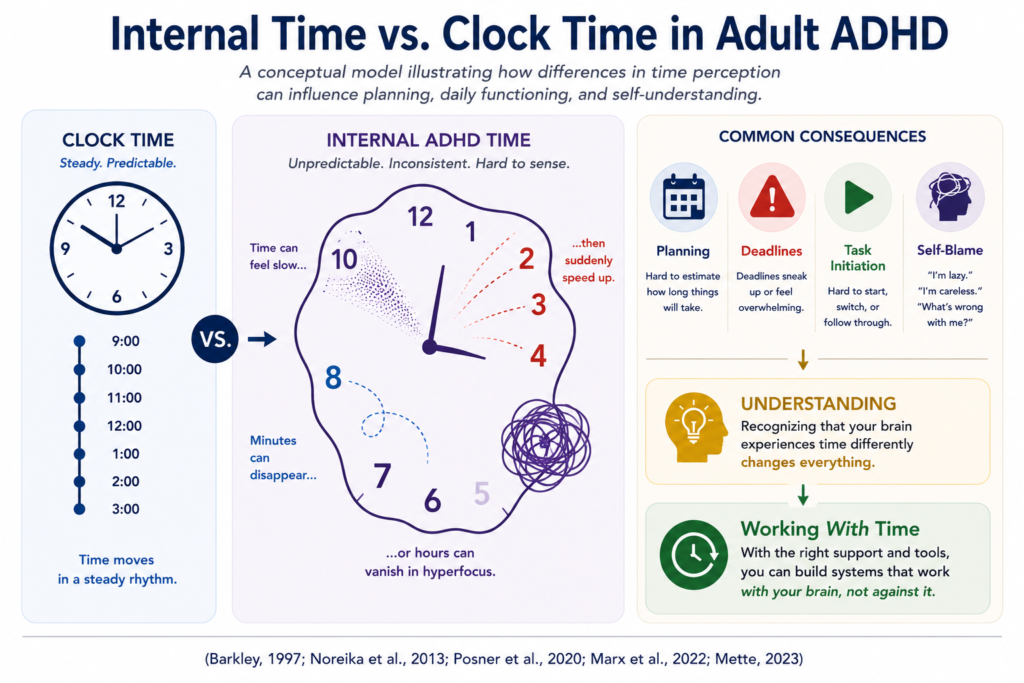
Although everyone’s experience is different, this conceptual model illustrates how subtle differences in the way adults with ADHD perceive and manage time can influence many aspects of daily life. The remainder of this article explores each part of this model in greater detail.
One of the first researchers to describe this idea in depth was psychologist Dr. Russell Barkley. He proposed that ADHD is not simply a disorder of attention, but a disorder of self-regulation that unfolds across time (Barkley, 1997).
According to Barkley, successfully managing daily life depends on more than knowing what time it is. It requires the ability to anticipate the future, organize behavior toward long-term goals, and translate intentions into action.
That’s where many adults with ADHD struggle.
Time blindness isn’t simply about running late or forgetting appointments.
It can also look like:
- Underestimating how long a project will take.
- Losing track of time while deeply focused on an activity.
- Feeling caught off guard when deadlines suddenly become urgent.
- Struggling to transition from one task to another.
- Finding it difficult to connect today’s decisions with tomorrow’s consequences.
Notice what these experiences have in common.
They aren’t simply problems with organization.
They’re challenges with using time to guide behavior.
That distinction matters because it helps explain why advice like “Just use a planner,” “Be more disciplined,” or “Manage your time better” often feels frustratingly inadequate.
Planning tools can certainly help, but they don’t fully explain why managing time feels so much harder in the first place.
Over the past several decades, researchers have studied many of the individual processes that contribute to what we commonly call time blindness. Their work has examined time estimation, attention, planning, reward processing, future-oriented thinking, and other cognitive abilities involved in navigating daily life. Together, this growing body of research suggests that time blindness reflects a genuine pattern of difficulties experienced by many adults with ADHD, even though the term itself remains informal (Barkley, 1997; Marx et al., 2021).
That raises an important question.
If adults with ADHD can read a clock just like everyone else, why does time often feel so difficult to manage?
To answer that question, we first need to understand how the brain experiences time.
Why Does Time Feel Different When You Have ADHD?
Most people think of time as something they read on a clock.
In reality, your brain is constantly doing something much more remarkable.
It creates your experience of time.
Without you even realizing it, your brain is estimating how much time has passed, predicting how long a task will take, deciding when it’s time to switch activities, and preparing for what comes next.
Most of the time, this happens automatically.
You rarely stop to think about it—unless something feels off.
For many adults with ADHD, that’s exactly what happens.
You may lose an entire afternoon while working on something interesting. Other times, five minutes can feel like forever while you’re waiting in line or sitting through a meeting.
Time seems inconsistent.
Sometimes it races.
Sometimes it crawls.
Researchers have spent decades trying to understand why.
Although no single theory explains every aspect of time blindness, growing evidence suggests that ADHD affects several of the brain systems responsible for perceiving, estimating, and managing time (Marx et al., 2021).
Your brain doesn’t have one single “time center.”
Instead, perceiving time depends on several brain regions working together.
The prefrontal cortex helps you plan ahead, prioritize tasks, and decide what to do next. The basal ganglia help regulate timing and are deeply involved in coordinating movement, habits, and the brain’s internal sense of timing. The cerebellum, long known for coordinating movement, also appears to play an important role in accurately measuring short intervals of time (Buhusi & Meck, 2005; Noreika et al., 2013).
These brain regions communicate using chemical messengers called neurotransmitters.
One of the most important is dopamine.
Most people think of dopamine as the brain’s “reward chemical,” but its role is much broader. Dopamine helps regulate attention, motivation, learning, and the ability to anticipate future rewards—all processes that influence how we experience time (Volkow et al., 2009).
Time isn’t simply measured. It’s interpreted.
Imagine two identical thirty-minute periods.
One is spent watching your favorite movie.
The other is spent waiting at the DMV.
The clock measures both exactly the same.
Your brain doesn’t.
Attention, interest, emotion, and motivation all influence how time is experienced. Researchers believe these same factors help explain why many adults with ADHD lose track of time during highly engaging activities yet struggle to stay focused when a task feels repetitive or unrewarding (Noreika et al., 2013).
This helps explain one of the great paradoxes of ADHD.
Time can disappear…or refuse to move at all.
Dr. Russell Barkley proposed that these difficulties extend beyond attention alone. He argued that ADHD is fundamentally a disorder of self-regulation across time, making it more difficult to use the past, present, and anticipated future to guide behavior toward long-term goals (Barkley, 1997).
More recent research has expanded on this idea. Rather than pointing to a single “broken clock” in the brain, scientists now believe time blindness likely emerges from the combined effects of attention, motivation, planning, reward processing, working memory, and other cognitive systems working together (Marx et al., 2021).
That helps explain why time blindness looks different from one person to the next.
Some adults consistently underestimate how long projects will take.
Others become so absorbed in an activity that hours disappear unnoticed.
Some struggle most with getting started.
Others have difficulty knowing when it’s time to stop.
Different experiences.
One common thread.
For many adults with ADHD, the brain’s internal experience of time doesn’t always match the clock on the wall.
That invisible difference may help explain years of frustration—and why managing time has often felt so much harder than it seemed for everyone else.
What Has Research Actually Discovered about Adult ADHD and Time Blindness?
Scientists have spent decades trying to answer an important question.
Do adults with ADHD actually experience time differently, or do they simply struggle to manage it?
The answer appears to be both.
Research suggests that many adults with ADHD experience measurable differences in several aspects of temporal processing, including estimating time, monitoring the passage of time, planning ahead, and anticipating future events (Marx et al., 2021). Rather than identifying one single cause, researchers now believe time blindness reflects the combined effects of several cognitive processes working together.
Let’s look at what they’ve discovered.
Why Am I Always Wrong About How Long Something Will Take?
You glance at your to-do list and think,
“This shouldn’t take more than an hour.”
Three hours later, you’re still working.
If that sounds familiar, you’re not alone.
Researchers call this time estimation—your brain’s ability to predict how long an activity will take. Studies have consistently found that many adults with ADHD perform less accurately on laboratory tasks involving time estimation, time reproduction, and other measures of temporal processing than adults without ADHD (Noreika et al., 2013; Marx et al., 2021).
These differences are often subtle.
But subtle errors repeated dozens of times each week can have a surprisingly large impact on everyday life.
Projects run long.
Appointments overlap.
The day slowly falls behind.
What this means
If you frequently underestimate how long tasks will take, the problem may not be poor planning alone. Your brain may simply be starting with a less accurate estimate of time.
Accurately estimating time is only one piece of the puzzle.
Even when people know a deadline is coming, many still struggle to act on that information until the last minute.
Why Do Deadlines Suddenly Feel Urgent?
Have you ever wondered why a deadline can feel comfortably far away one week…
…and overwhelmingly urgent the next?
Most people assume that’s simply procrastination.
Research suggests something more complicated may be happening.
One explanation involves delay discounting, sometimes called future discounting. This describes the brain’s tendency to value immediate rewards more highly than future ones. While everyone discounts the future to some degree, numerous studies suggest this effect is often stronger in people with ADHD (Sonuga-Barke, 2002; Jackson & MacKillop, 2016).
When a deadline is weeks away, it may not generate much urgency.
As it becomes immediate, however, its perceived importance increases dramatically.
The deadline didn’t change.
Your brain’s perception of it did.
What this means
Many adults with ADHD don’t ignore deadlines because they don’t care.
They struggle because the future often doesn’t feel psychologically “real” until it becomes the present.
Time blindness doesn’t only affect how we think about the future.
It also changes how we experience the present moment.
Why Do Hours Sometimes Disappear?
One of the most confusing experiences reported by adults with ADHD is losing track of time completely.
You sit down to work for thirty minutes.
The next time you look at the clock, two hours have passed.
Researchers continue to study this phenomenon, often called hyperfocus. Although there is still debate about exactly how hyperfocus should be defined, many experts believe intense engagement with highly rewarding activities can dramatically reduce awareness of the passage of time (Hupfeld et al., 2019).
Ironically, the same brain that struggles to stay engaged during routine tasks may become so engaged in something interesting that time virtually disappears.
What this means
Time blindness isn’t always about being distracted.
Sometimes it’s the opposite.
Your attention becomes so focused on one thing that your awareness of time fades into the background.
Of course, time blindness isn’t only about losing track of time.
Sometimes the greatest challenge comes before a task even begins.
Why Is Getting Started So Difficult?
You know exactly what needs to be done.
You’ve thought about it all day.
You even want to get started.
Yet somehow, you don’t.
Instead, you answer one more email, reorganize your desk, or tell yourself you’ll begin in just a few more minutes.
If this feels familiar, you’re not alone.
Many adults with ADHD describe knowing what they need to do but struggling to bridge the gap between intention and action.
Researchers believe task initiation depends on several brain systems working together. Before we begin a task, our brains estimate how long it will take, decide whether it’s worth doing now, weigh immediate effort against future rewards, and organize the first steps needed to get started (Barkley, 1997; Marx et al., 2021).
For many adults with ADHD, these processes don’t always work together efficiently.
A task that seems simple on paper can feel surprisingly difficult to begin, especially when the reward is distant, the outcome is uncertain, or the work feels overwhelming.
Time plays an important role in this process.
Before you can start a task, your brain has to imagine the future. It has to estimate how much time the task will require, predict when it should begin, and recognize the consequences of waiting too long.
When those judgments are less reliable, getting started can become much more difficult than most people realize.
What this means
Difficulty getting started isn’t simply a problem of motivation or willpower.
For many adults with ADHD, it reflects the challenge of translating good intentions into action—a process that depends, in part, on the brain’s ability to perceive, estimate, and use time effectively.
Why Time Blindness Affects So Much More Than Being Late
When most people hear the term time blindness, they think about chronic lateness.
Running behind is certainly part of the picture.
But it’s rarely the whole story.
Time blindness quietly influences hundreds of small decisions every week. Over months and years, those small moments can affect your career, relationships, health, confidence, and overall quality of life.
The consequences often extend far beyond the clock.
It Can Leave You Feeling Like You’re Always Behind
Many adults with ADHD describe feeling as though they’re constantly trying to catch up.
They finish one task only to realize they’re already late for the next. They rush from one responsibility to another, promising themselves that tomorrow will finally be different.
Over time, this creates more than a scheduling problem.
It creates chronic stress.
Research has consistently shown that adults with ADHD experience higher rates of occupational impairment, daily functional difficulties, and perceived stress than adults without ADHD (Asherson et al., 2016; Kooij et al., 2019).
Living one step behind eventually becomes exhausting.
It Can Affect Your Relationships
Time blindness doesn’t only affect your schedule.
It affects other people.
You tell your spouse you’ll be ready in ten minutes.
You genuinely believe you will.
Twenty-five minutes later, they’re still waiting.
You promise a coworker you’ll send something by the end of the day.
You fully intend to.
Then another task takes longer than expected, an unexpected interruption changes your plans, and suddenly you’re apologizing again.
Most adults with ADHD aren’t trying to disappoint the people they care about.
But repeated experiences like these can slowly erode trust, create frustration, and lead others to misunderstand what ADHD actually looks like.
It Can Change the Way You See Yourself
Perhaps the hardest part of time blindness isn’t losing track of time.
It’s spending years believing those struggles say something about your character.
After enough missed deadlines, forgotten appointments, rushed mornings, and broken promises to yourself, it’s easy to reach painful conclusions.
“Maybe I’m just lazy.”
“Maybe I’m irresponsible.”
“Maybe I’ll never get this figured out.”
Research and clinical experience suggest a different perspective.
Understanding time blindness doesn’t erase responsibility.
It helps explain why the same challenges keep happening despite genuine effort.
That’s an important difference.
Replacing self-blame with understanding is often the first step toward finding strategies that actually work.
The Small Things Add Up
Time influences almost everything we do.
Getting to work.
Paying bills.
Refilling prescriptions.
Preparing meals.
Getting enough sleep.
Keeping appointments.
Helping children get ready for school.
Individually, none of these tasks seems especially difficult.
But they all depend on the same underlying ability to estimate time, plan ahead, and transition smoothly from one activity to the next.
When those abilities are less reliable, everyday responsibilities often require much more effort than they appear to for other people.
A late bill.
A forgotten appointment.
A rushed morning.
An unfinished project.
A missed deadline.
None of these moments defines you.
But over time, they begin to accumulate.
That’s why time blindness feels so overwhelming. Adult ADHD and time blindness are an combination for frustration.
It’s rarely one major event.
It’s hundreds of small moments that slowly create stress, frustration, and the feeling that you’re always trying to catch up.
None of These Challenges Exist in Isolation
Time blindness rarely travels alone.
Constantly feeling behind can contribute to chronic stress and eventually ADHD burnout. Years of struggling to keep up may also fuel perfectionistic coping strategies or contribute to intense emotional reactions when plans unexpectedly change.
We’ll explore these topics in greater depth in our articles on Adult ADHD and Burnout, Adult ADHD and Perfectionism, and Adult ADHD and Emotional Dysregulation.
Recognizing these connections doesn’t mean every challenge is caused by time blindness.
It simply reminds us that the way we experience time influences far more than our calendar.
It shapes the way we experience everyday life.
Fortunately, understanding time blindness is only part of the story.
Researchers have also identified treatments and practical strategies that can help adults with ADHD work with their brains instead of constantly fighting against them.
Learning to Work With Time Instead of Against It
If you’ve recognized yourself throughout this article, you might be wondering whether time blindness can actually improve.
The answer is encouraging.
Although there isn’t a treatment that completely eliminates time blindness, research suggests many adults with ADHD can significantly improve their ability to manage time by combining medication, behavioral therapy, and practical systems that compensate for the brain’s internal timing challenges (Lopez et al., 2018; Corrales et al., 2023; Volkow & Swanson, 2013).
The goal isn’t to build a perfect internal clock.
The goal is to build a life that doesn’t depend on one.
Make Time Visible
Most people don’t realize how much they rely on an internal sense of time.
When that internal clock is less reliable, external cues become incredibly valuable.
Visual timers, countdown clocks, alarms, calendar alerts, and scheduled reminders help move time out of your head and into your environment.
Rather than relying on your brain to remember that thirty minutes have passed, these tools make the passage of time impossible to ignore.
That’s why they work.
They don’t improve willpower.
They reduce the need for it.
Stop Relying on Memory
Many adults with ADHD spend an enormous amount of mental energy trying to remember what they need to do.
Unfortunately, memory is often the least reliable place to store important information.
Instead, researchers and ADHD specialists recommend building trusted external systems for capturing appointments, deadlines, and tasks (Barkley, 1997).
Calendars.
Task managers.
Reminder apps.
Written lists.
The specific tool matters less than consistently using one system.
Your calendar shouldn’t simply record your life.
It should become an extension of your brain.
Make the Future Easier to See
One of the biggest challenges in ADHD is that future events often don’t feel urgent until they’re close.
That’s one reason breaking large projects into smaller, scheduled steps can be so effective.
Instead of focusing on a report due next month, your brain focuses on a planning session tomorrow morning.
Instead of one overwhelming deadline…
…you create several manageable ones.
Research on implementation intentions and structured planning suggests that making future actions more concrete increases the likelihood they’ll actually happen (Gollwitzer, 1999).
The future becomes easier to act on when it feels closer.
Train Skills—Not Just Attention
Medication remains one of the most effective treatments for the core symptoms of ADHD and often improves attention, focus, and executive functioning (Volkow & Swanson, 2013).
But medication doesn’t teach planning skills.
It doesn’t build routines.
And it doesn’t automatically create better habits.
That’s where behavioral treatments become so important.
Research has consistently shown that ADHD-specific cognitive behavioral therapy (CBT) helps adults develop practical strategies for planning, organization, prioritization, and managing distractions (Lopez et al., 2018).
Other evidence-based approaches, including Meta-Cognitive Therapy (MCT) and Dialectical Behavior Therapy (DBT)-based interventions, may be particularly helpful for improving planning, organization, time management, and emotional regulation in selected patients (Solanto et al., 2010; Zhang et al., 2025).
These therapies don’t teach people to “try harder.”
They teach people how to work differently.
Build Systems Instead of Depending on Willpower
Perhaps the most important lesson from ADHD research is that successful adults rarely depend on motivation alone.
They build environments that make success more likely.
They automate reminders.
They schedule important tasks.
They reduce unnecessary decisions.
They create routines that continue working even on difficult days.
The goal isn’t to become better at keeping time in your head.
It’s to make time visible everywhere around you.
Over time, these systems become less about managing ADHD and more about reducing unnecessary stress.
They allow your energy to be spent on meaningful work and relationships instead of constantly trying to remember, estimate, and catch up.
Understanding time blindness doesn’t mean accepting that nothing can change.
It means recognizing that the most effective strategies work with the way your brain experiences time—not against it.
What Researchers Still Don't Know
Over the past several decades, researchers have made tremendous progress in understanding how ADHD affects the way many people experience time.
We’ve learned that time blindness is more than simply poor organization or a lack of motivation. Research suggests it reflects differences in several cognitive processes involved in estimating time, planning ahead, anticipating future events, and translating intentions into action (Marx et al., 2021).
At the same time, important questions remain.
One of the biggest questions is whether time blindness is a single phenomenon or several different processes that simply appear similar in everyday life.
For example, someone who consistently underestimates how long tasks will take may not have the same underlying difficulty as someone who loses hours in hyperfocus or struggles to get started on important work. Researchers increasingly believe these experiences may arise from different combinations of attention, reward processing, planning, and temporal perception rather than from one single cause.
Researchers are also working to understand why time blindness affects people so differently.
Some adults with ADHD are chronically late.
Others are almost never late.
Some struggle most with planning.
Others have greater difficulty transitioning between tasks or maintaining awareness of time as the day unfolds.
We don’t yet know why these differences occur.
Another important question involves treatment.
Research clearly shows that medication, ADHD-specific cognitive behavioral therapy, and structured external supports improve daily functioning for many adults with ADHD (Lopez et al., 2018; Corrales et al., 2023).
What remains less certain is whether these treatments change the brain’s underlying perception of time or primarily help people develop more effective ways to compensate for those challenges. Either outcome represents meaningful progress for patients, but researchers continue to investigate exactly how these improvements occur.
Future research will undoubtedly provide more answers.
Advances in brain imaging, wearable technology, digital therapeutics, and personalized behavioral interventions are already helping scientists study how people experience time in their everyday lives rather than only in laboratory settings.
Science doesn’t have every answer.
But it has given us something equally valuable.
A better understanding of why so many adults with ADHD have spent years feeling as though they were constantly fighting the clock.
For many people, simply learning that these experiences have a scientific explanation can be profoundly validating. Understanding adult ADHD and time blindness allows many people to replace years of self-criticism with curiosity and opens the door to strategies that are grounded in evidence rather than frustration.
Understanding time blindness doesn’t make deadlines disappear.
It doesn’t eliminate responsibility.
But it does change the way many people understand themselves.
Time blindness may always influence how your brain experiences time.
It doesn’t have to define how you live your life.
Key Takeaways
- Time blindness is not an official medical diagnosis, but it is a widely used term that describes the difficulties many adults with ADHD experience when estimating, perceiving, planning, and managing time.
- Current research suggests that time blindness reflects the combined effects of several cognitive processes—including attention, temporal perception, planning, reward processing, and executive functioning—rather than a single “broken clock” in the brain (Mette, 2023; Marx et al., 2022).
- Many adults with ADHD have difficulty estimating how long tasks will take, anticipating future demands, losing track of time during hyperfocus, and translating intentions into action. These challenges are supported by a growing body of neurocognitive research (Noreika et al., 2013; Marx et al., 2022).
- Time blindness affects much more than punctuality. It can influence work performance, relationships, stress, confidence, and countless everyday responsibilities.
- Evidence-based treatments—including stimulant medication, ADHD-specific cognitive behavioral therapy (CBT), meta-cognitive therapy (MCT), and practical external time-management systems—can significantly improve daily functioning (Volkow & Swanson, 2013; Lopez et al., 2018; Solanto et al., 2010; Corrales et al., 2023).
- Understanding time blindness doesn’t remove responsibility. It replaces self-blame with a scientific understanding of why these challenges occur and provides a foundation for building strategies that work.
Frequently Asked Questions
Is time blindness an official symptom of ADHD?
No. Time blindness is not listed as a diagnostic criterion in the DSM-5-TR. Instead, it is a descriptive term used to explain a group of well-documented difficulties involving time estimation, temporal perception, planning, and future-oriented behavior. Although the term itself is informal, the underlying cognitive processes have been studied extensively (American Psychiatric Association, 2022; Mette, 2023).
Does everyone with ADHD experience time blindness?
No. ADHD presents differently from one person to another. Some adults primarily struggle with estimating time, while others experience greater difficulty with planning, task initiation, hyperfocus, or transitioning between activities. Research suggests that time blindness exists along a spectrum rather than as an all-or-none symptom (Marx et al., 2022; Ptáček et al., 2022).
Why do people with ADHD lose track of time so easily?
Time perception depends on several brain systems working together. Differences in attention, reward processing, and fronto-striato-cerebellar networks can reduce awareness of the passage of time, particularly during highly engaging activities or periods of distraction (Noreika et al., 2013; Posner et al., 2020).
Why do deadlines suddenly feel urgent?
Researchers believe this is partly related to delay discounting, in which immediate rewards feel more important than distant ones. As deadlines become closer, their psychological importance increases rapidly, creating the feeling that urgency appears “all at once” (Posner et al., 2020).
Is time blindness the same as procrastination?
No. Procrastination refers to delaying tasks despite intending to complete them. Time blindness refers to broader differences in perceiving, estimating, and managing time. While the two frequently occur together, they are not the same phenomenon (Mette, 2023).
Can ADHD medication improve time blindness?
Research shows that stimulant medications improve attention, executive functioning, and daily functioning for many adults with ADHD. Neuroimaging studies also suggest that medications such as methylphenidate can normalize activity in brain regions involved in timing tasks, although researchers continue to study whether medication directly changes time perception itself (Volkow & Swanson, 2013; Rubia et al., 2009; Smith et al., 2013).
Can time blindness improve?
Yes. Although there is no single treatment that eliminates time blindness, many adults experience meaningful improvement through a combination of medication, ADHD-specific psychotherapy, and practical external supports such as calendars, reminders, visual timers, and structured planning systems (Lopez et al., 2018; Corrales et al., 2023; Solanto et al., 2010).
Why do I always underestimate how long things will take?
Meta-analytic evidence suggests that many people with ADHD perform less accurately on tasks involving time estimation and temporal processing. Even relatively small errors can accumulate throughout the day, making schedules increasingly difficult to maintain (Marx et al., 2022).
How can I manage time blindness more effectively?
Research suggests the most effective approach combines medical treatment with practical behavioral strategies. Rather than relying on memory or willpower alone, many adults benefit from making time more visible through calendars, reminders, visual timers, structured routines, and external planning systems that compensate for differences in internal time perception (Lopez et al., 2018; Solanto et al., 2010).
Continue Learning
If you found this article helpful, you may also enjoy these evidence-based resources from AdultADHDCalifornia.com:
- The Complete Guide to Adult ADHD Diagnosis, Treatment, and What to Expect
- Can You Be Successful and Still Have ADHD? A Guide for High-Achieving Adults
- The Complete Guide to Adult ADHD Treatment
- Adult ADHD and Burnout: Why High-Achieving Adults Reach Their Breaking Point
- Adult ADHD and Perfectionism: Why Success Often Comes With Self-Criticism
- Adult ADHD and Emotional Dysregulation: Understanding the Intensity of ADHD Emotions
References
American Psychiatric Association. (2022). Diagnostic and statistical manual of mental disorders (5th ed., text rev.; DSM-5-TR). American Psychiatric Association Publishing.
Barkley, R. A. (1997). ADHD and the nature of self-control. Guilford Press.
Corrales, M., García-González, S., Richarte, V., et al. (2023). Long-term efficacy of a new 6-session cognitive behavioral therapy for adults with attention-deficit/hyperactivity disorder: A randomized, controlled clinical trial. Psychiatry Research, 331, 115642. https://doi.org/10.1016/j.psychres.2023.115642
Lopez, P. L., Torrente, F. M., Ciapponi, A., et al. (2018). Cognitive-behavioural interventions for attention deficit hyperactivity disorder (ADHD) in adults. Cochrane Database of Systematic Reviews, 3, CD010840. https://doi.org/10.1002/14651858.CD010840.pub2
Marx, I., Cortese, S., Koelch, M. G., & Hacker, T. (2022). Meta-analysis: Altered perceptual timing abilities in attention-deficit/hyperactivity disorder. Journal of the American Academy of Child & Adolescent Psychiatry, 61(7), 866–880. https://doi.org/10.1016/j.jaac.2021.12.004
Mette, C. (2023). Time perception in adult ADHD: Findings from a decade-a review. International Journal of Environmental Research and Public Health, 20(4), 3098. https://doi.org/10.3390/ijerph20043098
Noreika, V., Falter, C. M., & Rubia, K. (2013). Timing deficits in attention-deficit/hyperactivity disorder (ADHD): Evidence from neurocognitive and neuroimaging studies. Neuropsychologia, 51(2), 235–266. https://doi.org/10.1016/j.neuropsychologia.2012.09.036
Posner, J., Polanczyk, G. V., & Sonuga-Barke, E. (2020). Attention-deficit hyperactivity disorder. The Lancet, 395(10222), 450–462. https://doi.org/10.1016/S0140-6736(19)33004-1
Ptáček, R., Vňuková, M., Děchtěrenko, F., et al. (2022). Attention-deficit/hyperactivity disorder (ADHD) and time perception in adults: Do adults with different ADHD symptomatology severity perceive time differently? Findings from the National Czech Study. Medical Science Monitor, 28, e936849. https://doi.org/10.12659/MSM.936849
Rubia, K., Halari, R., Christakou, A., & Taylor, E. (2009). Impulsiveness as a timing disturbance: Neurocognitive abnormalities in attention-deficit hyperactivity disorder during temporal processes and normalization with methylphenidate. Philosophical Transactions of the Royal Society B: Biological Sciences, 364(1525), 1919–1931. https://doi.org/10.1098/rstb.2009.0014
Solanto, M. V., Marks, D. J., Wasserstein, J., et al. (2010). Efficacy of meta-cognitive therapy for adult ADHD. American Journal of Psychiatry, 167(8), 958–968. https://doi.org/10.1176/appi.ajp.2009.09081123
Smith, A., Cubillo, A., Barrett, N., et al. (2013). Neurofunctional effects of methylphenidate and atomoxetine in boys with attention-deficit/hyperactivity disorder during time discrimination. Biological Psychiatry, 74(8), 615–622. https://doi.org/10.1016/j.biopsych.2013.03.030
Volkow, N. D., & Swanson, J. M. (2013). Adult attention deficit–hyperactivity disorder. New England Journal of Medicine, 369(20), 1935–1944. https://doi.org/10.1056/NEJMcp1212625
Medical Review & Author Information
Written and medically reviewed by Troy Don, DC, AGACNP-BC, PMHNP-BC
For additional information about clinical education, professional credentials, and background, see Clinical Credentials & Professional Background.
Last medically reviewed: August 2026
Evidence reviewed through: August 2026
Medical Disclaimer
This article is for educational purposes only and is not a substitute for individualized medical advice, diagnosis, or treatment. If you have questions about ADHD, mental health symptoms, medications, or treatment options, discuss them with an appropriate healthcare professional.