
The executive function behind forgetfulness, overwhelm, procrastination, and inconsistent follow-through.
Have you ever walked into a room and completely forgotten why you went there?
Opened your email, stared at the screen, and realized you couldn’t remember what you intended to write?
Remembered something important while driving, only to lose the thought before reaching your destination?
Started one task, got interrupted, began another task, and later wondered what happened to the original plan?
If so, you’re not alone.
Many adults with ADHD spend years feeling frustrated by what appears to be chronic forgetfulness. They lose track of tasks, miss appointments, forget details from conversations, overlook deadlines, and struggle to follow through on things that genuinely matter to them.
Over time, many begin developing painful explanations.
“I’m lazy.”
“I’m irresponsible.”
“I don’t care enough.”
“I’m smart enough to know better, so why do I keep doing this?”
For many adults, however, the problem is not intelligence, motivation, character, or effort.
The problem may be working memory.
Working memory is one of the cognitive functions most consistently affected in ADHD research (Onandia-Hinchado et al., 2021; Posner et al., 2020). It plays a central role in executive functioning and helps people keep information active long enough to use it.
When working memory is functioning well, goals remain accessible.
Plans stay visible.
Tasks remain mentally available.
Future obligations stay on the radar.
When working memory is impaired, information can seem to disappear moments after it becomes important.
The result often looks like forgetfulness.
But the reality is usually more complicated.
Many adults with ADHD do not struggle because they cannot remember things.
They struggle because they cannot reliably keep information active in awareness long enough to act on it.
Understanding this distinction can be life-changing.
For some readers, it provides an explanation for difficulties that have been present for decades.
For others, it becomes the first step toward replacing self-criticism with self-understanding.
If you’ve ever thought, “I knew I needed to do it—I just lost track of it,” you’re not alone. Many adults with ADHD describe a frustrating experience where important tasks seem to disappear from awareness moments after they become important. The mental whiteboard model offers a simple way to understand why this happens. Rather than a lack of intelligence, motivation, or effort, the challenge often involves keeping important information active long enough to act on it.
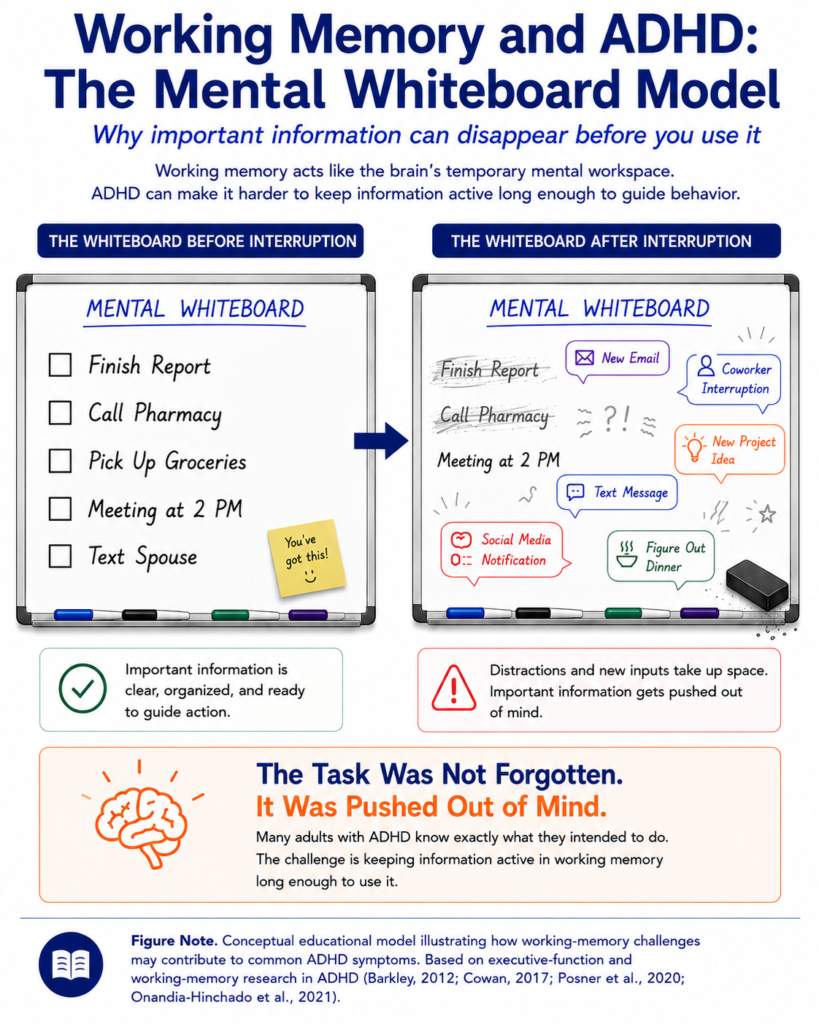
Table of Contents
ToggleWhat Is Working Memory and ADHD?
Working memory is often described as the brain’s temporary mental workspace.
It allows you to hold information in mind while simultaneously using it to complete a task (Cowan, 2017).
You rely on working memory countless times throughout the day.
For example, working memory helps you:
- remember a phone number long enough to dial it
- follow multi-step directions
- keep track of a conversation
- calculate a tip in your head
- remember what you were about to say
- follow a recipe while cooking
- keep your place while reading
- remember the purpose of opening a browser tab
Unlike long-term memory, working memory is designed for temporary use.
Its job is not to store information forever.
Its job is to keep information available right now.
This distinction helps explain why many adults with ADHD can remember detailed childhood events, obscure facts, professional knowledge, or favorite movie quotes while simultaneously forgetting what they were about to do thirty seconds ago.
The issue is not necessarily long-term storage.
The issue is temporary access.
Working Memory and ADHD: The Mental Whiteboard Analogy
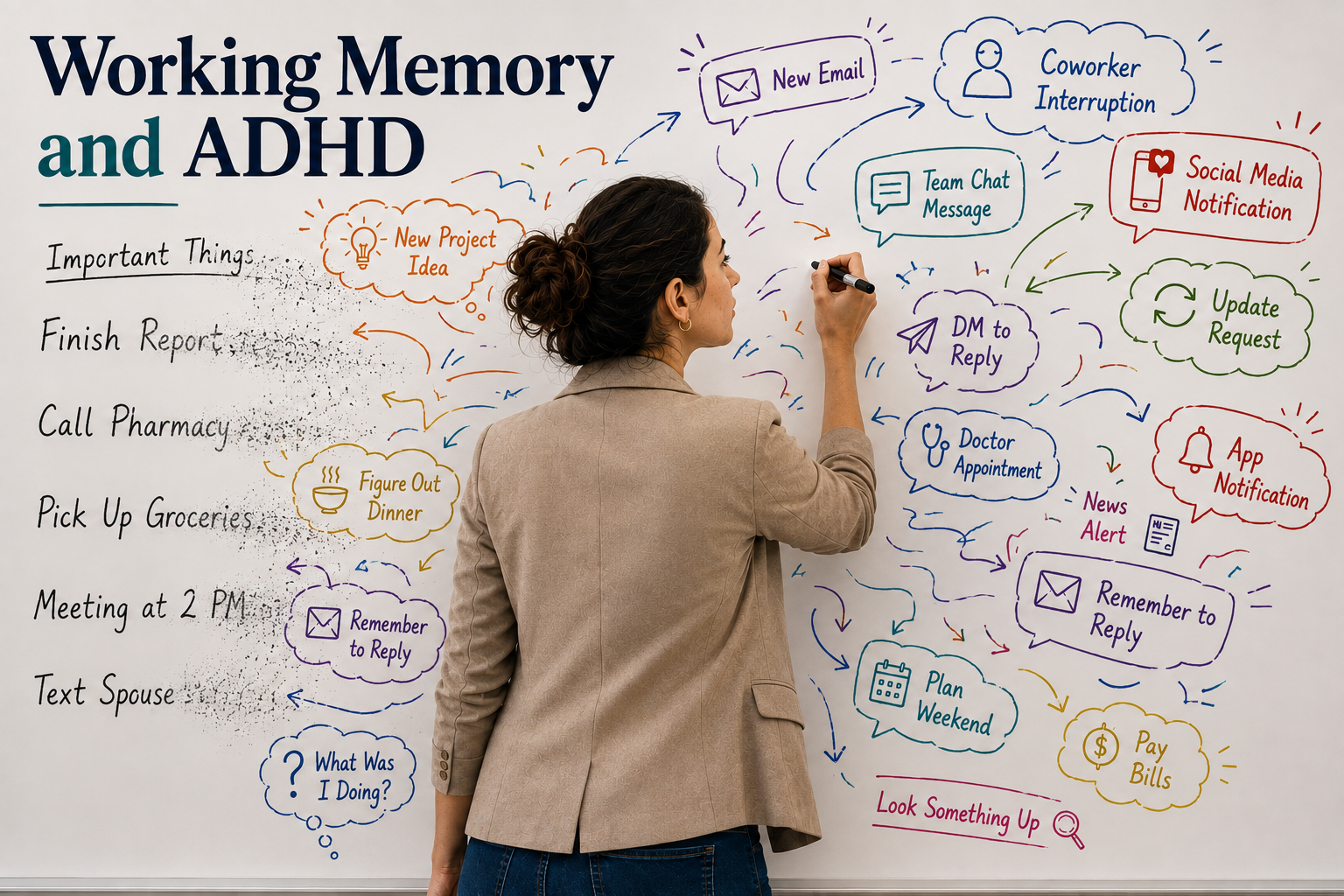
One of the easiest ways to understand working memory is to imagine a mental whiteboard.
Throughout the day, your brain continuously writes information on that whiteboard.
You might write:
- Call the pharmacy.
- Finish the report.
- Pick up groceries.
- Ask your spouse about Saturday.
- Respond to that email.
- Remember the meeting at 2 p.m.
The whiteboard keeps these items visible while you move through your day.
For many people, the board remains reasonably stable.
Information stays visible long enough to be used.
For many adults with ADHD, however, the whiteboard feels smaller, easier to erase, and more vulnerable to interruption.
A text message arrives.
Part of the board disappears.
A coworker asks a question.
Another section gets erased.
An interesting idea appears.
Now something else is occupying the space.
The original task may vanish entirely.
This is one reason ADHD-related forgetfulness often feels so confusing.
A person may genuinely intend to complete a task.
The intention was real.
The motivation was real.
The commitment was real.
But after enough interruptions, competing demands, emotional stressors, and distractions, the task simply disappears from active awareness.
Hours later, the person remembers and wonders:
“Why didn’t I just do it when I thought about it?”
The answer is often not laziness.
The answer is that the information no longer remained visible on the mental whiteboard.
Working Memory and ADHD vs. Short-Term Memory
People often use the terms working memory and short-term memory interchangeably.
While the concepts overlap, they are not identical (Aben et al., 2012; Cowan, 2017).
Short-term memory primarily involves temporarily storing information.
Working memory involves temporarily storing information while actively using it.
Think of short-term memory as a storage shelf.
Think of working memory as a workbench.
The shelf holds information.
The workbench holds information while you actively do something with it.
For example:
A six-digit verification code arrives on your phone.
Remembering the code long enough to enter it involves short-term memory.
Remembering the code while switching between apps, comparing it with another number, and completing additional steps places greater demands on working memory.
This difference may seem subtle, but it is important.
Many adults with ADHD do not simply struggle to hold information.
They struggle to hold information while simultaneously managing attention, decisions, competing demands, interruptions, and emotional distractions.
That is exactly the type of challenge working memory was designed to handle.
Is Working Memory and ADHD the Same Thing as Intelligence?
One of the most important things to understand about ADHD working memory problems is this:
Working memory is not the same thing as intelligence.
Unfortunately, many adults spend years assuming otherwise.
They notice that they forget appointments.
They miss deadlines.
They lose track of conversations.
They struggle to follow through on plans.
Eventually, they begin asking themselves a painful question:
“If I’m smart, why can’t I get my life together?”
Research suggests this question is based on a false assumption.
Working memory and intelligence are related but distinct cognitive abilities (Posner et al., 2020). A person can have exceptionally high intelligence while simultaneously struggling with working memory.
This helps explain why ADHD often goes unrecognized in successful adults.
Many people compensate for years through intelligence alone.
They solve problems quickly.
They learn efficiently.
They develop creative workarounds.
They work longer hours.
They rely on urgency.
They become perfectionistic.
From the outside, they may appear highly successful.
Inside, however, they often feel exhausted.
A physician may manage complex medical decisions while forgetting personal appointments.
An attorney may excel in court while struggling to keep track of administrative tasks.
An executive may oversee a large organization while constantly feeling overwhelmed by emails, schedules, and follow-up responsibilities.
A high-achieving woman may spend years believing she is disorganized, scattered, or failing in ways nobody else can see.
This disconnect is one reason many adults are not diagnosed until later in life.
Their intelligence masks the problem.
Their success hides the struggle.
Yet the effort required to maintain that success can become enormous.
For many adults, receiving an ADHD diagnosis is the first time they realize:
“The problem was never that I wasn’t smart enough.
The problem was that I was compensating for an executive-function weakness I didn’t know existed.”
Why Does ADHD Affect Working Memory?
To understand why working memory is so important in ADHD, it helps to understand where it fits within the brain’s broader executive-function system.
Executive functions are the mental processes that help us direct behavior toward goals. They allow us to plan, organize, prioritize, regulate attention, manage emotions, solve problems, and follow through on intentions.
Working memory is one of the core executive functions because it helps us keep information active while deciding what to do next (Posner et al., 2020).
Imagine trying to assemble a piece of furniture.
You need to remember:
- which step you’re currently on
- which parts you’ve already completed
- where the screws belong
- which tool you need next
- what the instructions said three steps ago
Working memory serves as the temporary workspace that keeps all of that information available while you work.
Research suggests that ADHD involves differences in brain networks responsible for attention, executive functioning, and self-regulation, particularly networks involving the prefrontal cortex and related dopamine and norepinephrine systems (Posner et al., 2020).
These systems help determine what information remains active and accessible.
When these networks are less efficient, maintaining information in awareness becomes more difficult.
This is why many adults with ADHD describe a frustrating experience:
- They know the information.
- They learned the information.
- They intended to use the information.
- Yet at the exact moment they need it, it seems unavailable.
Importantly, research suggests that distractibility and processing-speed differences account for a substantial portion of the apparent working-memory difficulties seen in ADHD (Mohamed et al., 2021).
In practical terms, many ADHD memory problems begin as attention problems.
If information never fully enters the mental whiteboard, it becomes difficult to use later.
This helps explain why many adults say:
“The second you interrupted me, I completely lost the thought.”
The information never had a chance to firmly establish itself before something else pushed it aside.
Why Working Memory and ADHD Often Create the Feeling of Being Overwhelmed
One of the most common complaints among adults with ADHD is:
“I feel overwhelmed all the time.”
At first glance, overwhelm may not seem related to memory.
In reality, working memory may help explain a significant part of that experience.
Imagine trying to carry ten grocery bags at once.
If one bag slips, you can usually recover.
If five bags begin slipping simultaneously, everything becomes harder to manage.
Working memory functions in a similar way.
The more information you must actively keep in mind, the greater the chance that something important gets dropped.
Many adults with ADHD feel as though they are carrying hundreds of unfinished thoughts simultaneously:
- emails that need responses
- appointments that need scheduling
- projects that need attention
- bills that need payment
- errands that need completion
- conversations that need follow-up
None of these items may be particularly difficult by themselves.
The challenge is keeping all of them active at the same time.
As the mental whiteboard becomes crowded, people often experience:
- mental clutter
- indecision
- overwhelm
- distractibility
- task avoidance
- difficulty prioritizing
This helps explain why seemingly simple responsibilities can feel disproportionately exhausting.
The task itself may not be difficult.
Managing all the information surrounding the task is what becomes difficult.
How Working Memory and ADHD Affect Daily Life
Working-memory difficulties often appear in surprisingly subtle ways.
Most adults do not walk around thinking:
“I have a working-memory problem.”
Instead, they notice consequences.
They notice unfinished tasks.
Missed deadlines.
Forgotten commitments.
Lost momentum.
Broken systems.
The underlying mechanism often remains invisible.
Working Memory and ADHD at Work
Modern workplaces place enormous demands on working memory.
Employees are expected to remember:
- instructions
- deadlines
- project details
- meeting discussions
- client requests
- follow-up tasks
- shifting priorities
Many adults with ADHD understand information perfectly during a meeting.
The difficulty begins afterward.
Several hours later they may struggle to remember:
- what was assigned
- which task is most important
- what the next step should be
- what decision was ultimately made
As a result, many professionals develop elaborate compensatory strategies.
They keep extensive notes.
They create color-coded systems.
They leave dozens of browser tabs open.
They send themselves emails.
They work late to double-check details.
From the outside, they may appear organized.
Inside, they often feel as though they are working twice as hard simply to keep up.
Working Memory and ADHD at Home
Home environments often contain fewer external structures than workplaces.
As a result, working-memory difficulties frequently become more noticeable.
Adults with ADHD commonly report:
- forgetting why they entered a room
- starting chores without finishing them
- leaving cabinets open
- misplacing keys and wallets
- forgetting errands
- losing track of household projects
- missing bill payments
- repeatedly buying items they already own
Many describe a constant feeling of playing catch-up.
No matter how hard they work, something always seems to be slipping through the cracks.
Working Memory and ADHD in Conversations
Conversations require more working memory than most people realize.
While listening, you must simultaneously:
- process what the other person is saying
- remember earlier parts of the conversation
- formulate responses
- monitor social cues
- stay focused on the topic
When working memory becomes overloaded, people may:
- lose track of the discussion
- forget what was just said
- interrupt unintentionally
- forget their own point before speaking
- ask others to repeat information
This can be frustrating and embarrassing.
It can also lead others to mistakenly assume the person is uninterested or not paying attention.
In reality, the opposite is often true.
Many adults with ADHD are working extremely hard to stay engaged.
Working Memory and ADHD in Relationships
Relationships depend heavily on remembering details.
Partners often expect each other to remember:
- conversations
- plans
- commitments
- preferences
- important dates
- household responsibilities
When working memory is unreliable, misunderstandings can develop.
A partner may think:
“If this mattered, you would remember.”
Meanwhile, the person with ADHD may think:
“It does matter. That’s why I’m so upset that I forgot.”
This disconnect can create hurt feelings on both sides.
Understanding working memory does not excuse broken commitments.
However, it often transforms the discussion from blame to collaborative problem-solving.
Working Memory and ADHD in Parenting
Parenting places enormous demands on executive functioning.
Parents must keep track of:
- school schedules
- appointments
- extracurricular activities
- forms
- transportation
- meals
- medications
- family obligations
Many parents with ADHD care deeply about their children’s needs.
The challenge is not caring.
The challenge is managing the extraordinary number of moving parts that must remain visible on the mental whiteboard every day.
Without reliable systems, even highly devoted parents can feel constantly behind.
Signs Your Working Memory and ADHD Challenges May Be Connected
Working-memory difficulties are not always obvious.
Many adults have spent decades compensating without realizing how much effort they are expending.
You may be experiencing significant working-memory challenges if you frequently:
- walk into rooms and forget why
- reread emails multiple times
- lose track of conversations
- forget tasks after interruptions
- rely heavily on reminders
- miss appointments without external systems
- forget what you intended to say
- struggle to follow verbal instructions
- feel mentally overloaded by routine responsibilities
- start tasks but fail to finish them
- lose track of multi-step projects
- frequently misplace important items
- need information repeated several times
- forget commitments unless immediately recorded
- struggle to return to a task after interruptions
You may also notice that your performance varies dramatically depending on how much information you are trying to manage.
When life is simple, you function well.
When demands increase, everything feels harder.
Many adults experience a moment of recognition when reading this list.
They realize they are not dealing with isolated incidents.
They are experiencing a consistent pattern.
That pattern often reflects an executive-function challenge rather than a character flaw.
The Hidden Emotional Impact of Working Memory and ADHD
The cognitive effects of working-memory problems are often obvious.
The emotional effects are often hidden.
Years of forgetfulness can slowly reshape how a person sees themselves.
A child repeatedly hears:
“Pay attention.”
“You need to be more responsible.”
“You need to try harder.”
“How could you forget that again?”
Over time, these messages become internalized.
Many adults eventually develop painful beliefs such as:
- I’m lazy.
- I’m unreliable.
- I’m careless.
- I’m irresponsible.
- I can’t be trusted.
- Something is wrong with me.
These beliefs frequently persist long after childhood.
The result may include:
- chronic shame
- anxiety
- low self-esteem
- perfectionism
- people-pleasing
- burnout
- fear of failure
Many high-achieving adults develop compensatory strategies.
They work longer hours.
They triple-check their work.
They become perfectionistic.
They avoid delegating.
They overprepare for everything.
Success may occur, but often at a significant emotional cost.
This is particularly common among adults whose ADHD was not diagnosed until later in life.
For many, the diagnosis provides something they have never had before:
An explanation.
Not an excuse.
An explanation.
Understanding working memory can help replace self-blame with self-compassion.
How Working Memory and ADHD Connect to Other ADHD Symptoms
Working memory rarely exists as an isolated problem.
It interacts with nearly every major executive function.
This is one reason working memory sits near the center of the ADHD experience.
Working Memory and ADHD Executive Function
Working memory is one of the foundational executive functions.
It supports:
- planning
- organization
- prioritization
- self-monitoring
- decision-making
- goal-directed behavior
Before you can organize information, you must hold it in mind.
Before you can prioritize tasks, you must remember what the tasks are.
Before you can make a decision, you must temporarily hold competing options in awareness.
For a broader discussion, see Adult ADHD and Executive Function.
Working Memory and ADHD Executive Dysfunction
Executive dysfunction refers to difficulties using executive functions effectively in everyday life.
Because working memory supports so many other executive skills, difficulties in working memory often contribute to broader executive dysfunction.
Consider what happens when an important task disappears from the mental whiteboard.
The person may:
- forget the task entirely
- postpone it unintentionally
- lose track of priorities
- struggle to restart after interruptions
- switch attention elsewhere
From the outside, this may appear to be poor motivation.
From the inside, it often feels as though the plan simply disappeared.
For more, see What Is Executive Dysfunction?
Working Memory and ADHD Procrastination
Most people think procrastination is primarily a motivation problem.
ADHD is often more complicated.
Many adults genuinely want to complete important tasks.
The challenge is maintaining awareness of the task long enough to move it forward.
Imagine a project written on your mental whiteboard.
As long as it remains visible, it continues influencing behavior.
But once it disappears, something else often takes its place.
A notification arrives.
An email appears.
A new idea becomes interesting.
The original goal slips off the board.
Hours later, the person suddenly remembers and wonders:
“Why didn’t I do that earlier?”
The answer is frequently not laziness.
The answer is that the goal temporarily disappeared from active awareness.
This is one reason ADHD treatment often emphasizes external systems rather than motivation alone.
For more, see Why Do Adults With ADHD Procrastinate?
Working Memory and ADHD Time Blindness
Working memory helps people keep future obligations mentally available.
To prepare for tomorrow’s meeting or next week’s deadline, those future events must remain visible on the mental whiteboard.
When that process becomes inconsistent, deadlines may feel strangely distant until they become urgent.
Many adults know something is important.
They simply cannot keep it active enough to influence present behavior consistently.
For more, see Adult ADHD and Time Blindness.
Working Memory and ADHD Decision Fatigue
Decision-making requires holding multiple pieces of information in mind simultaneously.
As working memory becomes overloaded, decision-making becomes more difficult.
Questions that should be simple begin feeling exhausting.
What should I work on first?
Which email should I answer?
What deserves my attention right now?
As the mental whiteboard fills, many adults experience:
- indecision
- avoidance
- overwhelm
- mental fatigue
See Decision Fatigue and ADHD for a deeper discussion.
Working Memory and ADHD Emotional Regulation
Many people think of working memory as a system for remembering tasks and instructions.
In reality, it also plays an important role in emotional regulation.
One of the most valuable functions of working memory is helping us maintain perspective.
Imagine receiving constructive criticism from a supervisor.
An emotional reaction may immediately generate thoughts such as:
- I messed up.
- They’re disappointed in me.
- I’m failing.
Working memory helps keep additional information visible on the mental whiteboard:
- My supervisor has complimented my work before.
- Everyone makes mistakes.
- This feedback may help me improve.
- One difficult conversation does not define my career.
When working memory is functioning well, these competing perspectives remain available.
They help create emotional balance.
When working memory becomes overloaded, however, the emotional information may begin dominating the whiteboard.
The criticism becomes the entire story.
The disappointment becomes the entire focus.
The broader context becomes harder to access.
Research increasingly suggests that executive functions, including working memory, contribute to emotional regulation and emotional recovery in ADHD (Slobodin et al., 2025).
This may help explain why many adults describe emotions as difficult to let go of once they have been activated.
For a deeper discussion, see Adult ADHD and Emotional Regulation.
Can ADHD Medication Improve Working Memory?
Medication can improve working memory for many adults, but it is important to maintain realistic expectations.
Stimulant medications influence dopamine and norepinephrine systems involved in attention and executive functioning (Posner et al., 2020).
Many adults experience improvements in:
- attention
- focus
- task initiation
- organization
- working-memory performance
However, medication does not create perfect memory.
Nor does it eliminate the need for systems.
A useful way to think about medication is that it may make the mental whiteboard larger and easier to use.
It does not eliminate the need for the whiteboard itself.
The strongest outcomes typically occur when medication is combined with behavioral strategies, environmental supports, and ADHD-specific skill development.
Practical Strategies for Managing Working Memory and ADHD
Understanding working memory is helpful.
Building systems is what changes daily life.
Externalize Information
Perhaps the most important principle is this:
Do not rely on working memory to remember what working memory struggles to hold.
Use:
- calendars
- reminders
- task managers
- planners
- written notes
If something matters, capture it.
Follow the One Calendar Rule
Every additional calendar creates another opportunity for information to disappear.
Use one trusted calendar whenever possible.
Future commitments should have one home.
Write It Down Immediately
Many adults tell themselves:
“I’ll remember that later.”
Unfortunately, later often never arrives.
Capture information immediately.
Trust systems more than memory.
Reduce Mental Load
Checklists, routines, templates, and automation reduce the number of items competing for space on the mental whiteboard.
The fewer things you must actively remember, the more mental energy remains available for what truly matters.
Use Environmental Supports
Your environment can remember things that your brain does not have to.
Consider using:
- visual reminders
- sticky notes
- alarms
- recurring calendar events
- medication reminders
- automated bill payments
The goal is not to prove that you can remember everything.
The goal is to create a system that does not require you to.
Break Tasks Into Smaller Steps
Large projects place enormous demands on working memory.
Breaking tasks into smaller actions reduces cognitive load and improves follow-through.
For practical guidance, see:
- Task Chunking for ADHD
- How to Start Tasks With ADHD: The Five-Minute Activation Exercise
- Time Blocking for ADHD
Future Skills Lessons such as Externalizing Your Memory System, Creating an ADHD Command Center, The One Calendar Rule, and How to Use Checklists With ADHD can further strengthen these systems.
Working Memory and ADHD Do Not Mean You Are Broken
Working memory is one of the executive functions most commonly affected in ADHD.
For many adults, understanding this concept becomes a turning point.
It provides an explanation for years of frustration.
An explanation for unfinished tasks.
An explanation for forgotten commitments.
An explanation for the exhausting gap between intention and action.
Most importantly, it provides an alternative to shame.
The problem is not that you are lazy.
The problem is not that you do not care.
The problem is not that you are unintelligent.
The challenge is that your brain may have more difficulty keeping information active long enough to guide behavior consistently.
Once you understand the challenge, you can begin building solutions.
With appropriate treatment, effective systems, self-awareness, and self-compassion, many adults learn to work with their brains rather than constantly fighting against them.
The goal is not perfect memory.
The goal is creating a life that no longer depends on remembering everything.
Key Takeaways: Working Memory and ADHD
- Working memory is the brain’s mental workspace for holding and using information in real time.
- ADHD often affects working memory, making it harder to keep goals, plans, and important information active in awareness.
- Working-memory difficulties are not a sign of low intelligence. Many highly successful adults with ADHD struggle with working memory.
- Forgetfulness in ADHD is often an executive-function challenge rather than a problem with long-term memory.
- Working-memory challenges can contribute to procrastination, time blindness, decision fatigue, emotional overwhelm, and executive dysfunction.
- External systems such as calendars, reminders, checklists, and routines reduce the burden on working memory.
- Medication may help improve working memory, but most adults benefit from combining treatment with practical systems and skills.
- Understanding working memory can replace years of self-criticism with greater self-awareness and self-compassion.
Frequently Asked Questions About Working Memory and ADHD
Is poor working memory a symptom of ADHD?
Yes. Working memory difficulties are one of the most common executive-function challenges associated with ADHD. Working memory helps you hold information in mind while using it. When working memory is impaired, it can become difficult to remember instructions, keep track of tasks, follow conversations, and manage multiple responsibilities at once (Barkley, 2012).
Why do people with ADHD forget things so easily?
Many adults with ADHD do not have a problem storing memories. Instead, they often struggle to keep information active in awareness long enough to act on it. Important tasks, plans, and commitments can be pushed out of mind by distractions, interruptions, and competing demands.
Is working memory the same as intelligence?
No. Working memory and intelligence are different cognitive abilities. Many highly intelligent adults with ADHD struggle with working memory challenges. In fact, strong intelligence can sometimes help people compensate for executive-function difficulties for years, contributing to delayed diagnosis.
Can ADHD medication improve working memory?
Research suggests that stimulant medications may improve attention and working memory for many individuals with ADHD. However, medication is not a complete solution. Most adults continue to benefit from external systems, routines, reminders, and executive-function strategies even when medication is effective.
Why do I forget what I was about to do?
This often occurs when working memory loses access to information that was temporarily active in awareness. Many adults with ADHD describe walking into a room and forgetting why they entered, opening a browser and forgetting what they intended to search for, or losing track of a task after a brief interruption.
Can working memory problems cause procrastination?
Yes. Working memory helps keep goals and intentions active in awareness. When information disappears from the brain’s mental workspace, tasks are easier to delay, overlook, or lose track of. This is one reason working memory difficulties often contribute to procrastination in ADHD.
Can working memory problems affect emotional regulation?
Yes. Working memory plays an important role in emotional regulation because it helps people hold perspective during emotionally charged situations. When working memory is overloaded, it may become harder to pause, consider alternative viewpoints, remember coping strategies, and regulate emotional responses.
This topic is explored further in our article on Emotional Regulation and ADHD.
How can I improve working memory with ADHD?
While you cannot completely eliminate working memory challenges, you can reduce their impact by externalizing information. Helpful strategies include:
- Using calendars and reminders
- Writing tasks down immediately
- Keeping one trusted task-management system
- Using checklists and routines
- Breaking large projects into smaller steps
- Creating visual cues in your environment
Many adults experience significant improvement when they stop relying on memory alone and begin building systems that support executive functioning.
Related Articles in the Executive Function Series
References
Aben, B., Stapert, S., & Blokland, A. (2012). About the distinction between working memory and short-term memory. Frontiers in Psychology, 3, Article 301. https://doi.org/10.3389/fpsyg.2012.00301
Barkley, R. A. (2012). Executive functions: What they are, how they work, and why they evolved. Guilford Press.
Cowan, N. (2017). The many faces of working memory and short-term storage. Psychonomic Bulletin & Review, 24(4), 1158–1170. https://doi.org/10.3758/s13423-016-1191-6
Mohamed, S. M. H., Butzbach, M., Fuermaier, A. B. M., Weisbrod, M., Aschenbrenner, S., Tucha, L., & Tucha, O. (2021). Basic and complex cognitive functions in adult ADHD. PLOS ONE, 16(9), e0256228. https://doi.org/10.1371/journal.pone.0256228
Onandia-Hinchado, I., Pardo-Palenzuela, N., & Diaz-Orueta, U. (2021). Cognitive characterization of adult attention deficit hyperactivity disorder by domains: A systematic review. Journal of Neural Transmission, 128(7), 893–937. https://doi.org/10.1007/s00702-021-02302-6
Posner, J., Polanczyk, G. V., & Sonuga-Barke, E. (2020). Attention-deficit hyperactivity disorder. The Lancet, 395(10222), 450–462. https://doi.org/10.1016/S0140-6736(19)33004-1
Slobodin, O., Har Sinay, M., & Zohar, A. H. (2025). A controlled study of emotional dysfunction in adult women with ADHD. PLOS ONE, 20(12), e0337454. https://doi.org/10.1371/journal.pone.0337454
Medical Review & Author Information
Written and medically reviewed by Troy Don, DC, AGACNP-BC, PMHNP-BC
For additional information about clinical education, professional credentials, and background, see Clinical Credentials & Professional Background.
Last medically reviewed: August 2026
Evidence reviewed through: August 2026
Medical Disclaimer
This article is for educational purposes and is not a substitute for individualized medical advice, diagnosis, or treatment. Dietary supplements can cause side effects and interact with medications or medical conditions. Decisions about supplementation, laboratory testing, or changes to ADHD treatment should be discussed with an appropriate healthcare professional.