

Table of Contents
ToggleYou may look like you have everything under control while quietly working twice as hard as everyone around you. ADHD masking often hides the effort, stress, and self-doubt that others never see.
Everyone thinks you have it together.
You’re dependable. Successful. Organized. The person people trust to get things done.
You show up on time. You meet deadlines. You remember important details. You seem calm under pressure.
People compliment your work ethic.
They tell you how responsible you are.
They assume things come naturally to you.
What they don’t see is the effort.
They don’t see the alarms, reminders, notes, backup plans, and mental checklists holding everything together. They don’t see the anxiety that follows you through the day because forgetting one appointment, missing one deadline, or overlooking one detail feels like proof that you’re failing.
They don’t see how exhausting it is to constantly monitor yourself.
They don’t see how hard you’re working to look like everyone else.
Maybe you triple-check your calendar because you’re terrified of forgetting something important. Maybe you arrive 30 minutes early because being late feels unbearable. Maybe you stay later than your coworkers, overprepare for meetings, or spend far more time organizing your life than anyone realizes.
From the outside, you may appear highly capable.
On the inside, you may feel overwhelmed, anxious, exhausted, and perpetually one missed detail away from falling behind.
Many adults with ADHD become experts at hiding their symptoms. ADHD masking is the term increasingly used to describe this process.
ADHD masking does not mean someone is pretending to have ADHD, nor does it mean their accomplishments are not real. Rather, it refers to the conscious or unconscious effort to conceal, suppress, or compensate for ADHD-related characteristics in order to meet social expectations and avoid negative evaluation or stigma (Maeda et al., 2026).
For many adults, the question is not:
“Can I function?”
The question is:
“How much is functioning costing me?”
What Is ADHD Masking in Adults?
ADHD masking refers to the conscious or unconscious effort to hide, minimize, suppress, or compensate for ADHD-related difficulties so that other people perceive you as focused, organized, dependable, productive, or “normal” (Maeda et al., 2026).
It can involve trying not to fidget, forcing yourself to appear attentive during conversations, hiding confusion, pretending you remember information that you have forgotten, or spending far more time preparing for a task than others realize.
For some people, masking involves behavioral suppression.
For others, it involves extensive compensatory systems.
Multiple calendars, alarms, reminder apps, color-coded lists, routines, and backup plans may help prevent visible mistakes while concealing the amount of effort required to maintain daily functioning.
Research on ADHD masking is still developing. Much of the current discussion has been influenced by the more established literature on social camouflaging in autism. In their narrative review, Maeda and colleagues (2026) note that researchers are still refining how ADHD masking should be defined and measured.
Nevertheless, emerging evidence suggests that many adults with ADHD experience a significant mismatch between outward performance and internal effort.
De Melo and Franca (2026) describe this phenomenon as a form of high functioning paired with high suffering. An individual may appear successful academically, professionally, or socially while simultaneously experiencing anxiety, shame, exhaustion, and cognitive fatigue that remain invisible to others.
The result is that people often see the outcome but not the cost.
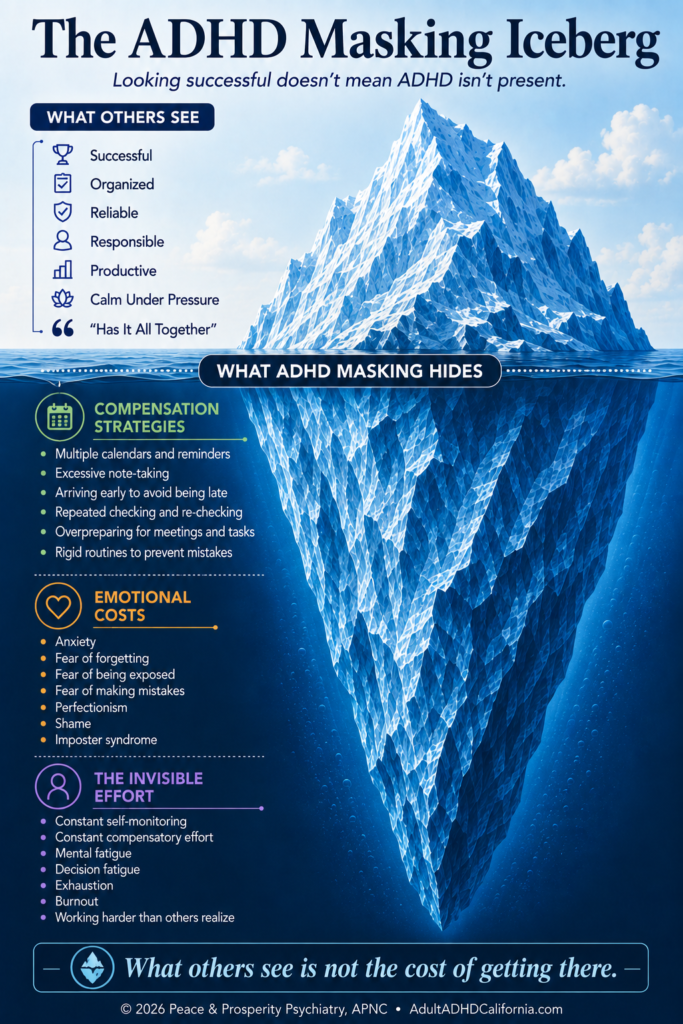
Coworkers may see competence.
Friends may see reliability.
Family members may see accomplishment.
What they do not see is the extraordinary amount of effort required to maintain those appearances.
Many adults with ADHD spend years developing systems, routines, and compensatory strategies that help them appear organized, reliable, and successful. The challenge is that others often see the outcome without seeing the effort behind it. Understanding how masking develops can help explain why ADHD frequently goes unrecognized until adulthood.
Conscious ADHD Masking
Conscious masking is intentional.
You may know that you struggle to sustain attention during meetings, so you force eye contact, take detailed notes, and actively monitor your facial expressions to appear engaged.
You may know that time management is difficult, so you build excessive buffers into your schedule and become known as the person who is always early.
You may know that verbal instructions are difficult to remember, so you request everything in writing and describe yourself as detail-oriented rather than acknowledging the memory challenges underneath.
Some adults consciously suppress behaviors they fear others will judge.
They work hard not to interrupt.
Not to fidget.
Not to lose track of conversations.
Not to appear distracted.
The effort may be invisible to everyone except the person doing it.
Unconscious ADHD Masking
Unconscious masking develops more gradually.
Many adults spent years hearing messages such as:
- “Try harder.”
- “Pay attention.”
- “Be more organized.”
- “You need to apply yourself.”
- “You’re not living up to your potential.”
Over time, these experiences can create a habit of constant self-monitoring.
A person may become intensely perfectionistic, overprepare for routine tasks, apologize excessively, or avoid situations where mistakes might be noticed.
Eventually these behaviors become so automatic that they no longer feel like strategies.
They simply feel like personality traits.
An adult may describe themselves as “a perfectionist,” “a workaholic,” or “someone who is always prepared” without realizing those patterns developed partly to compensate for ADHD-related difficulties.
Maeda and colleagues (2026) suggest that masking may become so ingrained that individuals no longer recognize it as an adaptive response to stigma, criticism, or past negative experiences. Instead, the behaviors become woven into their sense of identity.
ADHD Masking vs. Compensation vs Overcompensation
Masking and compensation overlap, but they are not the same thing.
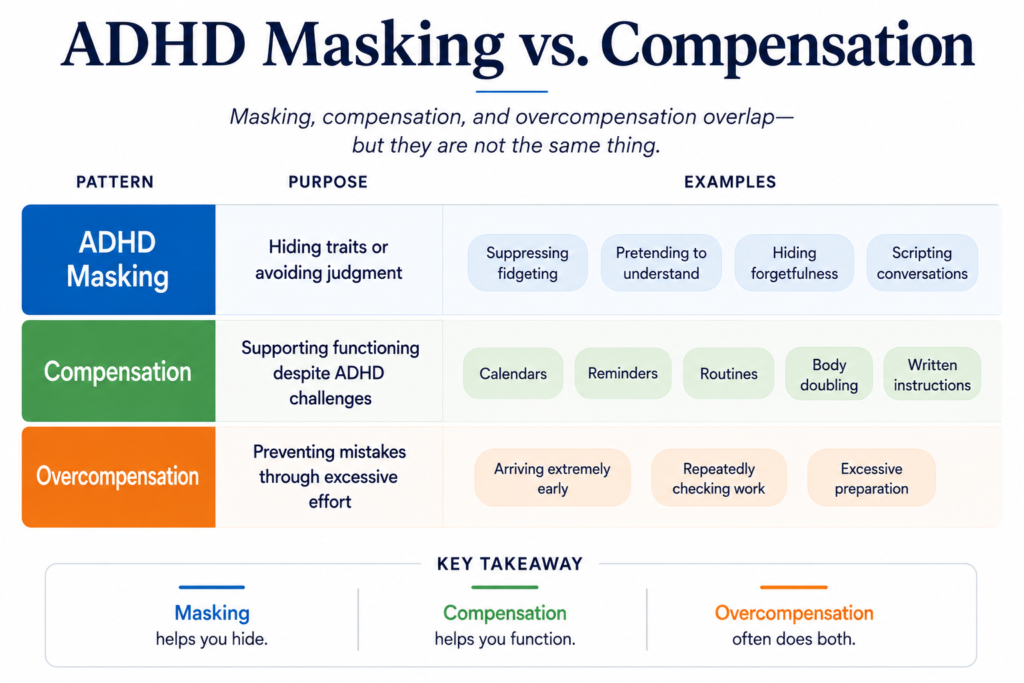
This distinction is important because not every coping strategy is a problem.
In a qualitative study of adults with ADHD, Canela and colleagues (2017) found that participants developed a wide range of organizational, attentional, social, motoric, and psychopharmacological strategies that helped them function before diagnosis and treatment.
Many of these strategies were genuinely useful.
Using a calendar is not unhealthy.
Using reminders is not unhealthy.
Creating structure is not unhealthy.
In fact, effective compensation is often one of the most important tools adults with ADHD can develop.
The concern arises when those strategies become driven primarily by fear, shame, perfectionism, or the need to conceal difficulties from other people.
For example, using a calendar to remember appointments may be healthy compensation.
Checking that calendar twenty times each day because you’re terrified of forgetting something may reflect a combination of compensation, anxiety, and ADHD masking.
Similarly, arriving ten minutes early for an appointment may be a practical strategy.
Arriving forty-five minutes early because being late feels emotionally catastrophic may suggest that fear has become part of the system.
The goal of treatment is not to eliminate effective supports.
The goal is to reduce the fear and exhaustion that often become attached to them.
Why ADHD Masking Develops
Most adults do not begin masking because they want to be inauthentic.
They begin masking because, at some point, it felt necessary.
ADHD Masking and the Desire to Fit In
Human beings naturally want acceptance.
Unfortunately, many ADHD symptoms are highly visible and easily misunderstood.
Interrupting conversations, forgetting commitments, losing track of details, misplacing important items, arriving late, appearing distracted, or needing instructions repeated can attract criticism from teachers, employers, coworkers, friends, and family members.
Over time, many people learn that certain behaviors lead to negative reactions.
Masking becomes a way to avoid those reactions.
Rather than risk embarrassment or judgment, they learn to hide their struggles and project competence.
Maeda and colleagues (2026) argue that stigma plays a central role in masking behaviors. Both public stigma and internalized self-stigma may motivate efforts to conceal ADHD-related traits and appear more socially acceptable.
In other words, ADHD masking is often less about deception and more about protection.
ADHD Masking and Avoiding Criticism
Many adults with ADHD have accumulated years of painful experiences.
Missed assignments.
Forgotten obligations.
Lost paperwork.
Unfinished projects.
Disappointment from teachers, supervisors, parents, spouses, or friends.
These experiences can gradually create a powerful internal belief:
“I cannot let people see me struggle.”
As a result, some adults become reluctant to ask questions, request help, seek accommodations, or admit when they feel overwhelmed.
The fear of appearing incompetent becomes stronger than the desire for support.
Research on adult ADHD consistently shows that repeated experiences of criticism and underperformance can contribute to negative self-beliefs that persist long after childhood (Lopez et al., 2018).
ADHD Masking and Fear of Failure
For some adults, anxiety becomes a productivity system.
Fear creates urgency.
Urgency creates action.
The person eventually completes the project, meets the deadline, studies for the exam, or prepares for the presentation.
From the outside, everything looks fine.
Internally, however, the process may involve procrastination, mounting anxiety, sleep deprivation, self-criticism, and last-minute panic.
The outcome looks successful.
The experience feels exhausting.
The cognitive-behavioral model of adult ADHD suggests that repeated experiences of frustration and perceived failure can contribute to maladaptive coping patterns, including anxiety-driven performance, avoidance, and perfectionism (Lopez et al., 2018).
Childhood Experiences and ADHD Masking
Many adult masking behaviors begin in childhood.
A child who is repeatedly criticized for forgetting things may become an adult who obsessively checks reminders.
A child who is told to “pay attention” may become an adult who forces intense concentration during conversations.
A child who is shamed for being disorganized may become an adult who spends enormous amounts of time trying to appear organized.
A child who is labeled lazy may become an adult who overworks themselves to prove otherwise.
These adaptations often develop for understandable reasons.
They help the child avoid criticism, embarrassment, rejection, or punishment.
The problem is that strategies designed for survival do not always create long-term well-being.
What protected someone at age ten may become exhausting at age forty.
Asherson and colleagues (2016) note that ADHD symptoms often evolve across the lifespan, interacting with changing environmental demands and personal experiences. The coping strategies that emerge during childhood may continue long into adulthood, even after they stop being helpful.
ADHD Masking and the Need to Feel Safe
At its core, ADHD masking is often about safety.
Safety from criticism.
Safety from embarrassment.
Safety from rejection.
Safety from feeling inadequate.
The behaviors themselves may look productive or responsible on the surface, but underneath them is often a fear that if the mask slips, other people will finally see what the individual has spent years trying to hide.
De Melo and Franca (2026) argue that many adults with ADHD live with a profound mismatch between external performance and internal experience. The result is a form of high functioning that may conceal significant suffering.
And that fear can become exhausting.
What ADHD Masking Looks Like in Real Life
ADHD masking is not one specific behavior.
It is a pattern of self-monitoring, compensation, suppression, and overpreparation that may show up differently depending on the environment.
The common thread is that other people see the outcome while missing the effort behind it.
De Melo and Franca (2026) argue that one of the major challenges in recognizing adult ADHD is that visible performance often fails to capture the substantial emotional, cognitive, and behavioral effort required to maintain that performance. As a result, outward functioning may conceal significant internal distress.
ADHD Masking at Work
For many adults, work becomes the place where masking is most visible.
ADHD masking at work may include:
- Taking extensive notes because you do not trust yourself to remember verbal information.
- Arriving unusually early because being late feels unacceptable.
- Staying late to compensate for distractibility or difficulty getting started.
- Overpreparing for meetings and presentations.
- Re-reading emails repeatedly before sending them.
- Creating detailed systems to avoid mistakes.
- Working through breaks to catch up.
- Becoming known as “the perfectionist.”
To coworkers, these behaviors may look like dedication, professionalism, or strong work ethic.
Sometimes they are.
But they may also reflect the tremendous effort required to compensate for ADHD-related difficulties.
A professional may appear exceptionally organized while privately feeling overwhelmed and afraid of falling behind.
The challenge is that performance alone does not reveal how much energy is being spent to achieve it. As de Melo and Franca (2026) note, two individuals may produce similar results while expending vastly different amounts of effort.
ADHD Masking at Home
The hidden cost of masking often becomes more apparent at home.
Many adults spend so much energy maintaining performance at work that they have little left when the workday ends.
ADHD masking at home may involve:
- Cleaning frantically before guests arrive.
- Hiding clutter or unfinished projects.
- Creating elaborate reminder systems.
- Using visual piles as memory aids.
- Avoiding paperwork until urgency forces action.
- Relying heavily on a spouse or family member for reminders.
- Appearing highly organized in one area while another area quietly falls apart.
Someone may appear polished and successful professionally while struggling to manage routine household responsibilities.
The contrast can be confusing and frustrating.
Particularly because other people often see only the successful side.
This discrepancy between public competence and private struggle is a recurring theme in adult ADHD research (de Melo & Franca, 2026).
ADHD Masking in Social Situations
Social situations can create a different kind of challenge.
Many adults with ADHD worry that their symptoms will be interpreted as rudeness, disinterest, immaturity, or poor social skills.
As a result, they often develop ways to compensate.
ADHD masking in social situations may include:
- Rehearsing conversations beforehand.
- Memorizing names and personal details.
- Pretending to follow a conversation when attention drifts.
- Monitoring facial expressions and body language.
- Suppressing the urge to interrupt.
- Using scripts during networking events or professional interactions.
- Avoiding situations where mistakes feel likely.
Research on ADHD masking suggests that many individuals consciously or unconsciously alter their behavior to avoid negative judgment and improve social acceptance (Maeda et al., 2026).
Some adults become so focused on monitoring themselves that they struggle to enjoy the interaction itself.
Instead of feeling connected, they feel as though they are performing.
The conversation becomes less about being present and more about avoiding mistakes.
ADHD Masking and Emotional Suppression
Not all masking is behavioral.
Some of the most exhausting forms of ADHD masking are emotional.
Adults with ADHD often learn to hide frustration, overwhelm, disappointment, anxiety, or emotional intensity because they fear being judged.
This emotional masking may include:
- Pretending everything is fine when it isn’t.
- Minimizing distress.
- Avoiding vulnerability.
- Suppressing frustration.
- Hiding overwhelm until reaching a breaking point.
- Criticizing yourself for emotional reactions.
Many people become skilled at looking calm while managing significant internal distress.
Friends, family members, and coworkers may have no idea how much effort is required to maintain that appearance.
Maeda and colleagues (2026) describe masking as a response not only to external stigma but also to internalized beliefs about how a person “should” behave. Emotional suppression may therefore become part of an ongoing attempt to appear capable, composed, and unaffected.
ADHD Masking and High-Achieving Adults
One of the most damaging myths about ADHD is that successful people cannot have it.
Many adults seeking evaluation have heard some version of:
- “You graduated from college.”
- “You have a successful career.”
- “You own a business.”
- “You’re too organized.”
- “You don’t seem like someone with ADHD.”
The assumption is understandable.
If someone is succeeding, why would anyone suspect ADHD?
The answer is that success and ADHD are not mutually exclusive.
In some cases, success actually helps conceal ADHD.
Professionals, executives, physicians, attorneys, educators, healthcare workers, entrepreneurs, and parents often develop sophisticated systems that allow them to function at a high level despite persistent ADHD symptoms.
Strong intelligence, creativity, supportive environments, and years of compensatory skill-building can help someone achieve impressive outcomes (Asherson et al., 2016).
But those outcomes do not necessarily reveal what it costs to maintain them.
The Effort-to-Output Gap
One of the most useful ways to understand ADHD masking is through what might be called an effort-to-output gap.
Imagine two professionals who consistently meet deadlines.
From the outside, their performance looks identical.
One completes tasks with a reasonable amount of effort.
The other depends on multiple reminder systems, extensive note-taking, repeated checking, anxiety-driven urgency, and hours of extra work.
The outputs are the same.
The costs are not.
De Melo and Franca (2026) argue that this distinction is often overlooked in ADHD assessment. Traditional approaches tend to focus on visible impairment and observable dysfunction. However, a person may maintain acceptable performance while experiencing substantial emotional distress, cognitive fatigue, and compensatory effort.
This perspective helps explain why many successful adults remain undiagnosed.
The issue is not whether they are functioning.
The issue is how much invisible work is required to sustain that functioning.
Success Does Not Eliminate ADHD
Many adults spend years wondering why success feels harder than it seems for everyone else.
They may be high earners, respected professionals, effective leaders, or accomplished entrepreneurs.
Yet they also experience:
- Chronic anxiety about forgetting something important.
- Difficulty getting started on tasks.
- Extreme reliance on structure and routines.
- Perfectionism.
- Mental exhaustion.
- Time-management struggles.
- Problems managing responsibilities outside of work.
The contradiction can be confusing.
People assume that achievement should make life feel easier.
But achievement does not eliminate ADHD.
In some cases, achievement becomes part of the mask.
De Melo and Franca (2026) argue that adult ADHD assessment should account for hidden effort and subjective distress rather than relying solely on observable impairment. Their work suggests that many adults are not low functioning at all. Instead, they are functioning through extraordinary effort.
Success is evidence of ability.
It is not evidence that ADHD-related impairment is absent.
Why ADHD Masking Often Leads to Late Diagnosis
ADHD is often recognized when symptoms create obvious problems.
But what happens when those problems are hidden?
Adults who mask effectively frequently do not fit common stereotypes associated with ADHD.
They may arrive early.
Bring detailed notes.
Appear highly organized.
Speak thoughtfully.
Describe years of academic or professional success.
A clinician who looks only at the surface may miss the broader picture.
The challenge is that masking can conceal the very difficulties an evaluation is attempting to identify.
Intelligence and Compensatory Skills
High intelligence can make ADHD more difficult to recognize.
A person may reason through tasks quickly, identify workarounds, or develop sophisticated systems that compensate for executive-function weaknesses (Asherson et al., 2016).
These adaptations can be highly effective.
But effectiveness is not the same thing as absence of symptoms.
Many adults with ADHD create systems involving:
- Checklists.
- Calendars.
- Alarms.
- Accountability partners.
- Written instructions.
- Structured routines.
Canela and colleagues (2017) found that adults with ADHD frequently develop compensation strategies across multiple domains of life, including organizational, attentional, and social functioning.
These supports can help maintain performance while simultaneously making symptoms less visible.
Anxiety-Driven Performance
Some adults rely on anxiety as a productivity tool.
Fear of failure creates urgency.
Fear of forgetting creates vigilance.
Fear of disappointing others creates overpreparation.
From the outside, this may look like responsibility and discipline.
Internally, it can feel like living in a constant state of pressure.
The person appears highly functional, but the system depends on chronic stress.
The cognitive-behavioral literature on adult ADHD suggests that repeated experiences of frustration, criticism, and underperformance can contribute to negative self-beliefs that fuel anxiety-driven coping patterns (Lopez et al., 2018).
External Scaffolding
Asherson and colleagues (2016) emphasize the importance of understanding context when evaluating adult ADHD.
Many children function reasonably well because external structure is abundant.
Parents help manage schedules.
Teachers provide reminders.
School creates routine.
Responsibilities are relatively limited.
As people move into adulthood, much of that scaffolding disappears.
They become responsible for managing:
- Work.
- Finances.
- Relationships.
- Household responsibilities.
- Parenting.
- Healthcare.
- Long-term planning.
The same individual who appeared successful in childhood may suddenly struggle when external supports are removed.
The ADHD did not suddenly appear.
The compensation simply became insufficient.
ADHD Masking in Women
ADHD masking may be especially important when understanding why many women are diagnosed later in life.
Historically, girls and women have been underrepresented in ADHD diagnosis and research. Hinshaw and colleagues (2022) note that females are more likely to present with inattentive symptoms and internalized difficulties than the disruptive hyperactive behaviors traditionally associated with ADHD.
As a result, many girls learn to compensate rather than attract attention.
They may become highly organized.
Highly responsible.
Highly perfectionistic.
Highly accommodating.
Or highly skilled at hiding their struggles.
These adaptations can be so effective that neither the individual nor the people around her recognize ADHD as a possibility.
Williams and colleagues (2025), who examined the lived experiences of young women reflecting on ADHD in girls, identified recurring themes involving misunderstanding, compensation, and delayed recognition.
Social expectations may further encourage masking.
Many women feel pressure to appear organized, emotionally regulated, dependable, and attentive to the needs of others. When ADHD symptoms interfere with those expectations, masking may become a way to preserve social acceptance.
The psychological cost can be substantial.
Wicherkiewicz and Gambin (2026) found that greater social camouflaging among women with ADHD was associated with lower life satisfaction and higher depressive symptoms.
For many women, diagnosis does not occur until adulthood, when increasing responsibilities overwhelm the systems that previously helped them compensate.
This is one reason ADHD evaluations in women often require looking beyond visible achievement and examining the effort required to maintain it.
For a deeper discussion of this topic, see our articles on ADHD in Women and ADHD in High-Achieving Women.
Signs You May Be Masking ADHD: A Self-Assessment Checklist
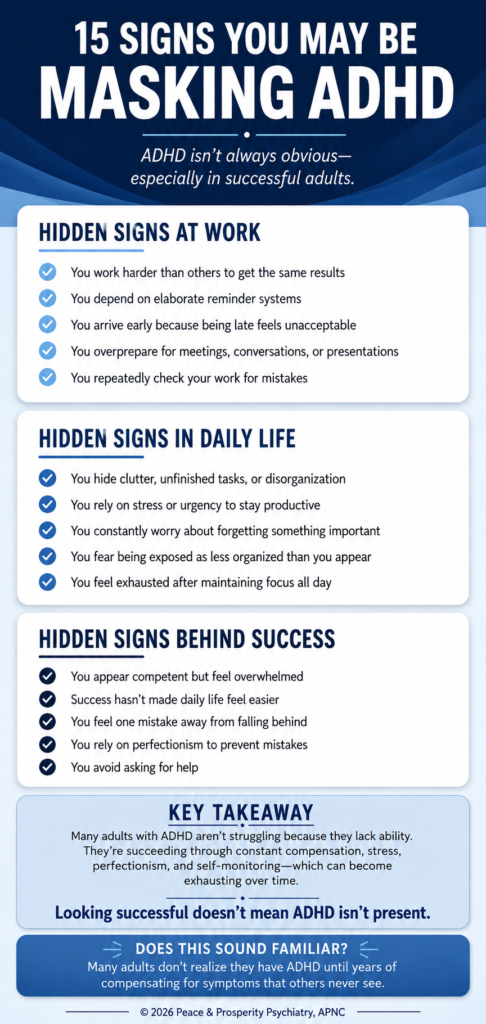
ADHD masking by itself does not diagnose ADHD.
Many of the behaviors shown in this infographic can also occur in anxiety disorders, depression, trauma-related conditions, sleep disorders, autism spectrum disorder, and other mental health conditions.
The individual behaviors are often less important than the overall pattern. A comprehensive ADHD evaluation examines childhood history, current symptoms, executive functioning, coping strategies, strengths, functional impairment, and alternative explanations for the difficulties being experienced (Olagunju & Ghoddusi, 2024).
Still, many adults who later receive an ADHD diagnosis recognize themselves in several of these patterns. If multiple signs feel familiar, it may be worth exploring whether ADHD could be part of the picture.
- Working significantly harder than others to achieve similar results.
- Depending on elaborate reminder systems to avoid mistakes.
- Arriving excessively early because being late feels intolerable.
- Overpreparing for meetings, conversations, travel, or routine responsibilities.
- Re-reading emails, messages, or documents multiple times before sending them.
- Hiding clutter, unfinished projects, or overdue responsibilities.
- Feeling constantly close to falling behind despite appearing successful.
- Using urgency, anxiety, or deadlines to get started on tasks.
- Avoiding situations where weaknesses might become visible.
- Feeling exhausted by everyday functioning.
- Using perfectionism to protect against criticism.
- Struggling privately while appearing capable publicly.
- Feeling as though life requires far more effort than it seems to require for other people.
- Wondering why accomplishments have never made daily life feel easier.
Many of these behaviors represent attempts to compensate for underlying difficulties rather than evidence that those difficulties do not exist. As Canela and colleagues (2017) observed, adults with ADHD often develop sophisticated organizational, attentional, social, and environmental strategies that help them function while simultaneously making symptoms less visible.
If several of these experiences sound familiar, it does not automatically mean you have ADHD. It may mean that a closer look is worthwhile.
ADHD Masking vs. Thriving
One of the most important distinctions in this discussion is the difference between masking and thriving.
They are not the same thing.
A person can appear highly functional while operating in a constant state of stress, anxiety, perfectionism, and self-monitoring.
From the outside, everything may look fine.
Internally, they may be struggling every day.
Maeda and colleagues (2026) note that masking may help individuals adapt to social expectations and avoid negative judgment. However, they also describe how masking can create significant psychological burden, particularly when it becomes a chronic response to stigma and self-criticism.
Masking often involves:
- Concealing difficulties.
- Hiding needs from others.
- Using shame or fear as motivation.
- Maintaining performance at significant personal cost.
- Constantly monitoring yourself for mistakes.
- Living with chronic anxiety about being exposed.
Thriving looks very different.
Thriving does not mean becoming careless.
It does not mean lowering standards.
It does not mean abandoning structure.
Instead, thriving means creating a life that works with your brain rather than forcing yourself to constantly fight against it.
Thriving may include:
- Understanding your ADHD profile.
- Building sustainable systems.
- Using supports without shame.
- Seeking treatment when appropriate.
- Setting realistic expectations.
- Choosing environments that fit your strengths.
- Asking for help when needed.
- Practicing self-compassion.
Moving Beyond a Deficit-Only View
Historically, ADHD discussions have focused primarily on deficits and impairment.
Those challenges are real and deserve attention.
However, thriving often requires a more balanced perspective.
Wurth and colleagues (2025) found that diagnosis acceptance, perceived strengths, and positive interpretations of neurodivergent traits were associated with better quality of life. Participants frequently identified meaningful challenges associated with ADHD, but they also described strengths such as curiosity, persistence, unique perspectives, and a strong drive to learn.
This finding does not mean ADHD is a superpower.
Nor does it suggest that ADHD-related difficulties should be minimized.
Instead, it suggests that people often do better when they develop a realistic understanding of both their challenges and their strengths.
For some individuals, those strengths may include:
- Creativity.
- Curiosity.
- Adaptability.
- Enthusiasm.
- Persistence.
- Novel problem-solving.
- The ability to think differently about complex problems.
Thriving is not pretending challenges do not exist.
Thriving is recognizing that challenges are not the only thing that exists.
The goal is not to eliminate every coping strategy.
The goal is to keep the strategies that genuinely help while letting go of those driven primarily by shame, fear, and impossible standards.
How ADHD Masking Connects to Other ADHD Symptoms
ADHD masking rarely exists in isolation.
It often develops in response to other ADHD-related difficulties.
Understanding those connections can help explain why masking becomes such a common experience for adults with ADHD.
ADHD Masking and Working Memory
Working memory allows you to temporarily hold and manipulate information.
When working memory is inconsistent, people often compensate with notes, reminders, alarms, visual cues, and repeated checking.
These tools can be incredibly helpful.
At the same time, the anxiety surrounding forgetfulness can become part of the mask.
Someone may appear exceptionally organized while privately depending on extensive systems simply to remember everyday responsibilities.
Canela and colleagues (2017) found that adults with ADHD frequently develop organizational and attentional compensation strategies, including calendars, reminder systems, lists, and environmental supports. While these tools can improve functioning, they can also make underlying working-memory difficulties less visible to other people.
ADHD Masking and Executive Dysfunction
Executive dysfunction affects skills such as planning, prioritization, organization, task initiation, and follow-through.
Masking can make executive dysfunction harder to recognize.
Instead of seeing disorganization, other people may see overplanning.
Instead of seeing difficulty starting tasks, they may see last-minute productivity.
Instead of seeing unfinished responsibilities, they may see perfectionism and overwork.
Asherson and colleagues (2016) describe executive-function difficulties as a core feature of adult ADHD. When individuals compensate aggressively for these difficulties, the impairment itself may become harder to recognize despite the substantial effort required to manage it.
ADHD Masking and Time Blindness
Many adults with ADHD struggle to accurately sense the passage of time.
To compensate, they may:
- Arrive extremely early.
- Set multiple alarms.
- Check the clock repeatedly.
- Build excessive buffers into their schedules.
- Avoid commitments they fear they might forget.
These behaviors can look like exceptional punctuality.
Sometimes they are actually responses to chronic anxiety about time management.
The person who is always early may not have mastered time. They may simply be working much harder than other people to avoid being late.
ADHD Masking and Decision Fatigue
Decision-making becomes harder when mental energy is already being consumed by constant self-monitoring.
Everyday choices that seem simple to others can become surprisingly draining.
What should I work on first?
Did I forget something?
Should I send that email?
Did I explain myself clearly?
The ongoing cognitive load of masking can contribute to significant decision fatigue over time. De Melo and Franca (2026) argue that invisible effort and compensatory burden are often overlooked components of adult ADHD despite their substantial impact on quality of life and daily functioning.
ADHD Masking, Anxiety, and Perfectionism
Some masking behaviors overlap with symptoms seen in anxiety disorders, obsessive-compulsive tendencies, and trauma-related hypervigilance.
For example:
- Excessive checking.
- Overpreparing.
- Fear of mistakes.
- Constant vigilance.
- Difficulty relaxing.
The behavior itself does not automatically reveal the cause.
This is one reason comprehensive assessment is important.
A clinician’s job is not simply to identify masking behaviors.
It is to understand why those behaviors developed and whether ADHD, anxiety, trauma, depression, sleep difficulties, or another condition may be contributing.
Maeda and colleagues (2026) note that masking appears to be strongly influenced by stigma and internalized negative beliefs. Similarly, de Melo and Franca (2026) describe perfectionistic overcompensation and chronic self-monitoring as factors that can obscure ADHD-related impairment while simultaneously increasing emotional distress.
What Happens When ADHD Masking Stops Working?
Many adults seek help when the strategies that once kept everything together stop working.
This often happens during periods of increasing responsibility, chronic stress, or major life change.
Examples include:
- A promotion that requires managing more people and projects.
- Parenthood and the added demands of family life.
- Starting or growing a business.
- Caring for aging parents.
- Relationship changes.
- Financial stress.
- Health problems.
- Burnout.
At first, people often assume they have become less disciplined.
Less motivated.
Less organized.
Less capable.
But that interpretation is frequently inaccurate.
What changed was not necessarily the person.
What changed was the balance between demands and available resources.
Asherson and colleagues (2016) describe how ADHD symptoms often become more apparent when environmental supports and external structure decrease. Similarly, de Melo and Franca (2026) argue that significant compensatory effort can conceal impairment until increasing demands overwhelm the systems that were previously keeping difficulties hidden.
For years, masking and compensation may have been enough.
Then life became more complex.
The workload increased.
The responsibilities multiplied.
The margin for error disappeared.
Eventually the effort required to maintain the mask exceeded what was sustainable.
This helps explain why many adults seek ADHD evaluations during major transitions.
The ADHD did not suddenly appear.
The systems that had been compensating for it simply stopped being enough.
Can ADHD Treatment Reduce ADHD Masking?
Researchers have not yet established whether ADHD masking itself decreases as a direct treatment outcome.
The literature is still too limited to make strong conclusions.
Maeda and colleagues (2026) note that ADHD masking remains an emerging area of research and that ADHD-specific conceptual models and measurement tools are still being developed. As a result, most treatment studies focus on ADHD symptoms, functional impairment, and quality of life rather than masking specifically.
However, treatment can reduce many of the underlying difficulties that masking exists to conceal.
As symptoms become more manageable, the need for constant self-monitoring and overcompensation may decrease.
A comprehensive treatment plan may include:
Accurate Diagnosis
Many adults spend years blaming themselves for struggles they do not understand.
An accurate diagnosis can provide a framework for understanding long-standing patterns and challenges.
Psychoeducation
Learning how ADHD affects attention, working memory, executive functioning, time awareness, emotional regulation, and motivation often helps reduce shame and self-blame.
Knowledge does not eliminate symptoms.
But it can change how people interpret them.
Medication
Clinical guidelines continue to identify stimulant medications as first-line treatments for many adults with ADHD because of their effectiveness in reducing core symptoms (Olagunju & Ghoddusi, 2024). Evidence from randomized trials and systematic reviews supports the use of both stimulant and certain non-stimulant medications as part of a comprehensive treatment approach (Cândido et al., 2021; Gonda et al., 2026).
Medication is not appropriate for everyone and should always be discussed with a qualified healthcare professional.
When effective, however, medication may reduce the amount of effort required to manage everyday responsibilities.
Cognitive Behavioral Therapy
Lopez and colleagues (2018) found that cognitive-behavioral interventions can improve symptom management in adults with ADHD.
CBT can be particularly helpful for addressing:
- Negative self-beliefs.
- Perfectionism.
- Avoidance.
- Emotional regulation difficulties.
- Unhelpful coping patterns that developed over years of struggling.
Coaching and Skills Training
Insight is important.
Practical implementation is equally important.
ADHD coaching and skills-based interventions can help adults build sustainable systems that support functioning without relying exclusively on anxiety and overcompensation.
The goal is not to eliminate compensation. The goal is to replace exhausting compensation with effective compensation.
Environmental Changes
Asherson and colleagues (2016) emphasize that ADHD symptoms are heavily influenced by environmental demands and available supports. Performance often depends not only on the individual’s abilities but also on the amount of structure, accountability, and external scaffolding available.
In some situations, modifying the environment may be just as important as modifying the individual.
Written instructions, reduced distractions, accountability systems, realistic workloads, accommodations, and supportive routines can all reduce unnecessary strain.
Self-Compassion
For many adults, self-compassion may be one of the most difficult and most important parts of treatment.
Years of criticism often create a habit of self-judgment.
Replacing:
“Why can’t I do this?”
with:
“What support would make this easier?”
can fundamentally change how someone experiences ADHD.
The purpose of treatment is not to help you hide ADHD more effectively.
The purpose is to help you need less hiding.
The goal is not perfection.
The goal is sustainability.
You Were Never Lazy
Many adults with ADHD spend years believing they are lazy.
Or careless.
Or irresponsible.
Or undisciplined.
Or simply not trying hard enough.
They look back at unfinished projects, missed deadlines, cluttered spaces, inconsistent performance, emotional overwhelm, and chronic exhaustion and conclude that the problem must be a character flaw.
But what if the story is more complicated than that?
What if the problem was never a lack of effort?
What if the problem was that nobody could see how much effort was already being spent?
The person who always arrived early may have been terrified of being late.
The person who seemed perfectly organized may have depended on dozens of systems just to stay afloat.
The person who looked calm may have been suppressing overwhelm.
The person who appeared successful may have been paying for that success with anxiety, exhaustion, perfectionism, and relentless self-monitoring.
De Melo and Franca (2026) argue that many adults with ADHD are not low functioning but rather “high functioning, yet high suffering.” Their work highlights a central problem in adult ADHD: visible performance can hide substantial distress, compensatory effort, and reduced quality of life.
For many adults, understanding ADHD masking becomes a turning point.
Not because it explains everything.
But because it finally provides language for an experience they have been living for years.
The experience of looking capable while feeling overwhelmed.
The experience of succeeding while struggling.
The experience of constantly wondering why life seems harder than it appears to be for everyone else.
Recognizing ADHD masking does not erase those challenges.
But it can replace self-criticism with understanding.
It can help explain why accomplishments never seemed to make life easier.
It can reveal the hidden work that has been happening behind the scenes for years.
And it can create space for a different question.
Not:
“Why can’t I keep doing this?”
But:
“What would my life look like if it didn’t have to be this hard?”
You do not need to reach a breaking point before your struggles deserve attention.
You do not need to look visibly impaired for your difficulties to matter.
And you do not need to keep proving your worth through exhaustion.
Understanding ADHD masking may not change the past.
But it can change how you understand yourself moving forward.
The goal is not to help you hide better.
The goal is to help you live better.
Could YOU Be Masking ADHD?
If this article felt uncomfortably familiar, it may be worth taking a closer look. Many adults spend years compensating for ADHD symptoms without realizing how much effort they’re expending just to keep up.
If you’re in California, Peace & Prosperity Psychiatry provides comprehensive adult ADHD evaluations and treatment. Contact us to learn whether ADHD may be part of the picture.
If you’re outside California, look for a clinician who specializes in adult ADHD and understands masking, compensation strategies, and high-achieving adults.
That’s short, helpful, and naturally transitions from education to action without sounding overly promotional.
Key Takeaways About ADHD Masking
- ADHD masking is the conscious or unconscious effort to hide, suppress, or compensate for ADHD symptoms.
- Many adults with ADHD appear successful, organized, and capable while privately struggling with overwhelm, anxiety, and exhaustion.
- Masking often develops as a response to criticism, shame, stigma, or repeated experiences of feeling different.
- High achievement does not rule out ADHD. In many cases, success is maintained through extraordinary effort and compensation.
- Common masking behaviors include overpreparing, perfectionism, extensive reminder systems, arriving excessively early, and working harder than others to achieve similar results.
- Masking can delay ADHD diagnosis because outward performance may conceal underlying difficulties.
- Long-term masking is associated with anxiety, burnout, self-criticism, imposter syndrome, and emotional exhaustion.
- Masking is not the same as thriving. Thriving involves understanding your brain, using effective supports, reducing shame, and functioning with less effort.
- If several masking behaviors feel familiar, a comprehensive ADHD evaluation may help clarify whether ADHD is contributing to your experiences.
Frequently Asked Questions About ADHD Masking
What is ADHD masking?
ADHD masking is the conscious or unconscious effort to hide, suppress, or compensate for ADHD symptoms in order to appear more organized, focused, or capable. Many adults develop masking behaviors to avoid criticism, embarrassment, or negative judgment.
What does ADHD masking look like in adults?
Common examples include overpreparing, arriving excessively early, relying on elaborate reminder systems, rechecking work repeatedly, hiding forgetfulness, suppressing restlessness, and working significantly harder than others to achieve similar results.
Can someone have ADHD and still be successful?
Yes. Many adults with ADHD are successful professionals, business owners, healthcare workers, educators, and parents. Success does not eliminate ADHD symptoms. In many cases, success is achieved through extensive compensation strategies and sustained effort.
Why is ADHD often diagnosed later in life?
Some adults develop effective compensatory strategies that hide their symptoms for years. Others benefit from supportive environments that provide structure. ADHD often becomes more noticeable during major life transitions such as college, parenthood, career advancement, or burnout.
Is ADHD masking the same as compensation?
Not exactly. Compensation involves strategies that help manage ADHD-related difficulties, such as calendars, reminders, and routines. Masking focuses on hiding symptoms or preventing others from noticing struggles. In practice, the two often overlap.
Can ADHD masking cause anxiety and burnout?
Yes. Constant self-monitoring, perfectionism, fear of mistakes, and sustained effort can contribute to anxiety, emotional exhaustion, and burnout. Many adults describe feeling overwhelmed despite appearing successful to others.
How do I know if I am masking ADHD?
No single behavior confirms ADHD. However, if you consistently work harder than others to stay organized, rely heavily on compensation strategies, fear being “found out,” and feel exhausted by daily functioning, it may be worth seeking a professional evaluation.
Does ADHD treatment reduce masking?
For many people, yes. Effective treatment can reduce the need for constant compensation and self-monitoring. The goal is not to help people hide symptoms more effectively, but to improve functioning while reducing unnecessary effort and stress.
References
Canela, C., Buadze, A., Dube, A., Eich, D., & Liebrenz, M. (2017). Skills and compensation strategies in adult ADHD: A qualitative study. PLOS ONE, 12(9), e0184964. https://doi.org/10.1371/journal.pone.0184964
Cândido, R. C. F., Menezes de Padua, C. A., Golder, S., & Junqueira, D. R. (2021). Immediate-release methylphenidate for attention deficit hyperactivity disorder (ADHD) in adults. Cochrane Database of Systematic Reviews, 2021(1), CD013011. https://doi.org/10.1002/14651858.CD013011.pub2
de Melo, I. H., & Franca, G. (2026). High functioning, yet high suffering: The need to incorporate invisible struggles in adult ADHD diagnostic assessment criteria. Frontiers in Psychiatry, 17, 1813029. https://doi.org/10.3389/fpsyt.2026.1813029
Food and Drug Administration. (n.d.). Approved drug products with therapeutic equivalence evaluations (Orange Book). https://www.fda.gov/drugs/drug-approvals-and-databases/approved-drug-products-therapeutic-equivalence-evaluations-orange-book
Gonda, X., Dome, P., Balogh, L., Baradits, M., & Réthelyi, J. M. (2026). Connecting the dots and finding the way forward: Pharmacological, neuromodulatory, and psychotherapeutic interventions for the complex treatment of adult ADHD. Pharmacology & Therapeutics, 280, 108997. https://doi.org/10.1016/j.pharmthera.2026.108997
Hinshaw, S. P., Nguyen, P. T., O’Grady, S. M., & Rosenthal, E. A. (2022). Annual research review: Attention-deficit/hyperactivity disorder in girls and women: Underrepresentation, longitudinal processes, and key directions. Journal of Child Psychology and Psychiatry, 63(4), 484–496. https://doi.org/10.1111/jcpp.13480
Lopez, P. L., Torrente, F. M., Ciapponi, A., et al. (2018). Cognitive-behavioural interventions for attention deficit hyperactivity disorder (ADHD) in adults. Cochrane Database of Systematic Reviews, 2018(3), CD010840. https://doi.org/10.1002/14651858.CD010840.pub2
Maeda, C., Knouse, L. E., Takeda, K., et al. (2026). A narrative review of stigma and masking in ADHD: Insights from English-language research and the Japanese cultural context. Frontiers in Psychology, 17, 1807337. https://doi.org/10.3389/fpsyg.2026.1807337
Olagunju, A. E., & Ghoddusi, F. (2024). Attention-deficit/hyperactivity disorder in adults. American Family Physician, 110(2), 157–166.
Philipsen, A., Jans, T., Graf, E., et al. (2015). Effects of group psychotherapy, individual counseling, methylphenidate, and placebo in the treatment of adult attention-deficit/hyperactivity disorder. JAMA Psychiatry, 72(12), 1199–1210. https://doi.org/10.1001/jamapsychiatry.2015.2146
Primich, C., & Iennaco, J. (2012). Diagnosing adult attention-deficit hyperactivity disorder: The importance of establishing daily life contexts for symptoms and impairments. Journal of Psychiatric and Mental Health Nursing, 19(4), 362–373. https://doi.org/10.1111/j.1365-2850.2011.01845.x
Asherson, P., Buitelaar, J., Faraone, S. V., & Rohde, L. A. (2016). Adult attention-deficit hyperactivity disorder: Key conceptual issues. The Lancet Psychiatry, 3(6), 568–578. https://doi.org/10.1016/S2215-0366(16)30032-3
Wicherkiewicz, F., & Gambin, M. (2026). Relations between social camouflaging, life satisfaction, and depression among Polish women with ADHD. Journal of Autism and Developmental Disorders, 56(7), 2875–2883. https://doi.org/10.1007/s10803-024-06410-6
Williams, T., Barclay, I., Bevan-Jones, R., et al. (2025). Reflections on the manifestation of attention-deficit hyperactivity disorder in girls from young adults with lived experiences: A qualitative study. British Journal of Psychiatry, 227(5), 775–782. https://doi.org/10.1192/bjp.2025.10376
Wurth, P., Fuermaier, A. B., Strand, A. H., & Thorell, L. B. (2025). Diagnosis acceptance, masking, and perceived benefits and challenges in adults with ADHD and ASD: Associations with quality of life. Frontiers in Psychiatry, 16, 1668780. https://doi.org/10.3389/fpsyt.2025.1668780
Medical Review & Author Information
Written and medically reviewed by Troy Don, DC, AGACNP-BC, PMHNP-BC
For additional information about clinical education, professional credentials, and background, see Clinical Credentials & Professional Background.
Last medically reviewed: August 2026
Evidence reviewed through: August 2026
Medical Disclaimer
This article is for educational purposes only and is not a substitute for individualized medical advice, diagnosis, or treatment. If you have questions about ADHD, mental health symptoms, medications, or treatment options, discuss them with an appropriate healthcare professional.