
Table of Contents
ToggleIf you're looking for a natural alternative to ADHD medication—or wondering whether a supplement could help alongside treatment—start here with what the adult research actually shows.
Written and medically reviewed by Troy Don, DC, AGACNP-BC, PMHNP-BC
Psychiatric Mental Health Nurse Practitioner
Last medically reviewed: August 2026
Evidence reviewed through: August 2026
Clinical Credentials & Professional Background
About This Series
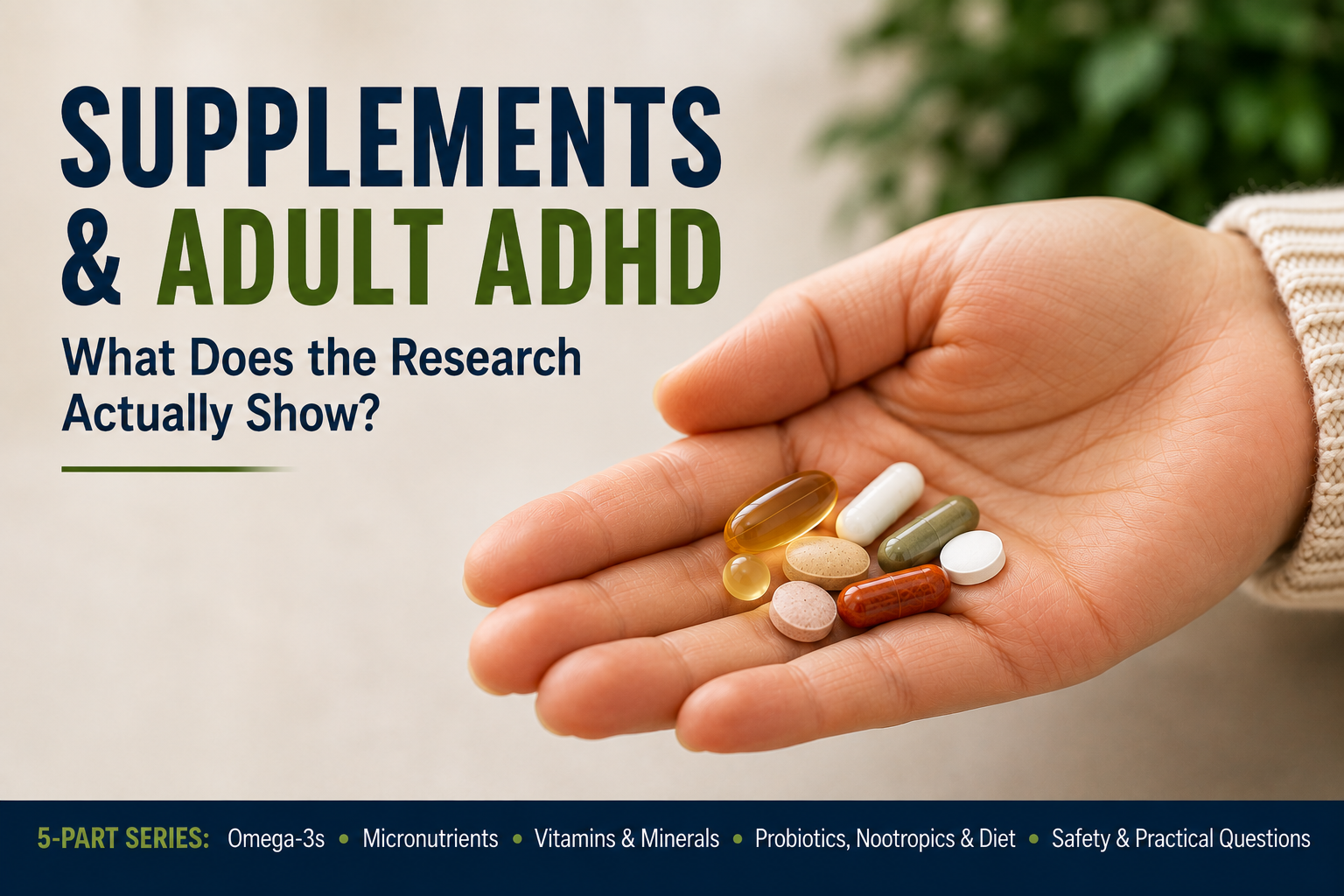
This is Part 1 of a five-part series examining supplements and adult ADHD. In the articles that follow, we will look separately at omega-3 fatty acids and broad-spectrum micronutrients; iron, vitamin D, magnesium, zinc, and saffron; probiotics, nootropics, and diet; and finally the practical questions of supplement safety, nutritional testing, combining supplements with ADHD treatment, and whether supplements can reasonably replace medication.
We are starting here because before asking which supplement “works,” we first need to understand what counts as convincing evidence—especially when so much ADHD supplement research has been conducted in children rather than adults.
This series actually grew out of one of those deep dives many adults with ADHD will recognize. I started looking more closely at the research on supplements for ADHD, followed one study after another, and eventually realized the evidence was much more nuanced than most of what I was seeing online. I wanted to organize what I learned and share it in a way that separates what looks promising from what has actually been demonstrated—especially in adults.
Maybe you have been diagnosed with ADHD—or you strongly suspect you have it—but you are hesitant to start medication.
You may be wondering whether there is something more “natural” you could try first.
Or perhaps you are already treating your ADHD and doing reasonably well, but you keep hearing about omega-3s, magnesium, vitamin D, iron, saffron, probiotics, or other supplements.
You want to know whether adding one of them could help you focus better, improve executive function, regulate your emotions, or simply make ADHD a little easier to manage.
Those are reasonable questions.
Unfortunately, the answers are not nearly as simple as much of the information online makes them sound.
Supplements do not have to be viewed as either a miracle alternative to ADHD medication or completely useless.
A much more useful question is:
Which nutritional interventions have credible evidence for adults with ADHD, who might reasonably benefit from them, and where does the evidence fall short?
That is the question we will examine throughout this five-part series.
The Short Answer
The research available today does not support any nutritional supplement as an equivalent replacement for established ADHD treatment in adults.
That does not mean every supplement is useless.
Some nutritional interventions have preliminary evidence.
Some have produced interesting findings in children but have barely been studied in adults.
Some have a small amount of genuine adult ADHD research.
And some nutrients may be particularly important when a person has an actual nutritional deficiency.
But for adults with ADHD, the evidence is considerably thinner than supplement marketing often suggests.
There is also an important difference between saying a supplement:
might be reasonable to consider
and saying research has established that it:
treats adult ADHD.
Those are not the same claim.
A large 2025 network meta-analysis examining 113 randomized controlled trials involving 14,887 adults with ADHD found substantially stronger evidence for established pharmacologic ADHD treatments than currently exists for nutritional supplements. In that analysis, stimulants and atomoxetine were the interventions with evidence of short-term benefit for core ADHD symptoms across both self-reported and clinician-reported ratings (Ostinelli et al., 2025).
That does not mean medication is the only meaningful component of ADHD care.
It means that when we compare treatment options, we should compare them based on the evidence we actually have.
A Note Before We Go Further
I realize some readers may not like some of what follows.
Supplements for ADHD are a subject with strong opinions and strong marketing. I may even get some criticism for some of the conclusions in this series.
My goal, however, is not to argue for supplements or against them.
It is not to convince you to take medication, either.
My goal is simply to share what the scientific literature actually shows as of 2026—including findings that are encouraging, findings that are disappointing, and questions for which we simply do not have a good answer yet.
That last category turns out to be particularly important for adults.
A substantial portion of nutritional-supplement research in ADHD has been conducted in children and adolescents, not adults.
Even for some of the most commonly recommended ADHD supplements, high-quality adult research is remarkably limited.
That does not mean pediatric research should be ignored.
It means we need to be honest about what it can—and cannot—tell us.
Why Supplements Are So Appealing to Adults With ADHD
There are several understandable reasons someone with ADHD might be interested in nutritional supplements.
And I think there are two groups of readers in particular who often come to this subject with somewhat different questions.
“I Want to Try Something Natural Before Medication.”
Some adults are uncomfortable with the idea of taking a stimulant or another psychiatric medication.
Maybe you are concerned about side effects.
Maybe you do not like the idea of taking medication every day.
Perhaps you had an unpleasant experience with medication in the past.
Or maybe you simply want to know whether there are reasonable alternatives worth considering before deciding what you are comfortable with.
Those preferences matter.
ADHD treatment does not have to be an all-or-nothing decision.
A comprehensive treatment discussion can consider medication, nonmedication treatments, behavioral strategies, psychotherapy or ADHD-focused skills work, sleep, exercise, nutrition, co-occurring conditions, clinically relevant nutritional deficiencies, and your individual preferences.
The important part is understanding what we know about each option—and what we do not.
Established ADHD treatments have a much larger evidence base than nutritional supplements for reducing the core symptoms of adult ADHD (Ostinelli et al., 2025).
That does not make nutrition irrelevant.
It does mean we should be careful about presenting a nutritional supplement as though research has shown it accomplishes the same thing as an established ADHD treatment.
“I’m Already Treating My ADHD. Is There Anything I Can Add?”
This is a somewhat different question.
Maybe medication, therapy, ADHD skills work, or another treatment is already helping, but you are still struggling with certain symptoms.
Could adding omega-3s help a little more?
What about magnesium?
Could correcting low iron or vitamin D make a difference?
What about some of the newer claims around saffron, broad-spectrum micronutrients, probiotics, or the gut-brain axis?
Here I think we need a higher standard than:
“It might help.”
Almost anything might help.
A better question is whether the expected additional benefit is meaningful enough to justify the cost, inconvenience, uncertainty, possible adverse effects, and potential medication interactions involved.
In other words:
“It might help” is not the same as “there is good evidence that adding it improves outcomes.”
That distinction becomes especially important in the supplement world, where biological plausibility, preliminary research, personal testimonials, and demonstrated clinical effectiveness can easily become blurred together.
They are not the same thing.
Before Asking Which Supplement Works, Ask These Four Questions
If you search online for supplements for adult ADHD, you can quickly find impressive-sounding claims.
A nutrient “supports dopamine.”
A supplement was associated with better attention.
A clinical trial produced a statistically significant result.
Children with ADHD were found to have lower levels of a particular nutrient.
All of those statements could potentially be true—and still tell us surprisingly little about whether taking that supplement will meaningfully improve ADHD in an adult.
Before deciding how much weight to give an ADHD supplement claim, I think we should ask four questions.
1. Was the Research Actually Done in Adults With ADHD?
This sounds obvious.
It may also be one of the most frequently overlooked issues in this entire subject.
A substantial portion of nutritional research in ADHD has been conducted in children and adolescents.
That includes much of the research involving omega-3 fatty acids, zinc, magnesium, iron, vitamin D, dietary interventions, and various herbal or nutritional products.
Pediatric research still matters.
ADHD is a neurodevelopmental disorder that often persists into adulthood, and a well-designed study showing benefit in children gives researchers a legitimate reason to ask whether adults might benefit as well.
But it does not answer the adult question.
Children and adults can differ in nutritional requirements, metabolism, hormonal factors, medical conditions, medication use, dietary patterns, and the ADHD-related outcomes that matter most in everyday life.
Can Research in Children Still Tell Us Something About Adults?
Yes.
But we need to use the right language.
A convincing pediatric study can provide a reasonable scientific basis for investigating an intervention in adults.
Depending on the strength of the evidence, potential risks, interactions, cost, and an individual’s circumstances, pediatric evidence might also contribute to a conversation about whether trying something is reasonable.
But there is an important difference between saying:
“There is evidence in children, and adults might benefit as well.”
and:
“Research shows this works in adults with ADHD.”
Until adequate adult studies have been performed, the second statement goes beyond the evidence.
This is why throughout this series you will repeatedly see me identify whether evidence comes from adults with ADHD, children with ADHD, mixed populations, or people who were not selected because they had ADHD at all.
That distinction matters.
2. Are We Correcting a Nutritional Deficiency—or Trying to Treat ADHD?
This may be the most important distinction in the entire supplement conversation.
Imagine that someone with ADHD also has iron deficiency.
If appropriate treatment corrects that deficiency and the person becomes less fatigued, thinks more clearly, or functions better, that can be clinically important.
But it does not automatically follow that taking additional iron will improve ADHD in someone whose iron stores are already adequate.
The same basic question applies to vitamin D, zinc, magnesium, and other nutrients.
There is another trap here.
Researchers may find that people with ADHD have lower average levels of a particular nutrient than people without ADHD.
That is an association.
It does not prove that the low nutrient level caused ADHD.
The relationship could potentially run in the other direction.
ADHD-related difficulties with planning, grocery shopping, cooking, maintaining routines, remembering meals, impulsive eating, or food choices could affect nutrition.
Other medical, lifestyle, socioeconomic, or genetic factors could influence both ADHD and nutritional status.
So when you hear:
“People with ADHD are deficient in X,”
the next question should not automatically be:
“How much X should I take?”
A better question is:
“Does correcting X improve ADHD—and was that demonstrated in people who weren’t deficient to begin with?”
Those are very different questions.
For some nutrients, the evidence of benefit appears more convincing when deficiency is actually present.
That does not mean every supplement works through deficiency correction.
And it does not mean a nutritional deficiency caused someone’s ADHD.
We will examine this much more closely in Part 3: Iron, Vitamin D, Magnesium, Zinc, and Saffron for Adult ADHD.
3. Was the Result Statistically Significant—or Clinically Meaningful?
“Statistically significant” sounds impressive.
But statistical significance and clinical significance answer different questions.
A statistically significant finding does not automatically tell us that an improvement was large enough for someone to notice in everyday life.
For someone living with ADHD, those practical questions matter.
Did the person become meaningfully better able to start and finish tasks?
Were they less impaired at work?
Did they stop repeatedly missing important deadlines?
Was there a noticeable improvement in distractibility or impulsivity?
Did relationships or overall functioning improve?
Or did researchers detect a small difference on one rating scale that reached statistical significance?
Those are not necessarily the same thing.
This is one reason effect size, confidence intervals, replication, study quality, and functional outcomes matter—not simply whether a study reported a p value below .05.
Small Benefits Are Not Necessarily Worthless
This distinction is not meant to dismiss small improvements.
A modest benefit could matter to an individual, particularly if an intervention is relatively safe, affordable, and being used thoughtfully alongside other treatment.
If something gives a particular person a genuine additional improvement and creates little burden or risk, that improvement may matter to them.
But a small or uncertain effect should be described as a small or uncertain effect.
It should not be transformed into:
“This supplement treats ADHD naturally.”
4. What Actually Improved?
Researchers can measure many different outcomes in an ADHD study.
They may measure the core ADHD symptoms of inattention and hyperactivity/impulsivity.
But they might also measure:
- executive function;
- emotional regulation;
- irritability;
- aggression;
- anxiety;
- depression;
- sleep;
- fatigue;
- memory;
- gastrointestinal symptoms;
- academic performance;
- quality of life; or
- general functioning.
Those outcomes can all matter.
But they are not interchangeable.
If a nutritional intervention improves sleep, that may be valuable.
If it reduces fatigue, that may be valuable.
If it improves emotional regulation, that may be valuable too.
But none of those findings, by themselves, necessarily means the intervention improved the core symptoms of ADHD.
Executive Function Is an Especially Important Example
Many adults with ADHD care less about how they score on a research questionnaire than whether they can actually manage their lives more effectively.
Can I get started on something I have been avoiding?
Can I organize a complicated work project?
Can I remember appointments?
Can I stop losing track of bills?
Can I estimate how long something will take?
Can I finish what I intended to finish?
Those are real-world outcomes.
An improvement on a computerized attention or memory test does not necessarily mean someone becomes better at those everyday tasks.
So whenever you hear that a supplement “helped ADHD,” I want you to ask:
Who was actually studied?
and:
What actually improved?
Those two questions eliminate a surprising amount of confusion.
So What Does the Supplement Evidence Look Like Overall?
Once we apply those standards, the evidence becomes considerably less impressive than many online “best ADHD supplements” lists suggest.
That does not mean there is nothing worth investigating.
There is.
For example, broad-spectrum micronutrients are notable because there is at least one randomized, double-blind, placebo-controlled trial conducted specifically in adults diagnosed with ADHD.
That trial involved 80 adults treated for eight weeks. Micronutrients produced greater improvement than placebo on self- and observer-rated ADHD measures, but not on the clinician ADHD rating scale (Rucklidge et al., 2014).
That is genuine adult randomized evidence.
It is also one relatively small, short trial with mixed results across different measures.
Both statements matter.
Omega-3 fatty acids have a much larger ADHD literature, but it is dominated by pediatric research. A 2023 meta-analysis of 22 randomized trials involving 1,789 participants found no statistically significant overall improvement in core ADHD symptoms compared with placebo, although studies lasting at least four months produced a more encouraging subgroup result (Liu et al., 2023).
Again, both statements matter.
A 2024 systematic review of ADHD treatments in children and adolescents likewise found that nutritional interventions as a broad category produced some improvement, but the evidence was highly variable across studies and specific supplements did not produce a simple, consistent answer (Peterson et al., 2024).
Meanwhile, newer interventions such as saffron and probiotics have produced intriguing early adult findings, but the evidence base is still small.
For example, one small adult randomized trial tested saffron in addition to methylphenidate, rather than as a replacement for medication, and produced encouraging but mixed results depending on the ADHD measure used (Pazoki et al., 2022).
A small 2024 randomized probiotic study in young adults with ADHD reported improvements in selected outcomes, including computerized hyperactivity measures, gastrointestinal symptoms, and academic performance (Levy Schwartz et al., 2024).
Those studies deserve attention.
They also deserve replication before being transformed into broad treatment recommendations.
ADHD Supplements for Adults: An Evidence Snapshot
Rather than ranking supplements from “best” to “worst,” I think it is more useful to show you where the evidence currently stands.
Intervention | Adult ADHD Evidence | Current Interpretation |
Broad-spectrum micronutrients | Limited but genuine randomized adult evidence | Promising, but preliminary |
Omega-3 fatty acids (EPA/DHA) | Very limited adult-specific treatment evidence; much larger pediatric literature | Well studied does not mean proven effective for adult ADHD |
Iron | No convincing adult ADHD treatment evidence | More relevant when correcting documented deficiency than as a general ADHD treatment |
Vitamin D | Adult observational evidence, but inadequate adult treatment evidence | Correct deficiency when appropriate; adult ADHD benefit remains unproven |
Zinc | Insufficient adult evidence | Some pediatric signals; not established in adults |
Magnesium | Insufficient adult evidence | Popularity exceeds the adult ADHD evidence |
Saffron | One small adult adjunctive randomized trial | Interesting and preliminary |
Probiotics | One small randomized study in young adults | Emerging and highly preliminary |
Creatine | No direct ADHD randomized trials identified in this review | Evidence for other cognitive or psychiatric outcomes does not establish an ADHD benefit |
Other herbs/nootropics | Generally insufficient or absent adult ADHD evidence | Marketing often exceeds the clinical evidence |
Notice what is missing from that table.
There is no:
“Best ADHD supplement: 9.7/10.”
That is intentional.
The science does not justify that kind of ranking.
And when an article gives you a confident list of the “10 best supplements for ADHD” without clearly distinguishing adult from pediatric research, deficiency correction from ADHD treatment, or preliminary findings from replicated evidence, I think some skepticism is appropriate.
Does This Mean Supplements Are Useless?
No.
That is not the conclusion I want you to take from this article.
A supplement can be useful without being an established ADHD treatment.
If someone has an iron deficiency, treating that deficiency may be important.
If someone has inadequate vitamin D, addressing it may be appropriate for reasons that extend beyond ADHD.
Someone may choose omega-3 for nutritional or other health reasons even though the adult ADHD treatment evidence is limited.
And a preliminary intervention can eventually become better supported if larger, well-designed trials reproduce the early findings.
The important thing is to match the claim to the evidence.
There is a tremendous difference between:
“This might be reasonable to consider.”
“This helps some people for another health reason.”
“There is preliminary research suggesting a possible ADHD benefit.”
and:
“This has been established as an effective treatment for adult ADHD.”
Those statements should not be used interchangeably.
What If You Want a Natural Alternative to ADHD Medication?
This deserves its own article, and we will address it in detail in Part 5.
But the short answer belongs here.
At present, no nutritional supplement has evidence establishing it as an equivalent replacement for established ADHD treatment in adults.
That conclusion does not mean every adult with ADHD needs medication.
It does not mean lifestyle, behavioral interventions, psychotherapy, exercise, sleep, nutrition, or other approaches are unimportant.
And it does not mean a person cannot reasonably have preferences about what treatments they are willing to try.
It simply means that choosing a supplement instead of an established ADHD treatment should not be based on the belief that research has demonstrated equivalent effectiveness.
It has not.
The large 2025 adult ADHD network meta-analysis is useful context here. Across 113 randomized trials, stimulants and atomoxetine showed evidence of benefit for short-term core ADHD symptoms across both clinician and self-ratings (Ostinelli et al., 2025).
We do not have a comparable evidence base for supplements.
What If You Want to Add a Supplement to Treatment That Is Already Working?
That is a more nuanced question.
Suppose your ADHD treatment is helping substantially, but you wonder whether adding something could give you another small improvement.
That is reasonable.
But I would use what I call an incremental-benefit standard.
Ask:
What additional benefit am I realistically expecting?
How good is the evidence that this particular supplement produces that benefit?
Was that benefit demonstrated in adults with ADHD?
What are the risks, interactions, cost, and inconvenience?
And is the likely benefit large enough to make all of that worthwhile?
That is a much better standard than:
“It can’t hurt.”
Supplements can have side effects and interactions, and taking more supplements does not necessarily produce better health or better ADHD control.
We will deal with these practical decisions—including supplement safety, nutritional testing, medication interactions, and whether supplements can reduce medication requirements—in Part 5 of this series.
How to Read the Rest of This Series
Now that we have established the framework, the next four articles will apply it to specific questions.
Part 2: Omega-3 and Micronutrients for Adult ADHD
We will take a deeper look at fish oil, EPA and DHA, treatment duration, whether high-EPA formulations really work better, whether omega-3 can reduce medication requirements, and why broad-spectrum micronutrients may represent one of the more scientifically interesting areas of adult ADHD supplement research.
[Read Part 2: Omega-3 and Micronutrients for Adult ADHD →] Link will go live when article is released.
Part 3: Iron, Vitamin D, Magnesium, Zinc, and Saffron for Adult ADHD
This article will focus on one of the most important distinctions in the series:
Are we treating ADHD—or correcting a nutritional deficiency that may be making someone feel and function worse?
We will also examine saffron, which differs from the other nutrients because it has been investigated as a possible psychiatric intervention rather than primarily as deficiency correction.
[Read Part 3: Iron, Vitamin D, Magnesium, Zinc, and Saffron for Adult ADHD →] Link will go live when article is released.
Part 4: Probiotics, Nootropics, and Diet for Adult ADHD
We will examine the gut-brain axis, probiotics, herbal products, “brain-boosting” supplements, nootropics, elimination diets, healthy dietary patterns, executive function, and emotional regulation.
The central question will be:
Do these interventions actually improve the real-world problems adults with ADHD care about?
[Read Part 4: Probiotics, Nootropics, and Diet for Adult ADHD →] Link will go live when article is released.
Part 5: Can Supplements Replace ADHD Medication?
Finally, we will bring the evidence back to the decisions adults actually have to make.
We will discuss supplement safety and regulation, third-party testing, nutritional blood testing, taking supplements with ADHD medication, trying supplements before medication, whether supplements can help someone use less medication, and how to make sense of “natural alternatives.”
[Read Part 5: Can Supplements Replace ADHD Medication? →] Link will go live when article is released.
What I Want You to Take Away From This Article
If you remember nothing else from Part 1, remember these questions.
When someone tells you a supplement “works for ADHD,” ask:
- Was it actually studied in people diagnosed with ADHD?
- Were the participants adults—or children?
- Was the supplement compared with placebo in a randomized, blinded trial?
- Was the person deficient in the nutrient to begin with?
- What actually improved—core ADHD symptoms, executive function, emotional regulation, sleep, mood, fatigue, cognition, or something else?
- How large was the improvement?
- Was it large enough to matter in everyday life?
- Has the finding been independently replicated?
- What are the risks, interactions, cost, and inconvenience?
- Is the supplement being added to effective treatment—or replacing something supported by much stronger evidence?
Those questions will protect you from a remarkable amount of bad health information.
The Bottom Line on Supplements for Adult ADHD
So, what does the research actually show?
It does not show that supplements are useless.
And it certainly does not show that nutrition is irrelevant to ADHD or overall health.
What it shows is something more nuanced.
Some nutritional interventions have interesting preliminary evidence.
A few have genuine adult ADHD studies.
Others have mostly been studied in children.
Some nutrients become particularly relevant when a deficiency exists.
And many popular ADHD supplements have substantially less adult clinical evidence behind them than their marketing suggests.
Most importantly:
No nutritional supplement currently has evidence establishing it as an equivalent replacement for established ADHD treatment in adults.
That conclusion may be less exciting than the promises you will find on supplement websites and social media.
But I think adults with ADHD deserve the more complicated answer.
You deserve to know when the research is encouraging.
You deserve to know when it is disappointing.
And you deserve to know when the most scientifically accurate answer is:
We don’t know yet.
Good ADHD care does not require choosing between being “natural” and being “medical.”
It means understanding your symptoms, your health, your nutritional status when relevant, your preferences, and the quality of evidence behind the options available to you.
And before deciding which supplement—or which treatment—you need, there is an even more fundamental question:
Do you understand what you are actually treating?
Frequently Asked Questions
What are the best supplements for adults with ADHD?
There is currently no evidence-based ranking of the “best” supplements for adults with ADHD.
Broad-spectrum micronutrients have some preliminary randomized adult evidence. Omega-3 fatty acids have been studied extensively, but most ADHD trials involve children and adolescents, and overall effects on core ADHD symptoms have generally been small, inconsistent, or absent in major analyses (Liu et al., 2023; Rucklidge et al., 2014).
Other supplements—including magnesium, vitamin D, iron, zinc, saffron, and probiotics—raise scientifically interesting questions, but none has evidence establishing it as a first-line or equivalent replacement for established adult ADHD treatment.
Do supplements actually help adult ADHD?
Some may, but the adult evidence varies dramatically by intervention.
One of the biggest problems is that many supplement claims made to adults are based primarily on studies involving children.
There are a few genuine adult trials involving interventions such as broad-spectrum micronutrients, saffron, and probiotics, but those evidence bases remain small and preliminary.
The appropriate question is therefore not simply whether “supplements work,” but which supplement, for which outcome, in which population, and with what quality of evidence?
Are vitamins good for ADHD in adults?
Vitamins are essential nutrients, but that does not mean taking additional vitamins treats ADHD.
If someone has a genuine nutritional deficiency, correcting it may improve health and potentially improve symptoms such as fatigue or cognitive difficulties that can make ADHD harder to manage.
That is different from demonstrating that vitamin supplementation reduces the underlying symptoms of ADHD in adults whose nutritional status is already adequate.
Why is so much ADHD supplement research based on children?
Historically, much ADHD research has focused on children and adolescents because ADHD is a neurodevelopmental disorder commonly identified during childhood.
That pediatric research can provide valuable clues about interventions worth studying in adults.
But evidence in children should not automatically be presented as proof that the same intervention works in adults.
Throughout this series, adult and pediatric findings are therefore identified separately.
Are natural supplements safer than ADHD medication?
“Natural” does not automatically mean safer.
Supplements can cause adverse effects, interact with prescription medications, and become harmful at inappropriate doses.
The risks vary considerably depending on the supplement, dose, other medications, medical conditions, and the individual taking it.
We will examine supplement safety and medication interactions in detail in Part 5 of this series.
Can supplements replace ADHD medication?
Current research does not establish any nutritional supplement as an equivalent replacement for evidence-supported ADHD medication in adults.
That does not mean every person with ADHD needs medication, nor does it mean medication is the only component of ADHD care.
It means the decision to use a supplement instead of established treatment should not be based on the assumption that research has demonstrated equivalent effectiveness.
What should I look for when researching an ADHD supplement?
Start by asking whether the research was conducted in adults diagnosed with ADHD, whether the study was randomized and blinded, whether participants were nutritionally deficient, what outcome actually improved, how large the improvement was, whether it mattered in real life, and whether independent researchers have replicated the finding.
Also consider safety, medication interactions, cost, product quality, and whether the supplement would be replacing a treatment supported by substantially stronger evidence.
Continue the Supplements & Adult ADHD Series
Next in the series:
[Part 2: Omega-3 and Micronutrients for Adult ADHD: What Does the Research Show? →]
Then continue with:
[Part 3: Iron, Vitamin D, Magnesium, Zinc, and Saffron for Adult ADHD →]
[Part 4: Probiotics, Nootropics, and Diet for Adult ADHD: What Actually Helps? →]
[Part 5: Can Supplements Replace ADHD Medication? What Adults With ADHD Should Know →]
About Our Evidence Standards
This article prioritizes systematic reviews, meta-analyses, randomized controlled trials, and other authoritative medical sources.
Because much of the supplement research in ADHD has been conducted in children and adolescents, pediatric findings are identified as such and are not presented as established evidence of effectiveness in adults.
We also distinguish between correcting a documented nutritional deficiency and using supplementation as a treatment for ADHD, and between statistically detectable changes and improvements likely to matter in everyday functioning.
References
Levy Schwartz, M., Magzal, F., Yehuda, I., & Tamir, S. (2024). Exploring the impact of probiotics on adult ADHD management through a double-blind RCT. Scientific Reports, 14, 26830. https://doi.org/10.1038/s41598-024-73874-y
Liu, T. H., et al. (2023). Omega-3 polyunsaturated fatty acids for core symptoms of attention-deficit/hyperactivity disorder: A meta-analysis of randomized controlled trials. The Journal of Clinical Psychiatry, 84(5), 22r14772.
Ostinelli, E. G., Schulze, M., Zangani, C., Farhat, L. C., Tomlinson, A., Del Giovane, C., Chamberlain, S. R., Philipsen, A., Young, S., Cowen, P. J., Bilbow, A., Cipriani, A., & Cortese, S. (2025). Comparative efficacy and acceptability of pharmacological, psychological, and neurostimulatory interventions for ADHD in adults: A systematic review and component network meta-analysis. The Lancet Psychiatry, 12(1), 32–43. https://doi.org/10.1016/S2215-0366(24)00360-2
Pazoki, B., Zandi, N., Assaf, Z., Sanjari Moghaddam, H., Zeinoddini, A., Mohammadi, M. R., & Akhondzadeh, S. (2022). Efficacy and safety of saffron as adjunctive therapy in adults with attention-deficit/hyperactivity disorder: A randomized, double-blind, placebo-controlled clinical trial. Advances in Integrative Medicine, 9(1), 37–43. https://doi.org/10.1016/j.aimed.2022.01.002
Peterson, B. S., Trampush, J., Maglione, M., Bolshakova, M., Rozelle, M., Miles, J., Pakdaman, S., Brown, M., Yagyu, S., Motala, A., & Hempel, S. (2024). Treatments for ADHD in children and adolescents: A systematic review. Pediatrics, 153(4), e2024065787. https://doi.org/10.1542/peds.2024-065787
Rucklidge, J. J., Frampton, C. M., Gorman, B., & Boggis, A. (2014). Vitamin-mineral treatment of attention-deficit hyperactivity disorder in adults: Double-blind randomised placebo-controlled trial. The British Journal of Psychiatry, 204, 306–315. https://doi.org/10.1192/bjp.bp.113.132126
Medical Review & Author Information
Written and medically reviewed by Troy Don, DC, AGACNP-BC, PMHNP-BC
For additional information about clinical education, professional credentials, and background, see Clinical Credentials & Professional Background.
Last medically reviewed: August 2026
Evidence reviewed through: August 2026
Medical Disclaimer
This article is for educational purposes and is not a substitute for individualized medical advice, diagnosis, or treatment. Dietary supplements can cause side effects and interact with medications or medical conditions. Decisions about supplementation, laboratory testing, or changes to ADHD treatment should be discussed with an appropriate healthcare professional.