

Table of Contents
ToggleTask Chunking for ADHD: How to Break Overwhelming Projects Into Small, Manageable Steps
Task Chunking for ADHD is an evidence-informed strategy that helps adults break overwhelming projects into smaller, manageable actions.
ADHD Skills Library — Lesson #2
You know the project matters.
Maybe it is a report you need to finish.
Your taxes.
A job application.
A presentation.
Cleaning the house.
Planning a trip.
Organizing paperwork that has been sitting on your desk for three months.
You may even know exactly what the finished project should look like.
But when you think about doing it, your brain seems to see the entire project at once.
There are too many steps.
Too many decisions.
Too many places to begin.
You think about one part, which reminds you of another part, which reminds you of three things you forgot to do.
Soon, the project feels enormous.
So you avoid it.
You check email.
You answer an easier message.
You reorganize something that did not need reorganizing.
You tell yourself:
“I’ll work on it when I have more time.”
The problem is that more time does not necessarily make the project feel smaller.
Sometimes it makes the pressure larger.
For adults with ADHD, this experience can reflect difficulties with executive functioning, including planning, sequencing, working memory, organization, and task initiation.
The solution is not always to push yourself harder.
Sometimes the more useful strategy is to make the task smaller.
That is the purpose of Task Chunking.
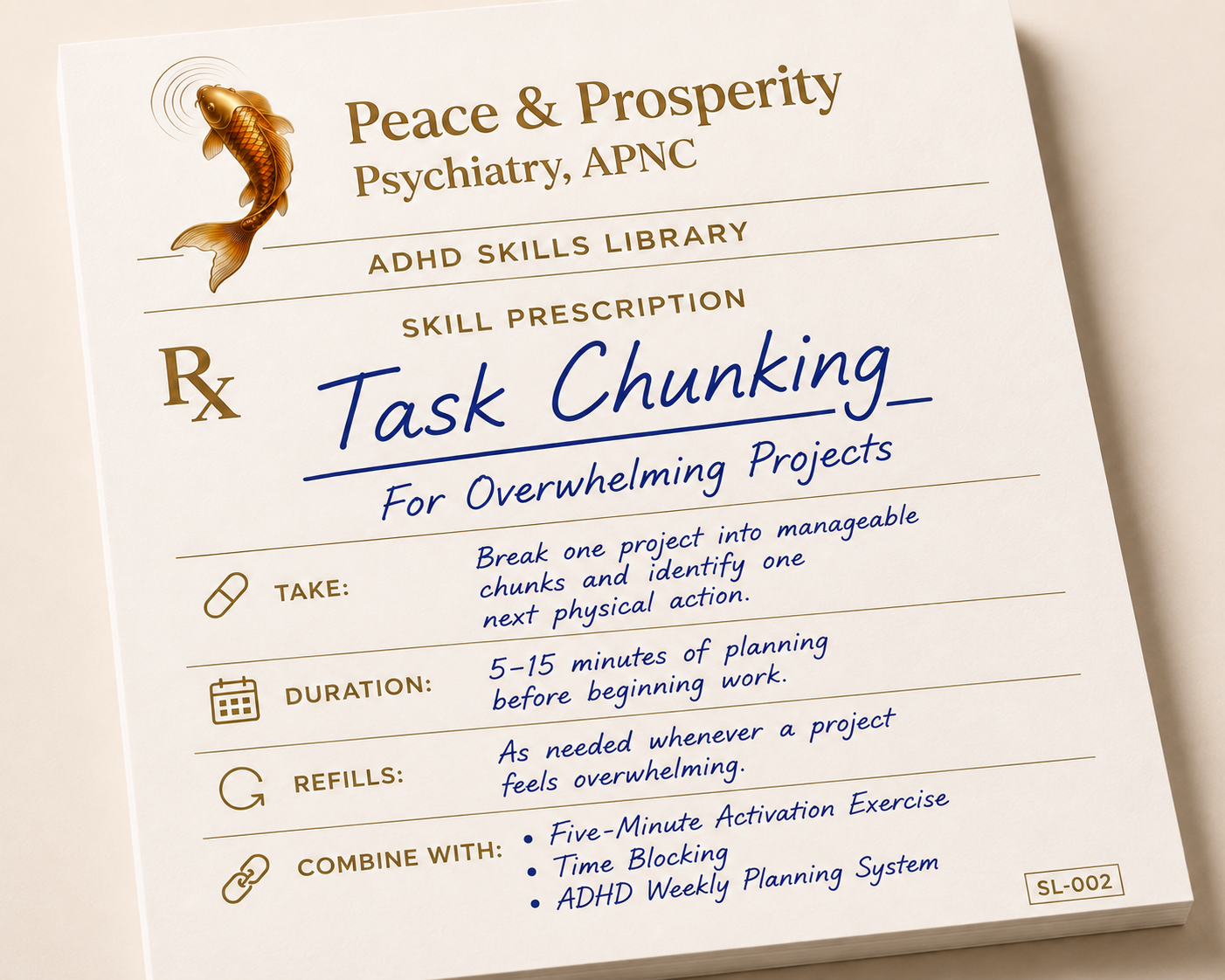
Quick Start Task Chunking for ADHD
Task Chunking
Lesson ID: SL-002
📄 Download the Companion Practice Sheet PDF: SL-002 Task chunking for ADHD PDF
ADHD Skills Library Lesson #2
A practical skill for turning overwhelming projects into manageable actions.
Use This Skill When
Use Task Chunking when:
- A project feels too big.
- You do not know where to start.
- You understand what needs to be done but still avoid it.
- You keep procrastinating on multi-step responsibilities.
- You feel overwhelmed before beginning.
- You start projects but lose your place.
- You keep mentally reviewing everything that still needs to happen.
What You’ll Do
- Define the project.
- Break it into major chunks.
- Break one chunk into specific actions.
- Identify the next physical action.
- Focus on that action rather than the entire project.
- Use the Five-Minute Activation Exercise if starting remains difficult.
What Success Looks Like
Success =
You identified the next manageable action and made progress on it.
Success does not require =
Finishing the entire project today.
That distinction matters.
The purpose of this skill is not to turn every project into a one-day productivity sprint.
It is to make continued progress easier.
Why Large Projects Can Feel So Difficult With ADHD
A project such as “prepare taxes” looks like one item on a to-do list.
But cognitively, it is not one task.
It may contain dozens of smaller operations:
Find documents.
Remember which documents are missing.
Log into financial websites.
Download forms.
Determine what belongs where.
Ask questions.
Make decisions.
Enter information.
Review the work.
Correct errors.
Submit everything.
Keep copies.
When those actions remain mentally bundled together as one vague instruction — do taxes — your brain may have to juggle several questions before you can even begin.
Where do I start?
What do I need?
What am I missing?
How long will this take?
What if I discover a problem?
What should I do first?
That creates cognitive demands before meaningful action has begun.
Adults with ADHD frequently experience difficulties in executive-function domains that are important for handling complex projects, including planning, organization, working memory, prioritization, and self-regulation (Barkley, 2015).
Structured cognitive-behavioral treatments for adult ADHD therefore devote substantial attention to organization, planning, sequencing, prioritization, time management, and problem solving (Lopez et al., 2018).
Task Chunking fits within that larger family of strategies.
Instead of asking your brain to manage the entire project, you create an external structure that tells you what matters now.
What Does "Chunking" Actually Mean?
The word chunking has a specific history in cognitive psychology.
Traditionally, chunking refers to organizing several pieces of information into a larger, meaningful unit so that the information can be processed more efficiently.
For example, remembering:
2 – 0 – 2 – 6
as
“2026”
turns four separate items into one familiar unit.
The concept is historically associated with Miller’s work on the limits of information processing and short-term memory (Miller, 1956).
More recent research has clarified how chunking can reduce demands on working memory.
Thalmann et al. (2019), for example, found across several experiments that chunking information could improve memory not only for the chunked material but also for other information being maintained at the same time. Their results support the idea that familiar chunks can function as more compact representations, freeing limited working-memory capacity.
In everyday clinical practice, the word chunking is often used somewhat differently.
Instead of combining information into larger units, we may help someone take a large behavioral goal and divide it into smaller, concrete parts.
For example:
Large project:
Prepare taxes.
Smaller chunks:
Gather documents.
Organize documents.
Enter information.
Review return.
Submit return.
These two uses of chunking are not identical.
That distinction is important.
However, they share a practical principle:
Reduce the amount of complexity that must be actively managed at one time.
In this lesson, when we use the term Task Chunking, we mean breaking a large project into smaller, specific, manageable actions.
Why Task Chunking for ADHD Works
There are several reasons this approach makes sense for adults with ADHD.
Some are directly supported by research.
Others represent clinical applications of broader evidence.
It is useful to know the difference.
1. Chunking Can Reduce Working-Memory Demands
What Research Directly Supports
Working memory is limited.
We cannot actively hold and manipulate an unlimited amount of information at once.
Research suggests that organizing information into meaningful chunks can reduce the amount of working-memory capacity required to maintain it.
In a series of four experiments, Thalmann et al. (2019) found evidence that chunking freed working-memory capacity for additional information.
Solopchuk et al. (2016) similarly found that participants using a consistent chunking strategy during symbolic sequence learning showed improved performance and reductions in measured cognitive workload over time.
Importantly, the benefit of chunking is not simply about producing a magical number of chunks.
The usefulness of the strategy depends on how information is structured and how effectively the chunks function as meaningful units (Thalmann et al., 2019).
Clinical Application
A complicated project may create similar pressure on working memory.
You may be trying to remember:
- What has already been done.
- What still needs to happen.
- Which step comes next.
- What information you need.
- What deadlines are approaching.
- What you must not forget.
Task Chunking externalizes some of this complexity.
Instead of continually reconstructing the entire project in your mind, you create a visible sequence.
Practical Skill
Do not ask yourself:
“How do I finish this project?”
Ask:
“What part of this project am I working on right now?”
Then:
“What is the next action inside that part?”
2. Breaking Down Tasks Can Reduce Executive Demands
Complex projects require more than memory.
They require planning.
Sequencing.
Prioritization.
Monitoring.
Decision-making.
Cognitive flexibility.
These are all executive processes.
What Research Directly Supports
Research on cognitive rehabilitation for executive dysfunction has included hierarchical approaches in which people begin with tasks containing fewer stages and gradually progress toward more complex tasks (Chung et al., 2013).
The American Speech-Language-Hearing Association’s clinical practice guideline on cognitive rehabilitation also supports structured interventions for planning, organization, and executive-function difficulties following acquired brain injury (Brown et al., 2022).
Research outside ADHD also provides evidence that chunking can function as a compensatory cognitive strategy.
For example, Huntley et al. (2017) found that an adaptive working-memory strategy intervention incorporating chunking improved verbal working memory in people with early Alzheimer’s disease and was associated with changes in task-related neural activation. Earlier work also found that people with mild Alzheimer’s disease retained an ability to use chunking to improve working-memory performance (Huntley et al., 2011).
These studies are not ADHD studies.
They should not be presented as proof that Task Chunking independently treats ADHD.
They do, however, support a broader principle: strategic organization of complex information can help people work more efficiently within cognitive limitations.
Clinical Application
For an adult with ADHD, a written sequence can reduce the need to repeatedly decide:
“What should I do next?”
Each decision you remove from the moment of action reduces one potential point of friction.
Clinical Pearl
Good Task Chunking reduces decisions, not just task size.
If your “chunked” project still requires you to stop every five minutes and figure out what to do next, you may need to make the steps more specific.
Task Chunking in ADHD-Focused CBT
This is where the evidence becomes particularly relevant to adults with ADHD.
What Research Directly Supports
Cognitive-behavioral therapy has been studied as a treatment for adult ADHD.
A Cochrane review by Lopez et al. (2018) described CBT interventions that included organizational and executive-management strategies such as goal setting, sequencing, prioritizing, scheduling, creating to-do lists, monitoring progress, and planning rewards and breaks.
Structured ADHD-focused CBT protocols similarly emphasize organization, planning, problem solving, and time-and-task management.
More recent research continues to support CBT as a useful intervention for adults with ADHD, including improvements in symptoms and aspects of functioning (Crespín et al., 2026).
What the Evidence Does Not Show
This distinction matters:
Most clinical trials do not isolate Task Chunking and test it by itself against a control condition.
Instead, task breakdown, sequencing, planning, scheduling, and related strategies are usually delivered together as part of a larger treatment program.
Therefore, it would be too strong to say:
“Research proves that Task Chunking alone improves ADHD.”
A more accurate statement is:
Task Chunking is an evidence-informed practical strategy consistent with techniques used in empirically supported ADHD-focused CBT programs.
That may sound less dramatic.
It is also more scientifically accurate.
Behavioral Activation: Why Small Actions Matter
There is another body of research that helps explain the behavioral side of Task Chunking.
Behavioral activation is a structured psychological treatment designed to reduce avoidance and increase engagement in meaningful or reinforcing activities.
What Research Directly Supports
Behavioral activation commonly uses strategies such as activity monitoring and activity scheduling.
Meta-analytic evidence supports behavioral activation as an effective treatment for depression, with outcomes that can be comparable to more comprehensive CBT approaches (Uphoff et al., 2020a).
Research examining weekly activity and depressive symptoms has also found evidence that increases in activity can precede subsequent improvement in symptoms, supporting the importance of behavior change rather than assuming people must feel better before they act (Hoyer et al., 2020).
Clinical Application
Task Chunking can make action easier to schedule.
Compare:
3:00 p.m. — Work on taxes
with:
3:00 p.m. — Download W-2 from payroll portal
The second instruction tells your brain exactly what behavior should occur.
This reduces ambiguity.
It also creates more opportunities for completion.
Important Limitation
Behavioral activation research does not directly prove that breaking projects into smaller steps improves ADHD symptoms.
Instead, it provides supporting evidence for a broader behavioral principle:
Specific, scheduled actions can help counter avoidance and increase engagement.
The Skill: How to Use The Task Chunking for ADHD
Now we turn the research into something you can use today.
Step 1: Define the Project
Start by naming the project.
Make it concrete enough that you know what “finished” means.
Avoid vague categories.
Too Vague
Get organized.
Fix my finances.
Deal with work.
Clean everything.
Get my career together.
Better
Prepare 2026 taxes.
Update my resume.
Complete quarterly report.
Clean the kitchen.
Apply for three project-management positions.
You do not need a perfect project statement.
You simply need enough clarity to know what you are trying to accomplish.
Step 2: Break the Project Into Major Chunks
Now identify the major phases.
Do not worry about every tiny detail yet.
Example: Prepare Taxes
Chunk 1: Gather documents
Chunk 2: Organize documents
Chunk 3: Enter tax information
Chunk 4: Review return
Chunk 5: Submit and save records
Already, “prepare taxes” has become more structured.
But these chunks may still be too large to act on.
That brings us to the next step.
Step 3: Break One Chunk Into Actions
Choose the first relevant chunk.
Then identify the actions inside it.
Chunk: Gather Documents
- Download W-2.
- Download 1099 forms.
- Locate mortgage-interest statement.
- Download brokerage statements.
- Find charitable-contribution receipts.
- Locate prior-year tax return.
Notice that you are not breaking down every chunk simultaneously.
You can.
But you do not have to.
For many adults with ADHD, creating an enormous master list can reproduce the same overwhelm you were trying to solve.
Start with the chunk you actually need.
Clinical Pearl
You do not need to see the entire staircase to take the next step.
A complete project plan can be useful.
But sometimes the most ADHD-friendly plan contains only enough detail to tell you what comes next.
Step 4: Find the Next Physical Action
Now ask one of the most useful questions in executive-function work:
“What is the next physical action?”
This is different from identifying a goal.
Goal
Update resume.
Next Physical Action
Open the resume file.
Goal
Prepare taxes.
Next Physical Action
Log into the payroll website.
Goal
Clean kitchen.
Next Physical Action
Put dirty dishes into dishwasher.
Goal
Apply for jobs.
Next Physical Action
Open LinkedIn and search for one role.
The question works because physical actions are easier to execute than abstract intentions.
“Get organized” cannot literally be performed.
“Put the loose papers into one pile” can.
Clinical Pearl
If you cannot easily picture yourself doing the action, it may still be too vague.
Step 5: Make the Chunk Small Enough to Start
There is no universal correct chunk size.
That is important.
Research suggests that chunking effectiveness depends on the way information is structured rather than simply on hitting a predetermined number of items (Thalmann et al., 2019).
The same principle is useful clinically.
A manageable chunk for one person may still feel overwhelming to another.
A chunk that works on Monday may feel too large on Friday afternoon.
Use your response to the task as feedback.
Ask:
“Does this feel startable?”
If yes, begin.
If no, shrink it.
Example
Too large:
Write presentation.
Smaller:
Create presentation outline.
Still difficult?
Create three section headings.
Still difficult?
Open PowerPoint.
Still difficult?
Create a blank presentation and type the title.
There is no prize for using large chunks.
The purpose is action.
Step 6: Focus on One Chunk at a Time
This is where many people accidentally undo the benefit of chunking.
They create a beautiful list of 37 steps.
Then they stare at all 37 steps.
Now the project feels overwhelming again.
Remember the goal:
Reduce what your brain must actively manage right now.
Once the project is broken down, narrow your visual and mental attention.
You might:
- Highlight only the current chunk.
- Put today’s steps on a separate note.
- Hide future tasks in a collapsed section.
- Write the next action on a sticky note.
- Move everything else into a project list you do not need to look at right now.
Clinical Pearl
Task Chunking is not just creating smaller steps. It is giving yourself permission to ignore the later steps temporarily.
Step 7: Combine Task Chunking With the Five-Minute Activation Exercise
Task Chunking is Skills Library Lesson #2 because it works naturally with the first skill.
The Five-Minute Activation Exercise answers:
“How can I get myself to begin?”
Task Chunking answers:
“What exactly should I begin?”
These are different problems.
You can know exactly what to do and still struggle to start.
You can also feel ready to work but become overwhelmed because the project has no clear starting point.
Use the two skills together.
Example
Project:
Quarterly business report.
Current chunk:
Revenue analysis.
Next action:
Open last quarter’s revenue spreadsheet.
Then use Five-Minute Activation:
Work on that action for five minutes.
You are not committing to finishing the report.
You are committing to beginning the next defined piece.
What If You Get Stuck?
“The Project Still Feels Too Big.”
Make the chunk smaller.
Instead of:
Clean bedroom.
Try:
Pick clothes up from floor.
Instead of:
Finish presentation.
Try:
Draft slide 1.
Instead of:
Handle email backlog.
Try:
Respond to the oldest important email.
If it still feels difficult, shrink again.
“I Made a Great Plan and Still Didn’t Start.”
Planning and initiation are separate executive functions.
A good plan does not guarantee action.
That is exactly when the Five-Minute Activation Exercise becomes useful.
Identify the next action.
Set a five-minute commitment.
Begin.
“I Keep Creating More Tasks.”
Stop expanding the map.
Ask:
“Which step matters now?”
Capture newly remembered tasks somewhere reliable if necessary.
Then return to the current action.
Your task list should support attention.
It should not compete with it.
“Every Step Seems Equally Important.”
Choose based on sequence.
Ask:
“What has to happen before something else can happen?”
That usually reveals the next action.
For example:
You cannot submit the application until the resume is updated.
You cannot update the resume until you locate the current version.
So:
Next action: Find the current resume file.
“I Want to Finish Everything Once I Start.”
Sometimes adults with ADHD move between avoidance and intense periods of effort.
If you enter a productive period, you can certainly use it.
But do not make marathon work sessions a requirement for success.
Your goal is to develop a method you can return to repeatedly.
One chunk.
Then another.
Task Chunking for ADHD: Myths vs. Facts
Myth:“If I cannot finish it today, there is no point starting.”
Fact
Most important projects are completed through multiple episodes of work.
One completed chunk changes the project from untouched to underway.
Myth: “I need the entire project mapped out before I begin.”
Fact
You need enough clarity to identify the next useful action.
Some projects become clearer only after work begins.
Myth: “Chunking means creating a giant detailed to-do list.”
Fact
A giant list can increase cognitive load.
The purpose of Task Chunking is to reduce complexity, not document every conceivable action.
Myth: “If I were motivated enough, I wouldn’t need this.”
Fact
Motivation does not eliminate the executive demands involved in planning, sequencing, prioritization, and initiation.
External structure can help reduce those demands.
Myth: “A chunk should be a certain size.”
Fact
There is no universal optimal chunk size.
The useful question is:
“Is this small and clear enough that I can act on it?”
A 7-Day Task Chunking Practice Prescription
For the next seven days, practice this skill intentionally.
Do not choose your hardest life problem.
Start with ordinary responsibilities.
Day 1
Choose one project you have been postponing.
Write down its name.
Then identify three to five major chunks.
Day 2
Choose one of those chunks.
Break it into specific actions.
Day 3
Practice asking:
“What is the next physical action?”
Do this with at least three everyday tasks.
Day 4
Choose one task you have been avoiding.
Chunk it.
Then use the Five-Minute Activation Exercise to begin.
Day 5
Experiment with chunk size.
If a step feels resistant, divide it again.
Notice how small a task must become before it feels clearly startable (is that even a word?).
Day 6
Use Task Chunking on a professional responsibility.
Examples:
- A report
- Presentation
- Administrative task
- Client follow-up
- Business project
Day 7
Review the week.
Ask:
- Which projects felt less overwhelming after chunking?
- Which types of chunks were easiest to start?
- Where were my steps still too vague?
- Did identifying the next physical action help?
- Did I create too many steps anywhere?
- What chunk size seemed to work best for me?
Progressive Loading
Once the skill becomes familiar, use it with increasingly complex responsibilities.
Week 1: Simple Tasks
Practice on:
- Laundry
- Cleaning
- Grocery shopping
- Paperwork
- Meal preparation
The goal is learning the process.
Week 2: Professional Tasks
Apply it to:
- Reports
- Presentations
- Documentation
- Email follow-up
- Administrative responsibilities
Pay attention to whether vague professional goals can be converted into specific behaviors.
Week 3: Multi-Step Responsibilities
Try:
- Taxes
- Home projects
- Financial organization
- Travel planning
- Credentialing
- Insurance paperwork
These tasks may require multiple chunks across several days.
That is expected.
Week 4: Long-Term Goals
Apply the same method to:
- Career transitions
- Starting a business project
- Professional certification
- Major financial goals
- Writing projects
- Long-term home projects
Do not attempt to complete the long-term goal.
Identify the next meaningful chunk.
Then act on it.
How to Measure Progress
Adults with ADHD sometimes use an all-or-nothing scorecard.
Either:
“I finished everything.”
Or:
“I failed.”
Task Chunking uses a different scorecard.
Track:
- How often you identified a next action.
- How many chunks you completed.
- How quickly you returned after interruption.
- Whether overwhelm decreased after breaking a task down.
- Whether you started more often.
- Whether you made progress more consistently.
- Whether fewer projects remained completely untouched.
You can even rate overwhelm.
Before chunking:
Overwhelm: 8/10
After chunking:
Overwhelm: 5/10
After completing the first action:
Overwhelm: 3/10
You are gathering information about how your brain responds to task structure.
That information can help you refine the skill.
What the Research Shows about Task Chunking for ADHD
The evidence for Task Chunking comes from several related areas.
The strongest interpretation is not that one isolated technique has been conclusively proven to treat ADHD.
Instead, multiple research traditions support the mechanisms and clinical practices that Task Chunking brings together.
1. Working Memory and Chunking
Experimental research supports chunking as a strategy that can reduce demands on limited working-memory capacity.
Thalmann et al. (2019) demonstrated that chunking could free capacity for other concurrently maintained information.
Solopchuk et al. (2016) found that chunking during sequence learning was associated with improved performance, reduced cognitive workload, and mechanisms involving working-memory updating.
Evidence Level
Direct evidence for cognitive chunking and working-memory efficiency.
Clinical Translation
Large projects can be organized so that fewer elements compete for attention simultaneously.
2. Executive Function and Structured Task Management
Executive-function rehabilitation uses structured approaches to planning, organization, sequencing, and gradually increasing task complexity (Brown et al., 2022; Chung et al., 2013).
Chunking-based working-memory interventions have also produced measurable cognitive benefits in populations with neurological impairment (Huntley et al., 2011, 2017).
Evidence Level
Direct evidence for structured cognitive strategies in executive-function rehabilitation, but not direct ADHD evidence.
Clinical Translation
External organization can reduce how much planning and sequencing must occur internally in the moment.
3. ADHD-Focused Cognitive-Behavioral Therapy
Adult ADHD CBT includes organization and planning skills such as prioritization, sequencing, scheduling, to-do lists, problem solving, and monitoring progress (Lopez et al., 2018).
Clinical studies support CBT as a useful intervention for adults with ADHD and associated functional difficulties (Crespín et al., 2026).
Evidence Level
Direct evidence supporting multicomponent ADHD-focused CBT.
Important Limitation
Task Chunking is usually embedded within a broader treatment package.
It has not generally been isolated as a stand-alone intervention.
Clinical Translation
Breaking projects into concrete steps is consistent with evidence-based ADHD CBT methods for managing planning and organizational difficulties.
4. Behavioral Activation and Follow-Through
Behavioral activation emphasizes structured engagement, activity scheduling, and reducing avoidance.
It has a substantial evidence base as a treatment for depression (Uphoff et al., 2020a).
Longitudinal analyses have also provided evidence that increased behavioral activity can precede subsequent symptom improvement (Hoyer et al., 2020).
Evidence Level
Direct evidence for behavioral activation and activity scheduling, primarily in depression.
Clinical Translation
Smaller, specific actions are easier to schedule and provide more frequent opportunities to engage in meaningful behavior.
The Bottom Line
Task Chunking is best understood as an evidence-informed executive-function strategy.
Research directly supports the cognitive principle that chunking can reduce working-memory demands and improve processing efficiency under certain conditions (Solopchuk et al., 2016; Thalmann et al., 2019).
Executive-function rehabilitation provides additional support for structured planning and graded task complexity (Brown et al., 2022; Chung et al., 2013).
ADHD-focused CBT incorporates closely related techniques — including sequencing, prioritization, scheduling, organization, problem solving, and task management — within treatments that have demonstrated clinical benefit (Crespín et al., 2026; Lopez et al., 2018).
Behavioral activation adds complementary evidence that structured, scheduled engagement can help reduce avoidance and increase adaptive behavior (Hoyer et al., 2020; Uphoff et al., 2020a).
At the same time, it is important not to overstate the evidence.
There is substantially more research supporting the mechanisms behind Task Chunking and the multicomponent treatments that use related strategies than there is research testing Task Chunking as an isolated ADHD intervention.
That distinction does not make the skill less useful.
It makes the rationale more accurate.
Remember This
When a project feels overwhelming, you do not need to solve the entire project.
Ask:
What is the project?
Then:
What are the major chunks?
Then:
Which chunk matters now?
Then:
What is the next physical action?
And if starting still feels difficult:
Can I do that action for five minutes?
Your goal is not to mentally carry the entire project.
Your goal is to make the next useful action clear enough to begin.
Your Next Skill
ADHD Skills Library Lesson #3: Time Blocking for ADHD
Task Chunking tells you:
What should I work on next?
The next challenge is deciding:
When will I actually do it?
That is where Time Blocking for ADHD comes in.
Time Blocking takes the manageable actions you created through Task Chunking and gives them a place in your day.
Together, the skills create a practical progression:
Task Chunking identifies the action. (This lesson)
Five-Minute Activation helps you begin. (Last Lesson)
Time Blocking protects time for the work to happen. (Next Lesson)
One skill builds on the next.
Learn More About Executive Function and ADHD
Task Chunking is most effective when you understand why large projects become overwhelming in the first place. Many adults with ADHD struggle with planning, prioritization, task initiation, and time management—not because they lack motivation, but because executive function works differently.
To continue learning, explore:
- Adult ADHD and Executive Function — Learn how executive dysfunction affects planning, organization, working memory, and self-regulation.
- Why Do Adults with ADHD Procrastinate? — Understand why procrastination is often a symptom of executive dysfunction rather than laziness.
- Adult ADHD and Time Blindness — Discover why estimating time, planning ahead, and meeting deadlines can be especially difficult with ADHD.
- How to Start Tasks with ADHD — Learn the Five-Minute Activation strategy for overcoming task initiation difficulties.
References
Barkley, R. A. (2015). Attention-deficit hyperactivity disorder: A handbook for diagnosis and treatment (4th ed.). Guilford Press.
Brown, J., Kaelin, D., Mattingly, E., Mello, M., Spencer, K., Watter, K., & the Guideline Development Panel. (2022). American Speech-Language-Hearing Association clinical practice guideline: Cognitive rehabilitation for the management of cognitive dysfunction associated with acquired brain injury. American Journal of Speech-Language Pathology, 31(6), 2455–2526. https://doi.org/10.1044/2022_AJSLP-21-00361
Chan, E., Fogler, J. M., & Hammerness, P. G. (2016). Treatment of attention-deficit/hyperactivity disorder in adolescents: A systematic review. JAMA, 315(18), 1997–2008. https://doi.org/10.1001/jama.2016.5453
Chung, C. S. Y., Pollock, A., Campbell, T., Durward, B. R., & Hagen, S. (2013). Cognitive rehabilitation for executive dysfunction in adults with stroke or other adult non-progressive acquired brain damage. Cochrane Database of Systematic Reviews, (4), CD008391. https://doi.org/10.1002/14651858.CD008391.pub2
Crespín, J. J., Corrales, M., Richarte, V., et al. (2026). Does attention-deficit/hyperactivity disorder predominant presentation matter? Examining functional and symptom changes after cognitive behavioural therapy. Clinical Psychology & Psychotherapy, 33(2), e70271. https://doi.org/10.1002/cpp.70271
Hoyer, J., Hoefler, M., & Wuellhorst, V. (2020). Activity and subsequent depression levels: A causal analysis of behavioural activation group treatment with weekly assessments over 8 weeks. Clinical Psychology & Psychotherapy, 27(3), 330–336. https://doi.org/10.1002/cpp.2430
Huntley, J., Bor, D., Hampshire, A., Owen, A., & Howard, R. (2011). Working memory task performance and chunking in early Alzheimer’s disease. The British Journal of Psychiatry, 198(5), 398–403. https://doi.org/10.1192/bjp.bp.110.083857
Huntley, J. D., Hampshire, A., Bor, D., Owen, A., & Howard, R. J. (2017). Adaptive working memory strategy training in early Alzheimer’s disease: Randomised controlled trial. The British Journal of Psychiatry, 210(1), 61–66. https://doi.org/10.1192/bjp.bp.116.182048
Lopez, P. L., Torrente, F. M., Ciapponi, A., Lischinsky, A. G., Cetkovich-Bakmas, M., Rojas, J. I., Romano, M., & Manes, F. F. (2018). Cognitive-behavioural interventions for attention deficit hyperactivity disorder (ADHD) in adults. Cochrane Database of Systematic Reviews, (3), CD010840. https://doi.org/10.1002/14651858.CD010840.pub2
Miller, G. A. (1956). The magical number seven, plus or minus two: Some limits on our capacity for processing information. Psychological Review, 63(2), 81–97. https://doi.org/10.1037/h0043158
Solopchuk, O., Alamia, A., Olivier, E., & Zénon, A. (2016). Chunking improves symbolic sequence processing and relies on working memory gating mechanisms. Learning & Memory, 23(3), 108–112. https://doi.org/10.1101/lm.041277.115
Thalmann, M., Souza, A. S., & Oberauer, K. (2019). How does chunking help working memory? Journal of Experimental Psychology: Learning, Memory, and Cognition, 45(1), 37–55. https://doi.org/10.1037/xlm0000578
Uphoff, E., Ekers, D., Robertson, L., Dawson, S., Sanger, E., South, E., Samaan, Z., Richards, D., Meader, N., & Churchill, R. (2020a). Behavioural activation therapy for depression in adults. Cochrane Database of Systematic Reviews, (7), CD013305. https://doi.org/10.1002/14651858.CD013305.pub2
Uphoff, E., Pires, M., Barbui, C., Barua, D., Churchill, R., Cristofalo, D., Ekers, D., Fottrell, E., Mazumdar, P., Purgato, M., Rana, R., Wright, J., & Siddiqi, K. (2020b). Behavioural activation therapy for depression in adults with non-communicable diseases. Cochrane Database of Systematic Reviews, (8), CD013461. https://doi.org/10.1002/14651858.CD013461.pub2
Wu, L., Knoblich, G., & Luo, J. (2013). The role of chunk tightness and chunk familiarity in problem solving: Evidence from ERPs and fMRI. Human Brain Mapping, 34(5), 1173–1186. https://doi.org/10.1002/hbm.21501