
Table of Contents
ToggleExecutive Dysfunction:
When knowing what to do isn't the same as being able to do it.
If the following sounds familiar, you may have come across the term executive dysfunction.
Maybe you know exactly what you need to do.
The email needs a response. The bill needs to be paid. The report is due tomorrow.
You are not confused about what needs to happen.
You may have been thinking about it all day.
You may even feel stressed about not doing it.
But somehow, getting started feels much harder than it should.
Or maybe starting isn’t the problem. You begin projects with enthusiasm but struggle to finish them. You lose track of time. You forget important details. Small responsibilities pile up until they become urgent.
Executive dysfunction is a common way of describing difficulties with the mental skills that help us plan, organize, remember, prioritize, focus, and follow through. It is common in adults with ADHD, but it is not the same thing as ADHD.
Understanding executive dysfunction can help explain why daily life sometimes feels harder than it seems like it should—and why the solution is often more complex than simply trying harder.
What Are Executive Functions?
Executive functions are mental processes that help you regulate your thoughts, emotions, and behavior in order to accomplish goals.
You rely on them throughout the day, often without realizing it.
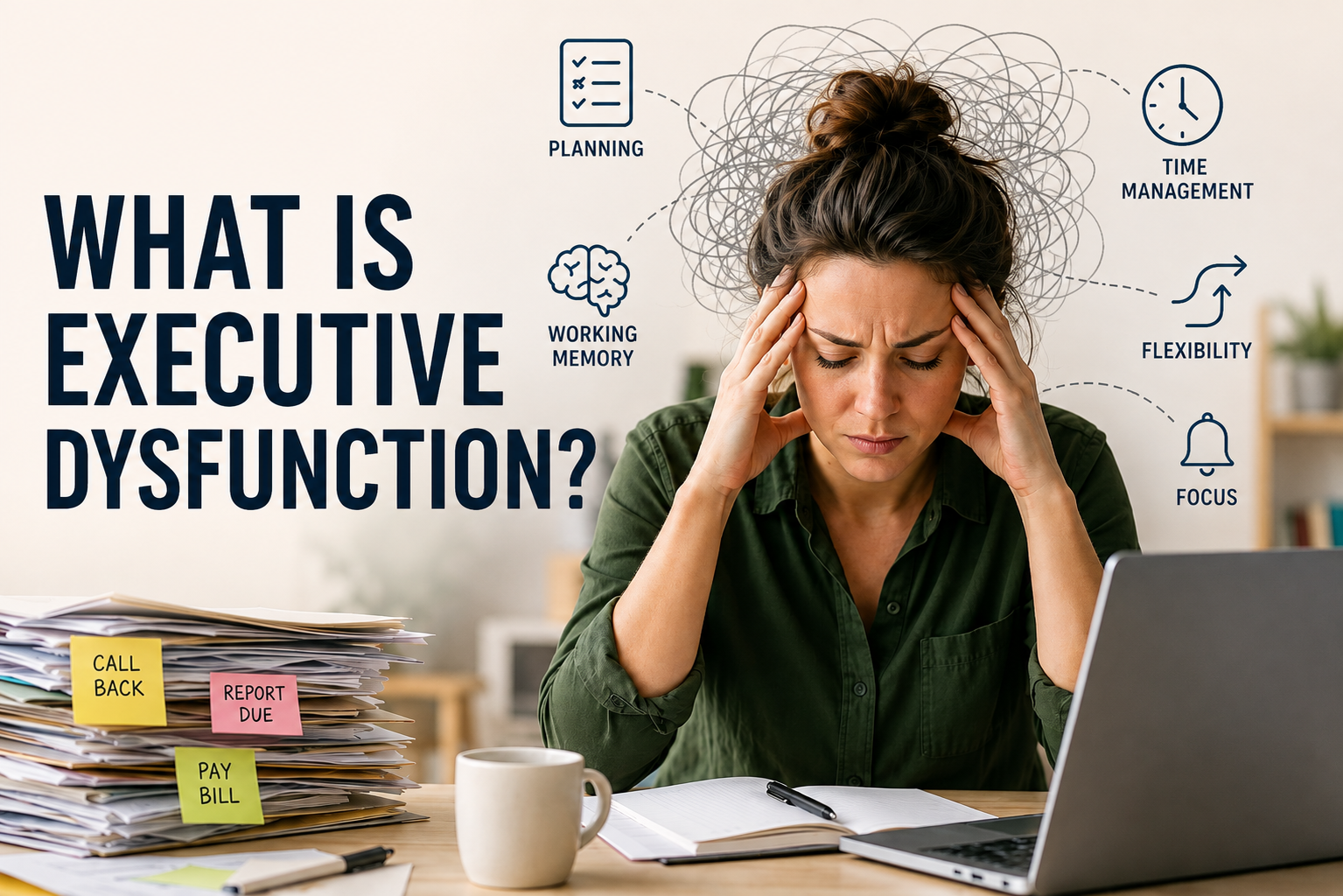
They help you decide what to do first, remember what you were doing, resist distractions, adjust when plans change, and stay engaged with a task long enough to finish it.
Researchers do not use one universally accepted definition of executive functioning. However, working memory, inhibitory control, and cognitive flexibility are commonly viewed as foundational executive processes (Diamond, 2013; Miyake et al., 2000).
Working memory helps you hold information in mind and use it.
Inhibitory control helps you resist distractions and impulses.
Cognitive flexibility helps you adapt when circumstances change or when a different approach is needed.
More complex skills such as planning, organization, prioritization, task initiation, self-monitoring, and time management depend on these underlying processes working together (Diamond, 2013).
Executive functions are not the same thing as intelligence.
A person can be highly intelligent, highly educated, creative, and successful while still struggling with executive-function challenges.
What Is Executive Dysfunction?
Executive dysfunction is a descriptive term for meaningful difficulty using executive-function skills effectively in everyday life.
It is not a psychiatric diagnosis.
Instead, it describes a pattern of difficulties that may occur in ADHD and many other medical, neurological, and psychiatric conditions.
One of the simplest ways to understand executive dysfunction is as a problem with turning intentions into actions.
A person may know exactly what needs to be done.
They may care about doing it.
They may understand the consequences of not doing it.
Yet they still struggle to consistently begin, organize, or complete the task.
That pattern is different from not caring.
It is a difficulty translating intention into sustained, organized action.
What Does Executive Dysfunction Look Like in Adults?
Executive dysfunction can show up in many different ways.
For some people, the biggest challenge is getting started. For others, it is staying organized, managing time, remembering details, or following through on plans.
Common examples include:
Difficulty Starting Tasks
You know you need to make the phone call, answer the email, complete the paperwork, or schedule the appointment.
You keep intending to do it.
But hours or days pass before you finally get started.
Problems Planning and Prioritizing
A project may feel overwhelming because there are too many moving pieces.
You know the final goal but struggle to determine what should happen first.
Difficulty Following Through
You start projects with good intentions but lose momentum once the task becomes repetitive, tedious, or less rewarding.
Working Memory Challenges
You walk into a room and forget why.
You lose track of what someone just said.
You forget a step in a multi-step task.
You open a browser tab and immediately forget what you intended to look up.
Time-Management Problems
You underestimate how long something will take.
You run late despite trying not to.
You tell yourself there is plenty of time until suddenly there isn’t.
Difficulty Managing Attention
You intend to focus on one task but find yourself pulled toward emails, notifications, conversations, internet searches, or other distractions.
In everyday life, executive dysfunction may look like an overflowing inbox, unpaid bills, unfinished projects, missed appointments, chronic clutter, or last-minute deadlines.
Over time, these difficulties often create more than practical problems.
Many adults begin to question themselves. They may wonder why tasks that seem easy for other people feel so difficult. Some become highly self-critical and start interpreting executive-function difficulties as laziness, lack of discipline, or personal failure.
How Is Executive Dysfunction Related to ADHD?
Executive-function difficulties are common in ADHD and help explain many of the challenges adults with ADHD experience.
Research consistently finds that adults with ADHD, on average, show more difficulties with executive-function skills than adults without ADHD, including differences in inhibition, working memory, planning, and cognitive flexibility (Boonstra et al., 2005; Willcutt et al., 2005).
However, executive dysfunction and ADHD are not interchangeable terms.
Not every adult with ADHD has the same executive-function profile.
And not every adult with ADHD demonstrates measurable executive-function deficits on formal cognitive testing.
In one influential study, only a subset of adults with ADHD met criteria for significant executive-function impairment on neuropsychological measures, although those individuals tended to experience greater real-world impairment (Biederman et al., 2006).
This helps explain something that often confuses people.
A person can struggle significantly with organization, time management, follow-through, and task initiation while still performing reasonably well during formal cognitive testing.
A testing environment typically provides clear instructions, a quiet setting, short tasks, novelty, a time limit, and an examiner’s presence.
Real life is different.
Real life requires you to create your own structure, manage interruptions, remember future obligations, prioritize competing demands, and persist through boring or repetitive tasks.
As a result, performance on neuropsychological tests and executive functioning in daily life often tell different parts of the story (Barkley & Fischer, 2011).
Can Successful Adults Have Executive Dysfunction?
Absolutely.
Executive functioning is not the same thing as intelligence.
Many adults with ADHD are highly successful academically or professionally.
Some compensate through intelligence, strong routines, supportive family members, anxiety-driven preparation, intense last-minute effort, or highly structured environments.
From the outside, they may appear extremely organized.
What others often do not see is the amount of effort required to maintain that appearance.
Achievement alone does not rule out ADHD or executive dysfunction.
Executive Dysfunction Does Not Automatically Mean ADHD
Executive dysfunction is associated with ADHD, but it is not unique to ADHD.
Many other conditions can affect executive functioning.
These include depression, anxiety, chronic stress, sleep deprivation, sleep disorders, substance use, medication side effects, traumatic brain injury, neurological disorders, and other psychiatric or neurodevelopmental conditions (Ozga et al., 2018).
This is why executive dysfunction should not be used as a shortcut for diagnosing ADHD.
The broader clinical picture matters.
How Is Executive Dysfunction Evaluated?
There is no single executive-function test that diagnoses ADHD.
Current guidelines recommend a comprehensive clinical assessment that includes symptom history, developmental history, functional impairment, psychiatric history, and consideration of alternative explanations for symptoms. Diagnosis should not be based solely on rating scales or observational measures.
Rating scales can be helpful.
Collateral information from parents, partners, school records, or other sources may also provide useful context.
Neuropsychological testing can sometimes be helpful, particularly when there are concerns about learning disorders, cognitive changes, traumatic brain injury, or a complicated diagnostic picture.
However, current adult ADHD assessment standards emphasize that no cognitive test has sufficient sensitivity and specificity to independently confirm or exclude an ADHD diagnosis (Adamou et al., 2024).
What Can Help?
The most effective approach depends on what is causing the executive-function difficulties.
When ADHD is contributing to the problem, evidence-based treatment may include medication, ADHD-focused cognitive behavioral therapy (CBT), psychoeducation, environmental modifications, and practical organizational systems. NICE guidelines recommend medication for adults whose ADHD symptoms continue to cause significant impairment and support structured ADHD-focused psychological interventions, including CBT-based approaches, when appropriate.
Medication can improve ADHD symptoms and may improve some aspects of executive functioning, although executive-function improvements vary between individuals (Surman & Walsh, 2023).
Many adults also benefit from practical external supports such as calendars, reminders, checklists, routines, accountability systems, and reducing distractions.
The goal is not to depend on memory, motivation, or willpower alone.
It is to build systems that make important tasks easier to start and easier to complete.
If task initiation is your biggest challenge, see our How to Start Tasks With ADHD: The Five-Minute Activation Exercise Skills Lesson.
If large projects routinely feel overwhelming, see our Task Chunking Skills Lesson.
The Bottom Line
Executive dysfunction is not laziness.
It is not a character flaw.
And it is not a sign that you simply need more discipline.
It is a term used to describe difficulties with the mental processes that help people plan, organize, remember, prioritize, and follow through on goals.
These difficulties are common in ADHD, but they can occur for many different reasons.
If executive-function challenges have repeatedly affected your work, relationships, finances, education, or daily life, a professional evaluation may help identify what is driving the problem and what forms of treatment or support are most likely to help.
Understanding the pattern is often the first step toward changing it.
Learn More About ADHD and Executive Function
Executive dysfunction is only one part of the larger ADHD picture. If this article felt familiar, these resources can help you understand what may be contributing to your challenges and what treatment options are available.
Start Here
The Complete Guide to Adult ADHD Diagnosis, Treatment, and What to Expect
A comprehensive overview of adult ADHD, including symptoms, executive functioning, diagnosis, treatment options, and what the evaluation process looks like.
Understanding ADHD
Do I Have ADHD? 12 Common Adult ADHD Symptoms + Self-Assessment
Learn about common signs of adult ADHD and how clinicians distinguish ADHD from normal distraction, stress, anxiety, and other conditions.
ADHD in High-Achieving Adults
Many successful professionals develop systems that mask ADHD for years. Learn why achievement does not rule out ADHD and why symptoms often become more noticeable later in life.
Treatment and Next Steps
Adult ADHD Treatment: The Complete Evidence-Based Guide
Explore the research behind medication, therapy, coaching, lifestyle strategies, and other evidence-based ADHD treatments.
ADHD Medication: Benefits, Limitations, and What to Expect
Learn how ADHD medications work, what improvements are realistic, and why medication is often only one part of a successful treatment plan.
ADHD vs. Anxiety: How to Tell the Difference
Many symptoms of anxiety and ADHD overlap. Learn how clinicians distinguish between the two and why accurate diagnosis matters.
Practical Skills for Executive Dysfunction
How to Start Tasks With ADHD: The Five-Minute Activation Exercise
A practical strategy for overcoming one of the most common executive-function challenges: getting started.
Task Chunking for ADHD (Coming soon, Skills Lesson)
Learn how to break overwhelming projects into smaller, more manageable steps that reduce procrastination and improve follow-through.
Time Blindness and ADHD
Understand why many adults with ADHD struggle to estimate time accurately, run late despite good intentions, and underestimate how long tasks will take.
References
Adamou, M., Arif, M., Asherson, P., Cubbin, S., Leaver, L., Sedgwick-Müller, J., Müller-Sedgwick, U., van Rensburg, K., & Kustow, J. (2024). The adult ADHD assessment quality assurance standard. Frontiers in Psychiatry, 15, 1380410. https://doi.org/10.3389/fpsyt.2024.1380410
Barkley, R. A., & Fischer, M. (2011). Predicting impairment in major life activities and occupational functioning in hyperactive children as adults: Self-reported executive function (EF) deficits versus EF tests. Developmental Neuropsychology, 36(2), 137–161.
Biederman, J., Petty, C. R., Fried, R., Doyle, A. E., Spencer, T., Seidman, L. J., Gross, L., Poetzl, K., Faraone, S. V., & Surman, C. B. H. (2006). Impact of psychometrically defined deficits of executive functioning in adults with attention-deficit/hyperactivity disorder. American Journal of Psychiatry, 163(10), 1730–1738.
Boonstra, A. M., Oosterlaan, J., Sergeant, J. A., & Buitelaar, J. K. (2005). Executive functioning in adult ADHD: A meta-analytic review. Psychological Medicine, 35(8), 1097–1108. https://doi.org/10.1017/S003329170500499X
Diamond, A. (2013). Executive functions. Annual Review of Psychology, 64, 135–168. https://doi.org/10.1146/annurev-psych-113011-143750
Holst, Y., & Thorell, L. B. (2017). Neuropsychological functioning in adults with ADHD and adults with other psychiatric disorders: The issue of specificity. Journal of Attention Disorders, 21(6), 467–479.
Miyake, A., Friedman, N. P., Emerson, M. J., Witzki, A. H., Howerter, A., & Wager, T. D. (2000). The unity and diversity of executive functions and their contributions to complex “frontal lobe” tasks: A latent variable analysis. Cognitive Psychology, 41(1), 49–100. https://doi.org/10.1006/cogp.1999.0734
National Institute for Health and Care Excellence. (2018). Attention deficit hyperactivity disorder: Diagnosis and management (NG87). https://www.nice.org.uk/guidance/ng87
Ozga, J. E., Povroznik, J. M., Engler-Chiurazzi, E. B., & Vonder Haar, C. (2018). Executive (dys)function after traumatic brain injury: Special considerations for behavioral pharmacology. Behavioural Pharmacology, 29(7), 638–653.
Surman, C. B. H., & Walsh, D. M. (2023). Do ADHD treatments improve executive behavior beyond core ADHD symptoms in adults? Evidence from systematic analysis of clinical trials. Journal of Clinical Pharmacology, 63(6), 640–653. https://doi.org/10.1002/jcph.2209
Willcutt, E. G., Doyle, A. E., Nigg, J. T., Faraone, S. V., & Pennington, B. F. (2005). Validity of the executive function theory of attention-deficit/hyperactivity disorder: A meta-analytic review. Biological Psychiatry, 57(11), 1336–1346.
Medical Review & Author Information
Written and medically reviewed by Troy Don, DC, AGACNP-BC, PMHNP-BC
For additional information about clinical education, professional credentials, and background, see Clinical Credentials & Professional Background.
Last medically reviewed: August 2026
Evidence reviewed through: August 2026
Medical Disclaimer
This article is for educational purposes only and is not a substitute for individualized medical advice, diagnosis, or treatment. If you have questions about ADHD, mental health symptoms, medications, or treatment options, discuss them with an appropriate healthcare professional.