

Table of Contents
ToggleFive Paradigm Shifts That Changed Modern Understanding of Adult ADHD and Executive Function
An Evidence-Based Narrative Review for Patients, Families, and Healthcare Professionals
Estimated Reading Time: 25–30 minutes
This review is intended for educational purposes and should not replace personalized medical advice or a comprehensive evaluation by a qualified healthcare professional.
Before You Begin
The Adult ADHD and Executive Function connection has become one of the most important—and most misunderstood—concepts in modern ADHD research.
For many adults, executive dysfunction helps explain why life can feel so much harder than it appears to be for everyone else. You may know exactly what needs to be done, yet still struggle to begin. You may thrive in moments of crisis while falling behind on routine responsibilities. You may be intelligent, motivated, and deeply committed to your goals, yet still struggle with planning, organization, time management, emotional regulation, or following through on good intentions.
If any of that sounds familiar, you are not alone.
Over the past four decades, researchers have made remarkable progress in understanding why these struggles occur. In the process, they have fundamentally changed how executive function—and ADHD itself—is understood.
What was once thought to be a simple problem of attention or self-control is now recognized as a far more dynamic interaction among cognition, emotion, motivation, environment, and interconnected brain networks. These discoveries have reshaped not only neuroscience, but also the way clinicians evaluate ADHD, the way treatment is delivered, and the way millions of adults make sense of their own experiences.
This review tells the story of that scientific evolution.
Rather than presenting executive function as a fixed concept, we’ll follow the research through five major paradigm shifts that transformed our understanding of Adult ADHD and Executive Function. Along the way, you’ll learn:
- Why executive function is far more than organization, planning, or time management.
- Why no single executive deficit explains every person with ADHD.
- How motivation, emotion, sleep, stress, and environmental demands influence executive functioning.
- Why someone can perform well on neuropsychological testing yet still struggle significantly in everyday life.
- How advances in neuroscience have shifted our understanding from isolated brain regions to interconnected brain networks.
- Why these discoveries matter for modern diagnosis, treatment, and long-term management of ADHD.
Although this review is grounded in decades of scientific research, it was written with one guiding principle in mind:
Scientific understanding is most meaningful when it helps people make sense of their own experiences.
Whether you are an adult living with ADHD, a parent, a spouse, a student, or a healthcare professional, my hope is that this article will provide more than an explanation of executive function.
I hope it will provide a framework for understanding ADHD with greater clarity, greater nuance, and greater compassion.
Because the better we understand how the ADHD brain works, the better equipped we become to replace frustration with understanding, develop more effective treatments, create environments that support success, and help people live healthier, more fulfilling lives.
With that foundation in place, let’s begin with a simple question:
What exactly is executive function—and why does it matter so much in everyday life?
Adult ADHD and Executive Function in Everyday Life
You aren’t lazy.
You aren’t unintelligent.
And you probably aren’t lacking motivation.
Yet somehow…
At work or school
- You know exactly what needs to be done but can’t seem to get started.
- You miss deadlines despite working hard.
- You start projects with enthusiasm but struggle to finish them.
- You underestimate how long even simple tasks will take.
At home
- You lose your keys, wallet, or phone more often than you’d like.
- Laundry, dishes, paperwork, or household chores quickly become overwhelming.
- You walk into a room and forget why you went there.
In everyday life
- You interrupt conversations before realizing it.
- You hyperfocus on one activity while forgetting everything else.
- You feel mentally exhausted trying to stay organized while others seem to manage effortlessly.
If these experiences sound familiar, you’ve already experienced executive function in action.
Think of executive function as the brain’s management system. It coordinates the mental skills that help you plan, prioritize, remember, regulate emotions, stay organized, and—perhaps most importantly—turn intentions into actions.
Most adults with ADHD don’t struggle because they don’t know what to do. They struggle because the mental systems that translate knowledge into consistent action don’t always work efficiently. These aren’t character flaws—they’re examples of how executive function influences everyday life.
For decades, researchers believed executive dysfunction might explain ADHD almost entirely. Today, the science tells a much more interesting story.
As you read this article, consider these questions:
- Is executive dysfunction the same as ADHD?
- Why do some adults with ADHD struggle far more than others?
- Why can someone perform well on cognitive testing yet feel overwhelmed in everyday life?
- What roles do motivation and emotions play in executive function?
- How has scientific understanding changed over the last decade—and why does it matter?
The answers have reshaped how researchers and clinicians understand adult ADHD. This review explores what science has confirmed, what it has revised, what remains debated, and where the field is headed next.
What We Still Know: The Foundation of Adult ADHD and Executive Function
Before exploring how scientific understanding has changed, it’s worth recognizing what has remained remarkably consistent.
Although researchers continue to refine theories of executive function, several foundational principles have stood the test of time. These enduring concepts provide the framework for understanding everything that follows.
Executive Function Is a Family of Mental Skills
One of the most common misconceptions about executive function is that it describes a single mental ability.
It doesn’t.
Executive function is better understood as a family of higher-order mental processes that allow us to regulate our thoughts, emotions, and behavior in pursuit of long-term goals (Barkley, 2012; Diamond, 2013).
These processes include:
- Working memory
- Response inhibition (self-control)
- Cognitive flexibility (adapting to changing situations)
- Planning and organization
- Prioritization and decision-making
- Self-monitoring
- Emotional self-regulation
Together, these processes form the brain’s management system. They allow us to translate intentions into actions, resist distractions, adapt when circumstances change, and complete complex, goal-directed behavior (Diamond, 2013).
When executive function operates efficiently, most of these processes occur automatically and with little conscious effort. When executive function is impaired, however, even routine daily activities may require substantially greater mental effort than most people realize (Diamond, 2013).
Adult ADHD and Executive Function Has Real-World Consequences
Executive function is far more than a laboratory construct—it has profound implications for everyday life.
Research consistently demonstrates that executive function difficulties contribute to many of the most disabling aspects of adult ADHD, including problems with:
- Academic performance
- Workplace productivity
- Time management
- Financial organization
- Household responsibilities
- Relationship functioning
- Emotional regulation
These difficulties are strongly associated with reduced occupational achievement, poorer quality of life, and greater functional impairment across adulthood (Barkley & Fischer, 2011; Biederman et al., 2022).
Importantly, executive dysfunction is not a measure of intelligence.
Many adults with ADHD are exceptionally intelligent, creative, and successful. They often compensate through extraordinary effort, carefully designed organizational systems, or the urgency created by impending deadlines. While these strategies may produce impressive accomplishments, they frequently come at the cost of chronic stress, burnout, emotional exhaustion, and the persistent feeling that everyday life requires far more effort than it should (Ceroni et al., 2022).
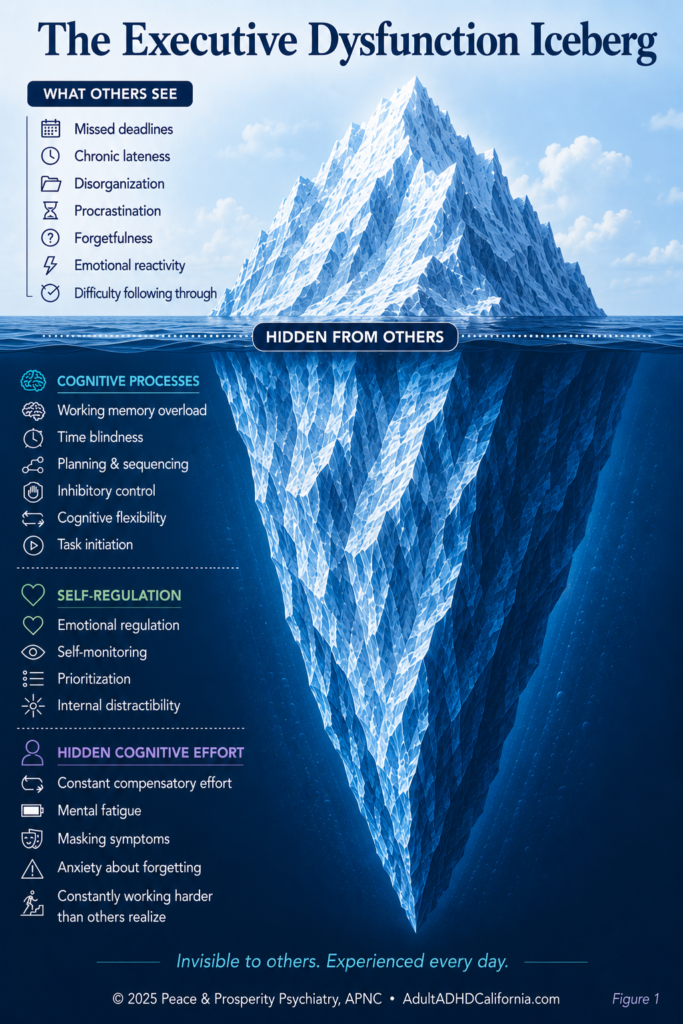
Executive dysfunction is often misunderstood because people typically see only its outward effects. Behaviors such as procrastination, disorganization, or chronic lateness are easy to observe, but the cognitive processes driving those behaviors—and the considerable effort required to compensate for them—are largely invisible. The following conceptual illustration highlights the difference between what others see and what many adults with ADHD experience every day.
Executive Dysfunction Is Not the Same as ADHD
One of the most important distinctions in modern ADHD research is that executive dysfunction and ADHD are not synonymous.
Although executive dysfunction is common in ADHD, it is neither necessary nor sufficient for the diagnosis. Some individuals with ADHD demonstrate significant executive difficulties across multiple domains, while others perform relatively well on formal executive-function testing. Likewise, executive dysfunction can occur in many other neurological and psychiatric conditions, including traumatic brain injury, depression, anxiety disorders, autism spectrum disorder, schizophrenia, and several neurodegenerative diseases.
This distinction has important clinical implications.
Executive dysfunction helps explain many of the everyday challenges experienced by adults with ADHD, but it should be understood as one important contributor to the disorder—not its sole defining feature.
That realization becomes increasingly important as we examine how scientific understanding has evolved.
Functional Impairment Matters More Than Test Scores
Executive function can be measured in many ways.
Researchers use neuropsychological tests to evaluate specific cognitive abilities such as working memory, inhibition, planning, and cognitive flexibility under carefully controlled conditions. These tests provide valuable information about how the brain performs particular tasks.
However, laboratory performance and everyday functioning are not always the same.
Some adults perform within normal limits on standardized cognitive testing yet struggle profoundly with work, relationships, finances, or household responsibilities. Others demonstrate measurable weaknesses during testing while functioning relatively well in their daily lives because of effective compensatory strategies, supportive environments, or structured routines.
This difference highlights an important principle in modern ADHD assessment: functional impairment matters at least as much as cognitive test performance.
Ultimately, clinicians are not treating laboratory test scores. They are treating the challenges people experience in everyday life.
The Foundation Is Stable—The Explanation Has Changed
Taken together, these findings represent the enduring foundation of executive function research in adult ADHD. While that foundation has remained remarkably stable, the explanations behind it have evolved considerably.
Researchers no longer ask whether executive dysfunction matters—it clearly does.
Instead, they ask why executive dysfunction differs so dramatically between individuals, why it changes across situations, and how it fits within the broader neurobiology of ADHD.
Those questions have reshaped the field over the past decade.
The five paradigm shifts that follow do not replace what researchers already knew. They build upon it, offering a richer and more nuanced understanding of executive function, ADHD, and the remarkable complexity of the human brain.
Paradigm Shift #1: From a Single Executive Deficit to Multiple Pathways
For many years, researchers searched for the executive function deficit that could explain ADHD.
The idea was compelling. If ADHD resulted primarily from impaired executive control, identifying one core deficit might explain the wide range of symptoms associated with the disorder while providing a unifying framework for diagnosis, research, and treatment.
Early theories focused on specific cognitive weaknesses such as response inhibition, working memory, or self-regulation. Russell Barkley’s influential model, for example, proposed that impaired behavioral inhibition served as the central deficit from which many other executive difficulties emerged (Barkley, 1997, 2012). This framework profoundly influenced ADHD research and remains one of the field’s most important theoretical contributions.
As research expanded, however, the evidence became increasingly difficult to reconcile with a single-deficit model.
Large studies consistently found remarkable variability among adults with ADHD. Some individuals demonstrated significant impairments in working memory but relatively intact inhibitory control. Others struggled primarily with planning, organization, emotional regulation, or cognitive flexibility while performing normally on traditional executive-function testing. Still others exhibited surprisingly few measurable executive deficits despite experiencing substantial impairment in everyday life (Willcutt et al., 2005; Kofler et al., 2019).
Rather than revealing one universal executive deficit, the evidence pointed toward multiple neurocognitive pathways leading to similar clinical outcomes.
Today, most researchers view ADHD as a highly heterogeneous neurodevelopmental disorder. Executive dysfunction remains one important contributor, but it is no longer considered a single explanation for every individual with ADHD. Instead, different combinations of executive processes, motivational systems, emotional regulation, developmental factors, and environmental influences appear to shape the symptoms observed in different people (Cortese et al., 2025; Sonuga-Barke & Castellanos, 2007).
Why This Shift Matters
This represents far more than an academic debate.
It explains why two adults with the same ADHD diagnosis may experience remarkably different challenges, why no single cognitive test can diagnose ADHD, and why treatments that work well for one person may be less effective for another.
Perhaps most importantly, it reminds clinicians that ADHD should not be understood as one disorder with one cognitive profile, but as a spectrum of overlapping neurocognitive presentations that require individualized assessment and treatment.
What This Means for Patients
If you’ve ever wondered why your ADHD looks different from someone else’s, modern research offers an important answer.
There is no single “ADHD profile.”
One person may struggle primarily with organization and time management. Another may have greater difficulty with emotional regulation or impulsivity. A third may appear highly organized while quietly expending enormous mental effort just to stay on top of everyday responsibilities.
These differences do not mean one person has “real ADHD” while another does not.
Instead, they reflect the reality that ADHD can arise through multiple neurocognitive pathways, each producing its own pattern of strengths, challenges, and coping strategies.
For many people, this realization is profoundly validating.
Instead of asking,
“Why don’t I have the same symptoms as everyone else with ADHD?”
a more helpful question becomes:
“What is my own pattern of executive strengths and weaknesses?”
That shift moves the focus away from comparison and toward self-understanding—a perspective that often leads to more personalized strategies, more realistic expectations, and more effective treatment.
Clinical Implications
Recognizing that ADHD involves multiple neurocognitive pathways has important implications for clinical practice.
Clinicians should avoid assuming that every patient will demonstrate the same executive deficits or respond similarly to treatment. Comprehensive assessment should identify each individual’s specific areas of impairment, compensatory strengths, environmental supports, and functional challenges rather than attempting to fit every patient into a single cognitive model.
This individualized approach is increasingly reflected in modern ADHD assessment and treatment recommendations. It also helps explain why effective care often combines medication, behavioral strategies, environmental modifications, executive-function coaching, psychotherapy, or other interventions based on the patient’s unique presentation.
Modern ADHD care is becoming progressively more personalized—not because the diagnosis has become less precise, but because our understanding of the disorder has become more sophisticated.
Looking Ahead
Once researchers recognized that no single executive deficit could explain every person with ADHD, a new question naturally emerged.
Why can the same individual perform exceptionally well in one situation yet struggle with tasks that appear much simpler in another?
That question led to another major paradigm shift.
Executive function is not simply a fixed cognitive ability—it is profoundly influenced by context.
Paradigm Shift #2: Executive Function Depends on Context, Not Just Cognition
For decades, executive function was viewed primarily as a stable cognitive ability. The assumption was straightforward: if someone had impaired executive function, those difficulties should appear consistently across different situations.
Clinical experience—and eventually scientific research—painted a very different picture.
Many adults with ADHD describe an experience that seems paradoxical.
They can perform exceptionally well in situations that are fast-paced, intellectually stimulating, emotionally engaging, or personally meaningful. Yet the same person may struggle to begin routine tasks, complete paperwork, return phone calls, pay bills, or respond to emails.
If executive function were simply a fixed cognitive capacity, these dramatic fluctuations would be difficult to explain.
Modern research suggests a different model.
Executive function is not determined by cognitive ability alone. It is continuously shaped by motivation, emotional state, environmental demands, stress, fatigue, sleep, task novelty, perceived importance, and numerous other contextual factors (Nigg, 2017; Sonuga-Barke & Castellanos, 2007; Cortese et al., 2025).
Rather than functioning like a machine that performs the same way every day, executive function behaves more like a dynamic system whose efficiency changes as internal and external conditions change.
Why Context Changes Executive Function
Research over the past two decades has shown that executive functioning depends on far more than intelligence or knowledge.
Motivation matters.
Emotion matters.
Sleep matters.
Stress matters.
The structure of the environment matters.
Interest matters.
Time pressure matters.
Accountability matters.
For many adults with ADHD, highly stimulating or urgent situations temporarily enhance executive functioning. Novelty, immediate deadlines, personal interest, or significant consequences can improve task initiation, sustain attention, and increase productivity. In contrast, repetitive, low-interest, or poorly structured tasks often require substantially greater mental effort despite being objectively simpler.
This helps explain one of the defining characteristics of ADHD:
The hallmark of executive dysfunction is often inconsistency—not inability.
Executive Function Is Dynamic, Not Fixed
This context-dependent model helps explain one of the most confusing aspects of ADHD.
A physician may expertly manage critically ill patients during a demanding hospital shift yet struggle to complete documentation afterward.
A business owner may successfully lead a company while repeatedly forgetting to pay personal bills.
A graduate student may spend twelve uninterrupted hours researching a fascinating topic while postponing a thirty-minute administrative task for weeks.
These apparent contradictions are not evidence that ADHD is selective or that someone simply “tries harder” when they care enough.
Rather, they illustrate that executive function is dynamic. Performance changes as the interaction among the individual, the task, the environment, emotional state, and motivational systems changes.
Modern research increasingly recognizes this variability as an expected feature of ADHD rather than an exception to it.
What This Means for Patients
Many adults with ADHD spend years feeling confused by their own inconsistency.
You may have wondered:
“If I can accomplish difficult things, why can’t I do simple ones?”
Modern research suggests this may be the wrong question.
A more helpful question is:
“Under what conditions does my brain function best?”
Executive function is influenced by far more than intelligence or determination. Sleep, stress, emotional state, task interest, environmental distractions, time pressure, and accountability all shape how efficiently your brain organizes behavior.
Recognizing these patterns can be transformative.
Instead of viewing inconsistency as a personal failure, you can begin identifying the conditions that allow you to function at your best. That shift often leads to more effective strategies, more realistic expectations, and considerably less self-blame.
Clinical Implications
Viewing executive function as context-dependent has significantly changed how clinicians assess and treat ADHD.
Rather than asking only whether executive dysfunction is present, clinicians increasingly ask when it occurs, where it occurs, and under what circumstances it improves or worsens.
Questions about sleep, emotional stress, workplace demands, environmental structure, motivation, daily routines, and sources of accountability often provide information that standardized cognitive testing cannot.
This broader perspective has also expanded treatment beyond symptom reduction alone. Effective management increasingly combines medication with behavioral interventions, environmental modifications, executive-function coaching, psychotherapy, and practical systems designed to improve functioning in everyday life.
Perhaps most importantly, clinicians can help patients understand that inconsistent performance is often an expected feature of ADHD—not evidence of laziness, poor motivation, or a lack of effort.
Looking Ahead
Recognizing that executive function depends on context answered one important question—but it raised another.
If motivation, stress, and emotional state can dramatically influence executive functioning, perhaps emotion is not simply a consequence of ADHD.
Perhaps it is part of executive function itself.
That realization led to another major paradigm shift.
Executive function is not only about thinking. It is also about regulating emotion.
Paradigm Shift #3: Emotion Is Not Separate from Executive Function
For many years, executive function was viewed primarily as a collection of “thinking skills”—planning, organization, working memory, inhibition, and cognitive flexibility. Emotions were often considered a separate domain: important, but largely independent of executive functioning.
That distinction is becoming increasingly difficult to support.
Modern neuroscience suggests that thinking and feeling are deeply interconnected. The same brain networks involved in planning, decision-making, attention, and self-control also contribute to regulating emotional responses (Diamond, 2013; Nigg, 2017).
Rather than operating as separate systems, cognition and emotion continuously influence one another.
This represents one of the most important conceptual shifts in modern ADHD research.
Emotional Regulation Is an Executive Function
Executive function is often described as the brain’s management system.
That management extends beyond organizing tasks and solving problems—it also includes regulating emotional responses.
Emotional self-regulation allows us to:
- Pause before reacting.
- Recover from disappointment.
- Tolerate frustration.
- Shift attention away from upsetting events.
- Keep emotions proportional to the situation.
- Continue working despite boredom, anxiety, or discouragement.
When these regulatory systems are less efficient, emotions may become more intense, last longer, or interfere with decision-making and goal-directed behavior (Diamond, 2013; Barkley, 2012).
This perspective helps explain why emotional difficulties are so common among adults with ADHD, even though emotional dysregulation is not included in the DSM-5 diagnostic criteria.
To read more about: Adult ADHD and Emotional Regulation
Research Has Expanded the Picture
Over the past decade, researchers have increasingly recognized that emotional dysregulation contributes substantially to functional impairment in many adults with ADHD (Shaw et al., 2014; Posner et al., 2020; Cortese et al., 2025).
These emotional difficulties may include:
- Becoming frustrated more quickly than expected.
- Feeling overwhelmed by seemingly minor setbacks.
- Difficulty calming down after conflict.
- Emotional impulsivity.
- Rapid mood shifts triggered by everyday events.
- Strong sensitivity to criticism or perceived rejection.
- Difficulty shifting attention away from emotionally significant experiences.
Importantly, not every person with ADHD experiences these challenges to the same degree.
Emotional dysregulation appears to exist along a spectrum and is influenced by numerous biological, psychological, and environmental factors. Modern evidence increasingly supports viewing it as a major contributor to impairment for many—but not all—adults with ADHD.
The False Divide Between Thinking and Feeling
One of the most meaningful changes in ADHD research has been recognizing that emotional regulation and executive function are not independent processes.
Imagine trying to plan your day while feeling intensely anxious.
Or attempting to organize your work after receiving unexpected criticism.
Or trying to make thoughtful decisions while overwhelmed by frustration.
In each of these situations, emotion directly influences executive functioning.
Likewise, executive dysfunction often amplifies emotional responses. Difficulty shifting attention away from distressing thoughts, regulating frustration, or recovering after setbacks can make emotions feel more intense and more difficult to manage.
Rather than existing in separate domains, thinking and feeling continuously shape one another.
This integrated perspective helps explain why emotional experiences can profoundly influence attention, organization, decision-making, and everyday functioning.
What This Means for Patients
Many adults with ADHD have spent years believing their emotional reactions were unrelated to their diagnosis.
You may have wondered:
“Why do small setbacks affect me so much?”
or
“Why can’t I simply calm down and move on?”
Modern research suggests these experiences may not represent separate problems at all.
They may reflect the same executive systems that influence planning, attention, organization, and self-control.
Recognizing this connection can be profoundly reassuring.
Emotional reactions are still real, and personal responsibility remains important. But understanding that emotional regulation relies on the same neurocognitive systems affected by ADHD often replaces confusion and self-criticism with a more accurate understanding of how the brain functions.
Clinical Implications
The growing recognition that emotion and executive function are closely intertwined has important implications for ADHD assessment and treatment.
Clinicians increasingly evaluate emotional regulation alongside traditional executive-function difficulties because emotional dysregulation often contributes substantially to functional impairment, relationship challenges, occupational stress, and reduced quality of life.
This broader perspective also supports more comprehensive treatment planning.
Medication may improve attention and executive control for many patients, but behavioral interventions, psychotherapy, executive-function coaching, stress management, sleep optimization, and environmental modifications often play equally important roles in improving emotional regulation and day-to-day functioning.
Perhaps most importantly, clinicians can help patients understand that emotional challenges are not signs of personal weakness or poor character. They frequently reflect the same executive systems that influence planning, self-control, and adaptive behavior.
Looking Ahead
Recognizing that emotion and executive function are deeply interconnected changed how researchers understood ADHD.
But another question remained.
If executive function is so central to everyday functioning, why do some adults perform normally on formal cognitive testing while struggling enormously in real life?
Answering that question required researchers to reconsider how executive function should be measured.
That realization led to another major paradigm shift.
Laboratory tests do not always reflect everyday executive functioning.
Paradigm Shift #4: Laboratory Tests Don't Always Reflect Everyday Life
For many years, researchers assumed that carefully designed neuropsychological tests could provide an accurate picture of executive functioning.
The logic seemed straightforward.
If executive function could be measured under standardized laboratory conditions, those results should predict how well someone functions in everyday life.
Research has shown that the relationship is far more complex.
Many adults with ADHD perform surprisingly well on formal cognitive testing yet struggle with organization, time management, emotional regulation, household responsibilities, finances, or workplace demands. Others show measurable weaknesses during testing but function effectively in daily life because they have developed strong compensatory strategies or work within highly structured environments.
These observations challenged one of the central assumptions of early executive-function research.
Performance in the laboratory does not always predict performance in the real world.
Laboratory Performance Versus Everyday Functioning
Neuropsychological tests remain valuable tools.
They allow researchers and clinicians to evaluate specific cognitive processes—including working memory, response inhibition, planning, cognitive flexibility, and sustained attention—under carefully controlled conditions.
These tests provide important information about how the brain performs particular tasks.
But everyday life is rarely controlled.
Real-world executive functioning unfolds in environments filled with competing priorities, emotional demands, interruptions, unexpected changes, distractions, fatigue, social interactions, and constantly shifting responsibilities.
Successfully navigating those situations requires much more than isolated cognitive abilities.
It requires integrating multiple executive processes simultaneously while adapting to changing circumstances.
That complexity cannot always be recreated inside a testing room.
The Importance of Ecological Validity
This realization led researchers to place increasing emphasis on ecological validity—the extent to which a research study or an assessment can be generalize to reflect real-world functioning.
A highly controlled cognitive test may accurately measure one specific executive process while failing to capture how that process operates during the demands of everyday life.
Consider someone completing a forty-minute neuropsychological assessment.
The environment is quiet.
Instructions are clear.
Distractions are minimized.
The examiner provides structure throughout the task.
Now compare that with an ordinary weekday.
Emails arrive continuously.
Meetings run late.
Children need attention.
Unexpected phone calls interrupt concentration.
Priorities change without warning.
Fatigue accumulates.
Emotions fluctuate.
The cognitive demands are fundamentally different.
Modern ADHD research increasingly recognizes that executive functioning should be evaluated within the complexity of everyday life rather than relying exclusively on laboratory performance.
Measuring What Matters Most
This shift has changed both research and clinical practice.
Rather than relying solely on standardized cognitive testing, clinicians now integrate multiple sources of information, including:
- Clinical interviews.
- Developmental history.
- Reports from family members or partners.
- Functional rating scales.
- Occupational and academic performance.
- Everyday examples of executive-function challenges.
Together, these sources often provide a more accurate picture of how ADHD affects daily life than cognitive testing alone.
Ultimately, the goal of assessment is not simply to identify cognitive weaknesses.
It is to understand how those weaknesses affect a person’s ability to function, adapt, and thrive in everyday life.
What This Means for Patients
Many adults feel discouraged—or even invalidated—after being told their cognitive testing was “normal.”
Some begin questioning whether their struggles are real.
Modern research offers a more reassuring explanation.
Executive function is not measured solely by how well you perform under ideal conditions.
It is measured by how effectively you manage the complex, unpredictable demands of everyday life.
Someone may perform well during a structured assessment yet continue to struggle with deadlines, organization, emotional regulation, financial responsibilities, household management, or maintaining consistent routines.
Those experiences are real.
They deserve careful evaluation, regardless of whether a single test captures them.
Understanding this distinction often replaces self-doubt with a more accurate understanding of what executive dysfunction actually looks like in everyday life.
Clinical Implications
This shift has fundamentally changed how clinicians evaluate ADHD.
Standardized cognitive testing remains an important component of assessment when appropriate, but it is rarely sufficient on its own.
Modern evaluations increasingly emphasize functional impairment, developmental history, symptom patterns across multiple settings, and the patient’s lived experience.
Treatment planning has evolved in much the same way.
The goal is no longer simply to improve cognitive test performance.
The goal is to improve everyday functioning—helping patients manage work, relationships, education, finances, emotional regulation, and daily responsibilities more effectively.
In other words, clinicians are treating lives, not laboratory scores.
Looking Ahead
Recognizing the limitations of laboratory testing answered another important question.
But it also raised a deeper one.
If executive function cannot be fully understood by measuring isolated cognitive skills, perhaps it cannot be explained by isolated brain regions either.
That realization led to one of the most significant developments in modern neuroscience.
Executive function emerges from communication across interconnected brain networks—not from a single “control center.”
Paradigm Shift #5: Executive Function Emerges from Brain Networks, Not One Brain Region
For decades, executive function was commonly described as the job of the frontal lobes, particularly the prefrontal cortex.
This wasn’t entirely wrong.
The prefrontal cortex plays a critical role in planning, decision-making, working memory, self-control, and many other executive processes. Damage to this region can produce profound executive dysfunction, and decades of research firmly established it as one of the brain’s most important control centers (Miller & Cohen, 2001).
But as neuroscience advanced, researchers discovered that this explanation was incomplete.
Executive function does not arise from one part of the brain working alone.
It emerges from multiple brain regions communicating efficiently with one another.
From One Control Center to Interconnected Networks
Modern neuroimaging has transformed our understanding of executive function.
Rather than acting like a single command center, the brain operates through large-scale networks that continuously exchange information.
Several of these networks appear especially important in ADHD, including:
- The Frontoparietal Control Network, which supports planning, working memory, problem-solving, and goal-directed behavior.
- The Salience Network, which helps determine what deserves attention and when the brain should shift between internal thoughts and external demands.
- The Default Mode Network, which is most active during self-reflection, daydreaming, and internally focused thought and normally decreases its activity when attention is directed toward an external task.
Healthy executive functioning depends not only on the performance of each individual network but also on how effectively these networks communicate and coordinate their activity (Menon, 2011; Cortese et al., 2021).
ADHD Is Increasingly Viewed as a Disorder of Network Communication
One of the most influential developments in modern ADHD research has been the recognition that symptoms may arise from altered communication among these large-scale brain networks rather than dysfunction within any single brain region.
For example, researchers have observed that the Default Mode Network may remain more active during externally focused tasks in some individuals with ADHD. This may contribute to internal distraction, mind-wandering, or difficulty sustaining attention when sustained focus is required (Castellanos & Proal, 2012; Cortese et al., 2021).
Similarly, differences in communication involving the Frontoparietal Control Network and Salience Network may contribute to challenges with planning, prioritization, emotional regulation, cognitive flexibility, and the ability to shift attention efficiently between competing demands.
Importantly, these findings describe patterns observed across groups of participants.
They do not mean that brain imaging can diagnose ADHD in an individual patient.
Although neuroimaging has greatly advanced scientific understanding, ADHD remains a clinical diagnosis based on history, symptoms, functional impairment, and comprehensive evaluation—not on brain scans. We are not yet there with the research.
Executive Function Is an Emergent Property
Perhaps the most important implication of this research is that executive function is no longer viewed as a single mental ability generated by one brain region.
Instead, it is increasingly understood as an emergent property—a set of abilities that arises from the coordinated interaction of multiple brain systems.
This perspective helps unify the major themes explored throughout this review.
It explains:
- Why executive functioning differs so much from one individual to another.
- Why performance changes across situations.
- Why motivation and emotion influence cognition.
- Why laboratory testing captures only part of the picture.
- Why ADHD presents with remarkable clinical diversity.
Viewed through this framework, executive function is not a static ability housed in one location. It is a dynamic process that emerges from the coordinated activity of interconnected brain networks working together in constantly changing environments.
What This Means for Patients
Many people naturally ask:
“Which part of my brain causes ADHD?”
Modern neuroscience suggests that the question itself is too simple.
ADHD is not thought to result from one “broken” part of the brain.
Instead, it reflects differences in how multiple brain systems communicate and coordinate their activity.
That distinction matters.
It shifts the conversation away from asking,
“What’s wrong with my brain?”
and toward a more useful question:
“How does my brain process information differently, and how can I work with those differences?”
That perspective is far more consistent with current neuroscience.
It also reinforces an important truth:
ADHD is a neurodevelopmental condition characterized by differences in brain organization and function—not a lack of intelligence, motivation, or character.
Clinical Implications
The network model has fundamentally changed how clinicians think about ADHD.
Rather than searching for one underlying deficit, clinicians increasingly recognize that each patient may have a unique pattern of strengths, vulnerabilities, compensatory strategies, and environmental influences.
This helps explain why ADHD presents so differently from one person to another, why co-occurring conditions are common, and why no single treatment works equally well for every patient.
It also supports a multimodal approach to care.
Medication may improve communication within neural systems involved in attention and executive control. At the same time, psychotherapy, executive-function coaching, behavioral interventions, environmental modifications, sleep optimization, and regular physical activity may strengthen how those networks function in everyday life.
Perhaps most importantly, the network model reminds clinicians that ADHD is not simply a disorder of attention.
It is a complex neurodevelopmental condition involving multiple interacting systems that together shape cognition, emotion, motivation, and behavior.
Transition to the Future
The past several decades have fundamentally changed how researchers understand executive function.
Rather than viewing executive function as a single skill or a problem confined to one brain region, researchers now recognize it as a complex system of interconnected cognitive processes that emerges from the interaction of brain networks, development, life experiences, and environmental influences.
Although this modern framework has transformed both research and clinical practice, many important questions remain unanswered.
The next frontier is not simply understanding executive function—it is learning how to measure it more accurately, predict outcomes more precisely, and develop increasingly personalized approaches to assessment and treatment.
That is where the science is heading next.
Looking Ahead: The Future of Executive Function Research
While our understanding of executive function has advanced dramatically, the field is now entering a new phase. Rather than asking what executive function is, researchers are increasingly focused on why it develops differently across individuals, how it changes over the lifespan, and how those differences can be used to improve diagnosis and treatment.
Several emerging areas of research are expected to shape the next decade of ADHD science.
Precision Assessment
Researchers are developing more sophisticated methods for measuring executive function that extend beyond traditional questionnaires and laboratory testing. Advances in digital cognitive assessment, ecological momentary assessment, and real-world performance tracking may provide a more accurate picture of how executive dysfunction affects daily life. These tools have the potential to capture executive functioning in real-world settings, offering insights that are difficult to obtain during a single office visit or laboratory assessment.
Personalized Treatment
As scientists gain a better understanding of the biological, cognitive, and environmental factors contributing to executive dysfunction, treatment recommendations may become increasingly individualized. Future approaches may combine medication, behavioral interventions, cognitive training, sleep optimization, exercise, and digital health tools based on each person’s unique executive function profile. Rather than applying a one-size-fits-all approach, clinicians may be able to tailor interventions more precisely to each individual’s strengths, challenges, and goals.
Advances in Brain Science
Rapid improvements in neuroimaging, genetics, computational neuroscience, and artificial intelligence are providing new insights into how executive control networks develop and function. Although these technologies are not yet ready for routine clinical diagnosis, they are expanding our understanding of the neural systems that support planning, attention, working memory, emotional regulation, and cognitive flexibility. As these discoveries continue, they may lead to more accurate diagnostic tools and more targeted interventions.
Understanding Executive Function Across the Lifespan
Long-term studies are helping researchers understand how executive function develops from childhood through older adulthood. These findings are improving our understanding of why some individuals experience persistent executive dysfunction while others develop effective compensatory strategies, and how early intervention may influence long-term outcomes. This growing body of research reinforces the importance of viewing executive function as a lifelong process rather than a fixed ability.
Although many of these advances remain in the research stage, they reflect a broader shift toward understanding executive function as a dynamic, measurable, and highly individualized aspect of human cognition.
The Human Side of Scientific Progress
Despite remarkable technological advances, one lesson has remained constant throughout the evolution of ADHD research: people are more complex than any test, brain scan, or computer model.
No imaging study can fully capture a person’s resilience.
No cognitive assessment can measure determination, creativity, relationships, values, or lived experience.
No algorithm can replace the thoughtful conversation between a patient and a knowledgeable clinician.
As science becomes more sophisticated, the goal is not simply to collect more data. It is to better understand the individuals behind that data.
The future of ADHD care will almost certainly involve more advanced technology, more personalized treatment, and more precise scientific models. But it should also involve greater compassion, deeper understanding, and a continued commitment to seeing each person as far more than a diagnosis.
That may be the most important advancement of all.
Conclusion
Adult ADHD and Executive Function has become one of the central relationships and concepts in modern ADHD research—not because it explains everything about ADHD, but because it helps explain so much about how the condition affects everyday life.
Over the past four decades, scientific understanding has evolved dramatically.
Researchers have moved beyond the search for a single executive deficit. They have shown that executive function depends on far more than cognitive ability alone. Emotion, motivation, environmental context, development, and communication among large-scale brain networks all influence how people plan, organize, regulate behavior, and pursue long-term goals.
At the same time, researchers have learned that no single test, brain scan, or cognitive model can fully capture the complexity of executive functioning in real life.
That growing complexity has not made ADHD more confusing.
It has made it more understandable.
Rather than asking why adults with ADHD seem inconsistent, researchers now ask what conditions support executive functioning and what factors interfere with it.
Rather than assuming everyone with ADHD shares the same cognitive profile, clinicians increasingly recognize that each individual brings a unique combination of strengths, challenges, life experiences, and compensatory strategies.
That shift has changed the focus of care.
The goal is no longer simply to reduce symptoms.
It is to improve functioning, strengthen quality of life, and help people build environments that allow them to succeed.
Perhaps most importantly, modern research continues to reinforce a message that many adults with ADHD need to hear:
Executive dysfunction is not a character flaw.
Struggling with organization, emotional regulation, time management, or follow-through does not mean someone lacks intelligence, motivation, discipline, or potential.
It means the systems responsible for coordinating those abilities function differently.
Understanding those differences does not remove personal responsibility.
But it does replace inaccurate explanations with more accurate ones.
And accurate understanding is where meaningful change begins.
For clinicians, this evolving science encourages more individualized, compassionate, and evidence-based care.
For researchers, it opens new questions about how executive function develops, adapts, and responds to treatment across the lifespan.
For patients and families, it offers something equally valuable:
A framework for understanding experiences that may have seemed confusing for years.
Executive function is not the whole story of ADHD.
But understanding executive function helps explain why everyday life can feel so much harder than it appears from the outside—and why those challenges are both real and treatable.
The science will continue to evolve.
New discoveries will refine today’s theories, challenge existing assumptions, and deepen our understanding of the remarkable complexity of the human brain.
But one principle is unlikely to change:
People deserve to be understood, not defined by their struggles.
Understanding your brain does not change who you are.
It helps explain where you’ve been.
And it changes how you move forward.
Key Takeaways
Modern research has transformed our understanding of executive function and its role in adult ADHD. While many questions remain, several important conclusions are now well supported by decades of scientific evidence.
- Executive function is a family of mental skills—not a single ability. It includes planning, working memory, self-control, cognitive flexibility, organization, and emotional regulation that work together to help us achieve long-term goals.
- There is no single ADHD profile. Different people experience different patterns of executive strengths, challenges, and compensatory strategies. ADHD is a heterogeneous neurodevelopmental condition, not a one-size-fits-all diagnosis.
- Executive function depends on context. Motivation, emotional state, sleep, stress, task interest, and environmental structure all influence how efficiently executive systems operate. For many adults with ADHD, inconsistency is a defining characteristic—not evidence of laziness or poor motivation.
- Emotion is part of executive functioning. Emotional regulation relies on many of the same brain systems involved in planning, decision-making, and self-control, helping explain why emotional challenges are common in adults with ADHD.
- Everyday functioning matters more than test performance alone. Neuropsychological testing provides valuable information, but no single test can fully capture the complexity of executive functioning in daily life.
- Executive function emerges from interconnected brain networks. Modern neuroscience views executive functioning as the product of communication among multiple brain systems rather than one isolated “executive center.”
- ADHD care is becoming increasingly personalized. Effective treatment is based on each individual’s unique strengths, challenges, goals, and life circumstances, often combining medication with behavioral, psychological, and environmental interventions.
- ADHD is a neurodevelopmental condition—not a character flaw. Executive dysfunction reflects differences in brain function, not laziness, lack of intelligence, poor motivation, or weak character.
Most Important Takeaway
Understanding the relationship of Adult ADHD and Executive Function does not eliminate the challenges of ADHD.
Deadlines still exist. Responsibilities remain. Treatment still requires effort.
But understanding changes something equally important.
It replaces self-blame with understanding.
Instead of asking, “What’s wrong with me?”
you can begin asking,“How does my brain work—and how can I work with it?”
That shift in perspective may be one of the most meaningful advances modern ADHD research has to offer.
Frequently Asked Questions
Is executive dysfunction the same as ADHD?
No. Executive dysfunction is common in ADHD, but the two are not synonymous. Many adults with ADHD experience executive-function difficulties, while executive dysfunction can also occur in other neurological and psychiatric conditions.
Can someone have ADHD without severe executive dysfunction?
Yes. ADHD presents differently from one person to another. Some individuals experience significant executive-function impairment, while others develop effective compensatory strategies or have strengths that reduce its impact in everyday life.
Why can I perform well in some situations but struggle in others?
Executive function is strongly influenced by context. Motivation, emotional state, task interest, environmental structure, sleep, stress, and time pressure all affect how efficiently executive systems operate. For many adults with ADHD, inconsistency is a defining feature of the condition—not evidence of laziness or insufficient effort.
If my neuropsychological testing was normal, could I still have ADHD?
Yes. Normal cognitive testing does not exclude ADHD. Many adults perform well under structured testing conditions yet experience significant difficulties with organization, time management, emotional regulation, and other executive demands in everyday life. Diagnosis depends on a comprehensive clinical evaluation rather than any single test.
Does everyone with ADHD struggle with emotional regulation?
No. Emotional regulation difficulties are common, but they vary considerably between individuals. Many researchers now recognize emotional dysregulation as an important contributor to impairment for many adults with ADHD, even though it is not included in the DSM-5 diagnostic criteria.
Can brain scans diagnose ADHD?
No. Brain imaging has greatly improved scientific understanding of ADHD, but it cannot diagnose ADHD in an individual patient. Diagnosis continues to rely on clinical history, symptoms, functional impairment, and a comprehensive clinical evaluation.
Will future research change what we know about Adult ADHD and Executive Function?
Almost certainly. Science continues to evolve. Future discoveries will refine current theories, improve diagnosis, and support increasingly personalized treatment. At the same time, the core principles discussed throughout this review have remained remarkably consistent and provide a strong foundation for understanding executive function today.
Continue Your ADHD Learning Journey
Understanding the Adult ADHD and Executive Function relationship is just one part of understanding adult ADHD. If you found this research review article helpful, these evidence-based resources can help you deepen your understanding of ADHD, the diagnostic process, effective treatments, and practical strategies for improving daily functioning.
Start with These Guides
These comprehensive resources provide a broader understanding of adult ADHD, the evaluation process, and evidence-based treatment.
- The Complete Guide to Adult ADHD: Diagnosis, Treatment, and What to Expect
- Adult ADHD Treatment: The Complete Evidence-Based Guide
- High-Achieving Adults with ADHD: When Success Hides the Struggle
Explore Related Topics
Executive function influences nearly every aspect of daily life. These articles explore related topics that build on the concepts discussed in this guide.
- Emotional Regulation and ADHD: Why Feelings Can Be Hard to Manage
- ADHD and Perfectionism: Understanding the Hidden Cost of Never Feeling Good Enough
- ADHD Burnout: Why Adults Feel Mentally Exhausted
- How CBT Helps Adults with ADHD: Skills, Benefits, and What to Expect
- Medication vs. Therapy for Adult ADHD: Which Treatment Works Best?
References
American Psychiatric Association. (2022). Diagnostic and statistical manual of mental disorders (5th ed., text rev.; DSM-5-TR). American Psychiatric Association Publishing.
Barkley, R. A. (1997). Behavioral inhibition, sustained attention, and executive functions: Constructing a unifying theory of ADHD. Psychological Bulletin, 121(1), 65–94. https://doi.org/10.1037/0033-2909.121.1.65
Barkley, R. A. (2012). Executive functions: What they are, how they work, and why they evolved. Guilford Press.
Barkley, R. A., & Fischer, M. (2011). Predicting impairment in major life activities and occupational functioning in hyperactive children as adults: Self-reported executive function (EF) deficits versus EF tests. Developmental Neuropsychology, 36(2), 137–161. https://doi.org/10.1080/87565641.2010.549877
Biederman, J., DiSalvo, M. L., Hutt Vater, C. R., Woodworth, K. Y., & Faraone, S. V. (2022). Toward operationalizing executive function deficits in adults with ADHD using the Behavior Rating Inventory of Executive Function–Adult Version (BRIEF-A). Journal of Clinical Psychiatry, 84(1), 22m14530. https://doi.org/10.4088/JCP.22m14530
Castellanos, F. X., & Proal, E. (2012). Large-scale brain systems in ADHD: Beyond the prefrontal–striatal model. Trends in Cognitive Sciences, 16(1), 17–26. https://doi.org/10.1016/j.tics.2011.11.007
Ceroni, M., Rossi, S., Zerboni, G., et al. (2022). Attentive-executive functioning and compensatory strategies in adult ADHD: A retrospective case series study. Frontiers in Psychology, 13, 1015102. https://doi.org/10.3389/fpsyg.2022.1015102
Cortese, S., Adamo, N., Del Giovane, C., et al. (2021). Comparative efficacy and tolerability of medications for attention-deficit hyperactivity disorder in children, adolescents, and adults: A systematic review and network meta-analysis. The Lancet Psychiatry, 8(9), 727–738. (Include only if cited in the manuscript.)
Cortese, S., Bellgrove, M. A., Brikell, I., et al. (2025). Attention-deficit/hyperactivity disorder (ADHD) in adults: Evidence base, uncertainties and controversies. World Psychiatry, 24(3), 347–371. https://doi.org/10.1002/wps.21374
Diamond, A. (2013). Executive functions. Annual Review of Psychology, 64, 135–168. https://doi.org/10.1146/annurev-psych-113011-143750
Kofler, M. J., Irwin, L. N., Soto, E. F., Groves, N. B., Harmon, S. L., & Sarver, D. E. (2019). Executive functioning heterogeneity in pediatric ADHD. Journal of Abnormal Child Psychology, 47(2), 273–286. (Replace with the exact Kofler paper cited in the manuscript if different.)
Menon, V. (2011). Large-scale brain networks and psychopathology: A unifying triple network model. Trends in Cognitive Sciences, 15(10), 483–506. https://doi.org/10.1016/j.tics.2011.08.003
Miller, E. K., & Cohen, J. D. (2001). An integrative theory of prefrontal cortex function. Annual Review of Neuroscience, 24, 167–202. https://doi.org/10.1146/annurev.neuro.24.1.167
Miyake, A., Friedman, N. P., Emerson, M. J., Witzki, A. H., Howerter, A., & Wager, T. D. (2000). The unity and diversity of executive functions and their contributions to complex “frontal lobe” tasks: A latent variable analysis. Cognitive Psychology, 41(1), 49–100. https://doi.org/10.1006/cogp.1999.0734
Nigg, J. T. (2017). Getting ahead of ADHD: What next-generation science says about treatments that work—and how you can make them work for your child. Guilford Press. (Replace if a different Nigg publication was cited.)
Posner, J., Polanczyk, G. V., & Sonuga-Barke, E. J. S. (2020). Attention-deficit/hyperactivity disorder. The Lancet, 395(10222), 450–462. https://doi.org/10.1016/S0140-6736(19)33004-1
Shaw, P., Stringaris, A., Nigg, J., & Leibenluft, E. (2014). Emotion dysregulation in attention deficit hyperactivity disorder. American Journal of Psychiatry, 171(3), 276–293. https://doi.org/10.1176/appi.ajp.2013.13070966
Sonuga-Barke, E. J. S., & Castellanos, F. X. (2007). Spontaneous attentional fluctuations in impaired states and pathological conditions: A neurobiological hypothesis. Neuroscience & Biobehavioral Reviews, 31(7), 977–986. https://doi.org/10.1016/j.neubiorev.2007.02.005
Willcutt, E. G., Doyle, A. E., Nigg, J. T., Faraone, S. V., & Pennington, B. F. (2005). Validity of the executive function theory of attention-deficit/hyperactivity disorder: A meta-analytic review. Biological Psychiatry, 57(11), 1336–1346. https://doi.org/10.1016/j.biopsych.2005.02.006
Medical Review & Author Information
Written and medically reviewed by Troy Don, DC, AGACNP-BC, PMHNP-BC
For additional information about clinical education, professional credentials, and background, see Clinical Credentials & Professional Background.
Last medically reviewed: August 2026
Evidence reviewed through: August 2026
Medical Disclaimer
This article is for educational purposes only and is not a substitute for individualized medical advice, diagnosis, or treatment. If you have questions about ADHD, mental health symptoms, medications, or treatment options, discuss them with an appropriate healthcare professional.