
Table of Contents
ToggleTime Blocking for ADHD: Reclaim Your Calendar, Reduce Overwhelm, and Follow Through More Consistently
Time blocking for ADHD is a practical, evidence-informed planning strategy that helps you stop relying on memory, motivation, or last-minute urgency to get things done. Instead of keeping important tasks on an endless to-do list, you assign them a specific place on your calendar. By turning intentions into scheduled appointments, time blocking for ADHD can reduce decision fatigue, support executive functioning, improve follow-through, and help you make steady progress on the things that matter most—without requiring perfect organization or endless self-discipline.
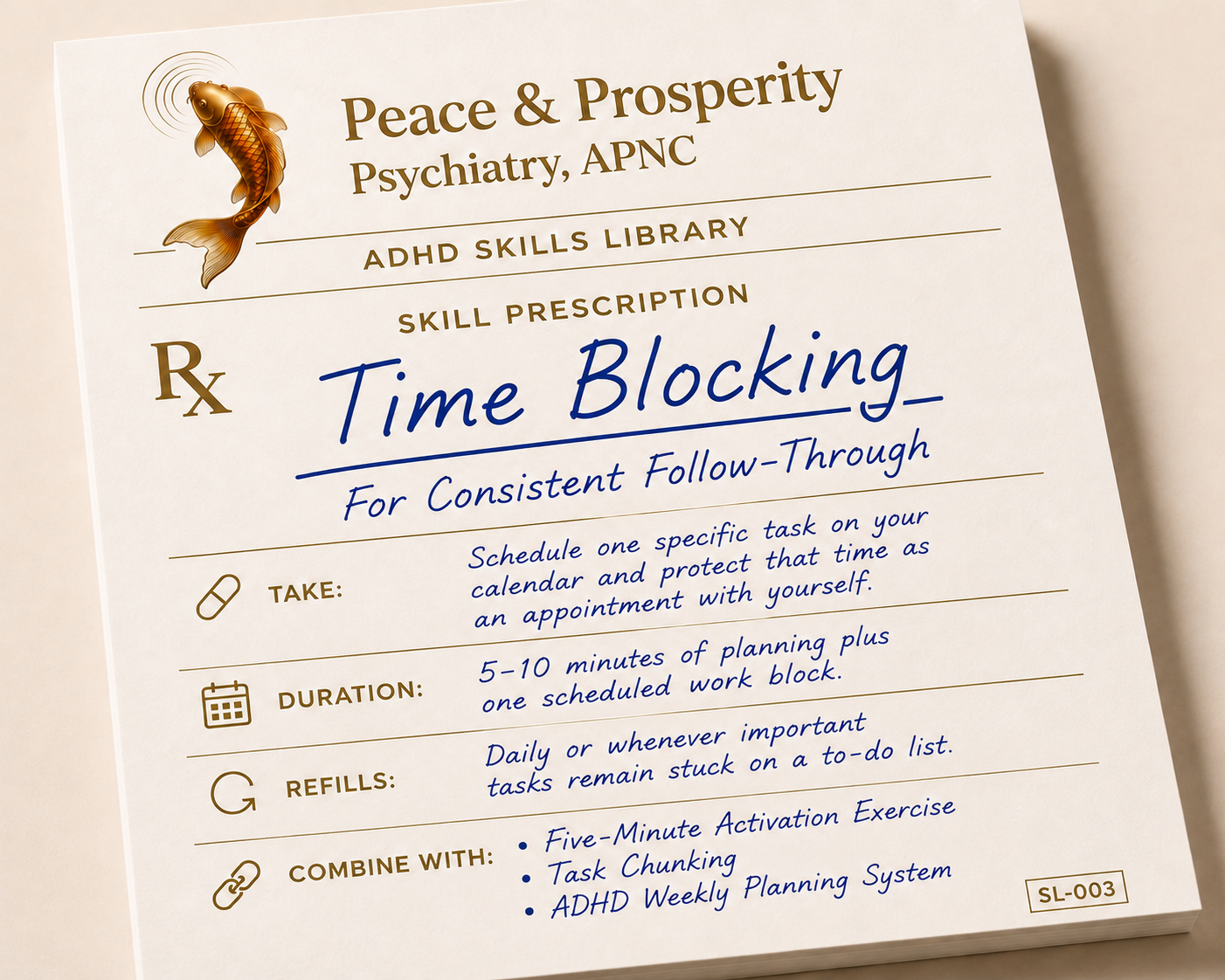
ADHD Skills Library – Lesson #3
Have You Ever Had This Experience?
You know exactly what you need to do.
The report needs to be written.
The taxes need to be organized.
The presentation needs to be prepared.
The email needs a response.
The workout needs to happen.
You may have even broken the task into smaller pieces.
But somehow the work still doesn’t get done.
Instead, the task sits on a to-do list for days.
Or weeks.
Sometimes months.
You wake up intending to work on it.
You genuinely want to work on it.
Then the day fills up.
A phone call comes in.
An urgent email appears.
Someone needs something.
You get distracted.
You get busy.
You work hard all day.
Yet when evening arrives, the important task remains untouched.
Many adults with ADHD know what they need to do.
The problem is not knowledge.
The problem is often timing.
The question is no longer:
“What should I do?”
The question becomes:
“When am I actually going to do it?”
This is where Time Blocking becomes valuable.
Time Blocking helps move a task from the world of intentions into the world of scheduled action.
Instead of hoping you will find time, you decide when the work will happen.
That sounds simple.
For many adults with ADHD, it can be transformative.
Quick Start: Time Blocking for ADHD
Lesson: Time Blocking
Lssson ID: SL-003
📄 Download the Companion Practice Sheet PDF: SL-003 SL-003 Time Blocking for ADHD Worksheet (PDF): Schedule Tasks, Reduce Procrastination, and Follow Through
Use This Skill When
- My to-do list keeps growing.
- Important tasks never get done.
- I feel busy all day but make little progress.
- I keep forgetting to work on priorities.
- I only work on things when deadlines become urgent.
- I know what to do but never seem to find the time.
What You’ll Do
- Identify a task.
- Estimate a realistic amount of time.
- Schedule a block on your calendar.
- Protect the block.
- Work only on that task during the block.
What Success Looks Like
Success = You showed up to the block.
Not:
Success = You finished the entire project.
This distinction is critical.
The goal is attendance before achievement.
Show up first.
Completion often follows.
Why Time Blocking of ADHD Matters
Many adults with ADHD rely heavily on memory, motivation, and urgency.
Unfortunately, these are often unreliable systems.
ADHD is associated with difficulties involving executive functioning, including planning, prioritizing, organizing, self-monitoring, and managing future-oriented behavior (Lopez et al., 2018).
Many adults also experience what is often called time blindness.
Future events feel distant.
Deadlines feel abstract.
Tasks seem like they can always be done later.
Until suddenly they cannot.
Another challenge involves prospective memory.
Prospective memory is remembering to do something in the future.
Call the client.
Submit the paperwork.
Pay the bill.
Review the document.
Remembering future intentions is often more difficult when attention is divided, stress is high, or cognitive resources are depleted (Jia et al., 2026).
As a result, many adults with ADHD unintentionally rely on hope as a planning system.
Unfortunately, hope is not a scheduling tool.
A to-do list tells you what to do.
A calendar tells you when to do it.
That distinction matters.
A task without a scheduled time often remains vulnerable to distraction, interruption, and procrastination.
A scheduled task becomes an appointment.
Clinical Pearl
A calendar is often more powerful than a to-do list because it assigns a time, not just a task.
What Is Time Blocking for ADHD?
Time Blocking is a planning strategy in which specific tasks are assigned to specific periods of time.
Instead of creating an open-ended list of things to do, you reserve dedicated time on your calendar for individual actions.
For example:
Instead of:
“Work on presentation sometime this week.”
Use:
Wednesday 2:00–2:30 PM: Create presentation outline.
Instead of:
“Handle paperwork.”
Use:
Thursday 10:00–10:20 AM: Complete insurance form.
Instead of:
“Exercise.”
Use:
Monday 7:00–7:30 AM: Walk around neighborhood.
Time Blocking converts intentions into appointments.
The task becomes linked to a specific time and place.
This reduces the number of decisions you must make later.
Why Time Blocking Works
Time Blocking combines several evidence-based principles.
Importantly, research has not specifically established Time Blocking itself as a stand-alone ADHD treatment.
However, several well-supported psychological and behavioral mechanisms help explain why it can be effective.
Externalizing Executive Functions
Adults with ADHD often struggle to keep plans active in working memory.
Calendars provide external structure.
Instead of remembering what needs to happen, the system remembers for you.
Research on organizational interventions and external memory supports suggests that offloading information into external systems can significantly improve performance and follow-through (Gilbert et al., 2023).
Clinical Application
A calendar becomes an external executive function.
Instead of repeatedly asking:
“What should I be doing right now?”
The answer is already waiting.
Reducing Decision Fatigue
Every decision requires mental effort.
Should I do emails?
Exercise?
Paperwork?
That report?
The presentation?
The harder the decision becomes, the more likely avoidance becomes.
Time Blocking makes many of those decisions in advance.
The decision is made once during planning rather than repeatedly throughout the day.
Decision fatigue is an important concept for ADHD, so much so it demands its own article.
Clinical Pearl
Many adults with ADHD are not avoiding work.
They are repeatedly exhausting themselves by deciding when to begin.
Supporting Prospective Memory
Prospective memory involves remembering to perform an intended action in the future.
Research suggests that external reminders can significantly improve performance when cognitive resources are strained (Jia et al., 2026).
Calendar alerts, reminders, and scheduled blocks create external cues that support future action.
Creating Implementation Intentions
Implementation intentions are “if-then” plans.
For example:
“If it is Tuesday at 7 PM, then I will gather tax documents.”
Implementation intentions are among the most extensively studied behavior-change strategies and consistently improve follow-through across a wide variety of goals (Wieber et al., 2015).
A time block essentially functions as a practical implementation intention.
Clinical Pearl
Every calendar appointment quietly answers the question:
“When exactly will I do this?”
What the Research Shows Related to Time Blocking for ADHD
Time Blindness and ADHD
Direct Evidence
Research consistently demonstrates deficits involving planning, future-oriented thinking, organization, and time management in ADHD (Lopez et al., 2018).
Clinical Application
Adults with ADHD often underestimate how quickly time passes and overestimate how much can be accomplished later.
Scheduling work creates visible commitments in time.
Limitations
Time Blocking does not eliminate time blindness.
It helps compensate for it.
Planning and Scheduling Deficits
Direct Evidence
Planning and organizational difficulties are core treatment targets in ADHD-focused CBT programs (Lopez et al., 2018).
Clinical Application
Scheduling creates structure where executive function may be inconsistent.
Limitations
A calendar only helps if it is regularly reviewed.
Implementation Intentions
Direct Evidence
Implementation intentions produce moderate-to-large improvements in goal attainment across numerous health and behavioral domains (Wieber et al., 2015).
Clinical Application
Time Blocking operationalizes implementation intentions by connecting a task to a specific future moment.
Limitations
Implementation intentions are less effective when the goal itself lacks importance or personal value.
Organizational Interventions
Direct Evidence
Meta-analytic evidence demonstrates meaningful improvements in organizational skills among individuals with ADHD receiving organizational skills interventions (Bikic et al., 2017).
Clinical Application
Time Blocking functions as one form of external organizational structure.
Limitations
Improvements in organization do not always translate into dramatic changes in academic or occupational outcomes.
ADHD CBT Planning Modules
Direct Evidence
Organization and planning skills are core components of evidence-based CBT protocols for adult ADHD (Lopez et al., 2018).
Clinical Application
Time Blocking fits naturally within these planning frameworks.
Limitations
Most CBT programs teach multiple skills simultaneously, making it difficult to isolate the effects of Time Blocking alone.
The Skill: Time Blocking for ADHD
Step 1: Choose One Important Task
Start with one clearly defined task.
Good examples:
- Respond to three client emails
- Gather tax documents
- Create presentation outline
- Review chapter one
- Walk for 20 minutes
Avoid vague goals.
Examples:
- Get organized
- Fix my finances
- Work on business
- Be productive
Your brain cannot schedule a vague task.
Clinical Pearl
Specific tasks create action.
Vague tasks create overwhelm.
Step 2: Use Task Chunking First
Time Blocking works best after Task Chunking.
Task Chunking identifies what to do.
Time Blocking identifies when to do it.
Example:
Project
Prepare taxes.
Chunk
Gather tax documents.
Time Block
Tuesday 7:00–7:20 PM.
Without chunking, a time block may feel overwhelming.
With chunking, the task becomes manageable.
Step 3: Estimate Time Realistically
Many adults with ADHD underestimate time.
A task expected to take 15 minutes may actually require 45.
A project expected to take an hour may consume an afternoon.
Try these approaches:
The Double-It Rule
Estimate the time.
Then double it.
Start Small
Begin with:
- 10 minutes
- 15 minutes
- 20 minutes
- 30 minutes
Short blocks are easier to protect.
Short blocks are easier to start.
Example
Instead of:
“Write entire report.”
Use:
“Draft introduction.”
20 minutes.
Step 4: Put It on the Calendar
The calendar is where intentions become commitments.
Use whatever system you will actually check.
Options include:
- Google Calendar
- Outlook Calendar
- Apple Calendar
- Paper planners
- Work calendars
- Family calendars
Examples:
Tuesday 8:00–8:20 AM:
Review meeting agenda.
Wednesday 6:00–6:30 PM:
Walk on treadmill.
Thursday 2:00–2:30 PM:
Draft proposal outline.
The best calendar is the one you consistently use.
Step 5: Protect the Block
Scheduling is only half the process.
Protection matters.
Consider:
- Silencing notifications
- Closing unrelated tabs
- Putting the phone away
- Using headphones
- Informing coworkers
- Setting boundaries with family
Research suggests planning is less effective when frequent interruptions fragment attention (Parke et al., 2018).
Clinical Pearl
Protecting the block often matters more than perfectly estimating the time.
Step 6: Show Up
This is the most important step.
Many adults with ADHD make a critical mistake.
They judge success by completion.
A healthier metric is attendance.
Did you show up?
Did you begin?
Did you engage with the task?
If yes, the block succeeded.
Completion is a bonus.
Clinical Pearl
Success is showing up to the appointment you made with yourself.
Flexible Time Blocking
Many productivity systems fail because they are too rigid.
Life happens.
Children get sick.
Meetings run long.
Unexpected demands appear.
The solution is not abandoning the system.
The solution is flexibility.
Priority Blocks
Reserve time for the most important work.
Protect these aggressively.
Buffer Blocks
Leave open time between activities.
Buffers absorb delays.
Catch-Up Blocks
Schedule recovery periods.
Examples:
Friday 3:00–4:00 PM:
Catch-up block.
Use this time for unfinished work.
Recovery Planning
Research suggests contingency planning may be particularly helpful when interruptions are common (Parke et al., 2018).
Instead of:
“If everything goes perfectly…”
Think:
“If something goes wrong, then I will…”
That is still effective planning.
If You Get Stuck
I Missed My Block
Reschedule it.
Do not abandon it.
A missed appointment does not mean the project is canceled.
Clinical Pearl
Missed blocks are data, not failure.
I Underestimated the Time
Excellent.
You learned something.
Adjust future estimates.
Planning improves through repetition.
My Entire Day Fell Apart
This happens.
Use recovery planning.
Choose the next available block.
Restart.
I Keep Ignoring My Calendar
Add reminders.
Use alarms.
Pair Time Blocking with the Five-Minute Activation Exercise.
When the reminder appears:
Commit to five minutes.
Often momentum follows.
Time Blocking for ADHD: Myths vs Facts
Myth: “If I schedule it, I must complete it.”
Fact: Success is showing up.
Myth: “Good planners follow schedules perfectly.”
Fact: Good planners adjust schedules consistently.
Myth: “I should wait until I feel motivated.”
Fact: Scheduling reduces reliance on motivation.
Myth: “My calendar failed because I missed one block.”
Fact: One missed block is normal. The goal is returning.
Practice Prescription
For the next seven days:
Each day:
- Schedule one block.
- Protect it.
- Show up.
That’s it.
Keep it simple.
Reflection Questions
At the end of the week ask:
- How many blocks did I schedule?
- How many did I attend?
- Which times worked best?
- Which times consistently failed?
- What interruptions appeared?
- What adjustments should I make?
Progressive Loading
Week 1
One block per day.
Week 2
Two blocks per day.
Week 3
Include both work and personal blocks.
Week 4
Create a weekly planning system.
Build a calendar that reflects your priorities.
Measuring Progress
Track:
- Blocks scheduled
- Blocks attended
- Tasks started
- Reduced procrastination
- Reduced overwhelm
- Improved follow-through
Do Not Track:
- Perfect calendar adherence
- Finishing everything
- Never missing a block
Those standards are unrealistic.
Integrating Time Blocking With Previous Skills
Lesson #1: The Five-Minute Activation Exercise
Five-Minute Activation helps you start.
When the calendar reminder appears:
Commit to five minutes.
Not the entire project.
Just five minutes.
Lesson #2: Task Chunking
Task Chunking identifies the next actionable step.
Time Blocking assigns that step a place on the calendar.
Together they solve two different problems.
Chunking answers:
“What should I do?”
Time Blocking answers:
“When will I do it?”
Five-Minute Activation answers:
“How do I start?”
Together, these three skills form the foundation of an ADHD productivity system.
Time Blocking for ADHD Clinical Pearls
- A calendar is often more powerful than a to-do list because it assigns a time, not just a task.
- Time Blocking works best after Task Chunking.
- Success is attendance before completion.
- Protecting the block matters more than estimating the perfect amount of time.
- Missed blocks are data, not failure.
- The goal is consistency, not perfection.
- External systems are often more reliable than memory.
- Scheduling reduces reliance on motivation.
Your Next Skill
ADHD Skills Library Lesson #4: The ADHD Weekly Planning System
If Time Blocking answers the question:
“When will I do this task?”
The ADHD Weekly Planning System answers:
“How do I organize my entire week?”
In the next lesson, you’ll learn how to create a simple weekly planning process that combines Task Chunking, Time Blocking, and regular review into a sustainable system for managing work, responsibilities, and long-term goals.
To go to lesson #4: The ADHD Weekly Planning System
References
Bikic, A., Reichow, B., McCauley, S. A., Ibrahim, K., & Sukhodolsky, D. G. (2017). Meta-analysis of organizational skills interventions for children and adolescents with attention-deficit/hyperactivity disorder. Clinical Psychology Review, 52, 108–123. https://doi.org/10.1016/j.cpr.2016.12.004
Gilbert, S. J., Boldt, A., Sachdeva, C., Scarampi, C., & Tsai, P. C. (2023). Outsourcing memory to external tools: A review of intention offloading. Psychonomic Bulletin & Review, 30(1), 60–76. https://doi.org/10.3758/s13423-022-02139-4
Jia, R., Deng, X., Xing, Q., et al. (2026). From internal timing to external clock-checking: The impact of ego depletion on dual-path attention in time-based prospective memory and the precise remediation by reminders. Psychological Research, 90(3), 94. https://doi.org/10.1007/s00426-026-02312-7
Lopez, P. L., Torrente, F. M., Ciapponi, A., et al. (2018). Cognitive-behavioural interventions for attention deficit hyperactivity disorder (ADHD) in adults. Cochrane Database of Systematic Reviews, 3, CD010840. https://doi.org/10.1002/14651858.CD010840.pub2
Parke, M. R., Weinhardt, J. M., Brodsky, A., Tangirala, S., & DeVoe, S. E. (2018). When daily planning improves employee performance: The importance of planning type, engagement, and interruptions. Journal of Applied Psychology, 103(3), 300–312. https://doi.org/10.1037/apl0000278
Wieber, F., Thürmer, J. L., & Gollwitzer, P. M. (2015). Promoting the translation of intentions into action by implementation intentions: Behavioral effects and physiological correlates. Frontiers in Human Neuroscience, 9, 395. https://doi.org/10.3389/fnhum.2015.00395