
Table of Contents
ToggleUnderstanding Rejection Sensitivity, Emotional Reactions, and What Can Help
Your supervisor says:
“This looks good. There are just a couple of things I’d like you to change.”
Nothing terrible happened.
You know that.
But your body reacts as though something did.
Your stomach drops. Your mind starts racing.
I screwed this up.
They’re disappointed in me.
Maybe I’m not actually good at this.
You make the changes. Your supervisor moves on.
But hours later, you are still replaying the conversation.
For some adults with ADHD, experiences like this are what lead them to search for Rejection Sensitive Dysphoria, or RSD—a term commonly used to describe unusually intense emotional reactions to rejection, criticism, disapproval, or perceived failure.
Maybe you experience it in relationships.
Someone doesn’t respond to a text, and your mind immediately starts searching for an explanation.
Are they upset with me?
Did I say something wrong?
Are they pulling away?
Or maybe it happens when you make a mistake.
You understand intellectually that everyone makes mistakes, but yours seem to carry an emotional weight that other people’s mistakes do not.
A small failure can feel like evidence that you are failing.
A correction can feel like criticism.
Criticism can feel like rejection.
And rejection can feel enormous.
There is an important distinction to understand from the beginning:
The experience is real even though the scientific status of the term “Rejection Sensitive Dysphoria” is less certain.
That distinction does not make the experience less important.
In fact, understanding what may actually be happening can make these reactions easier to recognize—and easier to manage.
What Is Rejection Sensitive Dysphoria?
Rejection Sensitive Dysphoria is a term commonly used to describe an intense emotional response to rejection, criticism, disapproval, failure, or the belief that one of those things has occurred.
Someone describing RSD might react strongly to:
- Criticism at work
- Being excluded
- Hearing “no”
- Making a mistake
- Disappointing someone
- Feeling that another person is upset with them
- Not meeting their own expectations
- Anticipating criticism before it has even happened
The word dysphoria refers to a state of emotional discomfort or distress.
In everyday ADHD discussions, RSD has essentially become shorthand for:
“Rejection or criticism affects me much more intensely than I think it should.”
For many people, that description creates immediate recognition.
There is value in finally having words for an experience that has been difficult to explain.
The problem comes when the term is presented as more scientifically established than it actually is.
Is Rejection Sensitive Dysphoria Part of ADHD?
Rejection Sensitive Dysphoria is commonly associated with ADHD, but RSD is not an official ADHD diagnosis or diagnostic criterion.
It does not appear as a diagnosis in the Diagnostic and Statistical Manual of Mental Disorders (DSM-5-TR), and researchers have not established RSD as a separate clinical disorder with agreed-upon diagnostic criteria or a validated RSD-specific assessment (American Psychiatric Association, 2022).
That does not mean the experiences people describe as RSD are imaginary.
It means the label is less scientifically established than the experiences behind it.
Those experiences overlap with areas that researchers have studied much more extensively, particularly:
- Emotional dysregulation
- Emotional impulsivity
- Rejection sensitivity
- Rumination
- Anxiety
- Sensitivity to negative evaluation
So the most useful question may not be:
“Is RSD officially part of ADHD?”
A more useful question is:
“Why do rejection and criticism feel so intense for some people with ADHD?”
There are several possible answers.
ADHD Can Affect Emotional Regulation
ADHD is usually discussed in terms of attention.
Difficulty concentrating.
Distractibility.
Forgetfulness.
Procrastination.
Disorganization.
But ADHD can also be associated with difficulty regulating emotions.
See related article: Emotional Regulation and ADHD
Emotional regulation is the ability to experience an emotion without having that emotion completely determine what happens next.
It does not mean staying calm all the time.
Everyone gets angry, embarrassed, frustrated, disappointed, and hurt.
The difference may be in the speed, intensity, and recovery of the emotional response.
Research has consistently found greater emotional dysregulation among adults with ADHD compared with adults without ADHD (Beheshti et al., 2020; Soler-Gutiérrez et al., 2023).
For some adults, this may look like:
- Becoming frustrated very quickly
- Feeling emotionally flooded
- Reacting before having time to think
- Having difficulty shifting attention away from something upsetting
- Taking longer to recover emotionally
- Experiencing criticism or disappointment much more intensely than expected
This can create a confusing internal conflict.
Your logical mind says:
This isn’t a catastrophe.
Your emotional system says:
It certainly feels like one.
Knowing that your reaction is larger than the situation seems to warrant does not necessarily make the reaction disappear.
That is part of what makes emotional dysregulation so frustrating.
Sometimes the Emotion Arrives Before the Explanation
Researchers sometimes use the term emotional impulsivity to describe rapid emotional reactions that can be difficult to inhibit once they begin (Faraone et al., 2019).
That concept is particularly useful when thinking about rejection sensitivity and ADHD.
Imagine receiving an email from your supervisor:
“Can you come see me when you have a minute?”
Your stomach drops before you have consciously decided what the message means.
Then your thoughts start.
What did I do?
Did I miss something?
Am I in trouble?
The emotion came first.
The explanation followed.
And once the emotion is present, the mind often begins looking for evidence to explain why you feel that way.
That can make an interpretation feel much more certain than it really is.
Years of Correction Can Shape What You Expect
There may also be a developmental component.
Many people with ADHD grow up receiving a tremendous amount of corrective feedback.
Pay attention.
Stop interrupting.
You forgot again.
Why didn’t you turn this in?
You need to try harder.
You have so much potential.
Parents and teachers may have been trying to help.
But imagine receiving variations of those messages repeatedly for years.
ADHD is also associated with difficulties in peer relationships and lower self-esteem. Emerging longitudinal research suggests that peer problems may contribute to the relationship between ADHD and the development of lower self-esteem over time (Russell et al., 2025).
Eventually, some adults become very good at anticipating correction.
You watch for the disappointed expression.
The change in tone.
The short email.
The pause before someone answers.
You begin scanning for evidence that you have gotten something wrong.
Research does not establish repeated criticism as the single cause of rejection sensitivity in ADHD.
But it offers one plausible part of the explanation.
Sometimes today’s criticism may feel connected to much more than what happened today.
When a Mistake Becomes a Judgment About You
There is an important difference between:
“I made a mistake.”
and:
“I am a failure.”
Between:
“I forgot something.”
and:
“I am irresponsible.”
Between:
“Someone is disappointed in something I did.”
and:
“I am disappointing.”
For adults who have spent years struggling with ADHD without understanding why certain things seemed harder for them, these distinctions can become blurred.
Repeated difficulties with organization, deadlines, follow-through, working memory, or impulsivity can gradually affect how someone sees themselves.
To read more about: Working Memory and ADHD
Research has linked adult ADHD symptoms with maladaptive beliefs involving failure and psychological distress (Miklósi et al., 2016).
So when criticism arrives, you may not be responding only to the criticism.
You may also be responding to an older belief:
Maybe this proves what I’ve always worried about myself.
That is one reason a relatively small event can produce such a large emotional response.
ADHD and Rejection Sensitivity
There is a related psychological concept called rejection sensitivity.
Unlike Rejection Sensitive Dysphoria, rejection sensitivity has been studied for decades.
It refers to a tendency to anxiously expect, readily perceive, and strongly react to rejection (Downey & Feldman, 1996).
Notice that rejection does not actually have to occur.
The expectation matters.
Imagine sending someone an important text.
Several hours pass.
The fact is:
They haven’t responded.
But your mind may quickly turn that fact into:
They’re upset with me.
Then:
I must have said something wrong.
Then:
Maybe they’re tired of dealing with me.
Nothing new has actually happened.
But emotionally, you may now be responding to a rejection that has never been confirmed.
There is some research connecting ADHD symptoms with increased rejection sensitivity. For example, one study of children and adolescents found higher anxious and angry rejection sensitivity among those with ADHD symptoms compared with peers without ADHD symptoms (Bondü & Esser, 2015).
However, the ADHD-specific research on rejection sensitivity is much smaller than the research on emotional dysregulation in ADHD.
That is another reason it is useful to think of RSD as a descriptive term rather than a separate ADHD disorder.
The experience may involve several overlapping processes rather than one unique condition.
The Rejection-Rumination Cycle
For many adults, the first emotional reaction is only the beginning.
What makes rejection particularly exhausting is what happens afterward.
You replay the conversation.
Why did they say it that way?
You analyze their expression.
They definitely seemed annoyed.
You revisit your own response.
I shouldn’t have said that.
You imagine what they must be thinking now.
They probably think I’m incompetent.
Then you replay the conversation again.
This is rumination—repetitive thinking about a distressing experience without actually resolving it.
Research has found a meaningful relationship between rejection sensitivity and rumination (Stewart et al., 2026).
Rumination can turn a 30-second interaction into six hours of emotional distress.
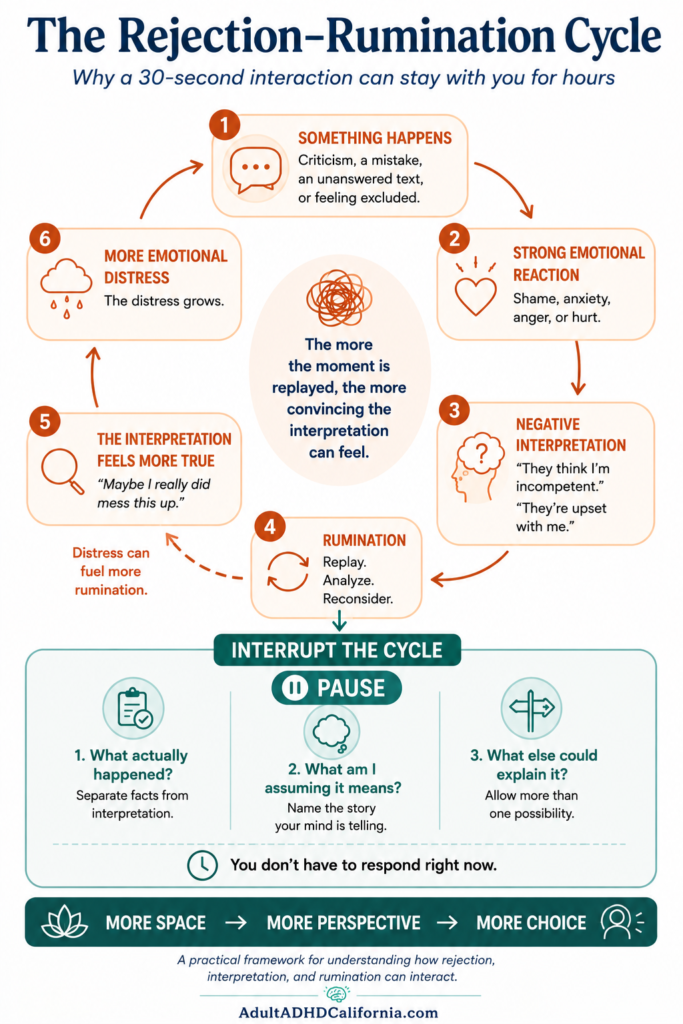
The cycle may look something like this:
Something happens
↓
Strong emotional reaction
↓
Negative interpretation
↓
Rumination
↓
The interpretation starts feeling increasingly true
↓
More emotional distress
The more you think about the event, the more important it feels.
And the more important it feels, the more your mind wants to keep thinking about it.
The Rejection-Rumination Cycle can make a brief interaction feel much bigger—and last much longer—than the original event. The infographic below shows how that cycle can build and where you can begin to interrupt it.
What Rejection Sensitive Dysphoria Can Look Like at Work
Workplaces provide almost endless opportunities for evaluation.
Performance reviews.
Deadlines.
Corrections.
Meetings.
Promotions.
Emails.
Feedback.
For someone who is highly sensitive to rejection, even normal workplace interactions can become emotionally loaded.
Your supervisor says:
“I’d like you to revise this section.”
You hear:
This isn’t good enough.
A coworker seems less friendly than usual during a meeting.
You think:
They’re annoyed with me.
You aren’t included in a meeting.
Your mind goes immediately to:
They don’t value my input anymore.
You make a mistake and spend the rest of the day wondering whether everyone has changed their opinion of you.
Feedback is a normal part of professional life.
But when every correction feels like a judgment about your competence, ordinary professional development becomes emotionally exhausting.
What It Can Look Like in Relationships
Relationships contain even more uncertainty.
Your partner seems quiet.
Their text is shorter than usual.
Their tone changes.
They go to bed without saying much.
For someone with strong rejection sensitivity, the mind may immediately begin searching for the problem.
Are you mad at me?
Did I do something?
Are we okay?
Sometimes asking for clarification is healthy.
But sometimes anxiety turns clarification into repeated reassurance-seeking.
Even after hearing:
“I’m fine. I’m just tired.”
the mind says:
Are you sure?
That can create an unfortunate cycle.
Fear of rejection leads to reassurance-seeking.
Repeated reassurance-seeking can create tension.
The tension then feels like evidence that the original fear was correct.
Recognizing the cycle makes it easier to interrupt.
What It Can Look Like in Friendships
Rejection sensitivity can also make friendships feel unexpectedly fragile.
A friend cancels plans.
You are not invited to something.
A group chat becomes quiet after you send a message.
Someone reacts enthusiastically to another person’s post but not yours.
Each event may have many possible explanations.
But when your mind is primed to expect rejection, ambiguity can quickly become certainty.
They don’t really like me.
I’m the person they tolerate, not the person they actually want around.
I must have done something.
Sometimes exclusion is real.
Sometimes relationships do change.
The goal is not to assume rejection never happens.
The goal is to avoid deciding what an ambiguous event means before you actually have enough information.
Rejection Can Send You Outward—or Inward
Not everyone responds to criticism or rejection in the same way.
Some reactions go outward.
You may:
- Become defensive
- Argue
- Become irritable
- Criticize the other person
- Send the angry email
- Push someone away
Other reactions go inward.
You may:
- Feel ashamed
- Withdraw
- Become quiet
- Criticize yourself
- Replay the situation repeatedly
- Avoid the person afterward
And some people experience both.
You become defensive during the conversation.
Then you spend the next three hours criticizing yourself for becoming defensive.
There is also another response that can be much harder to recognize.
Instead of reacting strongly after rejection happens, you may organize your life around preventing rejection from happening at all.
When Fear of Rejection Looks Like Perfectionism
Some adults with ADHD do not appear particularly sensitive to criticism.
They appear extremely competent.
They prepare.
Then they prepare some more.
They check everything.
Then they check it again.
They arrive early.
They rarely ask for help.
They take responsibility for things other people would delegate.
They stay late because submitting imperfect work feels intolerable.
From the outside, this can look like conscientiousness.
And some of it may genuinely be conscientiousness.
But underneath it may be another rule:
If I don’t make mistakes, nobody can criticize me.
That rule can become a powerful engine for achievement.
It can also become exhausting.
See related article: Perfectionism and ADHD
ADHD Masking, Overachievement, and the Fear of Being Found Out
For some adults, especially those diagnosed with ADHD later in life, years of compensation can make their difficulties almost invisible to other people.
They develop systems.
They overprepare.
They rehearse.
They double-check.
They work longer.
They hide how difficult ordinary tasks can feel.
This is one way ADHD masking [LINK PENDING] can show up.
Emerging research has begun examining the experiences of adults who appear to function well by external measures while experiencing considerable internal distress, as well as masking and compensatory behavior in adults with ADHD (de Melo & Franca, 2026; Maeda et al., 2026).
Fear of criticism can become part of that compensation.
The pattern may look something like:
Fear of criticism → overpreparation → perfectionism → masking → exhaustion
Direct research proving that exact sequence remains limited.
But the experience is clinically recognizable.
And it helps explain something important:
Success can hide ADHD.
A person can have advanced education, a demanding career, a successful business, or a reputation for being extremely dependable and still expend enormous amounts of energy compensating for ADHD symptoms.
Competence does not necessarily mean life feels easy.
Rejection Sensitivity in High-Achieving Adults
For some high-achieving adults, success becomes a form of protection.
If you perform well enough, perhaps nobody will criticize you.
If you prepare for every possible question, perhaps nobody can catch you unprepared.
If you handle everything yourself, perhaps nobody will be disappointed.
That may lead to:
- Excessive preparation
- Difficulty delegating
- Repeated checking
- Working longer than necessary
- Avoiding unfamiliar challenges
- Feeling devastated by relatively minor mistakes
There is a frustrating paradox here.
The strategy can work.
You may become the reliable employee.
The high performer.
The person everyone assumes has everything under control.
See related page: ADHD in High-Achieving Adults
But the internal cost can be anxiety, exhaustion, or burnout.
See related article: ADHD Burnout
Achievement may reduce the opportunities for criticism without ever changing the underlying fear of criticism.
Then, when criticism inevitably occurs, it can still feel devastating.
When Rejection Hasn't Actually Happened
One of the most useful skills for managing rejection sensitivity is learning to separate the event from the interpretation.
Consider the unanswered text again.
The Event
They haven’t responded.
The Interpretation
They’re upset with me.
Those are different statements.
The interpretation might be correct.
But it might also be wrong.
They could be working.
Driving.
Taking care of their children.
Distracted.
Exhausted.
Planning to answer later.
Or they may actually be upset.
The goal is not to convince yourself that everything is fine.
That can become another kind of distorted thinking.
The goal is to recognize:
I don’t know yet.
For someone who struggles with uncertainty, those four words can be surprisingly difficult.
But they create something important:
space between what happened and what you fear it means.
Rejection Sensitivity Is Not Unique to ADHD
Strong sensitivity to rejection can occur with ADHD.
But it is not unique to ADHD.
Rejection sensitivity has also been associated with anxiety, depression, and other forms of psychological distress (Gao et al., 2017).
Similar experiences may occur in the context of:
- Social anxiety
- Depression
- Trauma-related conditions
- Autism
- Mood disorders
- Relationship or attachment difficulties
- Certain personality disorders
These conditions can also occur alongside ADHD.
See related article: ADHD and Anxiety
That is why intense reactions to rejection cannot tell you, by themselves, whether you have ADHD.
A comprehensive ADHD evaluation looks at the broader pattern:
- Attention
- Impulsivity
- Executive functioning
- Developmental history
- Symptoms beginning in childhood
- Functional impairment
- Other possible explanations for the symptoms
See related article: Executive Dysfunction in Adults With ADHD
The goal is not simply to find the label that sounds most familiar.
The goal is to understand what is actually driving the difficulty.
If rejection sensitivity is occurring alongside longstanding difficulties with attention, organization, procrastination, forgetfulness, time management, or other executive function challenges, learning more about adult ADHD diagnosis may help put those experiences into a larger context.
See related page: Adult ADHD Diagnosis in California: What to Expect
Does ADHD Medication Help Rejection Sensitive Dysphoria?
This is an area where online claims often go beyond the available evidence.
There is currently no credible clinical-trial evidence showing that a medication specifically treats a separate condition called Rejection Sensitive Dysphoria.
That includes claims that certain medications are uniquely effective for “RSD.”
The research asks a somewhat different question:
Can ADHD medication improve emotional dysregulation?
Here, the answer is more encouraging.
Systematic reviews suggest that ADHD medications can produce modest improvements in emotional dysregulation in adults with ADHD, although the degree of improvement varies and appears to overlap substantially with improvement in core ADHD symptoms (Lenzi et al., 2018; Surman & Walsh, 2022).
For some people, treating ADHD may help them:
- Pause more easily before reacting
- Manage frustration more effectively
- Shift attention away from an upsetting event
- Reduce impulsive reactions
- Recover more quickly after emotional triggers
But medication is not an eraser for every painful emotional response.
And if years of difficult experiences have contributed to beliefs such as:
I’m incompetent.
I’m disappointing.
I’m going to fail.
medication alone may not change those beliefs.
That is where other forms of treatment can become important.
Can Therapy Help With Rejection Sensitivity and ADHD?
Therapy can help with a different part of the cycle.
The initial emotional response may happen quickly.
But what happens next is not necessarily predetermined.
Therapy can help someone begin to notice:
What happened?
What did I assume it meant?
What emotion followed?
What did I feel compelled to do?
Was there another possible interpretation?
Cognitive behavioral therapy (CBT) has evidence supporting its use in adults with ADHD, including benefits for ADHD symptoms and some associated symptoms of anxiety and depression (Lopez et al., 2018; Liu et al., 2026).
Depending on the individual, treatment may also involve:
- Emotional regulation skills
- Cognitive restructuring
- Mindfulness
- Distress tolerance
- Reducing rumination
- Increasing tolerance for uncertainty
- Addressing anxiety or depression
- Examining beliefs about failure, competence, or worth
The specific treatment should fit the person.
There is no one-size-fits-all approach.
The larger goal is to create more space between:
Something happened.
and:
Here is what I believe it means.
That space creates options.
What to Do When Rejection Hits
Understanding rejection sensitivity is useful.
But when your stomach has already dropped and your mind is racing, you need something practical.
Here is a simple sequence to try.
1. Name the Reaction
Start with:
“I’m having a strong reaction right now.”
Notice what you did not say.
Not:
“I’m being ridiculous.”
Not:
“I shouldn’t feel this way.”
You are simply identifying what is happening.
That creates a small amount of distance between you and the reaction.
2. Ask: What Actually Happened?
Strip away the interpretation.
My boss asked me to revise the report.
My friend hasn’t answered my text.
My partner seems quiet.
I wasn’t invited to the meeting.
Start with what you know.
3. Ask: What Am I Telling Myself It Means?
Now identify the interpretation.
My boss thinks I’m incompetent.
My friend is angry with me.
My partner is losing interest in me.
My coworkers don’t respect me.
Seeing the event and the interpretation separately can be surprisingly powerful.
4. Allow More Than One Explanation
Do not force yourself into positive thinking.
Instead, practice flexible thinking.
Ask:
“What are three possible explanations for this?”
Your feared explanation can be one of them.
Just do not let it automatically become the only one.
5. Delay the Response
Strong emotions create urgency.
Respond now.
Defend yourself.
Send another text.
Explain everything.
Quit.
Withdraw.
But emotional urgency is not always actual urgency.
If the situation allows it, give yourself time before responding.
6. Regulate Before You Problem-Solve
If you are emotionally flooded, more analysis may not help.
Move your body.
Take a walk.
Slow your breathing.
Step away from the email.
Give the emotional intensity time to decrease.
Then return to the problem.
7. Decide Whether Clarification Is Needed
Sometimes the healthiest response is simply to ask.
“I wasn’t sure how to interpret what happened earlier. Can we talk about it?”
But ask because clarification would genuinely be useful—not simply because anxiety demands immediate reassurance.
Learning the difference takes practice.
The Goal Is Not to Stop Caring What People Think
Rejection hurts because relationships matter.
Criticism hurts because competence matters.
Disappointing someone hurts because we care.
The goal of emotional regulation is not to become emotionally numb.
It is not to reach a place where you can say:
“I don’t care what anyone thinks about me.”
The goal is greater choice.
Right now, the process may happen almost instantaneously:
Event → Emotion → Interpretation → Reaction
Someone criticizes you.
Your stomach drops.
You decide they think you are incompetent.
You become defensive.
Or you withdraw.
Or you spend the rest of the day thinking about it.
With understanding and practice, you can begin to create another step:
Event → Emotion → Pause → Interpretation → Choice
The criticism may still hurt.
But the hurt does not automatically decide what happens next.
That is meaningful progress.
Moving Forward
Return to the supervisor from the beginning.
“This looks good. There are just a couple of things I’d like you to change.”
Your stomach may still drop.
Your first thought may still be:
I screwed this up.
The goal is not necessarily to eliminate that first reaction.
The change may come in what happens next.
You begin to recognize it.
There it is.
I’m feeling criticized.
My mind is turning this into something bigger.
What actually happened?
What do I know?
What am I assuming?
And eventually:
“I don’t like this feeling, but this feeling isn’t necessarily telling me the whole story.”
That may be the most useful way to understand what people often call Rejection Sensitive Dysphoria.
The term itself is not an established diagnosis.
But the experiences people are trying to describe with it deserve to be understood.
ADHD can make emotional regulation more difficult.
Rejection sensitivity can make ambiguous situations feel threatening.
Years of correction may influence expectations.
Anxiety, shame, and rumination can amplify the reaction.
Understanding those patterns replaces:
“Why am I like this?”
with:
“I understand what may be happening.”
And understanding creates options.
The goal is not to never feel rejected.
It is not to never make mistakes.
And it is not to stop caring what other people think.
The goal is to reach a point where criticism can be criticism, a mistake can be a mistake, and an unanswered text can remain an unanswered text long enough for you to find out what it actually means.
Key Takeaways
- Rejection Sensitive Dysphoria (RSD) is not an official diagnosis, but the intense reactions people use the term to describe can be very real.
- ADHD can make emotional regulation more difficult. Criticism, disappointment, or perceived rejection may trigger emotions that arrive quickly, feel unusually intense, or take longer to settle.
- Rejection sensitivity is not the same as RSD. Rejection sensitivity is a well-studied psychological pattern involving the tendency to expect, perceive, and react strongly to rejection.
- Past experiences may matter. Years of correction, mistakes, peer difficulties, or feeling that you have fallen short can shape how you interpret criticism later in life.
- The reaction is often about more than the event itself. A simple mistake can become “I’m a failure,” and an unanswered text can become “They’re upset with me.”
- Rumination can keep the pain going. Replaying conversations, analyzing someone’s tone, and searching for what went wrong can make a brief interaction feel much larger and longer-lasting.
- Fear of rejection can sometimes look like perfectionism or overachievement. Overpreparing, people-pleasing, masking difficulties, and avoiding mistakes may become ways of trying to prevent criticism.
- Treatment can help. ADHD treatment, therapy, emotional regulation skills, and treatment of co-occurring anxiety or depression may all reduce the impact of these reactions.
- The goal is not to stop caring what other people think. The goal is to create more space between the event, the emotion, the interpretation, and the response—so you have more choice over what happens next.
Frequently Asked Questions About Rejection Sensitive Dysphoria and ADHD
Is Rejection Sensitive Dysphoria a symptom of ADHD?
Rejection Sensitive Dysphoria (RSD) is commonly discussed in connection with ADHD, but it is not an official ADHD symptom or diagnostic criterion.
What is better established is that many adults with ADHD experience difficulties with emotional regulation, and some research suggests an association between ADHD symptoms and increased rejection sensitivity. These overlapping experiences may help explain why the term RSD feels so accurate to some people with ADHD.
See related article: Emotional Regulation and ADHD
Is Rejection Sensitive Dysphoria a real diagnosis?
No. Rejection Sensitive Dysphoria is not currently recognized as a separate psychiatric diagnosis, and there are no established diagnostic criteria or validated tests specifically for RSD.
That does not mean the emotional experience is not real. The intense reactions described as RSD overlap with recognized and better-studied concepts such as emotional dysregulation, rejection sensitivity, anxiety, and rumination.
What does Rejection Sensitive Dysphoria feel like?
People who identify with RSD often describe an unusually intense emotional response to criticism, rejection, disappointment, failure, or the belief that someone is upset with them.
It might feel like a sudden wave of shame, anxiety, anger, sadness, or embarrassment. Some people become defensive or withdraw, while others replay the interaction repeatedly and struggle to think about anything else.
What triggers rejection sensitivity in adults with ADHD?
Triggers vary from person to person. Common examples include criticism at work, making a mistake, being excluded, receiving a short or ambiguous message, disappointing someone, not receiving a response to a text, or believing another person is upset.
Sometimes rejection has actually occurred. Other times, uncertainty is interpreted as rejection before enough information is available.
Why does criticism feel so intense with ADHD?
There may be several contributing factors. ADHD can involve difficulty regulating emotional reactions, which may cause emotions to arise quickly and feel especially intense.
Past experiences may matter too. Years of correction, mistakes, peer difficulties, or feeling that you are falling short can influence how later criticism is interpreted. Anxiety, shame, and rumination can then amplify the original reaction.
Can you have rejection sensitivity without ADHD?
Yes. Rejection sensitivity is not unique to ADHD.
It has also been associated with anxiety, depression, and other forms of psychological distress. Similar reactions can occur with social anxiety, trauma-related conditions, autism, relationship difficulties, and certain personality disorders.
Experiencing rejection sensitivity by itself does not mean someone has ADHD.
Is rejection sensitivity more common in high-achieving adults with ADHD?
High achievement does not protect someone from rejection sensitivity. In some adults, fear of criticism or failure may contribute to behaviors such as perfectionism, overpreparation, repeated checking, people-pleasing, or masking ADHD difficulties.
These strategies can help someone perform very well while also requiring tremendous effort. Success can hide the struggle occurring underneath it.
See related page: ADHD in High-Achieving Adults
Does ADHD medication help Rejection Sensitive Dysphoria?
There is currently no established medication specifically approved or proven to treat Rejection Sensitive Dysphoria as a separate condition.
However, ADHD medications may improve emotional regulation for some people with ADHD. If treatment makes it easier to pause before reacting, manage frustration, or shift attention away from an upsetting experience, emotional reactions to criticism or rejection may become easier to manage as well.
Medication decisions should be individualized and based on a comprehensive evaluation rather than on an RSD label alone.
Can therapy help with rejection sensitivity and ADHD?
Yes. Therapy can help people recognize the thoughts and behaviors that occur after a strong emotional reaction.
Approaches such as cognitive behavioral therapy (CBT) may help with identifying automatic interpretations, reducing rumination, challenging all-or-nothing conclusions, tolerating uncertainty, and developing more effective emotional regulation skills. Treatment may also address co-occurring anxiety or depression when these are contributing to rejection sensitivity.
What can I do when I feel rejected or criticized?
A useful first step is to separate what happened from what you think it means.
For example:
What happened: “My supervisor asked me to revise the report.”
What I think it means: “My supervisor thinks I’m incompetent.”
Then pause before responding, consider other possible explanations, and give the emotional intensity time to decrease.
The goal is not to convince yourself that rejection never happens. It is to create enough space between the event, emotion, interpretation, and response that you can decide what to do next rather than reacting automatically.
Does having Rejection Sensitive Dysphoria mean I have ADHD?
No. Intense reactions to rejection or criticism cannot diagnose ADHD.
ADHD diagnosis requires a much broader evaluation of attention, impulsivity, executive functioning, developmental history, symptoms beginning in childhood, functional impairment, and other possible explanations for the symptoms.
If rejection sensitivity occurs alongside longstanding difficulties with focus, organization, procrastination, forgetfulness, time management, or other executive function challenges, learning more about the ADHD evaluation process may help clarify what is contributing to those difficulties.
See related page: Adult ADHD Diagnosis in California: What to Expect
Learn More About ADHD Evaluations
If difficulties with rejection sensitivity occur alongside longstanding problems with attention, procrastination, organization, forgetfulness, emotional regulation, or other executive function challenges, understanding whether ADHD may be contributing can be an important next step.
See related page: ADHD Evaluation and Treatment in Southern California
References
American Psychiatric Association. (2022). Diagnostic and statistical manual of mental disorders (5th ed., text rev.).
Beheshti, A., Chavanon, M. L., & Christiansen, H. (2020). Emotion dysregulation in adults with attention deficit hyperactivity disorder: A meta-analysis. BMC Psychiatry, 20(1), 120. https://doi.org/10.1186/s12888-020-2442-7
Bondü, R., & Esser, G. (2015). Justice and rejection sensitivity in children and adolescents with ADHD symptoms. European Child & Adolescent Psychiatry, 24(2), 185–198. https://doi.org/10.1007/s00787-014-0560-9
de Melo, I. H., & Franca, G. (2026). High functioning, yet high suffering: The need to incorporate invisible struggles in adult ADHD diagnostic assessment/criteria. Frontiers in Psychiatry, 17, 1813029. https://doi.org/10.3389/fpsyt.2026.1813029
Downey, G., & Feldman, S. I. (1996). Implications of rejection sensitivity for intimate relationships. Journal of Personality and Social Psychology, 70(6), 1327–1343. https://doi.org/10.1037/0022-3514.70.6.1327
Faraone, S. V., Rostain, A. L., Blader, J., et al. (2019). Practitioner review: Emotional dysregulation in attention-deficit/hyperactivity disorder—Implications for clinical recognition and intervention. Journal of Child Psychology and Psychiatry, 60(2), 133–150. https://doi.org/10.1111/jcpp.12899
Gao, S., Assink, M., Cipriani, A., & Lin, K. (2017). Associations between rejection sensitivity and mental health outcomes: A meta-analytic review. Clinical Psychology Review, 57, 59–74. https://doi.org/10.1016/j.cpr.2017.08.007
Lenzi, F., Cortese, S., Harris, J., & Masi, G. (2018). Pharmacotherapy of emotional dysregulation in adults with ADHD: A systematic review and meta-analysis. Neuroscience & Biobehavioral Reviews, 84, 359–367. https://doi.org/10.1016/j.neubiorev.2017.08.010
Liu, Y., Zhu, F., Yu, Y., et al. (2026). A meta-analysis of the intervention effect of cognitive behavioral therapy on adult ADHD. Journal of Affective Disorders. Advance online publication. https://doi.org/10.1016/j.jad.2025.121107
Lopez, P. L., Torrente, F. M., Ciapponi, A., et al. (2018). Cognitive-behavioural interventions for attention deficit hyperactivity disorder (ADHD) in adults. Cochrane Database of Systematic Reviews, 3, CD010840. https://doi.org/10.1002/14651858.CD010840.pub2
Maeda, C., Knouse, L. E., Takeda, K., et al. (2026). A narrative review of stigma and masking in ADHD: Insights from English-language research and the Japanese cultural context. Frontiers in Psychology, 17, 1807337. https://doi.org/10.3389/fpsyg.2026.1807337
Miklósi, M., Máté, O., Somogyi, K., & Szabó, M. (2016). Adult attention deficit hyperactivity disorder symptoms, perceived stress, and well-being: The role of early maladaptive schemata. The Journal of Nervous and Mental Disease, 204(5), 364–369. https://doi.org/10.1097/NMD.0000000000000472
Russell, A., Hoxha, D., & Murray, A. (2025). Developmental relations between ADHD and self-esteem: Evaluating peer problems as a mediating mechanism. European Child & Adolescent Psychiatry. Advance online publication. https://doi.org/10.1007/s00787-025-02752-3
Soler-Gutiérrez, A. M., Pérez-González, J. C., & Mayas, J. (2023). Evidence of emotion dysregulation as a core symptom of adult ADHD: A systematic review. PLoS ONE, 18(1), e0280131. https://doi.org/10.1371/journal.pone.0280131
Stewart, L. C., Sorid, S. D., & Olino, T. M. (2026). Rumination and rejection sensitivity: A meta-analysis. Journal of Clinical Psychology, 82(7), 1016–1029. https://doi.org/10.1002/jclp.70136
Surman, C. B. H., & Walsh, D. M. (2022). Do treatments for adult ADHD improve emotional behavior? A systematic review and analysis. Journal of Attention Disorders, 26(14), 1822–1832. https://doi.org/10.1177/10870547221110926