
Table of Contents
ToggleDecision Fatigue and ADHD: Why Everyday Choices Can Feel So Exhausting
Why choosing what to do next, what to buy, or even what to eat can feel surprisingly exhausting—and what ADHD has to do with it.
You open your laptop on Monday morning.
You need to answer emails, return a phone call, finish a report, pay a bill, schedule a doctor’s appointment, and decide which project deserves your attention first.
Thirty minutes later, you’ve barely started.
You weren’t scrolling social media.
You weren’t avoiding work on purpose.
You weren’t being lazy.
Instead, your brain was stuck deciding.
Which task is most important?
Which one is most urgent?
Which one will take the least time?
Which one should happen first?
For many adults with ADHD, this experience is surprisingly common. Some people can lead teams, run businesses, make high-stakes decisions at work, and solve complex problems for clients—yet feel completely overwhelmed trying to decide what to eat for dinner or which household task to tackle first.
“Why Can I Make Big Decisions at Work but Not Choose Dinner?”
If that sounds familiar, you’re not alone.
Decision-making requires mental energy. Every choice places demands on the brain systems responsible for planning, prioritizing, evaluating options, and initiating action. When those systems are already working harder because of ADHD, even seemingly simple decisions can become exhausting.
This is where the concept of decision fatigue becomes useful.
While researchers continue to debate exactly how decision fatigue works, there is growing evidence that repeated decision-making can reduce the quality and efficiency of subsequent decisions, especially when cognitive resources are already strained (Maier et al., 2025).
Understanding decision fatigue can help explain why everyday choices sometimes feel disproportionately difficult for adults with ADHD—and what you can do about it.
What Is Decision Fatigue and Why Does It Matter for Adults With ADHD?
Decision fatigue refers to the tendency for decision-making quality and efficiency to decline after prolonged periods of mental effort or repeated choices.
Researchers describe it as a state in which people become more likely to avoid decisions, delay decisions, rely on shortcuts, choose default options, or make impulsive choices after engaging in sustained decision-making (Pignatiello et al., 2022; Maier et al., 2025).
In practical terms, decision fatigue can look like:
- Procrastinating instead of choosing
- Feeling overwhelmed by options
- Constantly second-guessing yourself
- Choosing the easiest option rather than the best one
- Avoiding important decisions altogether
- Becoming mentally exhausted by routine choices
Importantly, decision fatigue is not the same thing as ordinary tiredness.
You can be physically rested and still experience decision fatigue.
Likewise, you can feel energetic yet become mentally overloaded after hours of evaluating options, switching priorities, solving problems, and making decisions.
The issue is not simply a lack of energy. It is the cumulative mental burden associated with repeated decision-making.
Is Decision Fatigue a Real Psychological Phenomenon?
The short answer is yes—but the science is more nuanced than many popular articles suggest.
The concept of decision fatigue emerged from research on self-regulation and the theory known as ego depletion, which proposed that self-control operates like a limited resource. According to this model, people become less effective at regulating behavior and making decisions after repeatedly exerting mental effort.
Over time, researchers began studying whether repeated decision-making itself could impair later choices.
Some findings supported the idea. People appeared more likely to:
- Delay decisions
- Choose default options
- Avoid effortful thinking
- Make impulsive choices
after sustained periods of decision-making.
However, not all studies produced the same results.
A 2025 systematic review examining 82 studies found evidence supporting decision-fatigue effects in approximately 45% of cases, while also noting that researchers often define and measure the concept differently (Maier et al., 2025).
Researchers now generally view decision fatigue as a plausible and partially supported phenomenon rather than a completely settled scientific fact. Motivation, stress, environmental factors, beliefs about willpower, and individual differences appear to influence how strongly people experience it.
In other words, the exact mechanisms remain debated.
But the real-world experience of becoming mentally overloaded by repeated decisions is well recognized by both researchers and clinicians.
Why Decision Fatigue and ADHD Often Go Hand in Hand
Decision fatigue is not unique to ADHD.
Anyone can experience it.
However, several core features of ADHD may increase vulnerability.
Executive Dysfunction
Executive functions are the brain’s management system.
They help us:
- Prioritize
- Plan
- Organize
- Shift attention
- Hold goals in mind
- Initiate action
ADHD is associated with impairments in these executive functions (Posner et al., 2020).
Every decision requires executive resources.
When deciding what task to start, your brain must evaluate options, estimate effort, predict consequences, and choose a course of action.
For someone with ADHD, these processes often require more effort from the start.
As a result, the mental “cost” of decision-making may be higher.
This is closely related to the challenges discussed in our article on What Is Executive Dysfunction?
Working Memory Limitations
Working memory allows you to temporarily hold and manipulate information.
Decision-making often requires comparing multiple possibilities simultaneously.
For example:
- Which project should I do first?
- Which restaurant should we choose?
- Which insurance plan makes the most sense?
The more options you must keep active in mind, the greater the cognitive load.
Because working memory weaknesses are common in ADHD, complex decisions can become overwhelming more quickly.
Time Blindness
Adults with ADHD often struggle to accurately evaluate time, future consequences, urgency, and long-term rewards.
Researchers have found that ADHD is associated with greater preference for immediate rewards and difficulty weighing delayed outcomes.
This can make decision-making harder.
A task due tomorrow may not feel meaningfully different from a task due next week.
A long-term benefit may not carry enough psychological weight compared with immediate discomfort.
These challenges are discussed further in Adult ADHD and Time Blindness.
Task Initiation Problems
Many people assume decision-making ends once a choice is made.
In reality, decisions and action are closely connected.
Adults with ADHD frequently experience difficulty initiating tasks, especially when tasks feel large, ambiguous, or emotionally uncomfortable.
Often, decision fatigue appears immediately before task initiation.
The person is not simply avoiding work.
They may be stuck evaluating possibilities, priorities, and next steps.
Emotional Regulation
Decision-making is not purely logical.
Emotions play a major role.
Adults with ADHD commonly experience:
- Anxiety
- Frustration
- Perfectionism
- Fear of failure
- Fear of making the wrong choice
When emotions become involved, decisions become heavier.
Instead of asking:
“Which option is best?”
the brain may begin asking:
“What if I make a mistake?”
or
“What if I regret this later?”
This emotional load increases the mental burden of decision-making and can amplify fatigue.
For more on this topic, see Adult ADHD and Emotional Regulation and ADHD and Perfectionism.
How Decision Fatigue Affects Adults With ADHD
Decision fatigue can affect nearly every area of life.
At Work
Many professionals with ADHD spend significant portions of the day deciding what deserves attention.
Common examples include:
- Constantly reprioritizing tasks
- Difficulty deciding where to begin
- Delaying important projects
- Email paralysis
- Repeatedly reviewing the same options
- Excessive planning without execution
Ironically, the more responsibilities someone has, the more opportunities exist for decision fatigue to develop.
At Home
Home environments often contain hundreds of small decisions.
Examples include:
- What should we eat tonight?
- Which chore should I do first?
- When should I schedule that appointment?
- Should I clean, exercise, or run errands?
Each individual decision may seem insignificant.
Collectively, they can become exhausting.
In Relationships
Decision fatigue can also affect interpersonal functioning.
People may:
- Avoid difficult conversations
- Delay making plans
- Struggle to choose activities
- Feel overwhelmed by scheduling decisions
Partners sometimes misinterpret this as disinterest or indecisiveness.
In reality, the person may simply be mentally overloaded.
Financial Decisions
Financial decisions often require evaluating risk, future consequences, and multiple competing options.
Adults with ADHD may find themselves:
- Delaying purchases
- Over-researching products
- Postponing investments
- Avoiding budgeting
- Putting off financial planning
The problem is rarely a lack of intelligence.
Instead, the decision process itself becomes mentally exhausting.
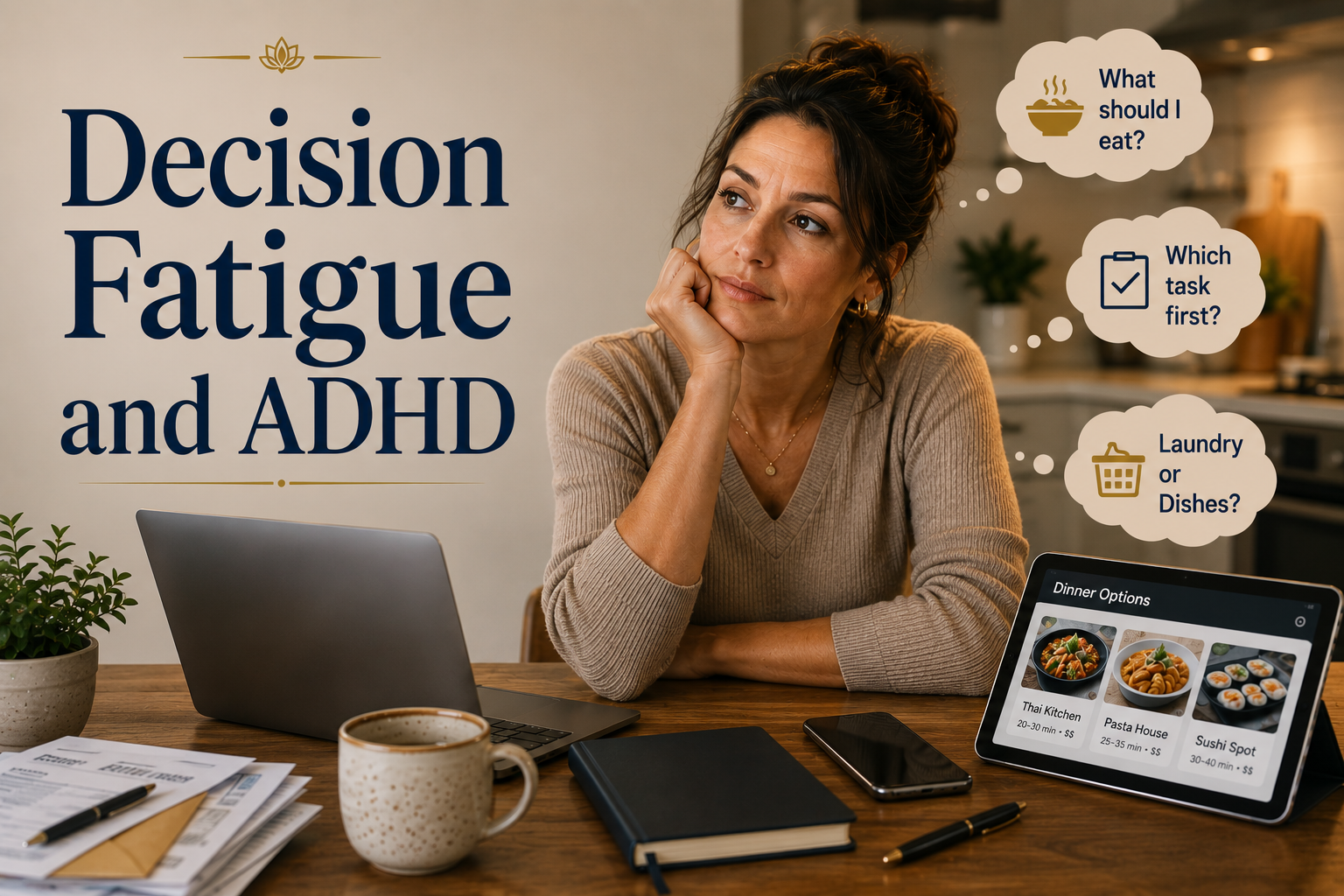
If you’ve ever wondered how you can manage complex projects, lead meetings, solve difficult problems, and still struggle to decide what’s for dinner, you’re not alone. Many adults with ADHD experience a surprising gap between what they are capable of doing and how difficult everyday decisions can feel. The graphic below illustrates a common experience reported by high-achieving adults with ADHD.
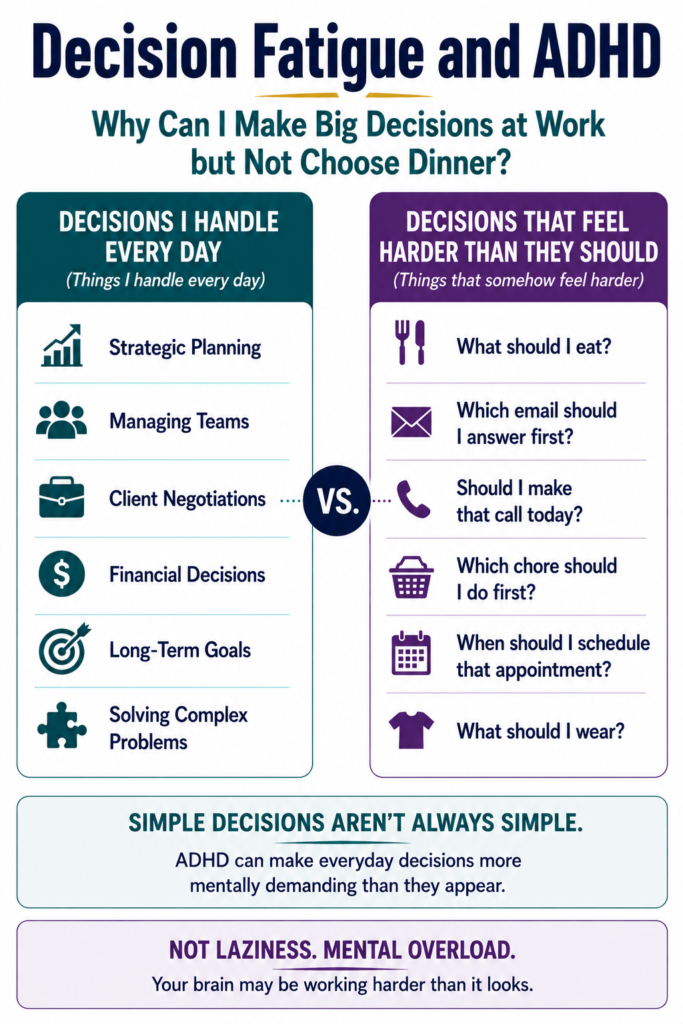
Decision Fatigue and ADHD in High-Achieving Adults
Many high-achieving adults feel embarrassed by decision fatigue.
They wonder:
“If I’m capable of leading a company, why can’t I decide what to order for lunch?”
The answer is simple.
Decision fatigue is not a measure of intelligence.
In fact, highly successful professionals may be especially vulnerable.
Executives, entrepreneurs, physicians, attorneys, business owners, and managers often spend their entire day making decisions.
Every meeting, email, staffing issue, budget discussion, client interaction, and strategic choice consumes executive resources.
By evening, those resources may be depleted.
This helps explain why successful adults often report feeling incapable of making seemingly simple personal decisions after work.
The issue is not competence.
The issue is cumulative cognitive demand.
Many adults diagnosed later in life recognize this pattern only after learning more about ADHD and executive functioning.
For more on this experience, see Why Wasn’t My ADHD Diagnosed Until Adulthood? and Can You Be Successful With ADHD? What the Research Really Shows.
How Decision Fatigue and ADHD Contribute to Procrastination and Burnout
Decision fatigue rarely exists in isolation.
Instead, it often becomes part of a self-reinforcing cycle.
The cycle frequently looks like this:
- Many decisions create cognitive overload.
- Cognitive overload makes decisions harder.
- Harder decisions increase procrastination.
- Procrastination creates stress.
- Stress contributes to burnout.
- Burnout further impairs decision-making.
Research suggests procrastination and decision fatigue share common roots in self-regulation difficulties. Individuals experiencing decision fatigue are more likely to delay decisions or avoid them altogether.
Burnout can further worsen the problem.
Studies have found significant relationships between burnout and procrastination, suggesting that emotional exhaustion can impair self-regulation and decision-making.
For adults with ADHD, these problems often compound one another.
This is why many people simultaneously struggle with:
- Procrastination
- Burnout
- Executive dysfunction
- Decision paralysis
Understanding the connection can reduce self-blame and help identify practical solutions.
Decision Fatigue and ADHD vs. Executive Dysfunction: What's the Difference?
Although the concepts overlap, they are not identical.
Executive dysfunction refers to broader difficulties involving:
- Planning
- Organization
- Working memory
- Inhibition
- Cognitive flexibility
- Task initiation
Executive dysfunction is considered a core feature of ADHD.
Decision fatigue, in contrast, refers specifically to the decline in decision-making efficiency or quality that can occur after repeated mental effort and decision-making demands.
One way to think about it is this:
Executive dysfunction is the underlying vulnerability.
Decision fatigue is one possible outcome.
A person with ADHD may begin the day with executive-function challenges already present. As decisions accumulate, those challenges may become more noticeable.
The two concepts frequently reinforce each other.
How to Manage Decision Fatigue and ADHD
There is no single solution for decision fatigue.
However, several evidence-based and clinically supported approaches can reduce decision burden and improve functioning.
Reduce Decision Load
One of the most effective strategies is simply making fewer decisions.
Examples include:
- Meal planning
- Standardized morning routines
- Recurring grocery lists
- Clothing systems
- Checklists
- Templates
Many highly successful people intentionally reduce routine decisions to preserve mental energy for more important choices.
Use External Systems
External systems help offload executive demands.
Examples include:
- Digital calendars
- Task management systems
- Project boards
- Reminder systems
- Written plans
When information exists outside your brain, fewer decisions must be recreated repeatedly.
Limit Choices
More options do not always improve outcomes.
In many situations, fewer choices reduce cognitive load and make action easier.
Examples include:
- Choosing from three meal options instead of thirty
- Creating a short list of preferred restaurants
- Using predefined task categories
- Limiting online comparison shopping
Create Environmental Structure
Research and clinical experience suggest that workflow design matters. Reducing decision density, prioritizing important decisions, using breaks strategically, and creating supportive systems can reduce cumulative decision burden.
Many decisions can be made once and automated.
The less frequently you must decide, the less energy you expend.
Treat ADHD When Appropriate
ADHD treatment can improve the executive functions that support decision-making.
Research suggests stimulant medications and atomoxetine improve several domains of executive functioning, including attention, inhibition, processing speed, and working memory.
Medication is not a cure for decision fatigue.
However, improving the underlying executive-function system may reduce vulnerability.
Other evidence-based treatments include:
- Cognitive behavioral therapy (CBT)
- ADHD coaching
- Skills-based interventions
- Organizational training
Learn more in:
- Adult ADHD Treatment
- How CBT Helps Adults With ADHD
- Medication vs Therapy for Adult ADHD
- What If ADHD Medication Doesn’t Work?
Protect Cognitive Health
Research also supports protecting the biological foundations of cognitive performance through:
- Adequate sleep
- Regular aerobic exercise
- Stress management
- Healthy dietary patterns
- Treatment of co-occurring conditions such as anxiety, depression, and sleep disorders
When cognitive reserve improves, decision-making often becomes easier.
Common Myths About Decision Fatigue and ADHD
Myth: “I’m Just Indecisive.”
Reality: Decision fatigue often reflects cognitive overload rather than a fixed personality trait.
Many adults who appear indecisive make excellent decisions when cognitive demands are lower.
Myth: “If I Were More Disciplined, This Wouldn’t Happen.”
Reality: Decision fatigue affects highly motivated, successful, and disciplined people.
In fact, people with greater responsibilities may face more opportunities for decision fatigue because they make more decisions throughout the day.
Myth: “Making More Decisions Will Make Me Better at It.”
Reality: Repeated decisions can sometimes reduce decision quality rather than improve it.
Research suggests that as mental demands accumulate, people become more likely to rely on shortcuts, defaults, avoidance, or impulsive choices.
Key Takeaways
Decision fatigue refers to the mental strain that can develop after repeated decision-making.
Although researchers continue to debate exactly how the phenomenon works, evidence suggests that sustained decision demands can make future decisions more difficult and less efficient.
Adults with ADHD may be especially vulnerable because decision-making relies heavily on executive functions such as planning, working memory, prioritization, and self-regulation.
If everyday choices feel overwhelming, that does not mean you are lazy, unintelligent, or incapable.
It may mean your brain is carrying too much decision load.
Reducing unnecessary decisions, building external systems, treating ADHD appropriately, and protecting cognitive health can all help preserve mental resources and improve functioning.
Understanding the relationship between decision fatigue and ADHD can help reduce self-blame and improve daily functioning.
If decision fatigue is contributing to procrastination, overwhelm, or burnout, practical ADHD skills can make a meaningful difference. The Skills Library articles Time Blocking for ADHD: How to Create Structure Without Feeling Trapped, Task Chunking for ADHD: How to Break Overwhelming Projects Into Small, Manageable Steps, and How to Start Tasks With ADHD: The Five-Minute Activation Exercise are excellent next steps.
Frequently Asked Questions About Decision Fatigue and ADHD
Is Decision Fatigue and ADHD a recognized connection?
Decision fatigue is not considered a core symptom of ADHD. However, ADHD-related challenges with executive functioning, working memory, prioritization, task initiation, and emotional regulation may make people more vulnerable to becoming mentally exhausted by repeated decisions.
Why can I make important decisions at work but struggle with simple decisions at home?
Many adults with ADHD spend significant mental energy making decisions throughout the day. By the time they face routine choices such as what to eat, which chore to do first, or whether to answer an email, their decision-making resources may already feel depleted. This does not mean they lack intelligence or capability.
Can decision fatigue cause procrastination?
Yes. Decision fatigue often increases the likelihood of delaying, avoiding, or postponing decisions. For many adults with ADHD, procrastination occurs when deciding what to do becomes mentally overwhelming.
How is decision fatigue different from executive dysfunction?
Executive dysfunction refers to broader difficulties involving planning, organization, working memory, inhibition, and task initiation. Decision fatigue refers to the mental strain that can develop after repeated decision-making. The two frequently overlap and can reinforce one another.
Does ADHD medication help with decision fatigue?
ADHD medication does not specifically treat decision fatigue. However, research suggests that stimulant and non-stimulant ADHD medications can improve executive functions such as attention, working memory, and inhibition, which may make decision-making less mentally demanding for some individuals.
How can I reduce decision fatigue with ADHD?
Many adults find it helpful to reduce unnecessary decisions through routines, meal planning, checklists, templates, time blocking, and external planning systems. ADHD treatment, cognitive behavioral therapy, coaching, adequate sleep, and stress management may also help reduce cognitive overload.
References
Baker, L. D., Espeland, M. A., Whitmer, R. A., et al. (2025). Structured vs self-guided multidomain lifestyle interventions for global cognitive function. JAMA, 334(8), 681–691.
Brody, D. L. (2025). Multidisciplinary cognitive performance optimization for mission-critical decision makers: Delivering “the whole pizza.” Frontiers in Neurology, 16, 1636406.
Carucci, S., Narducci, C., Bazzoni, M., et al. (2023). Clinical characteristics, neuroimaging findings, and neuropsychological functioning in attention-deficit hyperactivity disorder: Sex differences. Journal of Neuroscience Research, 101(5), 704–717.
Hall, N. C., Lee, S. Y., & Rahimi, S. (2019). Self-efficacy, procrastination, and burnout in post-secondary faculty: An international longitudinal analysis. PLOS ONE, 14(12), e0226716.
Isfandnia, F., El Masri, S., Radua, J., & Rubia, K. (2024). The effects of chronic administration of stimulant and non-stimulant medications on executive functions in ADHD: A systematic review and meta-analysis. Neuroscience & Biobehavioral Reviews, 162, 105703.
Maier, M., Powell, D., Murchie, P., & Allan, J. L. (2025). Systematic review of the effects of decision fatigue in healthcare professionals on medical decision-making. Health Psychology Review, 19(4), 717–762.
Pignatiello, G. A., Tsivitse, E., O’Brien, J., Kraus, N., & Hickman, R. L. (2022). Decision fatigue among clinical nurses during the COVID-19 pandemic. Journal of Clinical Nursing, 31(7–8), 869–877.
Posner, J., Polanczyk, G. V., & Sonuga-Barke, E. (2020). Attention-deficit hyperactivity disorder. The Lancet, 395(10222), 450–462.
Sonuga-Barke, E. J., Cortese, S., Fairchild, G., & Stringaris, A. (2016). Differentiating decision making in attention-deficit/hyperactivity disorder and related conditions. Journal of Child Psychology and Psychiatry, 57(3), 321–349.
Surman, C. B. H., & Walsh, D. M. (2023). Do ADHD treatments improve executive behavior beyond core ADHD symptoms in adults? Journal of Clinical Pharmacology, 63(6), 640–653.
Medical Review & Author Information
Written and medically reviewed by Troy Don, DC, AGACNP-BC, PMHNP-BC
For additional information about clinical education, professional credentials, and background, see Clinical Credentials & Professional Background.
Last medically reviewed: August 2026
Evidence reviewed through: August 2026
Medical Disclaimer
This article is for educational purposes and is not a substitute for individualized medical advice, diagnosis, or treatment. Dietary supplements can cause side effects and interact with medications or medical conditions. Decisions about supplementation, laboratory testing, or changes to ADHD treatment should be discussed with an appropriate healthcare professional.